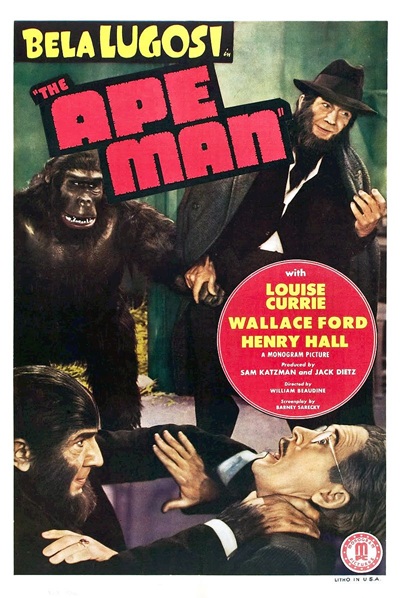
Horror Film Review: The Ape Man (dir by William Beaudine)


In this 1943 film, a mysterious man suggests to reporter Jeff Carter (Wallace Ford) that he should go out to the mansion of Dr. James Brewster (Bela Lugosi) and look into the recent disappearance of the doctor.  Dr. Brewster’s sister (Minerva Urecal) is a well-known ghost hunter and Carter’s editors likes the idea of Carter and photographer Billie Mason (Louise Currie) heading out to the mansion and getting a picture of a ghost.

Carter is upset because he’s having work with a — gasp! — woman.  Bliie is not impressed by the fact that Carter is still in America while all the other men his age are fighting overseas.  Carter explains that he’ll be enlisting in the Navy in a week.  Billie realizes that Carter is not an unpatriotic coward and we, the viewers, are reminded that this film was made during World War II.  I like the fact that America was so unified during World War II that even fictional characters were expected to explain what they were doing for war effort.

For the record, Dr. Brewster’s mansion is not haunted by ghosts.  Instead, the problem is that Dr. Brewster’s experiments have turned him into a man-ape hybrid.  He has a beard, he walks like a monkey, and he fears that he’s turning more into an ape everyday.  He spends almost all of his time locked up in a cage with a gorilla.  Dr. Brewster has (somehow) discovered that the only way to reverse the process is to get regular injections of spinal fluid.  However, it’s impossible to extract the spinal fluid without also killing the donor.  Dr. Brewster’s colleague, Dr. Randall (Henry Hall), refuses to be a party to murder but he still wants to help Brewster.  Unfortunately, Brewster is beyond saving and he’s also losing his mind as he finds himself slowly becoming more and more of an ape.

The Ape Man was directed by William Beaudine, a filmmaker who directed 179 movies over the course of his long career.  Beaudine worked in all genres, starting off as a major director during the silent era before then becoming a prolific B-movie maker during the sound era.  As a B-movie director, Beaudine was famous for rarely doing second take.  If someone flubbed a line or a piece of scenery nearly fell over, that was too bad.  Of course, it should be noted that Beaudine was working for various Poverty Row production companies and he probably didn’t have the budget to do multiple takes.  His job was to get the film shot quickly and for as little money as possible.

That certainly seems to be the philosophy between The Ape Man, which is only a little over an hour long and which features all of the usual plot holes and continuity eras that one might expect to find in a film that was tossed together in just a few days.  That said, The Ape Man is kind of a fun movie.  Bela Lugosi does his best, even when he’s wearing a totally ludicrous beard.  Wallace Ford and Louise Currie deliver their lines in the rat-a-tat fashion that seemed to be popular with journalists in the films of the 30s and 40s.  The plot’s cheeful lack of coherence actually becomes rather charming and the story ends with a nice moment of 4th wall breaking, as the film itself is saying, “Hey, we had fun, didn’t we?”

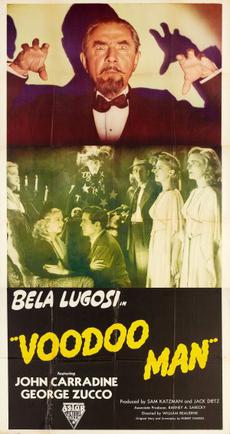
Horror Film Review: Voodoo Man (dir by William Beaudine)


In 1944’s Voodoo Man, Michael Ames stars as Ralph, a screenwriter who has been asked to write a treatment based on the real case of several “girl motorists” who have disappeared in the surrounding area.  Ralph turns down the assignment because he’s busy planning his wedding to Betty (Wanda McKay).  However, when Betty’s maid of honor, Stella (Louise Currie), vanishes, Ralph and Betty set out to investigate.  As Ralph puts it, he’s become a part of the story that he earlier rejected.

What has happened to Stella and all of the other women?  They’ve been abducted by Toby (John Carradine) and Grego (Pat McKee), two lunkheads who work for Dr. Marlowe (Bela Lugosi).  Dr. Marlowe lives in an isolated mansion where he is cared for by his loyal housekeeper (Mici Goty).  Twenty-two years ago, Dr. Marlowe’s wife, Evelyn (Ellen Hall), died but Marlowe has been able to keep her body in a sort of suspended animation ever since.  Marlowe is kidnapping women because, through the use of voodoo and mad science, he hopes to take their “will to live” and transfers it into Evelyn.  Helping Marlowe out is a voodoo priest named Nicholas (George Zucco).

Lugosi, Carradine, and Zucco!  Obviously, the main appeal of Voodoo Man is that it brings together three great names in horror. Even if the story doesn’t really make much sense (and it doesn’t), the film gets a lot of mileage out of the combination of Lugosi, Carradine, and Zucco.  While Lugosi does seem to be a bit bored with his role, Carradine and Zucco really throw themselves into their characters.  John Carradine, in particular, seems to be having the time of his life as he shuffles around the mansion and replies, “Yes, master,” to every command from Dr. Marlowe.  It’s the type of entertaining performance that could only be delivered by a trained Shakespearean slumming in a low-budget, B-grade horror film.  As for Zucco, he plays Nicholas with a certain amount of ruthless erudition.  Zucco is playing the Boris Karloff role here and he definitely seems to understand what that means.

As for the film itself, it has its moments.  Legend has it that director William Beaudine’s nickname was “One Shot” because he was usually only willing to do one take of each scene.  As a result, he filmed quickly and he didn’t spend a lot of money and that was probably a good thing for a production like Voodoo Man.  It also meant that if someone flubbed a line or bumped into a piece of furniture, that take would still be the one that showed up in the film.  My favorite moment of Voodoo Man was when the local sheriff (Henry Hall) referred to Dr. Marlowe as being “Dr. Martin,” and Bela Lugosi, who appeared to be struggling not to laugh, quickly said, “It’s Marlowe.”  The sheriff corrected himself.  That’s the type of fun you don’t get in movies made by people who do more than one take.

Voodoo Man has a quick 61-minute running time.  To enjoy it, it probably helps to already be a fan of low-budget, B-horror films from the 40s.  Lugosi, Carradine, and Zucco are combination that deserves to be seen.

Billy The Kid Versus Dracula (1966, directed by William Beaudine)


Dracula comes to the old west!

The count (John Carradine) has been traveling across the frontier, feasting on settlers and stagecoach riders.  When he comes to a town in the middle of nowhere, he poses as the uncle of saloon owner Betty Bentley (Melinda Plowman).  Using the name Mr. Underhill, Dracula hopes to make Betty into his latest bride.  Everything about Mr. Underhill indicates that he is a vampire but Betty refuses to believe it.  Even when she’s told that Mr. Underhill doesn’t cast a reflection, Betty dismisses it as just being “the old vampire test.”  Two German servants recognize her uncle as being a vampire and Betty again refuses to believe them.  Betty’s fiancé, Billy the Kid (Chuck Courtney), realizes that there is something wrong with Mr. Underhill but can he save his future wife?

The idea of vampires in the old west is one that has inspired a surprising number of movies, most of which are considerably better than Billy The Kid Versus Dracula.  In this movie, Chuck Courtney plays one of the old west’s most notorious outlaws but he’s portrayed as being one of the most upstanding members of his community.  John Carradine plays the world’s most notorious vampire but just comes across as being a grouchy old man.  Chuck Courtney is a convincing westerner but not a very interesting actor.  John Carradine sleepwalks through the role and later said Billy The Kid Versus Dracula was the only one of his many films that he actively disliked.  The movie was shot in 8 days and it looks like it.

This was also the final film of director William Beaudine, who had directed his first film 51 years earlier.  The film was released on a double feature with Beaudine’s Jesse James Meets Frankenstein’s Daughter.  Everyone ended up in the old west eventually.

Horror on the Lens: Jesse James Meets Frankenstein’s Daughter (dir by William Beaudine)


This 1966 western/horror hybrid is just about as stupid as you think it is but it’s also a lot of fun if you’re in the right mood.  Notorious outlaw Jesse James (John Lupton) attempts to hold up a stagecoach but, in the process, his hulking partner Hank (Cal Bolder) is serious wounded.  Some helpful peasants direct Jesse and Hank to the mysterious German doctor who happens to live in a nearby dark and scary house.  That doctor is Maria Frankenstein (Narda Onyx) and she’s been conducting experiments to bring dead Mexicans back to life.  Imagine her joy when the nearly dead Hank shows up at her laboratory.  Anyway, Maria performs a brain transplant on Hank and once Hank comes back to life, she informs him that his new name is “Igor.”  Yes, she does.  That plot description pretty much tells you everything you need to know about the movie but I vaguely enjoyed vaguely paying attention to it.  Maria’s German accent is hilariously overdone, the Frankenstein laboratory is full of pointless electrical things, and a character dies halfway through the film just to later show up again with no explanation.  It’s that type of movie.

And it’s also the type of movie that you can watch below!

Enjoy!

http://www.youtube.com/watch?v=BF1leghsszg

6 More Chilling Classics: Jesse James Meets Frankenstein’s Daughter, Scream Bloody Murder, Silent Night Bloody Night, Sisters of Death, War of the Robots, and Werewolf in a Girl’s Dormitory


For the past few months, I’ve been attempting to watch and review every film to be found in Mill Creek’s 50 Chilling Classics box set.  Here’s are 6 quick reviews of the latest few “chilling classics” that I’ve found the time to watch.
1) Jesse James Meets Frankenstein’s Daughter (Dir by William Beaudine)

This 1966 western/horror hybrid is just about as stupid as you think it is but it’s also a lot of fun if you’re in the right mood.  Notorious outlaw Jesse James (John Lupton) attempts to hold up a stagecoach but, in the process, his hulking partner Hank (Cal Bolder) is serious wounded.  Some helpful peasants direct Jesse and Hank to the mysterious German doctor who happens to live in a nearby dark and scary house.  That doctor is Maria Frankenstein (Narda Onyx) and she’s been conducting experiments to bring dead Mexicans back to life.  Imagine her joy when the nearly dead Hank shows up at her laboratory.  Anyway, Maria performs a brain transplant on Hank and once Hank comes back to life, she informs him that his new name is “Igor.”  Yes, she does.  That plot description pretty much tells you everything you need to know about the movie but I vaguely enjoyed vaguely paying attention to it.  Maria’s German accent is hilariously overdone, the Frankenstein laboratory is full of pointless electrical things, and a character dies halfway through the film just to later show up again with no explanation.  It’s that type of movie.
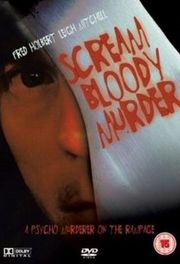
2) Scream Bloody Murder (dir. by Marc Ray)

So Matthew (played by Fred Holbert) is a disturbed young man who murders his father with a tractor and loses a hand in the process.  He’s sent off to a mental asylum for a few years and while there, he’s given a sharp and potentially deadly hook as a replacement for his hand.  Seriously, why would you give a weapon like that to a mental disturbed person who has just murdered his own father?  That’s just one of the many mysteries that goes unexplored in 1973’s Scream Bloody Murder, an occasionally watchable slice of entertainment that is ultimately too slow and predictable to really be effective.  Once Matthew is released from the asylum, he goes on the expected murder spree and goes all Collector-like on a prostitute named Vera (played by Leigh Mitchell, who also plays Matthew’s doomed mother in a clever bit of Oedipal casting).  Mitchell and Holbert both give surprisingly good performances and director Marc Ray comes up with a few visually inventive scenes of mayhem but, for the most part, this film never quite lives up to the excessive promise of its premise.
3) Silent Night Bloody Night (dir. by Theodore Gershuny)

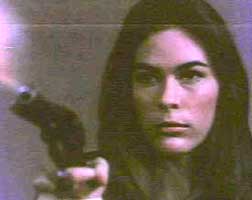
Filmed in 1972 and subsequently released in 1974, Silent Night Bloody Night is a real treat, an atmospheric thriller that has a wonderfully complicated plot that will keep you guessing.  On Christmas Eve, Jeff Butler (James Patterson) comes to an isolated town to arrange the sell of his grandfather’s home.  As we discover through some wonderfully dream-like flashbacks, Jeff’s grandfather died nearly 40 years ago when he was set on fire in his own home.  With the help of local girl Diane (Mary Woronov), Jeff investigates his grandfather’s death and discovers that the town is full of secrets and people who are willing to kill to maintain them.  Director Theodore Gershuny uses the low budget to his advantage and the sepia-toned flashbacks are truly disturbing and haunting.  Ultimately, Silent Night Bloody Night feels like a dream itself and the mystery’s solution is less important than the journey taken to reach it.
4) Sisters of Death (dir. by Joseph Mazzuca)

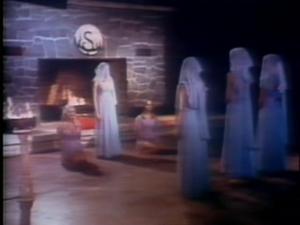
Technically, this isn’t the best film to be found in the Chilling Classics box set but it’s still one of my personal favorites.  The 1977 film opens with a very baroque sorority initiation that ends with one of the sisters being killed in a game of Russian Roulette.  A few years later, the surviving sisters are invited to an isolated and lavish estate where it turns out that the dead girl’s father (well-played by Arthur Franz) is looking for revenge.  This film is predictable and a lot of the plot depends on people refusing to use any common sense but Sisters of Death is such a fun little melodrama that I can’t complain too much.  The film plays out like a surprisingly violent Lifetime movie and it all ends on a wonderfully cynical note.
5) War of the Robots (dir. by Alfonso Brescia)

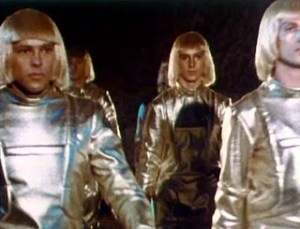
Whatever you do, don’t watch War of the Robots alone.  Seriously, you need somebody there — preferably several people — so you can take turns making snarky comments and rude jokes.  Otherwise, you’ll just be stuck watching this amazingly bad science fiction film from 1978 and wondering how much more of it you can take.  Set in the generic future, War of the Robots tells the story of what happens when two human scientists are kidnapped by a bunch of robots.  Capt. John Boyd (Antonio Sabato) is sent to get the scientists back and the end result?  A war of the robots.  Or something like that.  This is one of those films where it’s difficult to really pay that much attention to what’s happening on-screen.  However, it’s worth seeing just for the chance to spot the wires that are enabling the model spaceship to hang over the “alien” landscapes.  Naturally, since this film was made in the 70s, everyone wears space suits with really wide lapels.

6) Werewolf in a Girls Dormitory (dir. by Paolo Heusch)

First released in 1961, Werewolf in a Girls Dormitory is an Italian/Austrian co-production.  It was originally titled Lycanthropus and while Werewolf In A Girls Dormitory is a lot more memorable, it also makes this film sound like a lot more fun than it actually is.  This slow and oddly somber film tells the story about a series of murders that occur at a school for delinquent girls.  The school’s newest teacher is the obvious suspect but then again, the killer might just be a werewolf.  I liked the look of this film — the film is lit to emphasize shadows and it gives the whole thing a very noir-like feel — but, much like Scream Bloody Murder, this movie was just too slow to really be effective.

So, out of this batch of 6, I would definitely recommend that you track down and see Silent Night Bloody Night and Sisters of Death.  I would also definitely suggest that you do your best to avoid War of the Robots.  As for the other 3, they’re all better than The Wicker Tree.