April True Crime: Our Guys by Bernard Lefkowitz and Our Guys (dir by Guy Ferland)


If there’s any true crime book that I recommend without hesitation, it’s Our Guys by Bernard Lefkowitz.

First published in 1997, Our Guys deals with a terrible crime that occurred in the leafy suburban community of Glen Ridge, New Jersey.  In 1989, it was an affluent community that loved its high school football team and where conformity and financial success were the most valued qualities the someone could have.  On March 1st, a 17 year-old girl was invited to a house party where, after she was convinced to head down to the basement, she was raped with a broomstick and a baseball bat by several members of the football team.  The girl was intellectually disabled and was later determined to have an IQ of 64.  Her name has never been revealed to the public.  In his book, Lefkowitz assigned her the pseudonym of Leslie Faber.

The crime was terrible.  So was the aftermath.  When one of the witnesses went to a teacher with what he saw happen in the basement, the town responded by rallying around the accused.  Initially, Leslie was accused of lying.  Then, as it became clear that something actually had happened in that basement, Leslie was accused of bringing it on herself.  Leslie, who was desperate to have friends and who was later determined to be psychologically incapable of saying “no” or even understanding what consent meant, was cast as a wanton seductress who led the members of the football team astray.  A girl who went to school with Leslie even tape recorded a conversation with Leslie in which Leslie was manipulated into saying that she had made the entire thing up.  It also undoubtedly didn’t help that some of the accused boys had fathers who were on Glen Ridge’s police force.

It’s a book that will leave you outraged.  Lefkowitz not only examined the crime itself but also the culture of the town and its general attitude that “boys will be boys.”  Despite the fact that they had a losing record and the fact that one of them was infamous for exposing himself every chance that he got, the football team was viewed as being made up as winners.  They were allowed to party every weekend with their parties becoming so legendary that they bragged about them in their yearbook quotes.  With a group of supportive girlfriends doing their homework for them, the football team was free to do whatever they wanted and, by the time they were seniors, they were infamous for being voyeurs.  While one football player would have sex, all the others would hide in a closet and watch.  When one of the football players stole $600 from one of his classmates, his father paid back the money and no one was ever punished.  In a town that valued material success above all else and viewed being different as a sign of weakness, Leslie and her family were treated as being outcasts.  In the end, three of the football players were sentenced to prison.  One was sentenced to probation.  A few others accepted plea deals and had their arrests expunged from the record.  Years later, one of the guys who was in the basement but not charged would murder his wife while home on leave from the military.
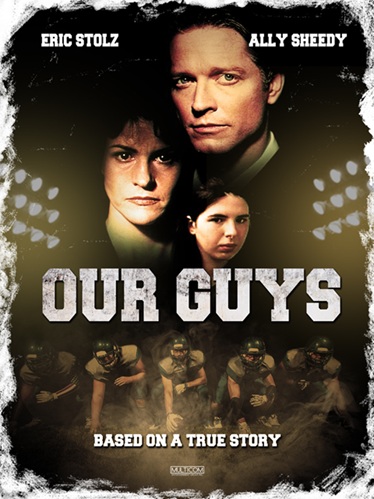
In 1999, Our Guys was adapted into a made-for-television movie.  Featuring Heather Matarazzo as Leslie, Ally Sheedy as the detective who investigated her rape, Eric Stoltz as the lawyer who prosecuted the case, and Lochlyn Munro as a cop who starts out on the side of the football team before realizing the truth, Our Guys simplifies the story a bit.  While the book focused on Glen Ridge and the culture of celebrating winners no matter what, the film focuses on Sheedy as the detective and her disgust with the suburbs in general.  Unfortunately, by not focusing on the culture of the town, the film presents the rape as being the bad actions of a group of dumb jocks as opposed to an expression of Glen Ridge’s contempt for anyone who was viewed as being on the outside.  What Lefkowitz showed through a precise examination of the town and its citizens, the film quickly dispenses by having Stoltz and Sheedy make a few pithy comments about how much the town loves it football team.  The story will still leave you outraged and Heather Matarazzo gives a heart-breaking performance as Leslie.  But, for those wanting the full story of  not only what happened in Glen Ridge but also how it happened, the book is the place to find it.

BloodRayne (2005, directed by Uwe Boll)


In 18th century Romania, Rayne (Kristanna Loken) is a vampire/human hybrid who is being forced to work in a freakshow by Leonid (Meat Loaf).  After Rayne escapes, she meets a fortune teller (Geraldine Chaplin) who informs her that her father is the feared king of the vampires, Kagan (Ben Kingsley), and that he raped her mother.  Rayne teams up with a group of vampire hunters (Matthew Davis, Michelle Rodriguez, and Michael Madsen) and sets out to destroy her father once and for all.

BloodRayne is perhaps not the worst film ever made about a vampire/human hybrid in Romania but it’s also nowhere near the best.  Instead, it’s another one of Uwe Boll’s cheap-looking video game adaptations where a group of talented actors slum it as action stars.  (Michael Pare, Udo Kier, and Billy Zane also appear in the movie.)  The movie is full of bad wigs and big swords.  Michael Madsen and Michelle Rodriguez are neither convincing as Russians or people who lived in the 18th Century.  Geraldine Chaplin tries to keep things interesting,  Ben Kingsley doesn’t.  Kristanna Loken is actually a good choice for Rayne, in that she’s hot and she’s convincing in the action scenes.  This is an easy film to laugh at but it features enough blood and nudity to keep its target audience happy.  Don’t try to follow the plot, though.  You’ll get a headache.

While we were watching the movie last night, Lisa suggested that Ben Kingsley was using his Gandhi Oscar as a stake.  Now that would have been something worth seeing!

Retro Television Reviews: Return To Cabin By The Lake (dir by Po-Chih Leong)


Welcome to Retro Television Reviews, a feature where we review some of our favorite and least favorite shows of the past!  On Sundays, I will be reviewing the made-for-television movies that used to be a primetime mainstay.  Today’s film is 2001’s Return To Cabin By The Lake!  It  can be viewed on YouTube.

Stanley Caldwell (Judd Nelson) is back!

At the end of Cabin By The Lake, screenwriter Stanley had managed to escape from the police by faking his own drowning.  Return to Cabin By The Lake finds Stanley using a variety of disguises and fake identities in his effort to once again become a part of the film industry.  He is particularly interested in the fact that his previous murder spree is being turned into a movie.  He’s considerably less happy about the fact that everyone involved in the movie continually disparages his work as a screenwriter.  He’s even less happy when he hears them speculating that there was a sexual-motive behind Stanley’s murders or that Stanley was acting out against his mother.  For someone who spent the previous movie drowning innocent women and then visiting their bodies in the lake, Stanley sure does seem to be shocked to discover that most people don’t have a high opinion of him.  You’re a murderer, Stanley.  People don’t like murderers.

Anyway, as a master of disguise, Stanley is able to work his way into the production of the film.  Even though everyone on the set is spending 24 hours a day obsessing on and recreating the crimes of Stanley, no one is suspicious of the guy who looks just like Stanley and who keeps saying stuff like, “Stanley would never do that!”  Stanley becomes obsessed with script writer Andrea (Dahlia Salem).  He also comes to resent the film’s shallow director, Mike Helton (Brian Krause, giving the film’s best performance).  Stanley decides that he would be a better director of the film so he buries Mike alive and then takes over direction.

Return To Cabin By The Lake is a bit more deliberately humorous than the first film.  If Cabin By The Lake was full of pleasant townspeople and earnest police officers, Return To Cabin By The Lake is populated with caricatures of various Hollywood phonies.  Everyone involved in Return To Cabin By The Lake‘s film-within-a-film is blithely unconcerned with the feelings of the the victim’s loved ones nor do they really care about telling the story accurately.  Helton’s only concern is that the script have enough sex.  That Stanley not only takes over as director but turns out to be a pretty good at it would appear to be Return To Cabin By The Lake’s ultimate statement on the film industry.

Judd Nelson is a bit more energetic in the sequel than he was in the first film.  That said, Return To Cabin The By The Lake makes the mistake of asking us to buy the idea of Stanley being a master of disguise.  Judd Nelson is always going to look and sound like Judd Nelson, regardless of whether he’s wearing a wig or not.

Though it’s a bit constrained by being a made-for-TV movie, Return To Cabin By The Lake is a marked improvement on the first film, one that has more humor and a better performance from its lead.  The film ends with an opening for another sequel but it was apparently never to be.