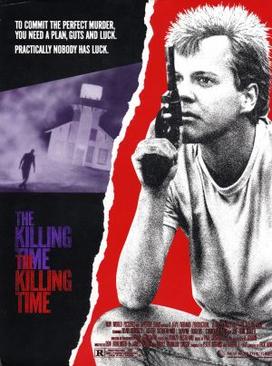
The Killing Time (1987, directed by Rick King)


After she is raped and beaten by her husband, Jake (Wayne Rogers), Laura Winslow (Camelia Kath) and her lover, Deputy Sam Wayburn (Beau Bridges), plot to murder him.  Sam and Laura come up with a plan to shoot Jake and frame another deputy, the recently hired Brian Mars (Kiefer Sutherland), for the crime.  What Sam doesn’t know is that Brian isn’t Brian.  Instead, “Brian” killed the real deputy and stole his identity.  Fake Brian has his own reasons for wanting to kill Jake but he also doesn’t appreciate Sam and Laura trying to set him up.

This is a typical 80s neo-noir, with an interesting premise that is sabotaged by subpar execution.  A big problem is with the casting.  Beau Bridges, whose stock-in-trade has always been a natural human decency, is miscast as a deputy who would conspire to not only murder someone but also frame an innocent man.  Camelia Kath doesn’t have the style necessary to be a compelling femme fatale.  Sutherland is good when he’s playing a psychopath but he’s less convincing when he has to pretend to be Brian.  It’s hard to believe that Sutherland’s obviously unstable killer would be able to fool anyone.

Instead, the film is stolen by Joe Don Baker and Wayne Rogers.  Joe Don Baker plays the sheriff who gives up his retirement plans so that he can solve the biggest crime that’s ever been committed in his jurisdiction,  Baker’s role isn’t huge but he still gives one of the better performances in the film.  If anyone was born to play a small-town sheriff, it was Joe Don Baker.  Meanwhile, Rogers is very much cast against type as the evil Jake but the film uses Rogers’s good guy persona to its advantage.

The other big problem is that, other than Baker’s sheriff, there’s no one likeable to be found in this movie.  The movie tries to generate sympathy for Sam but once you decide to frame an “innocent” man for murder, it’s impossible to then go back to being a sympathetic character.  Brian may be a killer but Sam didn’t know that when he and Laura decided to frame him for killing Jake.

Movies like this used to be a HBO mainstay.  Even though the movies themselves often weren’t that good, I still miss those days.


SHANE (The TV Series) – Episode 14: The Big Fifty (originally aired December 10th, 1966)


Episode 14 begins with one of Rufe Ryker’s men, Ed Bain, cutting barbed wire fence on the Starett ranch so their herd of cattle can go to a watering hole. As he’s cutting the fence, the sounds of gunshots from a “Big 50” rifle ring out as he’s shot and falls over. Shane (David Carradine) and Joey (Christopher Shea), who are riding through the area, hear the shots and find the wounded man. He rushes him to Sam Grafton’s saloon to see if Sam (Sam Gilman) can do anything to save him. Unfortunately the man was shot in the gut and there is no hope. About the time he dies, Rufe Ryker (Bert Freed) and his men come into the bar. He immediately asks Shane why he killed him. Shane, picking the wrong time to be a smartass, tells Ryker that if he had killed him it would have been for his cutting their fence, but that he didn’t do it. Ryker doesn’t believe him and neither do his men. They decide that Ed Bain deserves justice because “he was not only a good hand, but he was a good man.” Out for blood, Ryker decides he’s going to put Shane on trial for murder right then and there with only his men as the witnesses and jury. I call this the “Saint Bain” portion of the story. Harve (Lawrence Mann) tells us what a brave and hardworking man Bain was. Bain’s best friend Greevey (a guest starring Wayne Rogers) tells about all of their good times and card playing together. It seems that Bain is such a good guy that Shane clearly deserves to die even though none of them actually saw him shoot the man. 

While the sham of the trial is going, the saloonkeeper Ben (Owen Bush) slips out the back and rides out to the Starett ranch to tell Tom (Tom Tully) and Marian (Jill Ireland) what’s going on. The two immediately set about trying to round up some of the homesteaders to go into town with them to try to stop Ryker and his men from hanging Shane. One by one, each of the homesteaders turn them down because “this is not their fight” and reason that Shane probably did it because “he’s a gunfighter.” Knowing they have zero chance against Ryker on their own, Tom and Marian come up with a plan. He’ll head to Laramie to get the U.S. Marshall, and she’ll go try to buy some time from Ryker with the only bargaining chip they have, the deed to the family ranch. 

Episode 14 of Shane is a bit of a mixed bag. On the positive side, the gun that is used to kill Ed Bain at the beginning is a unique and interesting element of the story. The weapon is a Sharps “Big 50,” a .50 caliber rifle that was designed for buffalo hunting and introduced in 1872 by the Sharps Rifle Manufacturing Company. The Big 50 joins a tradition of powerful weapons in filmed entertainment that provide their users with an advantage over their adversaries. Other examples include the Winchester 73 rifle, Dirty Harry’s 44 Magnum and Paul Kersey’s 357 Wildey Magnum in DEATH WISH 3. At one point, the killer is firing the Big 50 into the Starett cabin at Shane, Marian and Joey. Based on the power of the gun as already shown, there is a real sense of danger that someone could be seriously hurt. There was also one good scene centered around the unspoken love between Shane and Marian, even if Shane wasn’t a part of it. With Shane’s life seriously in jeopardy, Tom reassures his daughter-in-law, “honey, you’ve only been in love with 2 men in your whole life. I’m gonna make sure you don’t lose them both.” She sure doesn’t protest. It was a sweet scene and I enjoyed that as well. 

On the negative side, episode 14 featured the most lazy storytelling thus far in the series. The series has gone to great lengths to show Rufe Ryker as a man who’s hard-as-nails, but also mostly reasonable. The writers throw that out the window in this storyline and require him to behave completely irrational in his quest for vengeance for his hired man. It would be one thing if Ed Bain was his son or something, but Ryker’s line about him being a “good man” doesn’t get close to explaining the turnaround in his behavior. And not only do they present him as irrational, they make him incompetent to boot. Joey rides up and convinces Ryker that he’s only there to take Shane some food. Ryker even checks his slicker for a gun before letting him go in. Turns out Joey did have a gun under his jacket and Ryker just didn’t find it. The show had seemed to really be hitting its stride before this episode and the lazy storytelling surprised me. They should have introduced a new character if they were going to make him so irrational and incompetent. That description just doesn’t fit the Ryker of the first 13 episodes. 

Overall, this may have been the least enjoyable episode so far. While it did have some good moments, I’m still struggling to let go of the way they changed Ryker’s character so completely for this one. We’ll see what happens with him over the last few episodes of the series. While I’m slightly disappointed with episode 14, I’m still looking forward to seeing what happens next. 

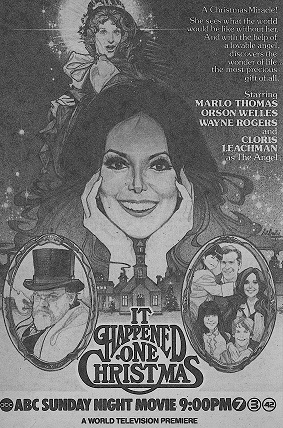
Holiday Film Review: It Happened One Christmas (dir by Donald Wyre)


The 1977 made-for-TV movie, It Happened One Christmas, opens in Heaven.  We hear the voice of Joseph (Charles Grodin), one of the top angels.  Joseph has noticed that, in the town of Bedford Falls, a lot of people seem to be praying and all of their prayers concern one person.  They are all worried about Mary Bailey Hatch (Marlo Thomas).

He requests that an angel be sent down to Earth to help Mary with her problems.  Unfortunately, the only angel available is Clara (Cloris Leachman) and Clara, despite her optimistic outlook and upbeat personality, is not considered to be a particularly smart angel.  She hasn’t even gotten her wings yet!  However, Joseph promises her that, should she convince Mary Hatch not to toss away her life on Christmas Eve, Clara will get her wings.

But first, Joseph shows Clara all of the important events in Mary’s life.  Clara watches as young Mary saves the life of her brother, Harry.  A few weeks later, Mary manages to keep Dr. Gower from accidentally poisoning a patient.  Though Mary dreams of leaving Bedford Falls and pursuing a career as a writer, she instead ends up taking over her late father’s old Building and Loan company.  With the help of her husband, George (Wayne Rogers), she helps hundreds of people move into affordable housing.  She is also one of the few people in town willing to stand up to Old Man Potter (Orson Welles)….

What was that?

Yeah, I know.  Just hold on.  I’m getting to that.

Anyway, everything is going great in Mary’s life until her irresponsible Uncle Willie (Barney Martin) accidentally loses a deposit on Christmas Eve.  Facing embezzlement charges and having yelled at her family, Mary considers jumping off a bridge.  Fortunately, Clara is there to show her what her life would be like if she had never been born….

Excuse me?  Did you say that this sounds familiar?

Yes, It Happened One Christmas is a remake of It’s A Wonderful Life.  The main difference is that the genders are swapped.  Jimmy Stewart’s role is played by Marlo Thomas.  Wayne Rogers plays the Donna Reed role.  This leads to a few changes in the story.  For instance, Mary still yells at ZuZu’s teacher but she doesn’t get sucker punched as a result.  Whereas the original Mr. Potter treated George Bailey with outright hostility, the remake’s Mr. Potter tends to use a tone of condescending concern when talking to Mary.  Since George Hatch doesn’t lose his hearing in one ear, he’s able to serve in World War II and he returns on crutches.  In the world where Mary was never born, George still never marries but, instead of working at the library, he becomes a boorish auto mechanic.  Violet is no longer an important character and Mary never tries to blame her visions of Pottersville on “bad liquor.”  These are cosmetic differences but, otherwise, it’s pretty much the exact same story.

To be honest, it probably sounds more interesting than it actually is.  It’s not that It Happened One Christmas is a poorly made or a badly acted film.  It’s fine, really!  But it’s not It’s A Wonderful Life.  Marlo Thomas plays her role with a lot of energy but she’s still no Jimmy Stewart.  Stewart, who was still dealing with his own World War II experiences, played up the haunting sadness behind George’s mild-mannered facade and that’s something that Thomas never accomplishes.  If Stewart’s George seems like he’s been beaten down by one lost dream after another, Marlo Thomas’s Mary just seems like she’s having a really bad night.  By that same token, Wayne Rogers is likable a the love of Mary’s life but he’s no Donna Reed.  Even the great Orson Welles can’t escape the shadow of Lionel Barrymore.  Barrymore’s Mr. Potter was a pure misanthrope who was at his happiest mocking the dead and approving men for the draft.  Oddly, Orson Welles brings an almost avuncular style to Mr. Potter.  One gets the feeling that Welles simply couldn’t resist winking at the audience and assuring them that he was still the bigger-than-life showman that they had grown up with.

So, you may be wondering ….. why remake It’s A Wonderful Life in the first place?  I was wondering about that so I did a little research and thanks to an obscure web site called Wikipedia (not many people have heard of it), I discovered that It Happened One Christmas was actually made before It’s A Wonderful Life started to regularly air during the holidays.  At the time it was made, it was aactually remake of a classic film that was no longer regularly watched.  Frank Capra angrily denounced It Happened One Christmas as being “plagarism” but, in 1977, it was enough of ratings success that it was re-aired in both 1978 and 1979.  But, by that time, It’s A Wonderful Life had started to regularly air during the holiday season and was being rediscovered by audiences young and old.  As a result, the okay remake was soon overshadowed by the vastly superior original.

And really, that’s the way it should be.  It Happened One Christmas isn’t a bad movie but it just no replacement for Capra’s Wonderful film.
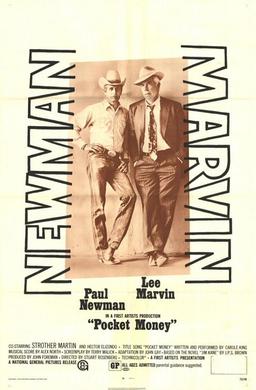
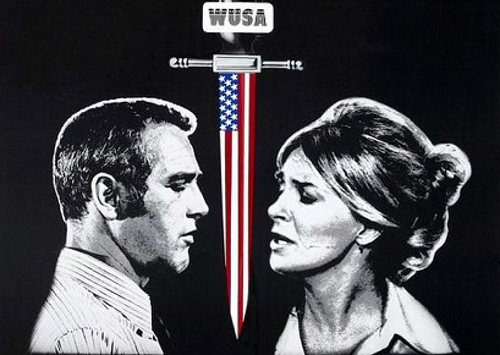
Embracing the Melodrama Part II #36: WUSA (dir by Stuart Rosenberg)


wusaI recently saw the 1970 film WUSA on Movies TV.  After I watched it, I looked Joanne Woodward up on Wikipedia specifically to see where she was born.  I was surprised to discover that she was born and raised in Georgia and that she attended college in Louisiana.

Why was I so shocked?  Because WUSA was set in New Orleans and it featured Joanne Woodward speaking in one of the most worst Southern accents that I had ever heard.  A little over an hour into the film, Woodward’s character says, “What’s all the rhubarb?”  And while “What’s all the rhu…” sounds properly Southern, the “…barb” was pronounced with the type of harshly unpleasant overemphasis on “ar” that has given away many Northern actors trying to sound Southern.  Hence, I was shocked to discover that Joanne Woodward actually was Southern.

That said, her pronunciation of the word rhubarb pretty much summed up every problem that I had with WUSA.  Actually, the real problem was that she said “rhubarb” in the first place.  It came across as being the type of thing that a Northerner who has never actually been down South would think was regularly uttered down here.  And I will admit that WUSA was made 16 years before I was born and so, it’s entirely possible that maybe — way back then — people down South regularly did use the word rhubarb.  But, for some reason, I doubt it.  I know plenty of old Southern people and I’ve never heard a single one of them say anything about rhubarb.

As for WUSA, it’s a long and slow film.  A drifter named Reinhardt (Paul Newman) drifts into New Orleans and, with the help of an old friend who is now pretending to be a priest (Laurence Harvey), Reinhardt gets a job as an announcer at a right-wing radio station.  He reads extremist editorials that he doesn’t agree with and whenever anyone challenges him, he explains that he’s just doing his job and nothing matters anyway.

Reinhardt also gets himself an apartment and spends most of his time smoking weed with long-haired musician types, the exact same people that WUSA regularly denounces as being a threat to the American way.  Living in the same complex is Geraldine (Joanne Woodward), a former prostitute who has a scar on her face and who says stuff like, “What’s all the rhubarb?”  She falls in love with Reinhardt but finds it difficult to ignore what he does for a living.

Meanwhile, Geraldine has another admirer.  Rainey (Anthony Perkins) is an idealistic and neurotic social worker who is regularly frustrated by his efforts to do good in the world.  Reinhardt makes fun of him.  The local crime boss (Moses Gunn) manipulates him.  And WUSA infuriates him.  When Rainey realizes that WUSA is a part of a plot to elect an extremist governor, Rainey dresses up like a priest and starts carrying around a rifle.

Meanwhile, Reinhardt has been assigned to serve as emcee at a huge patriotic rally.  With Geraldine watching from the audience and Rainey wandering around the rafters with his rifle, Reinhardt is finally forced to take a stand about the people that he works for.

Or maybe he isn’t.

To be honest, WUSA is such a mess of a film that, even after the end credits roll, it’s difficult to figure out whether Reinhardt took a stand or not.

Anyway, WUSA is not a lost masterpiece and I really wouldn’t recommend it to anyone.  The film’s too long, there’s too many scenes of characters repeating the same thing over and over again, and neither Newman nor Woodward are particularly memorable.  (You know a movie is boring when even Paul Newman seems like a dullard.)  On the plus side, Anthony Perkins gives such a good performance that I didn’t once think about the Psycho shower scene while watching him.

As boring as WUSA is, I have to admit that I’m a little bit surprised that it hasn’t been rediscovered.  Considering that it’s about a right-wing radio station, I’m surprised that there haven’t been hundreds of pretentious think pieces trying to make the connection between WUSA and Fox News.  But, honestly, even if those think pieces were out there, it probably wouldn’t do much for WUSA‘s repuation.  According to the film’s Wikipedia page, Paul Newman called it, “the most significant film I’ve ever made and the best.”  Paul Newman’s opinion aside, WUSA is pretty dire.