The Films of 2025: The Alto Knights (dir by Barry Levinson)


In The Alto Knights, I’m pretty sure that Robert De Niro sets the record for saying “What’s the mater with you!?” the most times in one movie.

I don’t know for sure, of course.  While I was watching the movie last night, I didn’t keep an exact count and, for that, shame on me.  That said, when you consider that The Alto Knights features Robert De Niro playing not just one but two old school Italian gangsters, you can be sure that there were a lot of scenes of either Vito Genovese (Robert De Niro) or Frank Costello (De Niro, again) demanding to know what was the matter.  When Genovese watches Costello testifying in front of a Congressional hearing, the “What’s the matter with you!?” count truly goes haywire.

The Alto Knights was directed by Barry Levinson, who has directed some great films.  It tells the relatively true story of the rivalry between Costello and Genovese.  Both Costello and Genovese were present when the modern Mafia was first created.  The diplomatic and negotiation-minded Costello was known as the “Prime Minister of the Underworld.”  Genovese was a much more violent gangster and he became one of the most powerful members of the New York Mafia by basically killing anyone who stood in his way.  Costello and Genovese started out as weary friends before coming mortal enemies.  Costello retired from the rackets after Genovese ordered one of his men to shoot Costello in the head.  Meanwhile, Genovese ended up involving the Mafia in the drug trade and died in prison.  In the film, Costello narrates their story.  There’s a lot of shots of an elderly Costello sitting in what appears to be a park as he speaks directly to the camera.  Interestingly enough, Gotti tried to do the same thing, with Travolta’s John Gotti speaking directly to the audience while standing in front of the Brooklyn Bridge.

The Alto Knights pretty much features all of the usual Mafia tropes.  All the usual points are hit.  Albert Anastasia (played by Michael Rispoli) is assassinated while getting a haircut and some viewers will remember that, before De Niro played the man who ordered Anastasia’s assassination, he also played the man who claimed to have shot Anastasia in The Irishman.  Personally, I love Mafia films but The Alto Knights felt a bit too recycled to be truly effective.  Barry Levison does the usual thing of dropping real-life newspaper headlines and photographs into the middle of the film and it doesn’t so much add verisimilitude as much as it just reminds one of David DeCoteau’s film about Bonnie and Clyde.

The film’s main selling point is that it features Robert De Niro playing two gangsters but there’s really not much gained from casting De Niro in both roles.  We get a few scenes of De Niro acting opposite of himself and it’s hard not to notice that Genovese’s reactions often don’t seem to match whatever it is that Costello’s saying.  As an actor, De Niro has the ability to be believable as both the cerebral Costello and the hot-headed Genovese but ultimately, the double casting just feels like a distraction.  Watching De Niro acting opposite himself, I found myself thinking how much more entertaining it would have been if Joe Pesci, Al Pacino, Harvey Keitel, or even John Travolta had played Genovese.  To be honest, if Levinson really had any courage, he would have given the role to James Woods and given us the Once Upon A Time In America/Casino reunion that we all deserve.

The film did win me over a bit towards the end with a recreation of the Apalachin meeting.  That was when Genovese invited every mob boss in the country to come to a meeting in upstate New York, just for the feds to suddenly show up and send everyone scattering.  For most of the film, it was hard not to feel that Barry Levinson was past his prime as a director but he actually did a good job with the Apalachin scenes.  I genuinely laughed when Genovese got into a pointless argument with his driver.  I loved the way the film captured the real-life absurdity of a bunch of mob bosses fleeing into the woods, all of their bravado suddenly dissipating as they scrambled into the wilderness.  If the entire film had just been about the Apalachin meeting, this review would probably be a lot of different.  As it is, one good sequence can’t save the film as a whole.

This is an offer you can refuse.
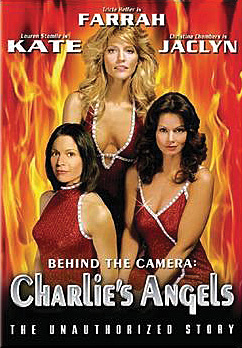
Behind The Camera: The Unauthorized Story of Charlie’s Angel (2004, directed by Francine McDougall)


Looking for a new hit, television producer Aaron Spelling (Dan Castellanata) comes up with the story of “three little girls who went to the police academy and who were assigned very hazardous duties” but who were taken away from all that by the mysterious Charlie.  The show is conceived as a star vehicle for Kate Jackson (Lauren Stamile), with fashion model Jaclyn Smith (Christina Chambers) and actress Farrah Fawcett-Majors (Tricia Helfer) playing her partners in investigating and solving crimes.  Kate wants to make a feminist statement.  Jaclyn wants to be a good role model to the little girls who sneak out of their room to watch the show.  Farrah wants to be a star without losing her possessive husband, Lee Majors (Ben Browder).  The critics hate the show.  Studio president Fred Silverman (Dan Lauria) and showrunner Barney Rozenweig (Michael Tomlinson) are embarrassed by it.  But Spelling has a hit and the actresses become stars.  But when Farrah decides she wants to leave after one season, the show’s future is put in doubt.

This was one of NBC’s Behind The Camera films and the only one to take us behind the scenes of a “drama” program.  (The other films looked at Diff’Rent Strokes, Mork and Mindy, and Three’s Company.)  This is probably the best of them, though “good” and “best” are both relative terms when it comes to these movies.  As with all of the films, there’s too many inside jokes about the network execs, with Dan Lauria stepping into the shoes of Brian Dennehy and Saul Rubinek as Fred Silverman.  But Dan Castellanata did a surprisingly good job as Aaron Spelling and the three actresses playing the Angels were all convincing, especially Christina Chambers.  The film’s main villain is Lee Majors, who is blamed for forcing Farrah to leave the show and who is portrayed as yelling, “Her name is Farrah Fawcett-Majors!”  It’s low-budget and doesn’t offer much that isn’t already known but at the cast keeps the story interesting.

Behind the Camera: The Unauthorized Story of Three’s Company (2003, directed by Jason Ensler)


Do you remember Three’s Company?

The sitcom was a big hit when it aired in the 70s and 80s and it still gets a lot of play in syndication today.  Based on a British sitcom (and you would really be surprised to how closely the first season followed the original series), Three’s Company starred John Ritter as Jack Tripper, an aspiring chef who moved in with two single women, Janet (Joyce DeWitt) and Chrissy (Suzanne Somers).  Because their impotent landlord (Norman Fell) didn’t want people of the opposite sex living with each other unless they were married, Jack pretended to be gay.  Every episode centered around a misunderstanding, though it was Suzanne Somers’s performance as the perpetually bouncy and braless Chrissy Snow that made the show a hit.  The show fell apart when Somers asked for more money, Ritter and DeWitt got angry with her, and the studio bosses lied to everyone.  Today, the show is legendary as an example of how backstage tension can end even a popular series.

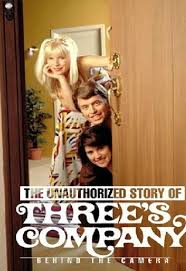
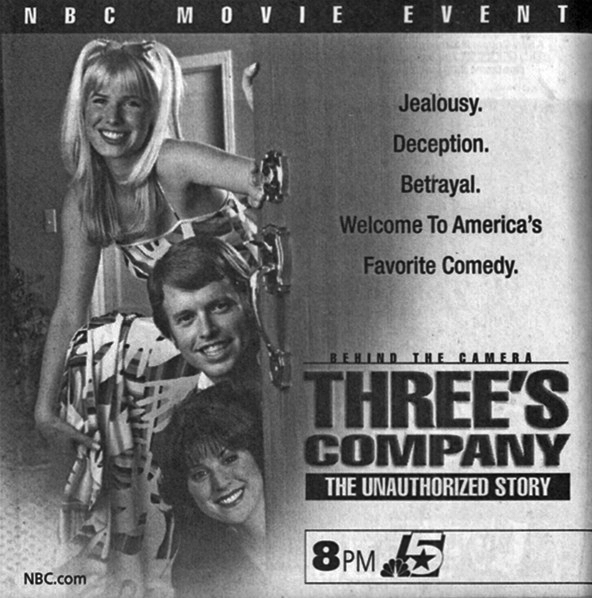
Behind The Camera: The Unauthorized Story of Three’s Company attempts to dramatize the success and eventual downfall of Three’s Company.  Joyce DeWitt appears at the beginning and the end to talk about how important she thinks the show was.  In the movie, she is played by Melanie Paxson.  John Ritter is played by a lookalike actor named Bret Anthony while an actress named Jud Taylor plays Somers.  Brian Dennehy plays ABC president Fred Silverman and other executives are played by Daniel Roebuck, Wallace Langham, Gary Hudson, and Christopher Shyer.  The movie recreates all of the drama that went on during Three’s Company without offering much insight or really anything new to the story.  Even though the movie was co-produced and hosted by Joyce DeWitt, Suzanne Somers is really the only sympathetic character in the movie.  DeWitt comes across as being jealous while Anthony plays John Ritter as being a bland nonentity who chooses his own success over being honest with his costars.  The network executives are more interesting, just because watching them provides a glimpse into how real producers and showrunners picture themselves.  They just wanted to make a good show about a sex addict pretending to be gay so he could live with two attractive, single women but the agents and the network presidents just keep getting in the way!  Won’t someone please think of the mid-level network executives?

Bland though this recreation was, it was enough of a rating hits that NBC went on to produce several more Behind The Camera films.  Three’s Company was only the beginning.

A Blast From The Past: Ace Hits The Big Time (dir by Robert C. Thompson)


Made in 1985 for CBS, Ace Hits The Big Time is a seriously strange little film.

It tells the story of Horace Hobart (Rob Stone, a likable actor), a 16 year-old kid from New Jersey who has just transferred to a new high school in New York.  He’s paranoid about going to his new school because it’s supposedly populated by gang members.  The school is so notorious for gang activity that the members of the gang even make an appearance on the front page of the paper of record, The New York Freaking Times!  Looking at the newspaper makes Horace Hobart so paranoid that he has musical fantasies in which the members of a gang known as the Purple Falcons surround him, start singing, and then beat him up while doing an interpretive dance.

Horace does eventually find the courage to go to his new high school but he insists on calling himself “Ace,” he wears a jacket with a fearsome dragon embroidered on the back of it, and he wears an eye patch because he’s got …. ewwww …. pink eye.  (Remember when Bob Costas got pink eye at the Olympics and traumatized thousands of viewers by insisting on going on the air every night and talking about snowboarding while struggling to keep his eye from popping out of its socket?  Those were crazy times!)  Ace looks so tough that the real Purple Falcons mistake him for being an associate of a notorious New Jersey gang (no, not the Sopranos) and they recruit him to be a member of their gang.  Ace is so convincing as a tough guy that a film crew decides to use him and his friends as extras in a movie!  (Interestingly, the director is really involved in picking and working with the extras.  There’ll be no second unit crap for Ace and the Purple Falcons!)  Unfortunately, another gang insists on trying to make the Purple Falcons look bad.  Fortunately, Ace is able to defuse the tension by baking a cake.  What?

This is like the dorkiest version of West Side Story ever made and I can’t really figure out what the message is supposed to be.  On the one hand, Ace is totally paranoid about any sort of gang violence and goes out of his way to try to prevent a gang war.  On the other hand, even before Ace shows up and starts quoting John Lennon, neither one of the show’s gangs are particularly violent or even intimidating.  The Purple Falcons are pretty much impossible to take seriously because they’re called “the Purple Falcons.”  (They all wear purple, as well.  I guess some other gang had already claimed all the cool falcon colors.)  They really don’t do any sort of “gang” stuff.  Instead, they eat a lot of pizza and appear in a movie.  That sounds like a pretty good deal, actually.  With its mix of dorky humor, random dance numbers, and “tough” gang talk, this is one of those old time capsules that simply has to be seen to be believed.

And here it is!

4 Film Reviews: Bridge To Silence, The Chocolate War, Kiss The Bride, Wedding Daze


Last week, I watched six films on This TV.

Which TV?  No, This TV!  It’s one of my favorite channels.  It’s not just that they show a lot of movies.  It’s also that they frequently show movies that are new to me.  For instance, last week, This TV introduced me to both Prison Planet and Cherry 2000.

Here are four other films, two good and two not so good, that This TV introduced to me last week.

First up, we have 1989’s Bridge to Silence.

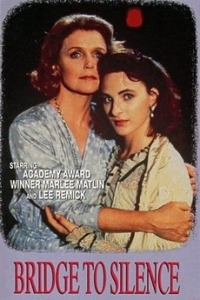
Directed by Karen Arthur, Bridge To Silence was a made-for-TV movie.  Lee Remick plays Marge Duffield, who has a strained relationship with her deaf daughter, Peggy (Marlee Matlin).  After Peggy’s husband is killed in a traffic accident, Peggy has a nervous breakdown.  Marge and her husband, Al (Josef Sommer) take care of Peggy’s daughter, Lisa, while Peggy is recovering.  However, even as Peggy gets better, Marge still doesn’t feel that she can raise her daughter so Marge files a lawsuit to be named Lisa’s legal guardian.  While all of this is going on, Peggy is starring in a college production of The Glass Menagerie and pursuing a tentative romance with the play’s director (Michael O’Keefe).

Bridge to Silence is one of those overwritten but heartfelt melodramas that just doesn’t work.  With the exception of Marlee Matlin, the cast struggles with the overwrought script.  (Michael O’Keefe, in particular, appears to be miserable.)  The film’s biggest mistake is that it relies too much on that production of The Glass Menagerie, which is Tennessee Williams’s worst play and tends to be annoying even when it’s merely used as a plot device.  There’s only so many times that you can hear the play’s director refer to Peggy as being “Blue Roses” before you just want rip your hair out.

Far more enjoyable was 1988’s The Chocolate War.

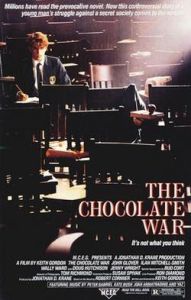
Directed by Keith Gordon, The Chocolate War is a satirical look at conformity, popularity, rebellion, and chocolate at a Catholic boys school.  After the manipulative Brother Leon accidentally purchases too much chocolate for the school’s annual sale, he appeals to one of his students, Archie Costello (Wallace Langham), to help him make the money back.  Archie, who is just as manipulative as Leon, is the leader of a secret society known as the Vigils.  However, Archie and Leon’s attempt to manipulate the students runs into a roadblack when a new student, Jerry Renault (Illan Mitchell-Smith) refuses to sell any chocolates at all.  From there, things get progressively more complicated as Archie tries to break Jerry, Jerry continues to stand up for his freedom, and Leon … well, who knows what Leon is thinking?

The Chocolate War was an enjoyable and stylish film, one that featured a great soundtrack and a subtext about rebellion and conformity that still feels relevant.  John Glover and Wallace Langham both gave great performances as two master manipulators.

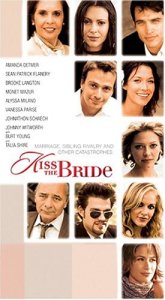
I also enjoyed the 2002 film, Kiss The Bride.

Kiss The Bride tells the story of a big Italian family, four sisters, and a wedding.  Everyone brings their own personal drama to the big day but ultimately, what matters is that family sticks together.  Directed by Vanessa Parise, Kiss The Bride featured believable and naturalistic performances from Amanda Detmer, Talia Shire, Burt Young, Brooke Langton, Monet Mazur, and Parise herself.

I have to admit that one reason why I liked this film is because it was about a big Italian family and it featured four sisters.  I’m the youngest of four sisters and, watching the film, I was reminded of my own big Irish-Italian family.  The movie just got everything right.

And then finally, there was 2006’s Wedding Daze.

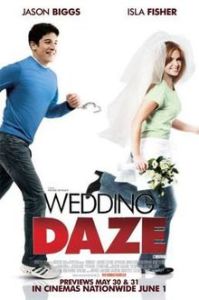
Wedding Daze is a romantic “comedy.”  Anderson (Jason Biggs) asks his girlfriend to marry him, just to have her drop dead from shock.  Anderson’s best friend is afraid that Anderson will never get over his dead girlfriend and begs Anderson to not give up on love.  Anderson attempts to humor his friend by asking a complete stranger, a waitress named Katie (Isla Fisher), to marry him.  To everyone’s shock, Katie says yes.

From the get go, there are some obvious problems with this film’s problem.  Even if you accept that idea that Katie would say yes to Anderson, you also have to be willing to accept the idea that Anderson wouldn’t just say, “No, I was just joking.”  That said, the idea does have some comic potential.  You could imagine an actor like Cary Grant doing wonders with this premise in the 30s.  Unfortunately, Jason Biggs is no Cary Grant and the film’s director, comedian Michael Ian Black, is no Leo McCarey.  In the end, the entire film is such a misjudged failure that you can’t help but feel that Anderson’s ex was lucky to die before getting too involved in any of it.