Lisa Reviews An Oscar Nominee: A Streetcar Named Desire (dir by Elia Kazan)


Poor, tragic Blanche DuBois.

In 1951’s A Streetcar Named Desire, the emotionally fragile Blanche (played by Vivien Leigh) has come to New Orleans to live with her younger sister, Stella (Kim Hunter).  From an old and formerly wealthy Southern family, Blanche has recently lost both her job as a teacher and the plantation where she and Stella grew up.  Even before that, she lost her husband to suicide.  And now Blanche has been reduced to living with Stella in the run-down apartment that she shares with her brutish husband, Stanley Kowalksi (Marlon Brando).

Stanley is tough and blue-collar, an earthy gambler whose bad manners stand in sharp contrast to Blanche’s attempts to present herself as being an elegant Southern belle.  Stanley, who is convinced that Blanche has money that she’s hiding from her sister, goes out of his way torment Blanche.  Stella, who is pregnant, tries to keep the peace between her sister and the man who claims to love her, his family, and the Napoleonic code.  (“Stella!” Stanley yells at one point, the cry of a wounded animal who desperately needs his mate.)  Blanche ends up going on a tentative date with Mitch (Karl Malden), one of Stanley’s co-workers,  Stanley, who sees Blanche as a threat to the life that he’s created for himself, goes out of his way to destroy even that relationship.  Blanche has secrets of her own and Stanley is determined to dig them up and use them to his own advantage.  When Blanche refuses to allow Stanley to destroy the fantasy world that she’s created for herself, Stanley commits an act of unspeakable violence.

Based on the play by Tennessee Williams, A Streetcar Named Desire is a recreation of the film’s legendary Broadway production.  Elia Kazan, who directed the theatrical production, does the same for the film.  Marlon Brando, Kim Hunter, and Karl Malden recreate their stage roles and many of the minor characters are also played by the same actors who played them on stage.  The only major change to the cast is Vivien Leigh, who replaces Jessica Tandy in the role of Blanche.  Tandy had won a Tony for playing the role of Blanche but the film’s producer insisted on an actress who had more box office appeal.  After both Bette Davis and Olivia de Havilland (both of whom would have had too strong of a personality to be believably pushed around by Stanley) declined the role, Vivien Leigh was cast.  Leigh has played Blanche on the London stage and, perhaps even more importantly, her own fragile mental health mirrored much of what Blanche had gone through before moving to New Orleans.

A few changes were made to the play.  In the play, it’s made clear that Blanche’s husband committed suicide after he was caught having an affair with another man.  In the film, Blanche simply says that her husband was too sensitive.  The film also includes a few scenes that are set outside of the apartment in an attempt to open up the play.  (That said, the film still comes across as being rather stagey.)  In the play, it’s made clear what Stanley does to Blanche while Stella is at the hospital.  The film leaves it ambiguous, though still providing enough hints for the audience to figure it out on their own.  Finally, the film ends with a suggestion that Stanley will ultimately suffer for his bad behavior.  It’s hardly a happy ending but it’s still not as dark as what happens in the play.

The film definitely retains its theatrical origins.  It’s very much a filmed play and again, it can feel rather stagey.  But the performance are so strong that it really doesn’t matter.  A Streetcar Named Desire was the first film to win three of the acting awards, with Oscars going to Hunter, Malden, and Leigh.  Marlon Brando was nominated for Best Actor but did not win, largely because he was competing against Humphrey Bogart who, himself, had never won an Oscar.  (The Brando snub would be rectified when he later won for On The Waterfront.)  Brando’s performance as Stanley still holds up today.  He’s so ferociously charismatic that it’s actually a bit scary to watch him.  One can see what drew Stella to him, even though Stanley is very much not a good man.  It’s a performance that will definitely take by surprise anyone who knows Brando only from his later years, when he was known for his weight and his oft-stated boredom with acting.  A Streetcar Named Desire shows just how brilliant an actor Marlon Brando was at the start of his career.  The intensity of Brando’s method acting matches up perfectly with Vivien Leigh’s more traditional style of acting and the film becomes not just the story of a domineering brute and a fragile houseguest but also a metaphor for the death of the antebellum South.  If Blanche represents a genteel past that may have never existed, Stanley represents the brutality of the 20th Century.

Along with the similarly dark A Place In The Sun, A Streetcar named Desire was considered to be a front runner for the 1951 Best Picture Oscar.  In the end, though, the voters went for the much less depressing An American In Paris.

A Streetcar Named Desire (1951, dir by Elia Kazan, DP: Harry Stradling)
Embracing the Melodrama #20: Ship of Fools (dir by Stanley Kramer)


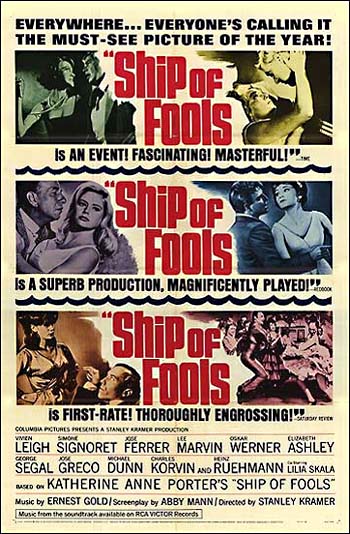
ship-of-fools-poster

The 1965 best picture nominee Ship of Fools follows a group of passengers as they take a cruise.  The year is 1933 and the luxury liner, which has just left Mexico, is heading for Nazi Germany.  Both the passengers and the crew represent a microcosm of a world that doesn’t realize it’s on the verge of war.

There’s Carl Glocken (played by Michael Dunn), a dwarf who has the ability to break the fourth wall and talk directly to the audience about all of the fools that have found themselves on this ship.  He alone seems to understand what the future holds.

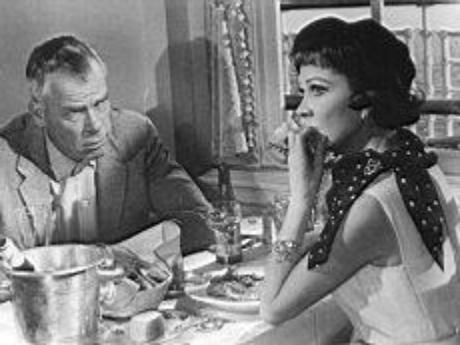
There’s Mary Treadwell (Vivien Leigh), an aging Southern belle who spends almost the entire cruise flirting with the crew and other passengers, desperate to recapture her fading youth.  That also seems to be the main goal of Bill Tenney (Lee Marvin), an unsophisticated former baseball player who spends most of the cruise brooding about his failed career.

There’s the Countess (Simone Signoret), a political prisoner who is being transported to an island prison.  She falls in love with the ship’s doctor (Oskar Werner).  The doctor’s dueling scar suggests that he is a member of the old aristocracy and he is literally the film’s only good German.  Perhaps not surprisingly, he is also in the process of dying from a heart condition.

And then there’s David (George Segal) and his girlfriend Jenny (Elizabeth Ashley).  David is a frustrated and depressed painter while Jenny is far more determined to enjoy life, which should be pretty easy because the boat is also full of performers and dancers.

Finally, there’s the buffoonish Rieber (Jose Ferrer), a German industrialist whose dinner table talk hints at the horrors that are soon to come.

Ship of Fools is a big, long film in which a large cast of stars deal with big issues in the safest way possible.  In short, it’s a Stanley Kramer film.  As one can tell from watching some of the other films that he directed (Judgment at Nuremberg, Guess Who’s Coming To Dinner, and R.P.M.), Stanley Kramer made films that were often easier to admire than to actually enjoy.  As the critic Mark Harris points out in his book Pictures At A Revolution, Kramer started out as a producer and he retained the sensibility of a producer even after he stared directing.  As such, his films would address issues that were certain to generate a lot of free publicity but, at the same time, he would never run the risk of alienating his audience by digging too deeply into those issues.  His films would have the type of all-star casts that would, again, bring in an audience but Kramer rarely seemed to give thought as to whether or not an all-star cast would distract from the film’s message.  Finally, unlike the truly great directors, Kramer never really figured out how to tell a story with images.  As a result, his movies were often full of characters whose sole purpose was to explain the film’s themes.

Does that mean that Stanley Kramer never made a good film?  No, not at all.  Judgment at Nuremberg remains powerful and R.P.M. is a guilty pleasure of mine.  Kramer was usually smart enough to work with talented professionals and, as a result, his films were rarely truly bad.  Some of them even have isolated moments of greatness.  It’s just that his films were rarely memorable and truly innovative and, therefore, they are easy for us to dismiss, especially when compared to some of the other films that were being made at the same time.

With all that in mind and for reasons both good and bad, Ship of Fools is perhaps the most Stanley-Kramerish of all the Stanley Kramer films that I’ve seen.  The film was apparently quite acclaimed and popular when it was originally released in 1965 but watched today, it’s an occasionally watchable relic of a bygone age.  How you react to Ship of Fools today will probably depend on whether or not you’re an admirer of any of the actors in large cast.  For the most part, all of them do a good job though you can tell that, as a director, Kramer struggled with how to make their multiple storylines flow naturally into an overall theme.  Not surprisingly, Vivien Leigh and Lee Marvin give the two most entertaining performances and Jose Ferrer makes for a wonderfully hissable villain.  Oddly enough, I find myself most responding to the characters played by George Segal and Elizabeth Ashley.  I’m not sure why — their storyline is rather predictable.  Maybe it was just because Elizabeth Ashley’s character goes wild and starts dancing at one point.  That’s what I would do if I found myself stuck on a boat with a tortured painted.

(What is especially interesting is that neither Oskar Werner or Simone Signoret are particularly memorable and yet they both received Oscar nominations.  Perhaps 1965 was a weak year for acting.)

In the end, Ship of Fools is a movie that will be best appreciated by those of us who enjoy watching old movies on TCM and take a special delight in spotting all of the wonderful actors that, though they may no longer be with us, have at least had their talent preserved on film.  Ship of Fools may not be a great film but it does feature Vivien Leigh doing an impromptu and joyful solo dance in a hallway and how can you not appreciate that?

ship-of-fools-1-1