Though the Academy of Motion Picture Arts and Sciences claim that the Oscars honor the best of the year, we all know that there are always worthy films and performances that end up getting overlooked. Sometimes, it’s because the competition too fierce. Sometimes, it’s because the film itself was too controversial. Often, it’s just a case of a film’s quality not being fully recognized until years after its initial released. This series of reviews takes a look at the films and performances that should have been nominated but were, for whatever reason, overlooked. These are the Unnominated.
Directed by John Boorman, 1998’s The General tells the story of Martin Cahill.
Martin Cahill (Brendan Gleeson) was a Dublin-based crime lord, a thief by trade who never made any apologies for his profession. The film opens with the end of Martin Cahill’s life. Leaving his suburban home, he’s sitting behind the steering wheel of his car when a young man runs up and shoots him in the face. Cahill’s car rolls forward while his wife (Maria Doyle Kennedy) screams for help. Cahill has been assassinated in front of his family and the reaction of the local police is to celebrate until Cahill’s oldest nemesis, Inspector Ned Kenney (Jon Voight), announces that they have nothing to cheer about. The film leaves it somewhat ambiguous as to who shot Cahill, though it heavily suggests that he was shot by the IRA, both because of their mistaken belief that he was moving drugs into the neighborhood but also because of his refusal to share his profits with them.
The film flashes back and we watch as Martin Cahill, a rebellious young man who stole to impress girls and to get a shot back at the establishment, grows up to become Martin Cahill, the crime lord that the papers nickname The General. Cahill is a professional thief and he’s fairly honest about it. When his government-controlled flat is torn down, Cahill camps out on the site in a tent, refusing to leave because the location of the new building is to close to the police station. He says he’d rather be moved to a richer part of town. It’s better for his work. As portrayed by Brendan Gleeson, Cahill is a fascinating and complex character, a ruthless criminal who is also devoted to his pigeons, his children and both his wife and his girlfriend (Angeline Bail). (Fortunately, for Martin, his wife and his girlfriend know about each other and are good friends.) He’s the type of crime lord who will test a man’s loyalty by nailing him to a pool table and then take him to the hospital afterwards. “Sorry, Martin,” another associate says after Martin shoots him in the leg to make a fake break-in look authentic. It’s hard not to like the film’s version of Martin Cahill, an intelligent and ultimately honest man who understands the importance of allowing his enemies to believe him to be a buffoon. He may be a criminal but he considers it to be an honest living, unlike the government officials who force unwanted laws and exorbitant taxation on the citizenry Director John Boorman certainly seems to like Cahill, which is interesting as Boorman was actually the victim of one of Cahill’s robberies. (Boorman recreates the robbery in the film.)
The film went unnominated at the Oscars, which were dominated that year by Shakespeare in Love and Saving Private Ryan. Brendan Gleeson definitely deserved a nomination for his charismatic performance as Martin Cahill. Equally worthy of a nomination was Seamus Deasy’s black-and-white cinematography, which gives the film the dream-like feel of a half-remembered legend. (The version of the film that’s on Tubi features desaturated color. It’s actually an effective look for the film’s story but I still prefer the black-and-white original.) Neither was nominated and, indeed, Brendan Gleeson would have to wait until 2023 to finally receive his first Oscar nominations for The Banshees of Inisherin.
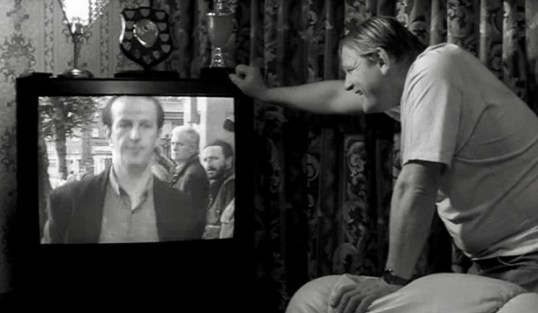
The General (1998, dir by John Boorman, DP: Seamus Deasy)
Previous entries in The Unnominated:
 Through the Shattered Lens