4 Or More Shots From 4 Or More Films is just what it says it is, 4 shots from 4 of our favorite films. As opposed to the reviews and recaps that we usually post, 4 Shots From 4 Films lets the visuals do the talking!
Today would have been the 109th birthday of actor Kirk Douglas! It’s time for….
4 Shots From 4 Kirk Douglas Films
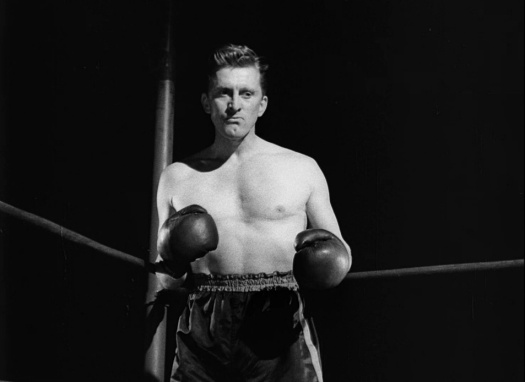
Champion (1949, dir by Mark Robson, DP; Franz Planer)
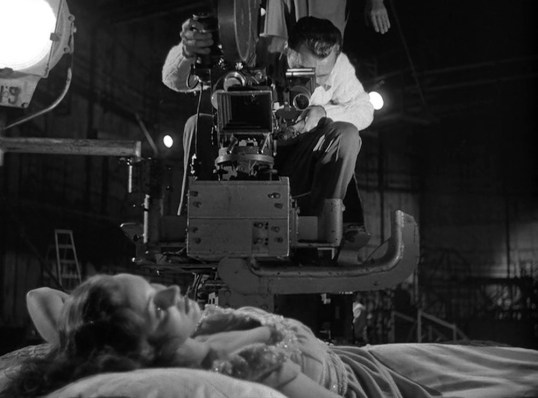
The Bad and the Beautiful (1952, dir by Vincente Minnelli, DP: Robert L. Surtees)
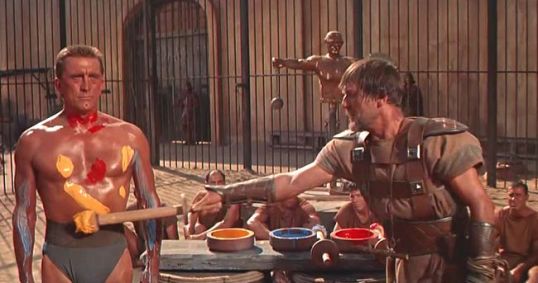
Spartacus (1960, dir by Stanley Kubrick, DP: Russell Metty)
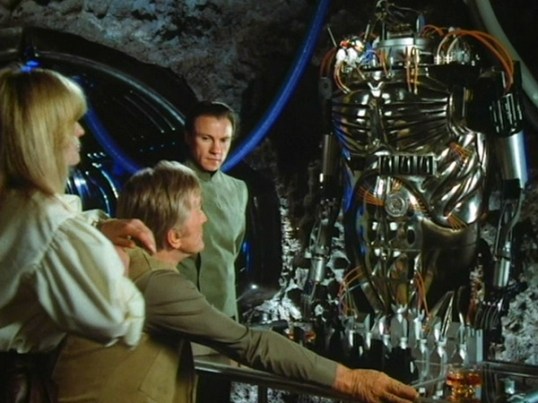
Saturn 3 (1980, dir by Stanley Donen, DP: Billy Williams)
4 Shots From 4 Films is just what it says it is, 4 shots from 4 of our favorite films. As opposed to the reviews and recaps that we usually post, 4 Shots From 4 Films lets the visuals do the talking!
Today, we celebrate the birth of Gene Kelly! It’s time for….
4 Shots From 4 Gene Kelly Films
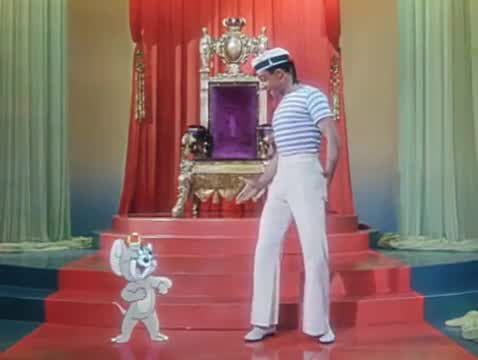
Anchors Aweigh (1945, dir by George Sidney, DP: Charles Boyle and Robert Planck)
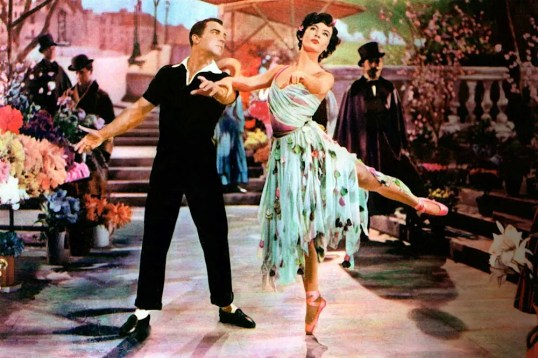
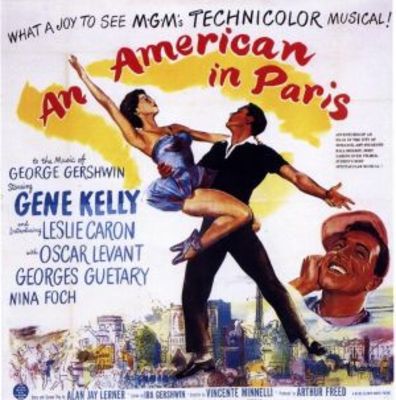
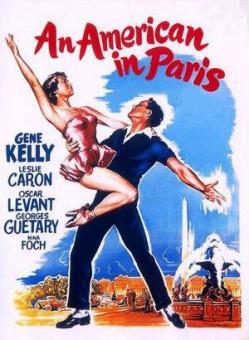
An American In Paris (1951, dir by Vincente Minnelli, DP: Alfred Gilks)
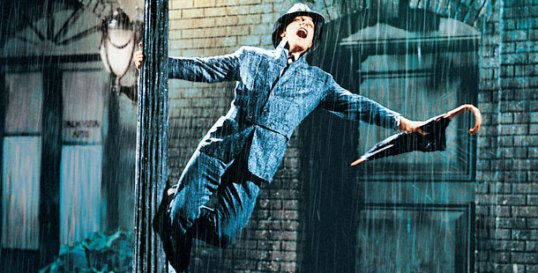
Singin’ In The Rain (1952, dir by Gene Kelly and Stanley Donen, DP: Harold Rosson)
Xanadu (1980, dir by Robert Greenwald, DP: Victor J. Kemper)
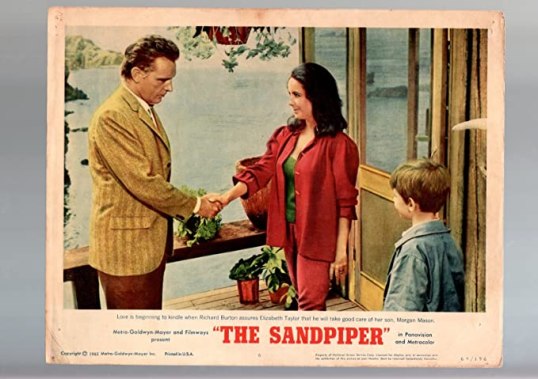
I recorded The Sandpiper that last time that it aired on TCM. This 1965 film is one of the many films that Elizabeth Taylor and Richard Burton made together after they fell in love during the making of Cleopatra. And while it’s true that Who’s Afraid of Virginia Woolf? won Taylor an Oscar and probably should have won one for Burton as well, the majority of the Taylor/Burton films were overproduced melodramas that often seemed as if they’d been rushed into production in order to capitalize on the couple’s tabloid popularity. Unfortunately, Virginia Woolf aside, neither Taylor nor Burton seemed to bring out the best in each other as actors.
The Sandpiper finds Taylor playing Laura Reynolds, an artist who lives in a California beach house with her young son, Danny (Morgan Mason). Laura is a free spirit who believes that everyone, including her son, should have the freedom to make their own choices. She is resistant to any and all authority. She’s a bohemian, a rebel, the type who doesn’t care what society has to say and who flaunts her refusal to follow the dictates of respectability. Good for her! However, she’s also Elizabeth Taylor, which means that she’s impossibly glamorous and even her “cluttered” beach house looks like it’s a hundred times more expensive than anything that anyone viewing the film will ever be able to afford. Though Taylor tries hard, there’s nothing convincingly bohemian about her.
Richard Burton plays Dr. Edward Hewitt, who runs the nearby Episcopal school. Dr. Hewitt is not a free spirit. Instead, he and his wife, Claire (Eva Marie Saint), very much believe in structure and playing by the rules. They believe in a traditional education and, when a judge orders Danny to be enrolled at their school, that’s what Hewitt plans to give him. This, of course, brings Hewitt into conflict with Laura. Both of them have differing ways of looking at the world and Laura is not a fan of religion in general. However, since they’re played by Burton and Taylor, they’re destined to fall in love and have a scandalous affair.
Dr. Hewitt is one of the many religious figures that Burton played throughout his career. In fact, Burton played so many alcoholic priests that I spent most of the movie assuming that Hewitt was an alcoholic as well. However, he’s not. He’s just Episcopalian. That said, Burton delivers every line of dialogue in his trademark “great actor” voice and every minute that he’s onscreen just seems to be full of self-loathing. Even before he cheats on his wife, Hewitt seems to hate himself. Of course, once Burton does start cheating on his wife, it only gets worse. The film presents Hewitt as being something of a hesitant participant, someone who knows that he’s doing the wrong thing but he simply cannot stop himself. Laura, meanwhile, is presented as being someone who is fully willing to break up a marriage to get what she wants. One gets the feeling that 1965 audiences probably just assumed they were watching the true story of how Taylor and Burton fell in love during the making the Cleopatra. That said, it’s all pretty tame. Just like Taylor, director Vincente Minnelli was too much of a product of the old Hollywood to truly embrace this story for all of its sordid potential.
If you’ve ever wanted to watch Charles Bronson debate religion with Richard Burton, this is the film for you. Bronson plays a sculptor and an atheist who upsets Hewitt by calling him “reverend.” Bronson is actually more convincing in the film than either Burton or Taylor, bringing a rough authenticity to his role. Whereas Burton and Taylor both seem to be going through the motions, Bronson comes across as if he actually has a personal stake in the film’s story. It’s not enough to save the movie, of course. Fortunately, a year later, Liz and Dick would be used to better effect in Who’s Afraid of Virginia Woolf?
Today is the 117th birthday of the great director, Vincente Minnelli!
While Minnelli actually made films in several different genres, he’s best remembered for his many musicals. It’s been said that Minnelli was one of the directors for whom technicolor was invented and his musicals certainly prove the truth of that statement. Minnelli made films that not only celebrated music and dancing but which left audiences wanting to sing and dance themselves.
Several of Minnelli’s films were honored by the Academy. Two of his films won the Oscar for Best Picture and today’s scene that we love comes from the first one to do so, 1951’s An American In Paris. In this scene …. well, the why is not important. What’s important is the way the Gene Kelly and Leslie Caron move and the way that Minnelli captures and celebrates every movement.
(For those following at home, Lisa is attempting to clean out her DVR by watching and reviewing 38 films by this Friday. Will she make it? Keep following the site to find out!)
I can’t believe it took me this long to see the Oscar-winning 1951 film, An American In Paris. Seriously, I love dancing. I love Paris. I love Gene Kelly. Though this film was made decades before I was born, it still feels like it was literally made for me. And yet, until last night, I had never seen it. Thank God for TCM (and thank God for the DVR that I used to record the movie when it aired on TCM).
Gene Kelly plays Jerry Mulligan, an American veteran of World War II who, now that he is out of the army, is making his living as a painter and living in Paris. (The real Paris is only seen in a few establishing shots. Most of the film takes place on sets that were clearly designed to look more theatrical than realistic. This is the Paris of our most romantic fantasies.) Jerry’s roommate is Adam (Oscar Levant), a pianist who fantasizes about playing before a huge audience.
When the movie begins, Jerry gets his first patron, the wealthy and lonely Milo Roberts (Nina Foch). Though Milo is in love with Jerry, Jerry falls in love with an innocent French girl, Lise Bouvier (Leslie Caron). Although Lise falls in love with Jerry, she feels obligated to marry French singer Henri (Georges Guetary) because Henri helped to keep her safe during the Nazi occupation. And, of course, Henri is friends with Adam who is the roommate of Jerry who is in love with Lise who is engaged…
It sounds a lot more complicated than it actually is. If anything the plot of An American In Paris is too simple. (Just compare An American In Paris to Singin’ In The Rain.) But ultimately, An American In Paris is not about the story. It’s about George Gershwin’s music and Gene Kelly’s dancing. It’s a triumph of pure style. It was said that Fred Astaire made love through dancing and that’s even more true of Gene Kelly, who is literally a force of masculine nature in this film. So impressive was his choreography that it received a special, noncompetitive Oscar.
Check some of this out:
It all eventually ends with the incredible 17-minute The American In Paris Ballet, which sees Gene Kelly and Leslie Carson dancing through a series of sets that were modeled on Impressionist paintings. It’s one of those great movie moments that simply has to be seen.
How impressed were the members of the Academy with An American In Paris? They were impressed enough to name it the best film of 1951. I don’t know if I would go that far because I’ve seen both A Streetcar Named Desire and A Place In The Sun. (And An American In Paris‘s victory is considered to be one of the biggest upsets in Oscar history.) But, with all that said, An American In Paris is still an incredibly enjoyable film to watch.
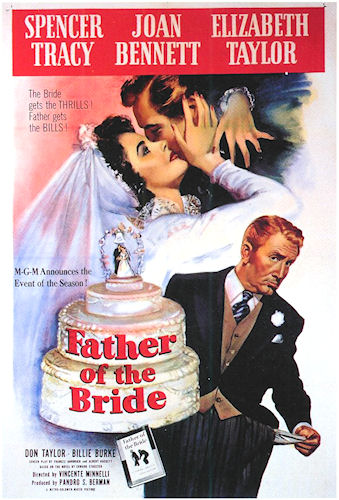
After I watched King Solomon’s Mines, I watched yet another 1950 best picture nominee, Father of the Bride.
In Father of the Bride, Spencer Tracy plays a lawyer named Stanley Banks. As you might expect of any character played by Spencer Tracy, Stanley Banks is a no-nonsense type of guy. He’s set in his ways and not particularly enthusiastic about the idea of change. Stanley has worked hard to get a good job and a nice house in the suburbs. He loves his wife, Ellie (Joan Bennett) and is a firm but good father to his two boys, Tommy (Russ Tamblyn) and Ben (Tom Irish). If Stanley does have a soft spot, it’s for his daughter, Kay (17 year-old Elizabeth Taylor). Stanley admits that he’s always given Kay everything that she’s ever wanted and that she is his favorite of all his children.
However, Kay has been acting strangely as of late. She just seems to be so happy! Stanley can tell that she’s in love, though he has no idea with whom. (He is, however, happy that it’s probably not the bespectacled political radical who Kay apparently dated at some point in the past.) Finally, during an otherwise typical family dinner, Kay announces that not only is she in love but she’s also engaged to be married!
His name is Buckley (Don Taylor, who would later direct Escape From The Planet of the Apes and Damien: Omen II) and, at first, Kay refuses to even introduce him to her parents. Eventually, however, Stanley does meet Buckley and he’s happy to discover that not only does Buckley come from a wealthy family but he also owns a small business of his own.
However, just because Buckley is the perfect 1950 man, that doesn’t mean that the wedding is going to be easy. As a befuddled Stanley watches, the wedding grows more and more elaborate (not to mention, expensive!). All of the expected complications ensue: Buckley and Kay have a fight, a wedding planner makes things difficult, and Stanley does not immediately get along with Buckley’s parents. But, for the most part, Father of the Bride is about Stanley struggling to accept that his daughter has grown up and is ready to start a life of her own.
Father of the Bride is a sweet little comedy, though it seems a bit out-of-place as a best picture nominee. It’s definitely a film of its time. For all of the scenes of Stanley worrying about the extravagance of modern weddings, there’s not a subversive moment to be found in Father of the Bride. (One can only imagine what Nicholas Ray or Douglas Sirk would have done with the material.)
Fortunately, this is also a Spencer Tracy film and whatever gravitas that the film may have comes from Tracy’s honest and straight forward performance. Tracy never begs for laughs but he gets them anyway, because of the honesty that he brings to the character. Perhaps his best moment comes after Buckley and Kay have had a fight. After comforting his daughter, Stanley discovers that Buckley is at the front door. At first, the protective Stanley tells Buckley that Kay doesn’t want to see him. Suddenly, Kay comes running down stairs and embraces Buckley. Between sobs and kisses, Buckley and Kay dramatically swear to each other that they will never fight again. The camera pans over to Stanley, standing a little to the side and listening. At first, Stanley seems befuddled by how overdramatic the two of them are acting over a relatively minor fight but there’s also just a hint of sadness in Stanley’s eyes as he realizes that his daughter truly has moved on.
Father of the Bride was nominated for best picture but it lost to the far more subversive All About Eve.
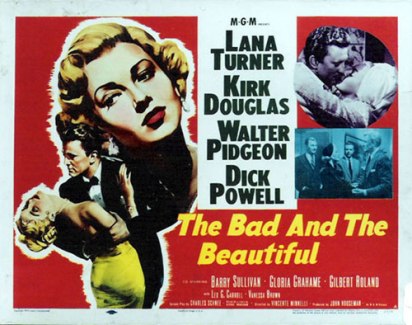
Released in 1952 and directed by Vincente Minnelli, The Bad and the Beautiful is arguably one of the greatest films ever made. It’s certainly one of my favorite films.
Perhaps appropriately, The Bad and the Beautiful is a film about the movies.
Jonathan Shields (played in a truly amazing performance by Kirk Douglas) is a legendary film producer. He’s won Oscars, he’s got a reputation for being a genius, and, as the film begins, he is one of the most hated men in Hollywood. It’s been years since Shields made a succesful film but he thinks that he’s finally come up with a movie that can put him back on top. His assistant, Harry Pebbel (played with a weary dignity by Walter Pidgeon), invites Hollywood’s best director, actress, and screenwriter to a meeting and he proceeds to spend the rest of the film trying to convince them to help Jonathan make his comeback.
The only problem is that all three of them hate Jonathan Shields and have sworn that they’ll never work with him again. Through the use of flashbacks, we see how each of them first met Jonathan and how each eventually came to despise him.
Director Fred Amiel (Barry Sullivan) first met Jonathan when Jonathan hired him to pretend to be a mourner at his father’s funeral. With Jonathan’s help, Fred moves up from directing B-movies to finally getting a chance to make his dream movie, an adaptation of a believably pretentious novel called The Far Off Mountain. With Jonathan’s help, Fred even gets womanizing film star Gaucho Ribera (a hilariously vain Gilbert Roland) to agree to star in Fred’s movie. Jonathan also introduces Fred to Georgia (Lana Turner), the alcoholic daughter of Jonathan’s mentor.
Jonathan eventually makes Georgia into a film star and Georgia falls in love with him. Of all the major actresses of the 1950s, Lana Turner seems to get the least amount of respect from film historians. She’s more remembered today as the epitome of glamour and scandal but, in The Bad and the Beautiful, Turner gives one of the best performances of her career. In her best scene, Georgia has a nervous breakdown while driving in the rain and, for those few minutes, you forget that you’re watching an iconic film star. Instead, you’re just amazed by the performance.
Finally, the screenwriter is James Lee Bartlow (Dick Powell), an intellectual novelist who is brought to Hollywood by Jonathan. While the reluctant Bartlow finds himself being seduced by J0nathan, his flighty wife (Gloria Grahame) is seduced by Gaucho.
The Bad and the Beautiful is perhaps one of the few perfect movies ever made, a film that qualifies as both art and entertainment. There are so many reasons why I love this film that its hard for me to describe them all. The film snob in me loves the fact that Minnelli directed The Bad and the Beautiful as if it were a classic black-and-white film noir. The entire film is lit and shot to emphasize shadows and moral ambiguity. As played by Kirk Douglas, Jonathan Shields is as seductive and dangerous a figure as Barbara Stanwyck in Double Indemnity. My inner film historian loves the fact that the film is full of barely disguised portraits of real life Hollywood figures like David O. Selznick, Val Lewton, Alfred Hitchcock, and Diane Barrymore. Finally, and perhaps most importantly, my girly girl side loves that this film is basically a big melodramatic soap opera. Lana Turner’s outfits are to die for and Jonathan Shields is the ultimate bad boy that we can’t help but love.
The Bad and the Beautiful received 6 Oscar nominations but it wasn’t nominated for best picture. (This snub is all the more surprising when you consider what the Academy did name as the best picture of 1952 — Cecil B. DeMille’s The Greatest Show on Earth.) Out of those six nominations, the Bad and the Beautiful won five Oscars. (Of all the film’s nominees, only Kirk Douglas failed to win.) As of this writing, The Bad and the Beautiful still holds the record for most Oscars won by a film that failed to be nominated for best picture.

 Through the Shattered Lens