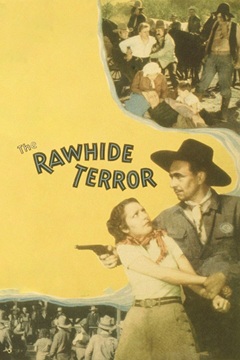
The Rawhide Terror (1934, directed by Jack Nelson and Bruce Mitchell)


There are some Poverty Row westerns that even I can’t defend.

A group of bandits, disguised as Indians, attack a pioneer family.  The father and the mother are killed but their twin boys survive.  One wanders into the wilderness while the other stays with the remains of his family and waits for help.  Years later, the town of Red Dog is thriving, with the former bandits as its leading citizens.  Someone has been gunning down the former bandits.  The townspeople demand that Sheriff Luke (Edmund Cobb) do something about the man that they’ve nicknamed the Rawhide Killer.  First, however, Luke has to deal with Jim Briggs (William Barrymore), who has been abusing his son (Tommy Bupp).  It also turns out that Jim Briggs is the Rawhide  Killer and he’s looking for vengeance against those who killed his parents.  Jim’s brother also lives in the town.  Guess who!

The Rawhide Terror gets off to a good start with the bandit attack but it falls apart soon afterwards.  I don’t know if it was just because I was watching a bad print but the sound quality was terrible and the lack of an original score really highlighted just how boring it is to watch men silently ride their horses from one side of the screen to the other.  This movie was only 47 minutes long and half of it was made up of shots of people riding horses.  Add some really bad acting and you’ve got a western that was bad even by the standards of a 1934 second feature.

Two men are credited with directing the film, though the production was actually supervised by Victor Adamson, the father of the notorious schlock filmmaker, Al Adamson.
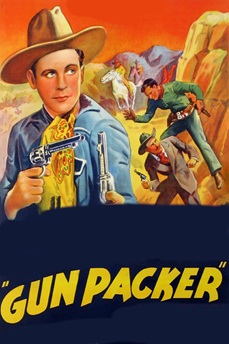
Gun Packer (1938, directed by Wallace Fox)


Someone is holding up stages and making off with a fortune of gold bullion.  The government decides to send in a gun packer.  Jack Denton (Jack Randall), the son of a legendary lawman, is sent to investigate, along with his sidekick Pinkie (Ray Turner) and Rusty the Wonder Horse.  Jack goes undercover, telling an elderly ex-con (Barlowe Borland) that he’s a former partner of his, which leads Jack to the leader of the robbers, Chance Moore (Charles King).

There are a lot of familiar faces in this western.  Not only does Charles King play yet another villain but Glenn Strange shows up in his customary role as the town sheriff.  Lloyd Ingraham, Forrest Taylor, Victor Adamson, George Hazel, Dave O’Brien, and Tex Palmer all have roles.  It’s interesting that the same actors showed up in these movies and almost always seemed to be playing the same roles.  The only thing that changed was the hero.  In this case, it’s Jack Randall, who may not have been a great actor but who was a believable western hero.  His sidekick here is Ray Turner, a black actor who began his career during the silent era and who had a long career in the westerns.  While Turner plays a subordinate character, the role still avoids a lot (though not all) of the demeaning racial stereotypes that were very common in most films from the 1930s.  Jack treats Pinky with respect and they’re clearly friends outside of work.  That may not sound like a lot but it was a big deal for a 1938 Poverty Row western.

The real hero here is Rusty the Wonder Horse.  Rusty’s best scene?  Jack, needing to climb a mountain, calls for Rusty to drop his lariat.  Jack grabs the rope and Rusty pulls him up.  Rusty truly earns the right to be called a wonder horse.

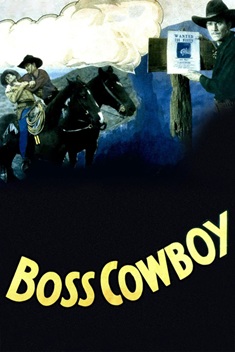
Boss Cowboy (1934, directed by Victor Adamson)


Boss Cowboy takes place in the 30s but it’s very much a western.  One car shows up and telephone poles dot the countryside but almost everyone in the movie rides a horse.  The Nolans and the Rosses are two ranching families.  Both families are losing cattle.  Nolan foreman Dick Taylor (Buddy Roosevelt) suspects that the culprit is the Ross foreman, Jack Kearns (George Cheseboro) and he’s right.  Kearns is ripping off both families.  Complicating Taylor’s effort to stop Kearns are his romantic feelings towards Mary Ross (Frances Morris), who is visiting from “back east.”  Sally Nolan (Fay McKenzie) is also visiting and running joke is her handing off her small dog to a ranch hand named Slim (Alan Holbrook).

No apparent relation to either Teddy or FDR, Buddy Roosevelt was a respected stunt man who tried his hand at starring in a few westerns,  Unfortunately, Buddy Roosevelt wasn’t much of an actor, which is painfully apparent while watching him in Boss Cowboy.  He’s fine when he’s riding a horse and pulling a gun but when he has to speak, it’s difficult to watch.  As bad as Buddy Roosevelt’s acting was, he was not the worst actor in Boss Cowboy.  That honor was split between Frances Morris and Fay McKenzie.  Boss Cowboy is pretty dull.  Every scene drags and there are plenty of awkward silences while the cast tries to remember their lines.

Though he wasn’t much of an actor, Buddy Roosevelt remained in a demand as a stunt man throughout the 40s.  In the 50s and 60s, he was kept busy playing townsmen in shows like The Life and Legend of Wyatt Earp.  In 1962, he made his final film appearance in The Man Who Shot Liberty Valance.  He then retired to Colorado, where he did at age of 75 in 1973.  In all, his Hollywood career spanned 46 years, from 1916 to 1962.


Billy The Kid In Texas (1940, directed by Sam Newfield)


Billy the Kid (Bob Steele) escapes from a Mexican prison (where he was being held on a trumped-up charge) and ends up in Corral City, Texas with his old friend, Fuzzy Jones (Al St. John).  This version of Billy the Kid may be an outlaw but he’s a really nice outlaw.  He holds up two men who had previously held up a express wagon but he turns over the loot after he and Fuzzy are appointed the new law in Corral City.  The bad outlaws don’t want Billy the Kid or anyone else as their new sheriff so they bring in a notorious gunslinger (Carleton Young) to help them keep the town under their control but it turns out that Billy and the gunslinger have a past that no one knew about.

Bob Steele played Billy the Kid in a series of films, until Buster Crabbe took over the role in 1942.  Steele was a convincing cowboy and a convincing gunman but he wasn’t a convincing kid.  Of course, this version of Billy the Kid didn’t have much in common with the real Billy the Kid.  The movie version of Billy the Kid got into a lot of trouble but it was usually due to a misunderstanding.

Billy the Kid In Texas is definitely a Poverty Row western.  It looks cheap and it was cheap but it did feature a good fight scene between Bob Steele and Charles King and the relationship between Billy the Kid and Carleton Young’s gunslinger also added some extra dimension to the otherwise predictable story.  This film is okay for western fans who aren’t sticklers for historical accuracy.


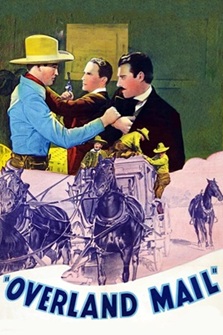
Overland Mail (1939, directed by Robert F. Hill)


Jack Mason (Jack Randall) has the most important job on the frontier.  He delivers the mail.  After he’s chased by the members of the local Indian tribe, he learns that an uprising is imminent because a young brave has been murdered and the tribe blames the citizens of a nearby town.  Of course, the murder was actually committed by a gang of counterfeiters led by saloon owner Pollini (Tristram Coffin).  Pollini is not only a counterfeiter but he also lies to sweet Mary Martin (Jean Joyce), telling her that he’s hiring her to be a waitress when he’s actually looking for a dance hall girl.  Jack has to bring Pollini to justice before a full scale war breaks out.

This is not a bad B-western.  It’s short and quick but the story is slightly better than the average Monogram oater and Jack Randall and co-star Dennis Moore are both believable as cowboys and gunslingers.  Fans of the genre will be happy to see Glenn Strange as the sheriff and Iron Eyes Cody as the chief of the tribe.  I’ve always liked westerns where the heroes were just trying to keep the peace so that they could deliver the mail.  We take mail for granted nowadays but in the 1800s, delivering mail was almost as dangerous as delivering money.  If you’re not into westerns, Overland Mail won’t change your mind but, if you’re already a fan of the genre, Overland Mail makes for an entertaining 50 minutes.