VGM Entry 28: Altered Beast


VGM Entry 28: Altered Beast
(Thanks to Tish at FFShrine for the banner)

The Sega Genesis/Mega Drive was launched in Japan on October 29th, 1988. By the end of the year, only four titles had been released on it. Three of them did not have very impressive music. Space Harrier II (Sega) and Super Thunder Blade (Sega) were designed more to showcase the system’s visual capabilities, presenting for perhaps the first time serious three dimensional gameplay outside of the arcade. In regards to audio, they both exploited the system’s sound capabilities towards the end of excessive and rather tasteless sound effects. Osomatsu-kun: Hachamecha Gekijō (Sega) was a bizarre, very Japanese side-scrolling cartoon game which might best be forgotten altogether. But the fourth game, Altered Beast (Sega), was an altogether different matter.

http://www.youtube.com/watch?v=tn6gcTOX6-0

Toshio Kai will forever hold the honor of having composed the first excellent fourth generation gaming soundtrack. Altered Beast might not have been on par with the sound quality achieved by Hisayoshi Ogura on Darius in 1986, but it was getting pretty close, and you could enjoy it in your bedroom.

Or perhaps I am going too far here. It is easy to forget what Takahito Abe, with a little help from Yuzo Koshiro, accomplished on the PC-8801, especially since the computer was only ever marketed in Japan. Xanadu Scenario II, Ys I, and plenty of other titles completely obscure to American audiences, like Taiyou no Shinden (Nihon Falcom, 1988), were all just gorgeous, and the sound quality does not appear to be any poorer than Altered Beast. The brilliant stretch of compositions Takahito Abe crafted in 1987/88 were consistently subtle, however, and his genius may well have extended into writing music which catered to the system. Toshio Kai did not have to worry about being subtle.

Altered Beast has a bass track that actually sounds like a bass, a piano which can at least be identified as such, fuller drumming, and synthier tones which sound so by choice, not out of necessity. It really feels as though the artist was not restricted in any critical sense, and in 1988 that was something of a novelty, or at least a luxury held exclusively by arcade composers.

http://www.youtube.com/watch?v=uPVeu83Jufk

“Gaum-Hermer” might not be the most exciting track in the game, but it merges with the gameplay in a sort of manner that you just don’t hear on the NES or Master System. It sounds like the sort of thing Hirokazu Tanaka just couldn’t quite pull off on Metroid. It is of course because Toshio Kai does such an excellent job that the ambiance of the song hits home, but I question whether such a track was even possible before.

Altered Beast did appear first as an arcade game. It was not necessarily composed with the Genesis in mind. But the fact that it could be ported without major alterations is something of a first. Developers of ports for the Nintendo had long been in the habit of commissioning entirely new soundtracks, or else altering the arcade music in extraordinary ways, such as in Double Dragon. Decisions to simply replicate the original as closely as possibly, such as in the eventual NES port of Altered Beast, tended to fall flat. You can hear subtle changes between the arcade and Genesis versions, but the NES version sounds terrible, and some of the songs are barely recognizable. Besides, most of the differences feel more like efforts to improve the song than failures to replicate it. The ruthlessly obnoxious drum line plaguing this arcade soundtrack from start to finish, for instance, is drastically subdued.

http://www.youtube.com/watch?v=4K7XoQCPjW4

It’s pretty hard to argue with the “Game Over” song. A lot, perhaps even the majority, of the best gaming music ever written appears on 4th generation platforms. It was an era that offered the best of both worlds. Here the sound is still electronic enough to form a distinct style. You couldn’t say, go hire a symphony orchestra and carry the recording straight away into the game. Musicians still had to work with limitations. But the technology had finally reached a point where those limitations did not deny the possibility of reproducing the same aesthetic appeal as say, an orchestra or a jazz band. The creativity and ingenuity required for good third generation song writing unabated, it was now given a medium in which to reach its full potential. The Mega Drive got a slower start than you might expect, and it wasn’t until well into the SNES era that a large collection of good Mega Drive soundtracks begin to appear, but by 1988 the possibilities were there.
VGM Entry 27: PC-8801


VGM Entry 27: PC-8801
(Thanks to Tish at FFShrine for the banner)

If I want to cover every field, it would be a certain mistake to overlook the impact of the NEC PC-8801 during this time. I have incorporated a few titles into the mix already. Thexder (Game Arts, 1985) by Hibiki Godai was the first noteworthy soundtrack for the platform I’ve found making use of the Yamaha YM2203 sound chip. Xanadu Scenario II (Nihon Falcom, 1986), predominantly the work of Takahito Abe, and Ys I: Ancient Ys Vanished (Nihon Falcom, 1987) by Yuzo Koshiro the following year were developed for various platforms, but the PC-8801 seems to have been Falcom’s flagship. Unfortunately I’ve found it nearly impossible, between the language barrier and the myriad ports, to find suitable examples of most of Takahito Abe’s other PC-8801 works, and Yuzo Koshiro’s pre-1988 works seem to be just as obscure. But were they the only composers making the system shine?

Silpheed (Game Arts, 1986) was another product of Hibiki Godai, at least as best I can tell. The only credits I could find were for the 1988 MS-DOS port by Sierra On-Line, which list Hibiki Godai, Nobuyuki Aoshima, Fumihito Kasatani, and Hiromi Ohba. Since the majority of the other names in the credits are Americans, it’s quite possible that all four of these musicians had a hand in the original composition.

In a way, the music feels a little bland compared to that of the European musicians I’ve recently discussed. This is certainly a product of differences in sound chips, but I am at least a little inclined to believe that both the distorted nature of Commodore 64 and ZX Spectrum sound and the atmosphere of experimentation and bold composition that permeated European sound programming did in fact inspire better music than competing scenes managed to produce at the time. Even so, Silpheed has some exceptional songs–most notably the one beginning at 13:00–and it’s a good example of what Japanese computer gaming sounded like.

http://www.youtube.com/watch?v=Aby9Upk3hQ8

Or so I like to believe. Sorcerian (Nihon Falcom, 1987) is yet another Yuzo Koshiro and Takahito Abe collaboration, with Mieko Ishikawa additionally credited. Kenji Kawai is listed separately as the 1992 PC-Engine arranger, so for once we can at least make some distinction in that regard. But so long as the same names keep popping up, I can’t help but think I’m only getting a very small sample of a much larger field. And furthermore, the significance of the PC-8801 for these titles musically is not a given. Almost all of Nihon Falcom’s games were released across an enormous spread of systems which typically included at least the PC-8801, PC-9801, Sharp X1, and MSX2. As has been shown with Ys I: Ancient Ys Vanished, this entailed endless variation and reinterpretation of the central themes. “Dark Fact” almost seemed to evolve with every port, with no clear explanation as to whether Yuzo Koshiro changed his mind about how it ought to sound or port arrangers independently reinterpreted the music at every step, often basing their take on previous ports rather than the original.

If these composers knew that their songs would take so many forms, did they really write their music for the PC-8801 at all, or were they aiming for compositions which could function through a wide array of sound configurations? Or, if they were personally involved in the ports, did they perhaps gear their music towards a preferred system for which the game might not necessarily be released on first? No amount of exploring PC-8801 compositions has helped to clarify these questions.

The problem is compounded by a complete absence of credits for the vast majority of PC-8801 games. In the absence of a PC88 game library (I am eternally in debt to such sites as Lemon 64, World of Spectrum, and Lemon Amiga), I have absolutely no clue what Shinra Bansho (Nihon Telenet, 1987) is beyond the name of its developer. This is my second favorite PC-8801 soundtrack (after Snatcher, which I’ll be addressing later), but I haven’t a clue who wrote it. Perhaps Nihon implies Yuzo Koshiro and Takahito Abe, if they were the only house musicians, but since this is Nihon Telenet, not Nihon Falcom, and I have no idea what that distinction entails, it would be folly to ascribe any artist attribution.

I am entirely at the mercy of grad1u52 on youtube for finding PC-8801 music in the first place, as he is the only member taking active steps to preserve it, but the information he supplies for each game is unfortunately non-existent. Lots of other titles, the music for which is readily available, fall into this same boat.

The only substantial hint I can offer is that composers hardly ever freelanced at this time, and developers rarely boasted a large sound staff. If you can identify a developer’s house composer in the mid-80s, it almost always seems to be the case that they scored every release during their tenure. Square and Enix make a good case in point. Such obscure PC-8801 titles as Cruise Chaser Blassty (Square, 1986) and Jesus: Dreadful Bio-Monster (Enix, 1987) were composed by Nobuo Uematsu and Koichi Sugiyama respectively, not passed off to secondary musicians (not that Uematsu had succeeded in making a name for himself by 1986). Both soundtracks were second rate, with Uematsu sounding completely lost in a non-fantasy setting and Sugiyama cutting corners to the extent of including tracks from Dragon Quest, but that is quite besides the point. With the company consistently identifying the composer, there might still exist a means to figure these old, cryptically credited PC-8801 games out short of learning Japanese.

VGM Entry 26: Tim Follin’s noise machine


VGM Entry 26: Tim Follin’s noise machine
(Thanks to Tish at FFShrine for the banner)

In most cases it’s fairly reasonable to think of the ZX Spectrum as a secondary system for game music. It didn’t seem to have the capacity of the Commodore 64, and a lot of the game themes that ended up there were toned down takes on C64 originals, attempting to emulate the SID sound as closely as possible. But the ZX Spectrum did have its own unique if seldom exploited flavor, and over the course of three years one ingenious artist in particular would develop that into a brilliant new chiptune style to rival anything produced for the SID.

Some time in 1985, or perhaps a bit earlier, Mike Follin scored a programming job at Insight Software. Mike passed the soundtrack of what would be his first commercially released game, Subterranean Stryker (Insight, March 1985), down to his musically inclined younger brother Tim, who thereby got his first taste of programming. The result was fairly simple–little more than an amateur doodle–but for a 15 year old kid with no prior programming experience it was a pretty sound start. Insight Software were satisfied enough to keep Tim Follin around, and over the next year he familiarized himself with the sounds of the ZX Spectrum.

What he probably didn’t do was familiarize himself with the sounds of Rob Hubbard. What emerged from Tim Follin’s early experimentation on the ZX Spectrum was a sound all of its own. Agent X (Mastertronic, 1986) was heavily influenced by progressive rock, a feature which would characterize Tim’s work across multiple decades and platforms, but its uniqueness rested on his productive employment of the system’s excessively distorted tones. Rather than viewing the distortion as an obstacle blocking the path to quality arrangements, Tim Follin made it an essential and intrinsic feature of the music.

Agent X didn’t appear out of nowhere. Follin’s sound steadily improved during his short stint with Insight Software, such that on Vectron (late 1985) you can definitely hear a rough draft of things to come. His better works also coincided with his first real job. Follin was hired by developers Software Creations in 1986 (they developed all of the Mastertronic games I’ll be featuring here); he was no longer tailing his brother and composing for spare change. The compositional quality understandably improved in turn.

Tim Follin’s ZX Spectrum sound was unlike anything heard on the Commodore 64. It was a sort of post-rock prog shoegaze madness before any such notion formally existed, meant to be blasted at maximum volume, encasing the listener in a wall of sound. Future Games (Mastertronic, June 1986), my personal favorite on the system, was a far more intelligent piece than Agent X. The way the song slowly builds up into a glitch-beat explosion at 2:06 is a tremendous feat given how little Follin had to work with. The song essentially ends unfinished at 2:31, but I think that can be forgiven in light of what all he accomplished here.

I think a lot of this style is the product of Follin’s own originality, and fairly unprecedented in its day. Certainly outside influence on some of the progressive rock elements is self-evident, and in an interview probably dated to 1999 or 2000, the original of which is now lost, Follin acknowledged that he was exposed to a lot of Genesis, Yes, and Rush growing up. But the shoegazey layer of static and especially the glitch beats are features I don’t start to identify in other musical scenes until some time later. It’s not like he was listening to Aphex Twin and Venetian Snares at home.

Agent X II (Mastertronic, 1987) was a good deal more accessible than most of his previous works, featuring a bluesy groove and plenty of rock and roll soloing, but noise was still the glue that held it all together. I think it’s pretty telling that when Tim Follin programmed the Commodore 64 port sound–Agent X II and Scumball (Mastertronic, 1987) were his first attempts at C64 composition–he wrote an entirely new set of songs. Follin based everything he wrote around the instrument with which he wrote it, and however much other artists were trying to make the ZX Spectrum sound like a C64, these were two different animals.

http://www.youtube.com/watch?v=ses2wOj43pU

Chronos (Mastertronic, 1987) is probably his most famous ZX Spectrum theme, and understandably so. Technically, or so I gather from the comments I’ve read, it is his most outstanding effort on the system. I don’t know enough to recognize technical skill in chiptune programming when it slaps me in the face. But I think the music speaks for itself. Tim Follin was to the ZX Spectrum what Rob Hubbard was to the Commodore 64, and it was only his first of many legacies.

VGM Entry 25: Meanwhile in Europe…


VGM Entry 25: Meanwhile in Europe…
(Thanks to Tish at FFShrine for the banner)

It can be pretty easy to get boxed into a NES perspective and forget that, while Nintendo may have controlled the majority of the gaming market, they weren’t a total monopoly. The Commodore 64 in particular was still a close rival in the area of gaming music.

The same small handful of names seem to pop up everywhere I turn for C64 music. I don’t know if there were in fact fewer musicians, if their works drastically outshines the competition, or if most C64 composers have been unfairly forgotten, but I can tell you this much. Between 1985 and 1987 Rob Hubbard composed the music for over 60 video games. That is completely unheard of for any other time and any other system. Monty on the Run, the first Hubbard work to catch my attention, also happened to be one of his earliest. He would carry on the innovative tradition for many years to come, with such original (to the best of my knowledge) compositions as Nemesis the Warlock (Martech, 1987) rivaling his more famous 1985 works.

The tendency towards covers continued as well. Rob Hubbard visited Larry Fast and his Synergy project again on Zoids (Martech, 1986), this time arranging “Ancestors” from Audion, the same album that featured “Shibolet”. This time around, a version of the original music is conveniently available.

Which Hubbard music I post from here is really quite arbitrary, because the quality of his works is consistently high. Delta (Thalamus, 1987) is among my favorites. Delta is an interesting example of just how low-key video game development used to be. The sequel to Sanxion (Thalamus, 1986), both Delta and its predecessor were programmed by Stavros Fasoulas and composed by Rob Hubbard. To the best of my knowledge, that’s it. Perhaps this is why Hubbard was not composing ending credits themes.

I’ve read that the music to Delta was inspired by Koyaanisqatsi by Phillip Glass, but I have no reliable source to confirm this, and I have not heard the song myself.

Ben Daglish is another prolific C64 composer with dozens upon dozens of titles to his name. It’s pretty easy to miss soundtracks like Mountie Mick’s Death Ride (Ariolasoft, 1987) in the sea of material out there, especially with Daglish not getting quite the excessive attention of Hubbard and Galway. A great stand-alone song, Mountie Mick’s Death Ride also achieves a much higher level of game relativity than the average C64 composition. Unless this video is misleading, the game doesn’t seem to have had a seperate sound effects track at all; Daglish’s composition incorporated the chug of the train into the basic beat of the music.

http://www.youtube.com/watch?v=n8jI_BUvUGI

(This video must have been removed in the past day or two, and I could not find a replacement nor did I have time to overhaul my article to adjust for it. I do hope this was deleted by the poster’s choice and not another victim to the most recent string of copyright threats by these media conglomerates who seem to be buying up massive quantities of obscure, out of print material and erasing all record of their existence. A whole ton of similarly innocent videos from different users seem to have vanished in the past few days.)

A Commodore 64 composer I drew attention to in an early post was Martin Galway, for his work in Yie Ar Kung-Fu and Roland’s Rat Race. I didn’t quite realize how significant the guy was at the time, but the more C64 soundtracks I look at (at least up through 1987), the more he comes across as the guy who scored every soundtrack that Hubbard didn’t. The two both put out ridiculous numbers. To Hubbard’s 60+, Galway can add another 30. Just how many games were released in this three year span?

By 1987, Galway seems to have gotten pretty experimental. A lot of his works don’t feel quite as “safe” as Hubbard’s. Game Over (Imagine, 1987) is a case in point. Weird as it may be, the first 1:50 still constitute a functional game soundtrack. But as the melody all drops out and nothing but Galway’s bizarre experimental drumming is left behind, well… whatever your take on the composition, I think you’ll be hard pressed to conceive of a relevant gaming context.

http://www.youtube.com/watch?v=jZcB_WOuPhQ

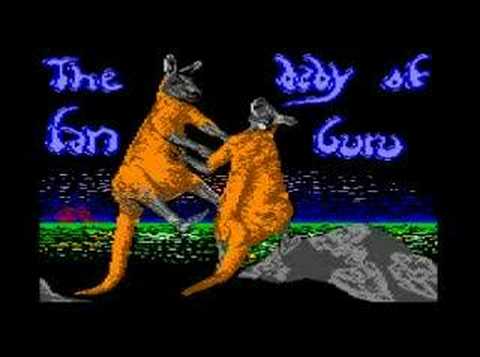
Maybe it’s just Game Over‘s cool box art that makes me think a relevant gaming context matters in the first place. I mean, if you tried to musically capture the title screen of The Baby of Can Guru (Rainbow Arts, 1987) you would probably be fired. So just as he did with The Great Giana Sisters that same year, Chris Hülsbeck said “to hell with this” and wrote whatever pleased him.

I mean, if the significance of what you’re now hearing hasn’t sunk in yet, let me try to clarify:

THIS GAME has a wicked soundtrack.

Anyway, this about wraps up my thoughts on SID music up through 1987. I will leave you with another Martin Galway piece: the Commodore 64 port of Arkanoid (Imagine, 1987), which is really just as absurd as Hülsbeck’s music for The Baby of Can Guru when you consider that the game is nothing more than a Breakout copycat.

http://www.youtube.com/watch?v=1stW0J7Myew

Rob Hubbard and Martin Galway were not the only two people writing music for the Commodore 64–I still know next to nothing about David Whittaker, for instance–but it is consistently their works which strike me as noteworthy in the mid-1980s. Chris Hülsbeck, or Huelsbeck if you prefer, seems to really start to make his presence known in 1987, and the works of Jeroen Tel would soon follow. Tim Follin, the mastermind behind the Bionic Commando port arrangement, would also start to really expand his impact beyond the ZX Spectrum in the late ’80s. ’85-’87 might for many people constitute the real glory days of Commodore 64 music, but there was much greatness still to come.

———————-

Notice: Square Enix have apparently deemed one of my soundtrack reviews a copyright infringement and demanded I remove the offending content (brief audio samples from an out of print ost). I have complied, and I kindly encourage you to boycott all Square Enix products in the future. Since their games are terrible these days anyway I am probably doing you a favor.

VGM Entry 24: Metal Gear and More


VGM Entry 24: Metal Gear and More
(Thanks to Tish at FFShrine for the banner)

Notice: Square Enix have apparently deemed one of my soundtrack reviews a copyright infringement and demanded I remove it. I have complied, and I kindly encourage you to boycott all Square Enix products in the future. Since their games are terrible these days anyway I am probably doing you a favor. (Their complaint involved brief audio samples from only one video game–amusingly out of print today–so I have left my other reviews intact.)

At the same time that RPG/adventure game music was coming into its own on the Nintendo, a lot of solid action soundtracks followed in the wake of Castlevania. Metal Gear (Konami, 1987) kicked off a series that would not really rise to major prominence until 1998, but its history of good scores dates back to the originals.

http://www.youtube.com/watch?v=pyKaAiuwsqM

Metal Gear called for a lot of spy work and sneaking around, and its original soundtrack captured precisely that. Not the music you were expecting to hear? Well, two versions of Metal Gear were released in 1987. The first, released in July, was for the MSX2, and it contained a completely different soundtrack from the NES version that followed it in December. It’s not entirely clear who composed it; Wikipedia lists Iku Mizutani, Shigehiro Takenouchi, and Motoaki Furukawa as the composers for Metal Gear without distinguishing between ports. That’s pretty shady business, as Kazuki Muraoka’s NES score contained a number of original compositions and was much more popular, at least in the western world. Most sites only list Iku Mizutani for the MSX2 and Kazuki Muraoka for the NES, while the only official release of the MSX2 soundtrack simply credits Konami Kukeiha Club.

Well, I watched the actual ending credits of the MSX2 version, and Konami lists it as:

Main Sound Effect:
Iku Mizutani

Sub Sound Effect:
Shigehiro Takenouchi
Motoaki Furukawa

The same bad translation persists on the NES version, where Kazuki Muraoka is responsible for all “Sound Effect”. So that’s enough to sort it out, right? All evidence suggests that Mizutani composed the MSX2 version (with a little help from Takenouchi and Furukawa) and Muraoka composed the NES version.

Of course these indecisive credits always leave room for speculation. Here’s one for you: The PC88 visual novel Snatcher (Konami, 1988) contains an arrangement of the song “Theme of Tara” (1:49). The game offers very thorough credits, and it expressly states that the song was composed by Masanori Adachi and arranged by Masahiro Ikariko and Kazuhiko Uehara. If it’s just an arrangement of the MSX2 original, then… wait a minute…

But Adachi isn’t even credited in Metal Gear. Did Konami perhaps forget who wrote the MSX2 music and credit Adachi by mistake? Here’s the real kicker. Snatcher was ported to the MSX2 shortly after its release, and for the port Iku Mizutani is credited with arranging Masanori Adachi’s composition, which was, if our credits all add up, a copy of Iku Mizutani’s original Metal Gear composition.

http://www.youtube.com/watch?v=-r0lEkwtqQU

Oh well. We are at least pretty sure Kazuki Muraoka wrote the NES one. In the very least he’s the only name appearing in the credits in association with sound. His score was a mix of arrangements from the MSX2 and new songs, and as far as I’m concerned the new material was almost always an improvement. Generally this consisted of replacing the weaker tracks, but Muraoka did take the risk of replacing “Red Alert!” (0:16 in the previous video), perhaps the best song in the MSX2 mix, with a completely new track under the same name (2:03). The decision paid off.

If you would like to hear some comparisons between the original MSX2 compositions and Muraoka’s ports, look for “Mercenary” (4:21 on the MSX2 video, 2:55 on the NES) and “Return of Fox Hounder” (6:52 on the MSX2 and 4:25 on the NES). Unless I overlooked something, the rest of this NES compilation consists of original compositions. The whole Metal Gear sound as established on the MSX2 turned out to be excellently suited for the NES–a system on which speed and catchiness served well to compensate for a lack of much bass or distortion. Even so, my favorite Muraoka addition is a slow one. I have no idea why “Password Entry” (3:37) was put to such petty use. It would have made a fine ending credits theme.

http://www.youtube.com/watch?v=SwiKP7etEnc

Castlevania II: Simon’s Quest (Konami) also made its first appearance in the summer of ’87. By this time Kinuyo Yamashita had moved on to other projects, and Kenichi Matsubara picked up the job. Like Kinuyo Yamashita in the original, it would be his only contribution to the series.

And what a contribution it was. His efforts to maintain stylistic consistency with the first game are commendable, and he did so while writing equally catchy and memorable songs. Obviously his most famous work (and probably the most famous song in the series) is “Bloody Tears”, appearing second in the video. But I was really quite surprised to encounter tracks like “Dwelling of Doom” (2:10), which could just as easily have become series staples had future writers chosen to retain them. Kenichi Matsubara arguably surpassed the original Castlevania with this soundtrack, and it wouldn’t be the last time that the series stood at the forefront of video game music.

In the meantime, Kinuyo Yamashita had by no means fallen by the wayside. Her work on Arumana no Kiseki (Konami, 1987) is really outstanding, taking advantage of the Family Computer Disk System’s enhanced capabilities to produce a very clean, crisp sound. (The FDS was an extension of the Famicom released only in Japan. Its early titles included The Legend of Zelda and Metroid.) I have to imagine the only reason Arumana no Kiseki never got much praise is because fewer people heard it. Konami seem to have gotten around the copywrite challenges of making an Indiana Jones ripoff by simply never releasing the game outside of Japan, although they may have been better off paying up and releasing it. The first licensed series game for the NES, Indiana Jones and the Temple of Doom (Mindscape), released some time in 1987 or 1988, was a gameplay disaster on par with E.T. the Extra-Terrestrial, and its soundtrack is a lame attempt to preserve the original John Williams score.

explod2A03 on youtube provides a nice collection of music from Arumana no Kiseki, available here, along with a number of other forgotten soundtracks from the era.

http://www.youtube.com/watch?v=Ei_YMyN_69Y

Of course we all know what the most important video game music series on the NES was, and Capcom, not Konami, get the credit this time. Known as Rockman in Japan, the original Mega Man was unleashed upon the world in December 1987. Manami Matsumae did not compose for the Mega Man series for long. After scoring Mega Man and contributing to Takashi Tateishi’s work in Mega Man 2, she sort of dropped off the face of the earth, not to resurface in the series again until Mega Man 10‘s massive collaborative effort in 2010. But the legacy she began is one of the finest in gaming history.

Here’s a track list for the compilation, in case you’re interested:
(0:00) Epilogue
(1:40) Stage Select
(1:57) Robot Intro
(2:04) Cutman
(2:52) Fireman
(3:28) Elecman
(4:22) Gutsman
(4:57) Iceman
(6:00) Dr. Wily’s Castle 1
(6:44) Dr. Wily’s Castle 2
(7:20) Robot Battle
(7:49) Dr. Wily Battle
(8:17) Bombman
(9:02) Victory!

Of course the series did not find massive commercial success until Mega Man 2 the following year, but from the beginning it was as intimately tied to its score as the Final Fantasy series. It isn’t nostalgia that leads modern-day rock bands and chiptune artists to cover “Cutman”, “Fireman”, and “Bombman”, just to name a few. It’s because the music is outstanding. I mean, I think the samples speak for themselves. Manami Matsumae established a standard of quality which Capcom would strive to maintain for many years to come. Takashi Tateishi would soon raise the bar higher, but it may well be argued that, without Manami Matsumae’s original concept of what Mega Man music ought to sound like, none of the future improvements would have ever been possible.

VGM Entry 23: Wizards & Warriors


VGM Entry 23: Wizards & Warriors
(Thanks to Tish at FFShrine for the banner)

If we are looking for the best soundtracks in the fantasy genre up through 1987, of what I have heard Koichi Sugiyama, Nobuo Uematsu, and the early team efforts of Yuzo Koshiro and Takahito Abe take the cake in pretty much every category, while the works of Kenneth W. Arnold in Ultima III and Ultima IV for the Apple II remain my personal favorites. But there is probably a lot of great stuff out there which I am missing. There are also some absolutely phenomenal songs that simply lack the context of well-rounded albums.

The works of David Wise in Wizards & Warriors (Acclaim, developed by Rare, 1987) make for an excellent example. The game is not in RPG or adventure format; it is a typical side-scrolling hack and slash with a medieval setting. As such, it calls for slightly more action-oriented songs, and that seems to have been a weak point for Wise at this stage of his career. But perhaps more importantly, he seems to sell himself short, leaving a lot of songs unfinished.

The title screen track is a simply gorgeous classical piano piece which could not help but function in any gaming medium past or present. It is a nice little reminder that the excessive emphasis on orchestration today is not always necessary. And it is not the only excellent song in the game.

“Outside the Castle” is arguably much better. In spite of the track looping after only 17 seconds, it feels as though it could go on forever. The periodically fading wave in the background is such a small touch, but it magnificently transforms an already pretty pleasing tune into something entirely enchanting. It has that sort of time dilation effect which came to characterize later forest-theme songs.

But the brevity of Wise’s compositions quickly begins to cause trouble. “Inside the Tree” could be a wonderful song, full of subtle, tasteful variations on a theme which is neither too safe for a little action nor too aggressive for anything else. But it isn’t. In fact, it’s only six seconds long! Wise, what were you thinking?

And on that note, why is this called “Inside the Tree” anyway? It sounds like it should be the sort of tune that plays inside a castle or library or something, whereas the actual song “Inside the Castle” is a boring mess that should have never been included in the game. I don’t think I’m being picky here–“Outside the Castle” functions well enough, but it definitely has a forest vibe to me, and there is a forest stage, you know. “Invincibility Potion” is actually really pretty, and could have functioned effectively as an end credit theme, or at least the start of one. (It’s only 16 seconds.) Instead, the game has no ending credit music at all. Meanwhile,”Invincibility Potion” is so out of character for any action sequence that I think I’d have been inclined to avoid the item during gameplay just to not ruin the vibe. And the boss music, oh the boss music! It simulates the sort of dread you might associate with learning that your mother-in-law is visiting for the weekend.

Here is “Forest”, or “Forest of Elrond”, depending on which track listing you’re looking at. Entirely inappropriate for the theme of the game and absurdly obnoxious when heard for more than half a minute or so, I think it reiterates my point. This whole soundtrack to me feels like Dave Wise either had zero confidence in his song-writing capabilities or else was given about three days to complete the project and had to submit incomplete tracks and some slapped-together last minute fillers. And yet the songs that pull through, most notably the title screen/end credits and “Outside the Castle”, rank among the best songs on the NES.

http://www.youtube.com/watch?v=0KQkBXjk6w4

The music of Gauntlet (Tengen, 1987) for the Nintendo was composed by Hal Canon. (Atari’s 1985 arcade Gauntlet, on which it is based, contained very little music, and Canon’s work is original.) The theme of Stage 1 is entirely appropriate for the ghoul and goblin-graced dungeon on the load screen. Despite the game being quite distanced from your typical adventure game, the music manages to keep pace and still present a wonderful medieval vibe. I do not wish to say that the album falls short after the first level, because it does remain fairly well written and entirely appropriate to the gameplay, but it abandons any serious attempt to sound classical after that first phenomenal success. The music only continues to work because the game itself isn’t nearly as thematic as the title screen leads us to believe. Hal Canon proves here to be a consistently good composer; he doesn’t quit trying the way Wise seems to have. If only he’d remained consistent in style as well, Gauntlet could have numbered among the best.

VGM Entry 22: Final Fantasy


VGM Entry 22: Final Fantasy
(Thanks to Tish at FFShrine for the banner)

Final Fantasy also lacks much of a kick. Nobuo’s decision to not use any drums might have seemed surprising, had Koichi Sugiyama not done the same thing. Much like Sugiyama, Uematsu was able to craft songs which were memorable and struck a pleasant balance among the available tones. Both artists successfully mastered the positive aspects of the Nintendo’s cleaner tones.

http://www.youtube.com/watch?v=q8_0vY3Nvqk

Final Fantasy doesn’t need much of an introduction. It’s worth noting that it was fairly lengthy for its day, with nineteen full songs. Garudoh did a fine job of capturing all of the best tracks in this collection. The songs which appear here in order are:

(0:00) Prelude
(0:49) Final Fantasy Main Theme
(1:40) Overworld Theme
(2:17) Battle Theme
(3:08) Undersea Shrine
(3:46) Sailing
(4:33) Airship
(5:04) Gurgu Volcano
(5:49) Matoya’s Cave
(6:30) Temple of Chaos
(7:08) Funeral
(7:57) Victory!

I think it would be easy to be a little critical of Nobuo Uematsu’s work, considering how much better his later soundtracks became. One can easily point to later improvements in “Main Theme”, for instance, to say that the original was a little bland. But if you turn to tracks that were not improved upon in future games, “Gurgu Volcano” for example, you can tell that the originals were valuable in their own right. Where Zelda II felt to me like a prototype for a desired sound which the Nintendo was unable to produce, Final Fantasy feels like a finished project.

You will also probably get the distinct impression that Uematsu was inspired by Sugiyama. At least, I did, but this may simply be a consequence of the decision on the part of both musicians to not use a drum track. Uematsu actually had a slightly longer history of writing game music. Koichi Sugiyama started this career late in life, composing his first two game scores, Dragon Quest and Wingman 2, in 1986 at the age of 55. Uematsu’s first soundtrack, a DOS game called Genesis, came out in 1985. The difference is slight, but by the end of ’87 Sugiyama had only one more composition on the books–Dragon Quest II. In that same span of time Uematsu managed to accumulate a staggering repertoire of thirteen.

http://www.youtube.com/watch?v=0VlFoVoqYQ8

I couldn’t find samples from either artist’s first soundtrack, but if you listen to King’s Knight, a Square game composed by Uematsu and released for the MSX in 1986, you can tell that Final Fantasy was no epiphany. It might have been his first recognized and highly acclaimed work, but it was not his first good one.

Uematsu and Sugiyama were acquainted at an early stage though. In an interview on nobuouematsu.com, he states that “Koichi Sugiyama is a big boss of game music. I think he was the first person to really pay attention to my works.” Whether this came before or shortly after the release of Final Fantasy, the two were certainly aware of each other’s work.

My best guess is Sugiyama did influence Final Fantasy, but not in regards to song-writing. That talent came naturally to both of them. Rather, I get the feeling Uematsu may have taken some tips from Dragon Quest on how to effectively arrange these types of songs for the NES medium. I suppose if you got an opportunity to interview Uematsu it would be a petty question to ask, but I’m curious all the same.

http://www.youtube.com/watch?v=USfEmMXFD1k

Perhaps Nobuo Uematsu is still guilty in some capacity of letting the NES sound limitations get the better of him. The sort of stuff he made his career writing worked just fine in King’s Knight, but the NES just didn’t have the capacity to take it all in. Some of the best NES artists dealt with these limitations by allowing the system to dictate the musical style; they approached the NES as an instrument rather than a medium through which to present music existing independently of it. I suppose I’ve said that a lot at this point. Perhaps MSX2 version of Final Fantasy will make it a little more clear. Micro Cabin released the port in 1989, with their sound programmer Tadahiro Nitta handling the new arrangement, not Uematsu himself. Nevertheless, it sounds a lot better than the original in my opinion, and I think it might be a more honest interpritation of the music than Uematsu’s own finished product. If Uematsu had been composing for the MSX in the first place, his music would have made a lot more sense. But the counter argument is fairly obvious; if he hadn’t composed Final Fantasy for the NES the way he did, this MSX version would have never existed.

VGM Entry 21: Zelda II and Metroid


VGM Entry 21: Zelda II and Metroid
(Thanks to Tish at FFShrine for the banner)

You’re going to see Zelda II: The Adventure of Link (Nintendo, 1987) on a lot of “best of the NES” soundtrack lists. I considered skipping over it, since I’m not a big fan myself, but I suppose a famous score ought to be addressed whether I care for it or not.

http://www.youtube.com/watch?v=EAaBxdJtmwY

Zelda II brought a completely new soundtrack to the table, sharing nothing in common with the original Legend of Zelda save a passing nod at the beginning of “Hyrule Overworld”. (The track list on this compilation is “The Adventure of Link” (0:00), “Hyrule Overworld” (1:22), “Danger” (2:17), “Village Theme 1” (2:53), “Village Theme 2” (4:07), “Palace” (4:27), and “Ending” (5:57), if you’re curious.) This departure is not a surprise in itself; Nintendo oddly chose to give Akito Nakatsuka rather than Koji Kondo the job, so we’re dealing with a different composer here. Zelda II was also a much more extensive soundtrack than the original, featuring 13 full-length songs if I’m counting correctly.

There is no obvious reason to dislike the soundtrack. “Hyrule Overworld” is catchy, no doubt, and “Palace” is a particularly noteworthy song. Zelda II has a few gems, and more thought went into it than many contemporary video game soundtracks out there. But is it really anything special? The simple fact that it wasn’t bad might have stood for something a few years prior, but by 1987 I expect a bit more. Most of Akito Nakatsuka’s compositions are pretty simplistic, not all that memorable, blandly arranged, and generally fail to capitalize on any of the system’s unique potential. I am rather inclined to believe the music was popular merely due to its having the name “Zelda” attached to it.

http://www.youtube.com/watch?v=pZnQT97A2kk

Another game which receives, I think, a little more praise than it deserves is Metroid (Nintendo, 1986). My complaint here is not nearly so well founded, especially considering it was, I’ll admit, a great soundtrack, and Hirokazu Tanaka, unlike Akita Nakatsuka, had a long and meritorious career in the video game music industry. (Nakatsuka’s only other claim to fame to the best of my knowledge is Excitebike (Nintendo, 1984).)

But Metroid and Zelda II are remembered in different degrees. If Zelda II makes all the lists, Metroid always seems to top them. The problem here can be seen in which tracks are well remembered. “Brinstar” (1:40) is probably the most famous song in the game, followed by the title theme (0:00). But “Brinstar”, much like “Escape” (4:09) and “Victorious” (5:18) in this video, are pretty standard fair. Catchy songs, better than most; I’ll grant them that. The best on the NES? Well, they’re at least worth considering as candidates. But if these are the songs Metroid is best remembered for, something went wrong here. What you hear at the beginning of the intro, as well as in “Norfair” (2:34) and “Kraid’s Lair” (3:17), is a bit more indicative of what I think Tanaka was aiming for, and the brief “Bridge” (7:33) at the end of this video is probably the most revealing track.

Tanaka was trying to bring the world of Metroid alive through music. He wasn’t just writing background pieces; he was integrating music into the gameplay environment, and that was no easy task on the Nintendo. To quote an interview with Hirokazu Tanaka conducted by Alex Brandon and published in 2002:

“…sound designers in many studios started to compete with each other by creating upbeat melodies for game music. The pop-like, lilting tunes were everywhere. The industry was delighted, but on the contrary, I wasn’t happy with the trend, because those melodies weren’t necessarily matched with the tastes and atmospheres that the games originally had. The sound design for Metroid was, therefore, intended to be the antithesis for that trend. I had a concept that the music for Metroid should be created not as game music, but as music the players feel as if they were encountering a living creature. I wanted to create the sound without any distinctions between music and sound effects.”

The introduction and “Bridge” pull this off wonderfully, and “Norfair” and “Kraid’s Lair” suit the vision admirably as well, but the majority of the more popular tracks from Metroid are nevertheless Tanaka’s poppier pieces. I wish I could write this off as fan failure to appreciate, but the truth is the other more obscure tracks, “Tourian” and “Mother Brain”, are excluded from garudoh’s compilation for a reason. They missed the mark, and they just weren’t all that good. Don’t get me wrong; I’m not suggesting Metroid was anything short of a great soundtrack, but it was nevertheless a little short of what it strove to be, and many of its redeeming qualities rest in the residual traces of precisely what Tanaka was trying to weed out.

Metroid deserves an honorable mention on any list of NES soundtrack greats, but it’s not top ten material. I think it has too many faults for that, and Tanaka himself would contribute to a better NES score on Mother a few years later anyway.

VGM Entry 20: The Great Giana Sisters


VGM Entry 20: The Great Giana Sisters
(Thanks to Tish at FFShrine for the banner)

A number of video games released in 1987 would go on to become major generation-spanning series. The Great Giana Sisters was not one of them. In fact, if was probably one of the worst ideas in gaming history. It was apparently developed for release on the Amiga, Amstrad CPC, Atari ST, Commodore 64, and MSX2 all at the same time, with a ZX Spectrum version to shortly follow. It was intended to be Rainbow Arts’ major commercial rival to the smash hit Super Mario Bros. But what was it exactly?

Well, one version of the box art depicts an attractive, perky-breasted woman in a miniskirt flying through a bizarre montage of giant lobsters, magical mushrooms, UFOs, and deadly dragons guarding foreboding castles on grim, icy mountain peaks.

Another depicts two trailer trash meth addicts sporting peace signs and an “I’m Cool” nametag, along with the suggestive comment that “The brothers are history!” A bit contradictory? Well, look right here! Zzap!64 says it’s “the greatest platform game of all time”, so it must be true!

The music, too, might lead you to believe this. It was also one of the first soundtracks composed by the now legendary Chris Huelsbeck (more often spelled Hülsbeck, though the artist himself uses Anglicized adaptation. For the sake of consistency I’ll stick to the latter in the future). The game’s title screen theme is pretty intriguing, bearing a sense of foreboding that aptly reflects the degree of strife and diversity which at least some versions of the cover art promise to bring.

Are you excited? Or at least curious? Good or bad, all signs point to a game that will in the very least be extraordinarily unique. Well, let’s take a look at the gameplay. Brace yourselves.

Needless to say, they got their pants sued off and pulled every version of the game from the shelves within weeks of its release, never again to see the light of day until Nintendo, perhaps for pure comedy value, allowed publisher Destineer to release it on the DS last year.

Rainbow Arts was a German publisher, and perhaps copyright laws are different there, but one has to imagine that a good many staff members were flipping burgers after this brilliant idea. Chris Hülsbeck would not be among them. He would go on to compose for many Rainbow Arts games to come, including the highly acclaimed Turrican series for which he is best known.

But before we brush The Great Giana Sisters off, really, what is going on with the music here? The main gameplay song is quite catchy and appropriate, but the title screen and underground theme (see Stage 4 in the video, 3:24) have about as much in common with the game as the box art. It would be interesting to find out why he chose these songs in particular. Perhaps they were some unaffiliated demos he had lying around in a dusty desk drawer, or perhaps he took advantage of a terrible game to write what he wanted to with no concern for relativity.

Whatever the case, the staff at Rainbow Arts heard his work even if no consumers did, and his future game assignments seem to reflect his personal style, not the reverse. The title theme and Stage 4 of The Great Giana Sisters examplify precisely the sound he would become famous for.

VGM Entry 19: Ys I


VGM Entry 19: Ys I
(Thanks to Tish at FFShrine for the banner)

Yuzo Koshiro’s first major breakthrough is generally considered to be Ys I: Ancient Ys Vanished (Nihon Falcom, 1987), sometimes alternatively subtitled as The Vanished Omens or The Ancient Land of Ys. While I don’t think it is quite musically on par with Xanadu Scenario II, it is certainly a commendable work. arx7893 on youtube has assembled a very nice collection of songs from various versions of the game. I especially recommend you check out the song “Palace”.

My intention here is to focus specifically on the music for the last boss, known as “Dark Fact” or simply “Final Battle”. It is one of the best examples you will presently find for multi-system song porting, both because Ys I: Ancient Ys Vanished was released on a staggering number of platforms and because the song is good enough for most versions to have found their way onto youtube.

This is the initial song. The game was originally developed for the PC-8801, but Yuzo Koshiro was surely aware that it would need to be quickly adapted to other platforms. This first release came on June 21, 1987, and the ports rapidly followed: to the X1 on June 26th, the PC-9801 on August 28th, the FM-7, 77, and 77AV on October 8th, the MSX2 on December 10th, the Famicom on August 26th, 1988, the Sega Mark III on October 15, 1988, the Sega Master System some time in 1988, MS-DOS, the Apple IIGS, and the PC Engine CD-ROM in 1989, the TurboGrafx-CD in 1990, the Sharp X68000 in 1991, and finally the TurboDuo in 1992. Did I mention the list was staggering? It is also available for Microsoft Windows, the Sega Saturn, the Playstation 2, the Nintendo DS, and the Wii now.

Aaanyway, what makes “Dark Fact” a little peculiar is that whoever all arranged it could not seem to agree on what constituted its main melody. In the original PC-8801 version above you have a faint, clean tone playing a simple melody over a deeper, more distorted and complex one. Throw in some basic bass and drums, occasionally accent it with a fifth track, and there’s your song.

The next readily available version is for the FM-7, released a little over three months later. You’ll notice that the original soft lead, previously overshadowed, is now completely gone, while the song’s deeper side is nearly identical. They distorted the principle bass track and made it a lot louder, but that’s about it. Half way through, the song transitions to a completely new melody which successfully outshines the bit they got rid of. From here it repeats.

Then came the MSX2 version, about another two months later. Clearly limited in sound channels, Yuzo Koshiro and crew set aside both of the humbler melodies they had toyed with earlier and elevated that deeper, distorted progression to center stage. The song does not quite function in a live playthrough, what with every other bass note cutting out, but its general idea is quite appealing. It feels like the sort of thing you might expect from a really stellar Game Boy soundtrack, and in a peculiar sort of way I find it more appealing than the previous two examples.

The Famicom port the following year built upon the same approach. Aside from adding drums to the mix, it tweaked the bass a bit to create a sound more suited for the system. Those rare moments where the bass line manages to not cut out in the MSX2 version video, mainly at the very start of the fight, you can really tell how beautifully the two tones compliment each other. The two tracks play fairly equal roles in creating what feels like a single solid sound. But Famicom tones were always a little soft, and the sound team made amends by having the bass line here function more as an appendage to the percussion. The bass note changes as seldom as possible, remaining stagnant where the MSX2 version does not. Rather than complimenting the melody to the fullest, it emphasizes the breakneck pace of the song, creating a much more intense feel to the whole fight.

The MSX2 version is a much more aesthetically pleasing stand-alone track–probably my favorite among the lot of them–but it doesn’t really enhance the fight much, especially considering it pushes too far beyond the system’s limitations for the player to effectively experience it and kill the boss simultaneously. On the Famicom it almost feels as if they acknowledged this and focused on an arrangement that, while fairly similar, makes a bit of a self-sacrifice for the sake of enhancing the actual gameplay experience.

When the game finally made it to the Sega Master System, that soft melody present on the original PC-8801 take and long since forgotten mysteriously resurfaced. The arrangement is bland, lacking any of the contrast of the original, and the obnoxiously bad drums really nullify any redeeming values it may have otherwise had. But the return is an interesting decision. I wonder, whose decision was it?

It is nearly impossible to tell where Yuzo Koshiro’s involvement ends and that of various other staff members begins. The PC-8801, FM-7, MSX2, and Famicom versions certainly sound to me like a careful progression through improvement and system adaptation. I am convinced if nothing else that whoever arranged each of them listened to the previous versions and not just the original.

The SMS approach gives me no such impression. It sounds like the arrangement took the original PC-8801 cut and hastily slapped together a replica with no attention to detail. It is completely devoid of the sophistication present in all four earlier arrangements I have been able to find. The end-game credits list Bo (Tokuhiko Uwabo), Ippo (Izuho Numata), and Neko (still anonymous today) as the sound team, and make no mention of Yuzo Koshiro. The game also features a number of original tracks.

If I may go out of sequence for a moment, it’s worth noting that the Sharp X68000 version, released in 1991, is even worse. It completely abandons the complex and compelling melody which the MSX2 and Famicom versions embraced exclusively, providing nothing more than that boring PC-8801 ‘soft’ melody track and a gimmick “rock and roll” drum beat and guitar rhythm. The drums are less annoying than in the SMS version only because better technology carries them, and they have no greater value. And in consideration of the technology, the wholesale abandonment of the more complex melody is simply inexcusable.

But an interesting point can still be made here. If all you had to go on were the MSX2 and the Sharp X68000 versions, you would likely conclude that they were two entirely unrelated compositions. Yet both clearly and distinctly derive from the original.

I will leave you with the 1989 PC Engine CD-ROM arrangement of “Final Battle”/”Dark Fact”, because almost all future ports and remakes of the game (the Sharp X68000 version excluded) derive from it, not the original.

Based on various liner notes and some samples of his other works, I am pretty positive this was arranged by Ryo Yonemitsu. Unlike the “port arrangements”, which focused on direct improvements to the original, system limitations, or otherwise mere expedience, the PC Engine CD-ROM approach is more of an authentic reinterpretation of the music. It pays ample homage to Yuzo Koshiro, but it doesn’t feel confined by any obligations or limitations. It is faithful and unique at the same time. While I am certainly not blown away, I respect what Ryo Yonemitsu is doing here.

Ryo Yonemitsu, by the way, has quite a history with the Ys soundtrack, having released arrangements of it as early as 1987. Was he the guiding light who ensured so many excellent port arrangements of the final battle theme? Was it Yuzo Koshiro himself? Or was it perhaps a chance occurrence–the consequence of various talented artists recognizing the song’s worth and having a go at it?