30 More Days of Noir #8: Accomplice (dir by Walter Colmes)


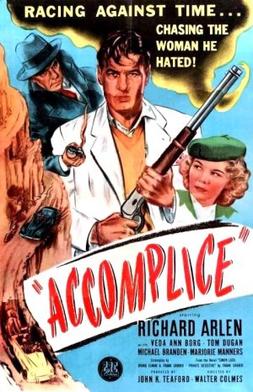
The 1946 film noir, Accomplice, tells the story of Simon Lash (Richard Arlen).

Now, I guess if you have a name like Simon Lash, you’re pretty much destined to become a private detective.  In this case, Lash is both a detective and an attorney.  I did some research — which is a fancy way of saying that I checked with Wikipedia — and what I discovered is that there was apparently quite a few stories written about Simon Lash.  He was a pulp hero created by Frank Gruber.  Gruber went on to write the screenplay for Accomplice, which was based on the novel Simon Lash, Private Investigator.  I don’t know if this was the only Simon Lash film or not.  If there were more Simon Lash films, let’s hope they found a more interesting actor than Richard Arlen to play him.

Yes, indeed, Richard Arlen makes for a rather dull hero in Accomplice.  Physically, he seems like he’s right for the role.  You look at Richard Arlen and you can imagine him beating someone up.  But, in this film at least, he has a boring screen presence that makes it difficult to really get invested in Simon as a character.  He doesn’t have the wounded cynicism of Humphrey Bogart or the killer eyes of Alan Ladd.  He’s just kind of there.

Simon Lash is hired by his ex-fiancée, Joyce (Veda Ann Borg), to track down here husband.  Joyce claims that her husband is president of a huge bank and that he’s suffering from amnesia.  Simon doesn’t quite trust Joyce and he worries that she’s actually using him to dig up dirt for a divorce.  Simon doesn’t work divorce cases.  Apparently, it’s a matter of honor for him.  Not surprisingly, it does turn out that Joyce hasn’t been totally honest with Simon.  Of course, it also turns out that Joyce’s husband has some secrets and tricks of his own.

Indeed, it’s a very complex story, which is something I appreciated.  I always love all the twists and turns of a typical California noir and this one had several.  It all eventually led to a shoot out at a castle in the desert and again, that’s exactly what you want a film like this to lead to.  Accomplice is only 66 minutes long and, as such, it never drags and the double and triple-crosses all come quickly.  That’s definitely a good thing.

Unfortunately, despite all of that, the film itself falls flat.  The main problem is one that I already pointed out.  Richard Arlen is just not a very compelling hero.  While Veda Ann Borg has the right look to play a femme fatale, she still has a strangely bland screen presence in this film.  It’s easy to imagine her trying to fool someone but it’s next to impossible to believe that she could actually do it.  She’s just a bit too boring for the role.  With different actors in the lead roles, Accomplice could have been a classic low-budget noir.  (Seriously, just imagine the film if it had reunited Detour’s Tom Neal and Anna Savage as Simon and Joyce.)  As it is, Accomplice is a bit of a disappointment.  The possibilities are more fun than the execution.
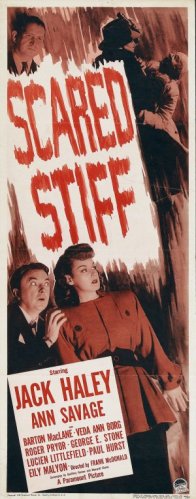
The Fabulous Forties #13: Scared Stiff (dir by Frank McDonald)


Poster_of_the_movie_Scared_Stiff

Last night, as a gentle rain fell outside, I watched the 13th film in Mill Creek’s Fabulous Forties box set, 1945’s Scared Stiff.  (The version in the box set appeared under the title Treasure of Fear, which was what the title was changed to when the film was later re-released.  However, the film was originally entitled Scared Stiff and that’s the title that I’m going to use.  Scared Stiff is just a better title and I happen to like the Scared Stiff film poster, featured above.  So, just remember that if you ever find yourself watching an old movie called Treasure of Fear, you’re actually watching Scared Stiff.)

As I attempted to watch Scared Stiff, I was reminded of some of the problems that occasionally come with watching a film that has slipped into the public domain.

On the one hand, the public domain is great because it makes it a lot easier to watch old movies.  And while it’s true that many public domain films aren’t exactly classics, there are a few gems to be found.  For instance, since I started watching the movies in the Fabulous Forties box set, I’ve discovered The Black Book, Trapped, and Jungle Book.

On the other hand, being in the public domain means that virtually anyone can duplicate and sell a copy of the film.  As a result, many of these films are available (and frequently viewed) in versions that are of an extremely poor quality and which have often been haphazardly edited.

That’s one reason why it’s going to be difficult for me to review Scared Stiff.  The version that I saw was, even for a public domain B-movie, rough.  The picture was slightly fuzzy and the sound quality was not the greatest.  I don’t think you can ever truly understand that importance of a clean soundtrack until you listen to a scratchy one.

As for Scared Stiff itself, it’s a comedic murder mystery and thankfully, it’s only 65 minutes long.  Jack Haley plays a reporter who covers chess tournaments for his uncle’s newspaper.  Unfortunately, Haley’s not a very good reporter so his frustrated uncle orders him to go to Grape City so that he can cover a beauty contest, apparently believing that there’s no way that Haley could possibly screw that up.

However, Haley manages to do just that.  He gets off the bus at Grape Center, instead of Grape City.  He finds himself stranded at an inn that’s run by two twins (both played by Lucien Littlefield).  The twins hate each other for reasons that aren’t clear.  However, they do possess a chess set that was once owned by Marco Polo!  One twin owns the white pieces while the other owns the black pieces!  Haley wants to buy all the pieces but things get complicated when it turns out that a gang of thieves are also in town and they want to steal the set for themselves.

But that’s not at all!  One of the passengers on the bus is found murdered and he has a chess piece in his hand.  Of course, everyone suspects Haley.  So, Haley has to get the chess pieces, clear his name, and hopefully get to Grape City before his uncle fires him.

Scared Stiff is way too frantic for its own good and I have a feeling that I would feel the same even if I had seen a version that didn’t sound scratchy or often look fuzzy.  That said, it is interesting to see Jack Haley, who is best known for being The Tin Man in The Wizard of Oz, play a human being.  Also of interest, to film noir fans, was that Haley’s girlfriend was played by Detour‘s Ann Savage.  Both Haley and Savage gave good performances but it was not enough to save this misbegotten little film.

The Daily Grindhouse: Revenge of the Zombies (dir by Steve Sekely)


revengeofzombies36

Last night, the Late Night Movie Crew and I watched the 1943 film, Revenge of the Zombies.

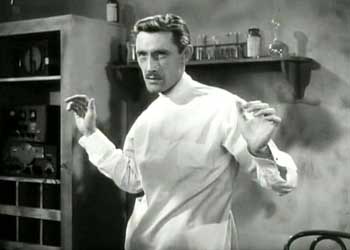
Revenge of the Zombies deals with the mysterious Dr. von Aldermann (John Carradine), who has a house on the Louisiana bayous and who is involved in weird, 1940s-style scientific experiments.  As is evident from his name (but not particularly from Carradine’s disinterested performance), von Aldermann is from Germany and his experiments are designed to create an army of zombies who will destroy American from within for the benefit for the Third Reich.  This is a pretty big deal and von Aldermann isn’t particularly subtle about his schemes but, as the film’s begins, nobody has figured out what’s going on.

I guess you can get away with anything on the bayous.

Von Aldermann’s wife Lila (Veda Ann Borg) has recently died but, thanks to the mad scientist, she’s still walking around Louisiana and leading an army of zombies.  Lila’s brother (Robert Lowery) shows up with a private investigator (Mauritz Hugo) and yet another mad scientist (Barry Macollum)  and they eventually figure out that something weird is happening.  With the help of von Aldermann’s secretary (Gale Storm), they try to thwart von Aldermann’s plans and keep the world safe for democracy.

There are a few good points about Revenge of the Zombies.  For one thing, the film is only 61 minutes long so the suffering is short.  As with any low-budget John Carradine horror film, Revenge of the Zombies is fun to watch with a group of snarky friends.  Historically, this film is significant for being one of the first zombie movies.  It’s always interesting to see how non-threatening zombies were in the days before George Romero and The Walking Dead.

revengeofzombies25

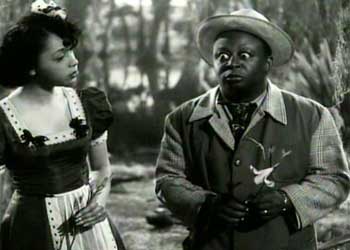
And then there’s the character of Jeff (Mantan Moreland), who is a chauffeur and who provides most of the film’s comic relief. It’s always difficult for contemporary audiences to deal with the racial attitudes displayed in the films and literature of the past.  On the one hand, Jeff is written as a complete and total stereotype and, as you listen to his dialogue, you’re painfully aware of the fact that the goal was to get audiences to laugh at him as opposed to with him.  On the other hand, Moreland is literally the only actor in the film who actually gives a good performance.  Even when delivering the most cringe-worthy of dialogue, Moreland does so with a conviction and commitment that holds your interest.  As you watch Revenge of the Zombies, you really don’t care what happens to most of the bland and interchangeable characters.  But you really do want Jeff to survive.

And, ultimately, you do take some comfort in that.  Moreland was given a role that, as written, was very demeaning but, in the end, Jeff is the only character that you care about.

As for the rest of Revenge of the Zombies, it’s short, it’s pretty bad but it’s not terrible, and you can watch it below!

http://www.youtube.com/watch?v=AOBM9kxpkoU

Shattered Politics #13: The Fearmakers (dir by Jacques Tourneur)


The_Fearmakers_film_poster

Did you know that 75% of people are sick of hearing the results of polls about what people think about other polls?  It’s true!

Me, I first got sick of polls back in 2012.  That was when, every day, everyone on twitter would be talking about the result of another political poll.  A poll would come out showing that Obama was ahead of Romney in the presidential election and all of my Republican friends would immediately start tweeting about why the poll could not be taken seriously.  Then 2014 came along and polls started to show that the majority of American citizens did not approve of the job Obama was doing.  And all of my Democrat friends would immediately start tweeting about why those polls could not be trusted.

As for me, I was always more concerned with what the polls said over on Rotten Tomatoes.  Really?I would think.  Only 35% of critics gave California Scheming a good review?  67% of moviegoers want to see the new Transformers film?

Oh my God, I thought, those numbers have to be so fake…

Because, let’s face it.  The only time that we believe a poll is when we agree with it.  Otherwise, we assume that they’re either the result of subtle manipulation, selective interpretation, or just completely and totally untrue.

Believe it or not, this suspicion is not a new phenomena.  I’ve always felt that you can learn a lot about history by watching the movies.  That doesn’t mean that movies are historically accurate.  One need only read my review of Magnificent Doll to see that.  However, movies do reflect the culture and concerns of the time in which they were made.

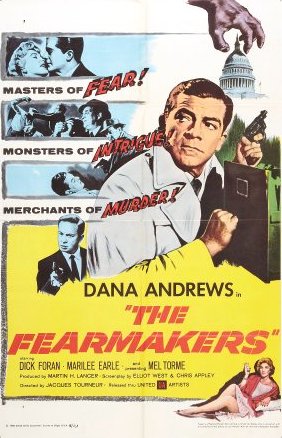
For instance, The Fearmakers was made in 1958 and it shows that not only has polling been around for a while but so has the fear of being manipulated by a fraudulent poll.

In The Fearmakers, Dana Andrews plays Alan Eaton.  Before the start of the Korean War, Alan owned one of the best and most respected polling firms in Washington D.C.  However, while serving in the army during the war, Alan was captured and held prisoner by the Chinese.  After years of being tortured and perhaps brainwashed, Alan is finally released.

He returns to an America that is far different from the country that he left.  For instance, while on a flight to Washington, D.C., he finds himself sitting next to a shifty scientist (Oliver Blake) who tries to convince Alan to support a group that believes in nuclear disarmament.  Even worse, once the plane lands, Alan discovers that he’s been forced out of his polling firm and that his partner has died under mysterious circumstances.

The firm’s new owner, the outwardly friendly, inwardly cold-hearted Jim McGinnis (Dick Foran), offers to hire Alan as a special consultant.  Alan is at first resistant but then he has a meeting with his old friend, Senator Walder (Roy Gordon).  Walder explains that he suspects that Alan’s old polling firm has been infiltrated by outside forces and that it might be using its polling to try to push communist propaganda on the American people.  Alan agrees to work for Jim and to help track down any and all subversives….

The Fearmakers is better than it sounds.  Beyond the fact that the story remains relevant in our poll-driven times, it was directed by Jacques Tourneur, who directed several atmospheric and intelligent horror films in the 30s and 40s.  He brings a similar atmosphere of doom to The Fearmakers.  Perhaps the film’s best scenes are the ones where Tourneur just focuses his camera on Andrews’s face while Alan struggles to understand the country to which he has returned.  As played by Andrews, Alan is troubled and hardly your typical hero.  You’re never quite sure how much of the film’s danger is real and how much of it is just the result of Alan’s own paranoia.

I first saw The Fearmakers on Netflix.  The next time you’ve got 84 minutes to kill, check it out.

A Quickie With Lisa Marie: Big Jim McLain (dir by Edward Ludwig)


During my sophomore year of college, I was acquainted with a bearded sociology major who would tell anyone that he met that he was a communist.  He also insisted that he was a revolutionary in the tradition of Che Guevara though, for the most part, he never seemed to do much more than hang out in the lobby of Bruce Hall and yell at the top of his lungs.   When he wasn’t attacking George W. Bush and Dick Cheney, he was busy quoting Karl Marx and telling people about how communism would fix all of America’s problems.  He would also get very upset if you called him a socialist.  “No,” he would say, “I’m a communist and I’m proud of it!”

I have to admit that I usually went out of my way to avoid him and I would cringe whenever I would hear him shouting my name and inviting me to come sit down next to him so he could attempt to give me my daily indoctrination while he stared at my breasts.  I could never summon up much enthusiasm for his ideology or his idolization of Hugo Chavez.  It all sounded rather dreary and boring to me.

I recently found myself thinking about those days in Bruce Hall lobby after I watched the 1952 anti-communist melodrama, Big Jim McLain.

Produced by and starring John Wayne, Big Jim McLain was made at the height of the red scare.  Produced in full cooperation with the infamous House Un-American Activities Committee, Big Jim McLain was meant to be an answer to all those weak-willed liberal types who claimed that the committee was going too far in its hunt for communist subversives.

Big Jim McLain starts out with a thunderstorm.  While stock footage of lightning illuminates the screen, a medley of patriotic songs play on the soundtrack and a somber-voiced narrator quotes The Devil Vs. Daniel Webster.  

Suddenly, the scene changes.  We’re in Washington D.C. and we’re watching a meeting of the House Un-American Activities Committee.  A shifty little man with a beard is being interrogated by the members of the committee.  They ask him if he’s ever been a communist.  He takes the fifth amendment.  He’s asked if he would ever take up arms against the United States.  Again, he pleads the fifth.

The camera pans back to reveal two remarkably tall men listening to the man’s testimony.  They both share the same look of disgust, a look that leaves no doubt how they feel about this sleazy little subversive and his constitutional rights.  They are Big Jim McLain (John Wayne) and his partner, Mal Baxter (James Arness) and they fight communists.

Suddenly, we hear the familiar sound of John Wayne’s determined drawl on the soundtrack and we realize that Big Jim McLain was using multiple voice-overs long before Terrence Malick even made his first film.

Wayne, speaking in character as Big Jim, explains that he and Mal have spent the last few months proving that the witness is a communist.  And now, they have no choice but to watch as he hides behind the constitution.  We’re told that this communist will be able to return to his position of teaching economics at an unnamed “north eastern college.”

That opening scene pretty much tells you everything that you need to know about the ideological outlook of Big Jim McLain.  The government is looking out for our best interests, outsiders are dangerous, and good men know the importance of following orders.

HUAC sends Big Jim and Mal to “the territory of Hawaii,” where they hand out a lot of subpoenas, conduct a smattering of illegal wiretaps, and try to figure out who is actually in charge of the local communist party.  Along the way, Big Jim meets and romances a naive secretary named Nancy (played by Nancy Olson).  Nancy just happens to work for a communist doctor but we know that she’s okay because she’s the widow of a serviceman.

Big Jim McLain is a real curiosity piece, a true product of its time.  Perhaps not surprisingly, the film really does feel like a time capsule.  Full of simplistic characters and nonstop speech-making from John Wayne, it’s easy to laugh at and dismiss a film like this.

Then again, the main idea behind Big Jim McLain seems to be that the government is justified in doing anything to fight its enemies and that anyone who openly questions or disagrees our leaders most be either evil or mentally incompetent.  Just how much has our culture changed since then?  How different is anti-communist crusader Big Jim McLain from those who today continually assure us that we have nothing to fear from the NSA?  One gets the feeling that if this film were made today, Big Jim would be hunting down Edward Snowden and directing drone strikes against America’s enemies.

Perhaps for obvious reasons, Big Jim McLain is a fairly obscure film.   I first found out about it from reading J. Hoberman’s Army of Phantoms.  Oddly enough, within a day or two of my reading about it, Big Jim McLain turned up on TCM.  It’s not a very good film but, in the best exploitation tradition, it is a document of its time and therefore, worth seeing as a piece of history.

As for the communist of Bruce Hall, he ended up dropping out at the end of the semester and, apparently, he later turned up in New York doing the whole Occupy Wall Street thing.  I’ve been told that he was recently spotted in Austin, still wearing his Che Guevara t-shirt.

One thing’s for sure.

Big Jim McLain would have taken him out with one solidly placed right hook.