[Some Spoilers Within]
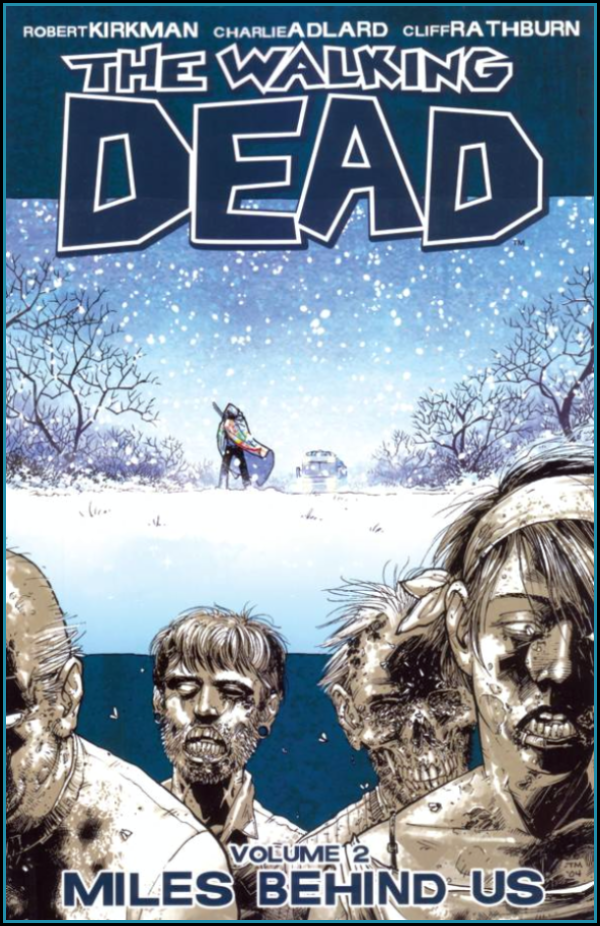
Robert Kirkman’s The Walking Dead Vol.2 – Miles Behind Us puts together issues 7 through 12 into one collection. The first six issues introduce the reader to the main character of Rick Grimes and his discovery of a world turned upside-down and inside-out as the legions of undead walk and prowl the streets, fields and by-ways. The rest of that first volume reunites Rick with his wife and son and a ragtag bunch of other survivors just looking for a safe place to stay. I loved how Kirkman used the backdrop on a world of the undead to tell a story of survival and how extreme situations can have surprising and lasting effects on those left behind.
In Miles Behind Us, Robert Kirkman’s story has a new artist in Charlie Adlard. Adlard’s style has a different look to that of previous artist Tony Moore. Where Moore’s pages and panels had a smoother and more cinematic feel to them, Adlard’s rougher, sketchy style actually fits the mood and feel of the story Kirkman is writing. I love Moore’s work and the gory detail he put in the first issues, but Adlard’s just seems to resonate a bit more with the subject matter of survival and doing what it takes to survive. There’s certain scenes in Miles Behind Us where its hard to tell the difference between the survivors and the zombies. I like this technique in how it shows that the zombies and the survivors may have alot more in common after all in relation to the title of the story.
Kirkman introduces in this volume quite a bit of new characters to the group Rick is leading as they leave the campground at the outskirts of Atlanta. They’ve lost three of their numbers in the previous volume. Two of them to the predations of the undead who stumbled into their campground and another to the stress and jealousy that weighed on the mind of one of their own.
Miles Behind Us brings in two groups of survivors. One is a father, his daughter and the girl’s boyfriend. Tyrese is an interesting character right from the get-go and hints of problems with the daughter and boyfriend are gradually doled out to help bring in new conflicts to the group dynamic. The other group is a farmer and his children and some neighbors from down the road. The introduction of Herschel and his family helps in showing how not everyone reacted the same way to the undead crisis. To say that Herschel’s reaction and temporary solution to how to handle the undead crisis was a bad idea all-around was an understatement. Hershel’s actions helps lead to the biggest sequence event in this volume and how far-reaching its ramifications are. While new characters are introduced some of the people in Rick’s group fall by the wayside as their search for a safe place to stay in becomes more and more dangerous and people are lost and/or nearly lost along the way.
I agree with the assertion that The Walking Dead is really not all about the zombies and the gore (it helps that it has them in abundance), but that its about the effects of extreme events and situations on the personality, psyche and behavior of those left behind trying to survive. From the Dale (the oldest) all the way down to Carl (one of the youngest), the survivors are affected right down to their bones with all that has happened to them. Sometimes the result makes each individual stronger and at times it just leads to conflicts and brings out the baser nature of man as an individual.
Miles Behind Us continued to impress me in how well Kirkman has taken the zombie apocalypse theme and ran with it. It’s a testament to his storytelling and imagination that I consider The Walking Dead series as equal to anything Romero has done. I think from fans of zombie and apocalyptic stories that’s high praise indeed.
 Through the Shattered Lens