Some shows require a bit of patience on the part of the viewer and that’s certainly the case with The Serpent, an uneven but ultimately rewarding 8-episode British miniseries that can currently be viewed on Netflix.
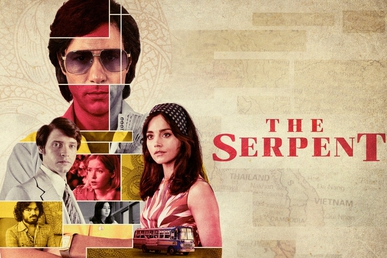
The Serpent tells the true story of Charles Sobhraj (played by Tahar Rahim), a career criminal who spent the 70s smuggling diamonds and killing hippies. Living in Bangkok, Sobhraj and his two associates — his French-Canadian lover, Marie-Andree LeClerc (Jenna Coleman) and his henchman, Ajay (Amesh Edireweera) — preyed on travelers who had come to Asia in search of adventure and sometimes enlightenment. Using the name Alain, Sobhraj would befriend his victims and then drug them. When they were violently ill, he would nurse them back to health. He would also steal their money, use their passports, and he ultimately killed a huge number of them. Sobhraj was a serial killer but, unlike other serial killers, he didn’t kill for pleasure as much as he just killed because it was a part of his business. Sobhraj was also frequently described as being charming and witty, a sort of real-life Bond villain. When he was captured, he would inevitably find a way to escape. When he had finished serving his sentences, he would go to the media and give self-promoting interviews. Indeed, his need for notoriety would ultimately be his downfall.
It’s an interesting tale but it’s also not an easy one to break down into a collection of easy story beats. Sobhraj committed so many crimes and victimized so many different people in so many different countries that it’s hard to know where to ever start with him. The Serpent focuses on the time Sobhraj spent in Bangkok and the efforts of a Dutch diplomat named Herman (Billy Howle) and his wife, Angela (Ellie Bamber), to prove Sobhraj’s guilt and to bring some justice to his countless victims. Working with Herman and Angela are a cynical Belgian named Paul Seimons (Tim McInnerny) and, ultimately, Sorbhaj’s French neighbors, Nadine (Mathilde Warnier) and Remi (Grégoire Isvarine). Throughout the film, we get to know not only Sobhraj’s gang and the people investigating him but also Sobhraj’s victims, the majority of whom were just happy to see a seemingly helpful and friendly face in an unknown land.
As I said, The Serpent requires some patience. The show makes heavy use of flashbacks, continually going back and forth from Sobhraj first meeting his associates and his victims and Herman and Angela investigating his crimes months later. Especially during the first two episodes, it’s difficult to keep track of what’s happening in the past and what’s happening in the show’s present. As the series progresses it becomes easier to follow the plot and the show’s flashback structure actually starts to pay off. You find yourself watching the same scene a second or a third (or even a fourth time) but this time, you have new information and what once seemed odd or obscure suddenly makes terrifying sense. The show’s third episode — which deals with a French tourist (Fabien Frankel, giving a harrowing performance) who finds himself practically a prisoner of Sobhraj and his associates — is especially powerful and suspenseful. It’s the type of thing that will make you wonder about every time a stranger has ever offered to help you out. At its best, The Serpent is a hell of a paranoia generator.
The show divides it’s attention between Sobhraj and Herman. That Herman becomes obsessed with capturing Sobhraj and understanding his crimes is not surprising. That often happens to amateur sleuths. (Michelle McNamara’s self-destructive obsession with the Golden State Killer comes to mind.) Unfortunately, as played by Billy Howle, Herman comes across as being slightly unhinged before he even starts investigating the murders and, as such, we’re kind of left wondering whether it’s his obsession that’s destroying his career or just his own self-righteous personality. As for Tahar Rahim, it took me a few episodes to really appreciate his performance. At first, Rahim’s performance seemed almost too restrained for a character who was charismatic enough to fool an untold number of victims into trusting him. But, as the series progressed, I came to see that Rahim was essentially playing Sobhraj as being an empty but attractive vessel, someone upon whom his eventual victims could project their desires. For those who wanted a lover, Sobhraj projected charm and sensuality. For those who wanted a friend, Sobhraj projected compassion. But, ultimately, it was all projection because there was nothing going on underneath the surface. Sobhraj knew how to manipulate humans but he didn’t know to actually be one.
For me, the series was pretty much stolen by Jenna Coleman, Ellie Bamber, and Mathilde Warnier. Coleman, especially, does a good job of playing Marie-Andree. It’s easy to just say that Marie-Andree was brainwashed by Sobhraj but Coleman suggests that Marie-Andree knew exactly who and what Sobhraj was but chose to pretend otherwise because the glamorous fantasy of their life was preferable to the drab reality of her life back in Quebec. Mathilde Warnier is the story’s often unacknowledged hero, as she repeatedly puts her life in danger to find and photograph evidence of Sobhraj’s crimes. She’s at the center of the majority of The Serpent‘s most suspenseful moments. Ellie Bamber, meanwhile, brings Angela to likable life despite the fact that the script often seems to be trying to sabotage her by giving her some of the show’s worst lines. (In real life, Angela played as active a role in investigating Sobhraj as her husband. In the show, though, Angela is often just portrayed as being wearily supportive even as she worries about Herman’s growing obsession.)
That said, the heart of the show is with Sobhraj’s victims, all of whom are portrayed with more compassion and respect than one typically expects from a true crime series. All of them, from the American girl looking for one night of fun before becoming a nun to the Danish tourists who make the mistake of trusting Sobhraj and Marie-Andree, are portrayed with compassion. Your heart breaks for them and also for what their deaths represent. All of them are too trusting. All of them are, in the beginning, too naïve. All of them are looking for something more than what they had in the boring safety of their old lives. In the end, their murders represent the death of innocence.
As I said, The Serpent requires some patience but it’s ultimately more than worth watching.

 Through the Shattered Lens