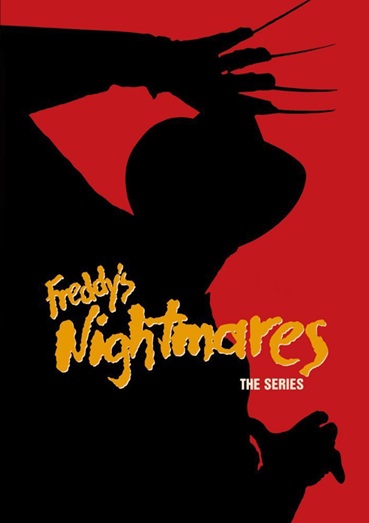
Welcome to Late Night Retro Television Reviews, a feature where we review some of our favorite and least favorite shows of the past! On Fridays, I will be reviewing Freddy’s Nightmares, a horror anthology show which ran in syndication from 1988 to 1990. The entire series can be found on Tubi!
This week, more and more people are coming to Springwood.
Episode 2.3 “Welcome to Springwood”
(Dir by Ken Wiederhorn, originally aired on October 22nd, 1989)
Roxanne (Leah Ayres) and her husband, Doug (Michael Horton). have just moved to a new house in Springwood, Ohio. Doug, a lawyer, has to go to his office and he leaves Roxanne, who is recovering from a mental breakdown, alone with the boxes that the moves have already brought into the house. He tells her not to worry about opening them and promises her that they’ll unpack when he gets home.
Roxanne, however, opens the boxes. And she finds things that clearly don’t belong to her. She calls Doug at work. Doug says that there must have been a mix-up with the moving company and that he’ll call and make sure that their stuff gets delivered as soon as possible.
Meanwhile, at the house, Roxanne starts to see people who may or may not be there….
As surprised as I am to say this, the first segment of this episode of Freddy’s Nightmares was an enjoyably macabre story. Yes, the final twist is one that you’ll see coming but director Ken Wiederhorn does a great job creating and maintaining atmosphere and Ayres, Horton, and Todd Allen all give strong performances.
The second story isn’t close to be anywhere as interesting. Emily Jamison (Dey Young) has moved into a new home and she finds a hidden stack of letters that were written years before. The letters detail a doomed romance and Emily soon starts to see ghosts. The story isn’t terrible but it’s a bit bland.
Still, this was another good episode of Freddy’s Nightmares. So far, at least, the show appears to have found its footing during its second season. It’ll be interesting to see if that continues next week.
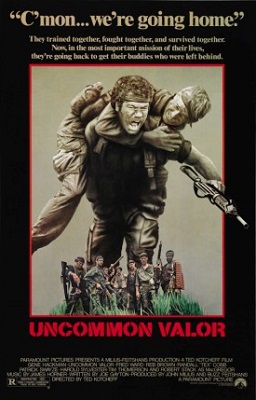
Retired Marine Colonel Jason Rhodes (Gene Hackman) and oilman Harry MacGregor (Robert Stack) share a tragic bonf. Both of them have sons that served in Vietnam and are listed as being MIA. Believing that their sons are still being secretly held in a POW camp in Loas, Rhodes and MacGregor put together a team to sneak into Southeast Asia and rescue them.
With MacGregor supplying the money and Rhodes leading the mission, the team includes Blaster (Red Brown), Wilkes (Fred Ward), Sailor (Randall “Tex” Cobb), and Charts (Tim Thomerson), all of whom served with Rhodes’s son. Also joining in his helicopter pilot Curtis Johnson (Harold Sylvester) and former Marine Kevin Scott (Patrick Swayze), whose father was also listed as being MIA in Vietnam. After a rough start, the group comes together and head into Laos to bring the prisoners home!
UncommonValor is one of the many movies released in the 80s in which Vietnam vets returned to Asia and rescued those who were left behind. In the 80s, there was a very strong belief amongst many Americans that soldiers were still being held prisoner in Vietnam, Cambodia, and Laos and Hollywood was quick to take advantage of it. The box office success of UncommonValor set the stage for films like Rambo and Missing In Action, film in which America got the victory that it had been denied in real life.
What set UncommonValor apart from the films that followed was the cast. Not surprisingly, Gene Hackman brings a lot more feeling and nuance to his performance as the obsesses Col. Rhodes than Sylvester Stallone and Chuck Norris brought to their trips to Vietnam. The film surrounds Hackman with a quirky supporting cast, all of whom represent different feelings about and reactions to the war in Vietnam. Fred Ward’s character suffers from PTSD. Randall “Tex” Cobb, not surprisingly, is a wild man. Patrick Swayze’s character is trying to make the father he’ll never know proud. Robert Stack and Gene Hackman represent the older generation, still trying to come to terms with everything that was lost in Vietnam and still mourning their sons. The raid on the POW camp is exciting but it doesn’t feature the type of superhuman action that’s present in other POW-rescue films. Col. Rhodes and his soldiers are ordinary men. Not all of them survive and not all of them get what they want.
UncommonValor started out as a screenplay from Wings Hauser, though he’s not present in the cast of the final film and he was only given a “story” credit. John Milius served as producer. Director Ted Kotcheff is best-known for FirstBlood, another action film about America’s struggle to come to terms with the Vietnam War.
Terrorists have taken over the local power and water plant and are threatening to poison the water supply if their demands are not meant. Among those that they are holding hostage is a group of college students who were on what would have otherwise been the most boring field trip of their lives. While Colonel Gentry (Robert Forster) tries to negotiate with the terrorists, one college student, Lenny Slater (Corey Haim), takes matters into his own deadly hands. Lenny also finds time to ask track star Jenny (Ami Dolenz) to go to the homecoming dance with him.
How many times can the exact same thing happen to the same person? That’s what you might expect Lenny Slater to ask as he finds himself sneaking around and taking out terrorists one-by-one. Demolition University is a sequel to Demolition High, with Lenny Slater now in college and a member of the school’s football team. What’s strange is that, even though Haim is playing the same character from the first film, no one mentions the events of Demolition High. No one mentions that Lenny not only blew up his old school but he saved the entire midwest from being bombed into a nuclear ash heap. When Lenny tries to tell Prof. Harris (Laraine Newman!) that it’s obvious that terrorists have taken over the power plant, she ignores him because he has a history of playing pranks. But he also has a history of tracking down and killing terrorists! I would listen to him.
Demolition High wasn’t good but it was watchable. Demolition University is just dull. Haim actually gives a better performance here than he did in the first film, if just because it’s easier to buy him as a college student instead of as a high school student. But he’s actually barely in the film. Most of the running time is taken up with Robert Forster trying to negotiate with the leader of the terrorists. That’s kind of cool because Robert Forster was the man but the movie still seems like what Die Hard would have been if it had just been two hours of Paul Gleason standing outside the tower while Bruce Willis killed people offscreen. Even when we do get Lenny fighting the the terrorists, the action scenes feel flat and interchangeable. There’s nothing to really distinguish them from every other 90s action film that you’ve ever seen.
Demolition University has higher production values than Demolition High and it actually looks like a real movie but it’s just not much fun. I’m not surprised that there was never a Demolition Grad School.
Oh my God, what is the thing with Ouija boards in movies?
Seriously, nothing good ever comes from using one. I have seen hundreds of movies featuring people foolishly using Ouija boards and, without fail, it always seems to lead to someone getting possessed by an evil spirit and then killing all of their friends. Whenever I see anyone using a Ouija board in a movie, I always want to ask them if they’ve never seen a horror movie before.
Then again, despite knowing all the of the terrible things that can happen as a result, I have had a few Ouija board experiences. For instance, when I was like 13, I asked a Ouija board if a boy named Diego liked my friend Jenny. The board replied that Diego liked me and Jenny needed to deal with it. Jenny accused me of manipulating the pointer and basically never spoke to me again but I suppose that’s better than either one of us getting possessed by a homicidal spirit. Myself, I don’t even believe in ghosts but I still find it difficult to resist a séance.
I guess my point is that it’s easy to laugh at movie characters who foolishly use Ouija boards but the main reason were laughing is because we know that we’re just as stupid as they are.
I recently watched one of the better Ouija board movies, 1988’s Witchboard. It’s about an angry spirit that might be named David, a skeptic named Jim (Todd Allen), a believer named Brandon (Stephen Nichols), and the woman who they both love, Linda (Tawny Kitaen). When I watched the movie, I immediately related to Linda, mostly because we both have red hair and everyone in the kept talking about how Linda hardly ever curses. That’s pretty much the way I am too, though there are exceptions. For instance, on Monday, the internet was down for 12 hours and I cursed up a storm. Linda, meanwhile, starts cursing after she has a bad experience with a Ouija board.
Jim (who is Linda’s current boyfriend) and Brandon (who is Linda’s ex) spend a lot of time debating who is to blame for Linda potentially getting possessed. Personally, I hold them both responsible. Brandon is the one who brought his Ouija board to Jim and Linda’s party. Brandon is also the one who contacts the spirit of a boy named David. At the same time, Jim’s the one who insulted the spirit, which led to Brandon’s tires getting slashed and Brandon storming out of the party. Brandon left behind his Ouija board, which Linda then used unsupervised. (Apparently, that’s something you should never do.) Basically, Jim and Brandon came together to form a perfect storm of testosterone-driven incompetence in this movie.
Soon, people are dying and Linda’s acting weird. When one of Jim’s friends is killed in a construction accident, Linda is upset to see that Jim didn’t even cry. Brandon informs her that Jim has “ice water in his veins.” For his part, Jim just wants to know why Linda is suddenly using so much profanity. Brandon brings in a medium named Zarabeth (played by Kathleen Wilhoite), who is one of those extremely flamboyant and outspoken characters that you’ll either totally love or thoroughly hate. (Personally, I liked the character. Even if she was somewhat annoying, she brought a jolt of life to the film.) Zarabeth attempts to exorcise the spirit of David and ends up getting tossed out a window as a result.
It’s tempting to just shrug and say, “Well, this is what happens when you mess around with the spirit world,” but Witchboard actually does a pretty good job of developing its characters and getting you to care about what happens to them. The fact that Jim and Brandon are both in love with Linda adds a bit of unexpected depth to the film’s story. Does Brandon really believe that Linda is being stalked by a spirit or is he just trying to win her back for himself? Even the seemingly throw-away detail about Jim’s emotional reticence pays off later in the movie. And, when that evil spirit does finally actually make a physical appearance, he’s just as creepy as you would hope he would be.
Witchboard is a definitely a film that will be appreciated by anyone who has ever used a Ouija board and felt kind of nervous about it afterwards.


 Through the Shattered Lens