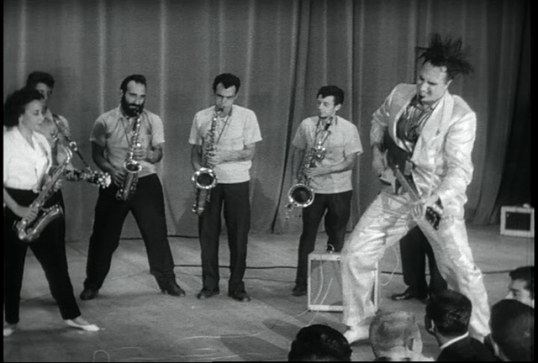
Lisa Cleans Out Her DVR: Change of Habit (dir by William A. Graham)


(Lisa is currently in the process of cleaning out her DVR!  How long is it going to take?  Some would say forever but, here at the Shattered Lens, we’re hoping that she might have it all done by August.  Anyway, she recorded the 1969 film Change of Habit off of Starz on March 20th!)

It’s Elvis vs. God for the heart of Mary Tyler Moore!

(Okay, so that may be a little bit glib on my part but, seriously, that pretty much sums up Change of Habit.)

Change of Habit opens with three nuns walking through New York City.  There’s the forgettable nun, Sister Barbara (Jane Elliott).  There’s the black, streetwise nun, Sister Irene (Barbara McNair).  And then there’s the idealistic and wholesome nun, Sister Michelle (Mary Tyler Moore).  Because they’re nuns, even notoriously rude New Yorkers are nice to them.  They walk across a busy intersection and all of the cars stop for them.  A cop sees them jaywalking and just smiles and nods at them.  In case you were ever wondering why someone would become a nun, it’s because nuns always have the right-of-way and they don’t have to obey arbitrary laws.  It’s a good life.

The sisters are shopping and, as the opening credits roll, the three of them duck into a dressing room and change into contemporary civilian clothing.  Obsessively, the camera keeps zooming in on everyone’s bare legs.  You can literally hear the film’s producers telling all the boys in the audience, “This may be a G-rated Elvis film but that’s not going to stop us from implying nun nudity!”

It’s Sister Michelle’s idea that the nuns should wear contemporary clothing, the better to relate to the Godless youth of the 1960s.  Unfortunately, now that they’re dressed like everyone else, they have to actually obey traffic laws.  When they attempt to cross the street for a second time, cars honk at them and the cop yells at them for jaywalking.

Michelle, Irene, and Barbara get jobs working at a free clinic.  The clinic is run by John Carpenter (Elvis Presley).  Carpenter is looking for aspiring actresses to appear in a movie about a babysitter being stalked by a masked murderer on Halloween and … oh sorry.  Wrong John Carpenter.  This John Carpenter is a no-nonsense doctor who will stop at nothing to bring peace and good health to the most poverty-stricken neighborhoods in New York!

That’s right.  It’s an Elvis film with a social conscience!

And that probably sounds like a joke but Change of Habit‘s heart is in the right place.  It’s intentions are good.  At least a few of the people involved in the film were probably trying to make the world a better place.  There’s a subplot involving an autistic child that, when you consider this film was made in 1969, is handled with unusual sensitivity.  Of course, that doesn’t mean that the rest of Change of Habit doesn’t feel totally and completely out-of-touch.  The entire film feels so dated that I imagine it probably even felt dated when it was initially released.  This is one of those films where the local black militants give Sister Irene a hard time about being a sell-out, just to eventually admit, during a block party, that maybe white folks aren’t so bad after all.  By the end of the movie, they’re even joking with the cops.  All that was needed was for Elvis to sing a song or two.  To be honest, there are times when Change of Habit feels like the 1969 version of Kendall Jenner’s Pepsi commercial.

Of course, the majority of the film deals with Elvis falling in love with Mary Tyler Moore.  He doesn’t know that she’s a nun and, as she falls in love with him, she’s forced to make a difficult choice.  Does she follow God or does she follow Elvis?  Actually, the film ends before she officially makes that choice but there’s little doubt as to what she’s going to eventually do.  In his final non-concert film appearance, Elvis is totally miscast as a serious-minded doctor and, it must be said, he looked miserable throughout the entire film.  You get the feeling he’d rather be doing anything than starring in Change of Habit.  (Maybe he was already thinking about how much he wanted a special FBI badge.)  Mary Tyler Moore is a bit more believable as a nun.  Fortunately, both Moore and Elvis were likable performers and their likability makes Change of Habit, as ludicrous as it often is, far more watchable than it has any right to be.

In the end, Elvis may not have saved society but he did get to sing a gospel song or two.

Cleaning Out The DVR Yet Again #10: The World’s Greatest Sinner (dir by Timothy Carey)


(Lisa recently discovered that she only has about 8 hours of space left on her DVR!  It turns out that she’s been recording movies from July and she just hasn’t gotten around to watching and reviewing them yet.  So, once again, Lisa is cleaning out her DVR!  She is going to try to watch and review 52 movies by Wednesday, November 30th!  Will she make it?  Keep checking the site to find out!)

the-worlds-greatest-sinner-2

As I continued to clean out my DVR, I decided to take a break from watching Lifetime films and, instead, I watched a movie that I recorded off of TCM on October 30th.

Filmed in 1962 but apparently never given an official theatrical release, The World’s Greatest Sinner is a genuine oddity and one that everyone should see at least once.  The infamously eccentric character actor Timothy Carey wrote, directed, and starred as Clarence Hilliard, a small-town insurance salesman who, one day, decides to quit his job and … well, your guess is as good as mine as to what he’s doing or why he’s doing it.  Here’s what I can tell you for sure: after stumbling across a concert and seeing how excited everyone is over rock and roll music, Clarence decides to become a street preacher.  While standing on bags of fertilizer, Clarence preaches that everyone is God and that everyone can live forever.

At first, Clarence faces persecution for his beliefs but soon, he has a loyal cult following.  He funds his new church by seducing elderly widows and he even becomes a rock star himself.  At first, he’s held back by his lack of facial hair but then he starts to wear a fake goatee.  He even changes his name to God Hilliard and, while he may have alienated his family, he is now loved by young people everywhere.  In fact, in a remarkably icky scene, we find out that the 40-something God now has a 14 year-old girlfriend.

God Hilliard is so popular that he’s approached by a shadowy figure who suggests that maybe he should run for President.  As the candidate for the Eternal Man Party, God gives ranting speeches that are listening to by his rabid fans, the majority of whom are now wearing arm bands with the letter “F” on them.  (F for Faust, perhaps?  Or F for Fake, as Orson Welles might argue.)  At first, the press ignores God but God runs as an outsider, giving speeches in which he promises to do away with the establishment and return the government to the people and … well, let’s just say that this film, which was obviously designed to be an over the top satire, now feels more than a little prophetic.

It looks like God Hilliard is about to become the most powerful man in the free world but the other God — the one who is vengeful and jealous and capable of throwing lightning bolts and all that — might have other plans….

(Incidentally, this entire story is told in 77 minutes, which should give you some clue of just how frantically paced The World’s Greatest Sinner is.)

Oh my God (not, not you Clarence), this is a weird film.  It’s shocking today so I can only imagine how it must have looked to audiences in 1962.  (Or, I should say, how it would have looked if it had actually been given a theatrical release.)  Admittedly, The World’s Greatest Sinner is a ragged film, full of haphazard editing and occasionally inconsistent sound.  Made for just $90,000, its low budget is obvious in almost every scene.  And yet, all of this works to the film’s advantage.  The World’s Greater Sinner literally feels like a cinematic dream, with its inconsistencies contributing to its otherworldly feel.  This is one of those films that you need to see at least once because you’ll probably never see another one like it.

The entire film is a Timothy Carey production.  He wrote, produced, directed, and starred, creating an indie film at a time when being independent was something more than just a trendy buzzword. If you’re into classic films — and particularly if you’re a fan of Stanley Kubrick’s early work — you might recognize Carey.  He was one of those legendary character actors who was always called upon whenever a movie needed a memorable crazy or an intimidating henchman.  From what I’ve read, Carey was reportedly as eccentric as the characters that he played.  His performance in The World’s Great Sinner swings back and forth between being histrionic and being surprisingly subtle, often in the same scene.  The same can be said of his direction.  For every uneven or poorly lit scene, there’s another that’s artfully composed and full of surprising detail.

The World’s Greatest Sinner is simply something that has to be seen to believed.

the-worlds-greatest-sinner


What Lisa Marie Watched Last Night: Head (dir. by Bob Rafelson)


Last night, I turned over to TCM and I watched the 1968 film Head.

Why Was I Watching It?

Though Head was a notorious box office bomb when it was released in 1968, it has since become notorious as one of the most incomprehensible movies ever made.  Every book that I’ve ever read about film or pop culture in the 1960s makes mention of Head.  Not only was the film written by a pre-Easy Rider Jack Nicholson, but the film also featured The Monkees literally acting out against their stardom by committing career suicide by appearing the film that was apparently conceived while Nicholson and director Bob Rafelson were tripping on LSD.  I’ve read about Head in dozens of books and I’ve seen it described as being “a surreal masterpieces,” “an incomprehensible, pretentious mess,” and “a total head trip of a film.”  Having now seen the film, I can say that’s all true. 

I do have to admit that before I saw Head, I didn’t know who the Monkees were.  Don’t get me wrong — I knew that there was a band in the 60s called The Monkees and I knew that they had their own TV show.  Thanks to the fact that The Brady Bunch Movie played on cable for like two months straight earlier this year, I knew which one was Davey Jones.  But, that was about it.  Even after seeing Head, I’m still not really sure I could tell you which was one was Mickey Dolenz and which one was Peter Tork.  I also have to admit that I spent the first half of the film referring to Michael Nesmith as the “Texan with the sideburns.”

Fortunately, I watched Head with two wonderful groups of people on twitter — the TCM Party and the Drive-In Mob.  They came together last night and provided a very entertaining live tweet session devoted to the film.  Unlike me, they actually knew one Monkee from another and following their tweets helped me survive the film’s rough first half.  To all of them, I say “Thank you for the education.”

What’s It About?

That’s not an easy question to answer but I’ll try.

The Monkees jump off a bridge and plunge into the psychedelic waters below but they’re saved from drowning by a bunch of mermaids.  This, of course, leads to the four members of the groups finding themselves in scenes from a war film, a boxing film, a western film, and eventually they discover that they’re actually dandruff on the head of actor Victor Mature.  Ultimately, they end up wandering around on a studio backlot where they’re menaced by veteran scary actor  Timothy Carey and an ominous black box that seems to intent on trapping them.  The Monkees react to this by running for their lives, complaining to Jack Nicholson and Bob Rafelson about the script, and telling everyone that they meet that they’re just actors in a film.  Eventually, it appears that the Monkees don’t have any options left beyond committing public suicide but Rafelson has other ideas…

What Worked?

If you’re as obsessed with pop cultural history as I am, Head is one of those films that simply you have to see.  Even if you find the film to be totally incomprehensible and just a tad bit pretentious, Head is a valuable artifact of its time.  Head is a film that could have only been made in the late 60s and it epitomizes everything about the age that produced it.  It’s like a cinematic Pompeii.

Now, I have to admit that most of the enjoyment I got out of the first half of the film came more from my own curiosity as a secret history nerd than from the film itself.  However, the second half of the film is often times genuinely entertaining.  The satire is a bit sharper and the overall theme (i.e., the struggle to maintain your own unique individuality in a world that demands conformity) starts emerge from the film’s mix of surreal images.

For me, the film really picked up with Davy Jones’ performance of Daddy’s Song:

The woman dancing with Davy Jones was Toni Basil, who choreographed all the dance numbers in this film.

Here’s another sequence that I particularly enjoyed.  This came towards the end of the film and, as I said on twitter, who doesn’t enjoy a little psychedelic dancing?

What Did Not Work?

While Head had all the virtues of its time, it also had all the flaws.  It’s a definite hit-and-miss affair, with the stronger (and occasionally insightful) moments uneasily balanced with plenty of sequences that dragged.  As you may have guessed, Head is the type of film that’s brilliant if you’re in the mood for it but it’s rather annoying if you’re not.


“Oh my God! Just like me!” Moments

I would have loved to have been Toni Basil, dancing with Davy Jones in the Daddy’s Song number.

Lessons Learned

Watching Head, I realized that I had discovered this year’s perfect Christmas present.  I’m going to get a 100 copies of Head on DVD and give them out to everyone I know.  That way, I’ll have an excuse to call everyone up in November and tell them, “Don’t worry, I’m giving you Head for Christmas.”  I think, if nothing else, that’ll make me a very popular girl come December.