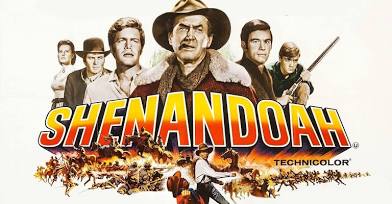
I review SHENANDOAH (1965), starring James Stewart! 


Jimmy Stewart plays Charlie Anderson, the patriarch of a large farming family in Virginia during the time of the Civil War. His family doesn’t own slaves, so he doesn’t figure it’s any of their business what all the fighting is about. He wants to keep working the land in hopes that the war will pass them by. Besides, he has six sons, a daughter, and a daughter in law that he wants to keep safe. He’s trying to keep the family together on his own as his beloved Martha had passed away sixteen years earlier giving birth to their youngest son, who we only know as Boy (Phillip Alford). Aside from the war that’s going on all around them, things seem pretty good for the Anderson’s. They all sit down for a big delicious meal every night. They attend Church every Sunday where they’re usually late and given the side-eye by Pastor Bjoerling (Denver Pyle). One of the sons, James Anderson (Patrick Wayne) and his wife Ann (Katharine Ross), have a precious newborn baby to take care of. The beautiful daughter Jennie (Rosemary Forsyth) is being courted by, and eventually marries, a lovestruck confederate officer named Sam (Doug McClure). Unfortunately the war won’t just go away, and when Boy is taken prisoner by Union soldiers, Charlie can’t stand idly by any longer. They head out to find him and bring him home. 

In the guise of an entertaining semi-western, SHENANDOAH does a great job of illustrating how futile and randomly tragic war can be. The movie starts out lighthearted and fun as the family goes about its normal life, with Jimmy Stewart’s Charlie Anderson giving his homespun advice and rolling his cigars. This is a self-sufficient family that loves, respects and enjoys each other even if they don’t agree on everything. But the war keeps inching its way into their lives. First in the form of small group of confederate soldiers who come by to get some water and try to convince the boys to join up. None of the boys will join up, but they do help bury the soldiers when they’re ambushed and killed just down the road. Next a group of men come to the ranch to try to confiscate their horses for the Union army. Of course, Charlie Anderson isn’t going to let that happen and this turns into the type of brawl that seems to come right out of John Wayne western comedy like MCLINTOCK. Everybody joins in with the participants punching and being punched repeatedly, while Boy keeps getting knocked into the horse trough. This shouldn’t be a surprise because Director Andrew V. McLaglen directed MCLINTOCK and many other John Wayne films. Finally, Boy is taken prisoner because he is wearing a confederate cap that he found floating down the steam while he was out fishing one day. Once Charlie and most of his family head out to search for Boy, the movie begins a turn into tragedy. I won’t give the specifics away, but some members of the family will die, and not a single one of their deaths will be based on the actual fighting of a war. Rather, their deaths will be based on the chaos and depravity that surrounds the war. It’s tough to see, especially when they were all so happy just a little bit earlier. For me, the movie’s changes in tone make the tragedy more powerful and really drive home its message about the futility of war. But the Anderson family, like the United States of America after the Civil War, is made up of tough, resilient folks, and the movie ends on a hopeful note that definitely brought some extra moisture to my eyes. 

Jimmy Stewart commands the screen in SHENANDOAH. You simply can’t take your eyes off of him, and his performance alone would make the movie worth watching. But with its powerful message, excellent cast, and solid direction, the movie is much more than just Stewart’s strong performance. I highly recommend it. 
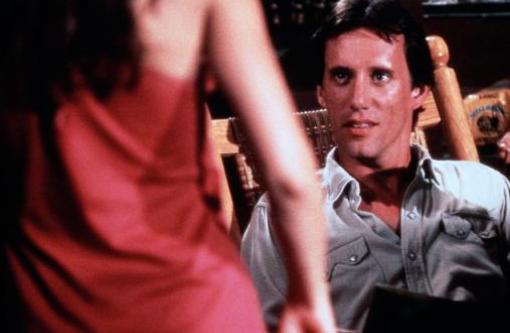
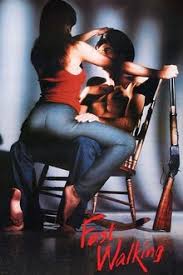
FAST-WALKING – James Woods and Kay Lenz light up the screen!


One of the first movies I ever watched starring James Woods is COP. It’s a 1988 action thriller about a police detective on the trail of a serial killer. I really enjoyed the movie, which was directed by James B. Harris. Harris is a producer and director whose various credits include THE KILLING (1956), PATHS OF GLORY (1957), LOLITA (1962) and TELEFON (1977, with Charles Bronson). Harris also directed James Woods in a movie from 1981 called FAST-WALKING. 

FAST-WALKING is about a prison guard named Frank “Fast-Walking” Minniver. He loves to smoke pot and dream about a future life in a beautiful part of Oregon. In order to make that move, though, he needs to make some money. When a black revolutionary named William Galliot is transferred to his prison, he finds himself with some options, as he receives offers of money from two different sides. On one side is his cousin Wasco, a prison trustee who offers Fast-Walking $25,000 to kill the revolutionary as part of a staged prison race riot. On the other side is Galliot’s own people who offer him a bag of money containing $50,000 if he’ll help Galliot escape. The biggest obstacle to taking the bigger payday is that Wasco threatens to kill Fast-Walking’s lady love Moke, if he doesn’t make the right choice.

The cast is phenomenal in FAST-WALKING beginning with James Woods as the title character. In his best roles, Woods is somewhat morally ambiguous, and we hope he makes the right decisions at the end. This definitely fits that mold. Kay Lenz was sexy as hell as Moke. We’re not supposed to be sure if she’s just using Fast-Walking or if she truly loves him. She plays that balance well. In a surprising turn of events, M. Emmet Walsh gives the most memorable performance of his career, and it doesn’t have a thing to do with his acting. Rather, he does a full frontal nude scene. I’d like to forget this performance, but it’s burned into my psyche at this point. Tim McIntire was the revelation to me, though, as Fast-Walking’s inmate cousin Wasco. This is the only role I really know him from, and he absolutely nails it. The fate of his character is one of the most satisfying parts of the entire film. Unfortunately, McIntire would suffer from drug and alcohol addiction and would pass away a few years after completing his role in FAST-WALKING. I can’t help but think there could have been more great performances if his career would have been longer. 

I recommend FAST-WALKING. It’s not a perfect film, but James Woods, Kay Lenz, and Tim McIntire all make it worth watching. 

Horror on TV: Circle of Fear 1.16 “Earth, Air, Fire, and Wind” (dir by Alex Singer)


On tonight’s episode of the show that was once Ghost Story, six artists rent out a space to create and show their art.  Unfortunately, they also find a trunk, one that contains six ancient glass containers.  Everyone’s work starts to take a dark turn as the artists become more and more obsessed with the containers.

That plot description might not sound like much but this is a pretty good episode, one that’s full of atmosphere and sly humor.  The script was by Harlan Ellison and D.C. Fontana.  Anyone who has ever spent any time in a commune will be able to relate!

This episode aired on January 19th, 1973.

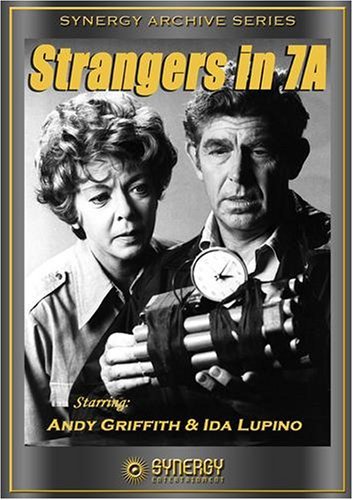
The Strangers in 7A (1972, directed by Paul Wendkos)


Artie Sawyer (Andy Griffith) is a man who no one respects.  Having recently been fired from his long-time job, he’s forced to take a job as a superintendent for an apartment building in New York.  The tenants don’t think much of him.  His wife, Iris (Ida Lupino), is getting tired of his self-pity.  The only person who seems to like Artie is Claudine (Susanne Benton).  The young and beautiful Claudine approaches Artie in a bar and, after flirting with him, reveals that she needs a place to stay.  Artie agrees to let Claudine check out Apartment 7A.  At the apartment, Claudine rolls around in the bed, dances seductively, and then reveals that she has three male friends who are going to be staying in the apartment with her.  Billy (Michael Brandon), Virgil (Tim McIntire), and Riff (James A. Watson, Jr.) all served in Vietnam together and now they need to crash at the apartment for a while.  Artie can either let them stay or they can reveal to his wife that he was at a bar, trying to pick up young women.

Led by the psychotic Billy, the three men are planning on robbing the bank next door.  When Artie, who is having doubts about whether or not it was a good idea to let four obviously unstable people live rent-free in his building, discovers their plans, he and Ida are taken hostage.  When the bank robbery goes wrong, Billy tries to use the hostages and a bomb as leverage for his escape from the police.

As far as films about bank robberies goes, The Strangers in 7A is no Dog Day Afternoon.  While it’s interesting to see the usually confident Andy Griffith play a loser, he never seems like enough of a loser that he would actually risk a job that he clearly needs just because Claudine flashed a little leg at him.  Even when he’s playing a character who is down on his luck, he’s still Andy Griffith.  Along with the lead role being miscast, the bank robbers are too generic to really be credible or threatening.  Susanne Benton is sexy as the femme fatale and Ida Lupino is sympathetic as Artie’s wife but otherwise, The Strangers in 7A is forgettable.

The Strangers in 7A was made for television.  At the time, Andy Griffith was still trying to escape being typecast as Mayberry’s amiable Sheriff Taylor.  Griffith was a convincing villain in movies like Pray For The Wildcats and Savages but he’s just not believable as a loser in this film.

The Gumball Rally (1976, directed by Chuck Bail)


When he gets bored in a business meeting, Michael Bannon (Michael Sarrazin) calls his old friend, Prof. Samuel Graves (Nicholas Pryor) and says only one word: “Gumball.”  Inspired by that one word, dozens of racers assemble in New York, all planning on taking part in the Gumball Rally.

What is the Gumball Rally?  It’s a highly illegal race in which teams of two compete to see which team can drive from New York to the other side of the country in the least amount of time.  Bannon and Graves currently hold the record for completing the Gumball Rally in the quickest amount of time and all of the racers are determined to try to claim that record for their own.  Meanwhile, one cop named Roscoe (Norman Burton) is determined to break this race up.  Has there ever been a good cop named Roscoe?  Rosco P. Coltrane probably had more of a chance of stopping them Duke Boys than Roscoe does stopping the Gumball Rally.

If The Gumball Rally sounds familiar, it’s because it’s basically a less star-filled version of The Cannonball Run.  Instead of Burt Reynolds and Dom DeLuise, The Gumball Rally has Michael Sarrazin, Nicholas Pryor, Tim McIntire, and Norman Burton.  Instead of Jackie Chan making his American debut, The Gumball Rally has early performances from Raul Julia and Gary Busey.  Instead of Dean Martin and Sammy Davis, Jr., The Gumball Rally has Steven Keats and Wally Taylor.  You get the idea.  However, the lack of big stars in the cast works to The Gumball Rally‘s advantage.  Whereas you watch The Cannonball Run with the knowledge that there’s no way Burt Reynolds isn’t going to at least come in second, it seems like anyone of the eccentric teams in The Gumball Rally could win the race.

Make no mistake about it, The Gumball Rally is a car chase film, one that was released at the height of that underrated genre’s popularity.  The actors are all likable and almost all of the characters get at least one funny, personality-defining moment but the real stars of The Gumball Rally are the cars and the stunts. That’s not surprising as this film was directed by legendary stuntman Chuck Bail.  This film is full of spectacular crashes and near misses.  (The race’s lone motorcyclist is especially accident-prone.)  Again, the lack of stars in the cast (and the fact that the cast reportedly did most of their own driving) bring an added element of suspense to the stunts.  You watch The Cannonball Run and Smoky and the Bandit secure in the knowledge that Burt Reynolds is never going to crash his vehicle because he’s Burt Ryenolds.  You don’t have that same automatic security when the car is being driven by Michael Sarrazine or Tim McIntire.

It may not be as well known as some of the films that it inspired but, if you like a good car chase (or a good car crash) film, The Gumball Rally is for you.

Fast-Walking (1982, directed by James B. Harris)


Frank Miniver (James Woods) is the prison guard that everyone calls Fast-Walking.  He’s involved in almost every vice that a man living in a small town in Oregon can be involved in.  He takes bribes.  He usually shows up for work stoned and what he doesn’t smoke, he sells to the prisoners and the other guards.  He’s got a second job, running a trailer park brothel behind his cousin’s general store.

Frank’s cousin, Wasco (Tim McIntire), has been incarcerated and he expects Frank to help him take over the prison.  At first, Frank has no problem working with Wasco and letting his cousin have free reign of the cell block.  Wasco has soon established himself as the most powerful man behind bars.  When a black power activist named Galliot (Robert Hooks) arrives at the prison, Wasco wants to arrange for him to be assassinated.  Meanwhile, Galliot has offered Frank even more money to help him escape from the prison.

While Frank tries to keep both sides happy and make off with some money for himself, he’s also sleeping with Wasco’s accomplice on the outside, Moke (Kay Lenz).  Originally, Wasco ordered Moke to seduce Frank in order to keep Frank in line but, as Moke and Frank’s relationship continues, Wasco starts to get jealous and starts plotting to put Frank back in his place.

Fast-Walking is a gritty film that features a good deal of dark humor.  Unfortunately, the film’s many different parts never really come together and the film never strikes the right balance between comedy and drama.   James Woods is perfectly cast as Frank and the underrated Kay Lenz does wonders with an underwritten role but Tim McIntire is a less than ideal Wasco.  McIntire was a good actor but, physically, he’s all wrong for a character who is supposed to be so intimidating that he can walk into a prison and automatically take it over.  Wasco is written and played as being such a cartoonish character that it’s difficult to take him or his plots seriously.  The movie works best when it’s just focuses of James Woods’s nervy performance and Frank’s attempts to keep the other prison guards (including M. Emmett Walsh) from discovering his own racket.

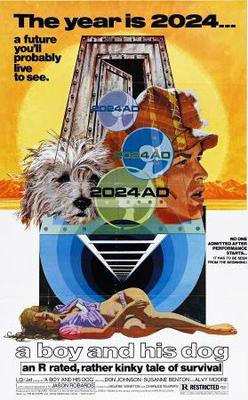
The TSL’s Grindhouse: A Boy And His Dog (dir by L.Q. Jones)


(Nearly every Saturday night, the Late Night Movie Gang and I watch a movie.  On January 20th, we watched the 1975 science fiction satire, A Boy and His Dog.)

A Boy and His Dog begins, quite literally, with a bang.  A bang followed by a mushroom cloud.  And then a second mushroom cloud.  And then another.  And another.  When the explosions finally stop, we are informed that World War IV only lasted five days.  Of course, it destroyed most of society.  The year is now 2024 and … well, things aren’t great.

(For those of you keeping track, that means we’ve got another six years left.  Enjoy them!)

The world is now a barren wasteland, an endless stretch of desert.  There are a handful of survivors but they’re not exactly the types who you would want to survive an apocalypse.  Take Vic, for instance.  Vic (played by Don Johnson) is an absolute moron.  He can’t read.  He’s not very good at thinking.  He has no conscience.  He’s someone who kills and rapes without giving it a second thought.  When Vic isn’t scavenging for food and supplies, he’s obsessing on sex.  When we first meet him, the only thing redeeming about Vic is that almost everyone else in the world is even worse than he is.

That Vic has managed to survive for as long as he has is something of a minor miracle.  Vic has been lucky enough to team up with a dog named Blood.  Blood is not only surprisingly intelligent but he’s also telepathic.  Unfortunately, the same experiment that granted him telepathy also caused him to lose his instinct as a hunter.  So, Blood and Vic have an arrangement.  Vic keeps Blood supplied with food and Blood helps Vic track down women.

Blood’s voice is provided by actor Tim McIntire and, from the minute we first hear him, it becomes obvious that Blood may be cute on the outside but, on the inside, it’s a totally different story.  Blood rarely has a good word for anyone or anything.  He delights in annoying Vic, calling him “Albert” while still demanding that Vic get him food.  He’s a surprisingly well-read dog but you wouldn’t necessarily want to get stuck in a kennel with him.  Much as with Vic, Blood’s only redeeming trait is that everyone else is marginally worse than he is.

(Sadly, if there was an apocalypse like the one that starts this movie, most of the survivors probably would be like Vic.  The only people who would survive something like that would be the people who were solely looking out for themselves.)

A Boy and His Dog is a highly episodic film, following Vic and Blood as they wander across the wasteland and bicker.  They fight other scavengers.  They spend a rather depressing night at a makeshift movie theater.  Eventually, they come across a young woman named Quilla June (Suanne Benton).  Blood dislikes her but Vic says he’s in love.  (Mostly, he’s just excited that he’s now having sex regularly.)  Eventually, through a whole series of events, Vic discovers an underground city named Topeka, where everyone wears clown makeup.  The head of the town (Jason Robards) informs Vic that his sperm will be used to impregnate 35 women.  Vic is excited until he finds out that reproduction in Topeka is a matter of artificial insemination.

(Both the wasteland and Topeka are nightmarish in their own different ways.  The wasteland is world without morality or compassion.  Topeka is a world where everyone looks like a mime, there’s always a marching band, and order is maintained by a robot wearing overalls.)

Of course, while Vic is dealing with life underground, Blood waits above ground.  By the end of the film, Vic is forced to make a choice between settling down or remaining loyal to his dog.  It all leads to a final comment from Blood that will either make you laugh or throw a shoe at your TV.  I did both.

A Boy and His Dog is a strange movie.  It definitely isn’t for everyone.  It’s a comedy but the humor is pitch black.  Still, that strangeness — along with the talent of the dog playing Blood and Tim McIntire’s savagely sarcastic voice work — is what makes the film watchable.  There’s literally no other film like A Boy and His Dog.  By the time Vic ends up in Topeka, the film has become almost a fever dream of apocalyptic paranoia and satire.  The ultimate message of the film appears to be that the apocalypse would really suck so let’s try to not blow each other up.

Who can’t get behind that?