In 1979’s The Toolbox Murders, someone is murdering the female tenants of a building in Los Angeles. The killer, who wears a mask and a leather jacket, uses tools. One woman is killed by a hammer to the head. Another is skewered by a power drill. One is stabbed with a screwdriver. Another is shot with a nail gun. The identity of the killer would be a total mystery if not for the fact that we’ve already seen Cameron Mitchell’s name in the cast list.
Indeed, it’s a bit pointless to cast Cameron Mitchell in any sort of whodunit-type of film. Nine times out of ten, Mitchell being in a movie means that that Mitchell (who, in the early days of his career, originated the role of Death of a Salesman‘s Happy Loman on Broadway) is going to be revealed as the murderer. In this case, Mitchell plays Vance Kingsley, the owner of the building. Vance has never recovered from the death of his daughter so he’s punishing women who he considered to be sinful.
The actual toolbox murders are pretty much finished after the first twenty minutes of the film. The rest of the movie deals with Laurie (Pamelyn Ferdin), a 15 year-old girl who is kidnapped by Vance and his nephew, Kent (Wesley Eure). Joey (Nicholas Beauvy), who is Laurie’s brother, attempts to find and then rescue his sister and turns out to very much not up to the task. The film itself ends on a rather sick note, one that is followed by a title card that informs us that the film is based on a true story. Yeah, sure, it was.
The Toolbox Murders has somehow earned a reputation for being a gory and shocking grindhouse film. It was among the films that was banned in the UK for several years. It’s actually not that gory and the use of tools to commit the murders is not quite as clever as the film seems to think it is. Even the nail gun murder (which is the film’s best known moment) feels rather awkward as the victim (Kelly Nichols) never really makes a run for it despite the fact that Vance has to stop to reload after every nail that he fires.
The scenes with Laurie being held hostage are far more disturbing and weird, largely due to Mitchell’s characteristically over-the-top portrayal of Vance’s psychosis. When you watch a movie called The Toolbox Murders, you’re probably not expecting a lengthy scene where Laurie — pretending to be Vance’s dead daughter — tells a long story about what it’s like in the afterlife. In the role of Vance’s nephew, Wesley Eure is even more disturbing than Mitchell. As opposed to the sinister-looking Mitchell, Eure actually has the look of a nice, young community college student and that makes his actions at the end of the film all the more icky to watch.
The Toolbox Murders doesn’t quite live up to its bloody reputation but it’s still a disturbing film nonetheless. Did you know that Heaven smells like lollipops? After this film, you’ll never forget.
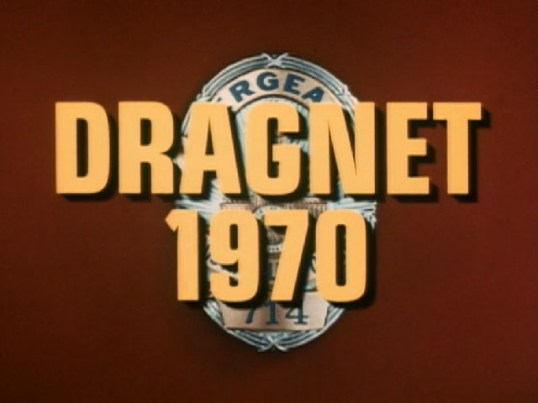
Dragnet began as a radio program in 1949 before making it’s way over to television in 1951. Each episode starred (and the majority were directed by) Jack Webb, who played a no-nonsense cop named Joe Friday. Friday narrated every episode, dropping trivia about the history of Los Angeles while also showing viewers how the cops went about catching criminals. Despite what is commonly believed, Joe Friday never said, “Just the facts, ma’m,” but he did investigate each case with the cool determination of a professional who kept his emotions under control. The majority of Dragnet’s episodes were based on actual cases that were worked by the LAPD, hence the opening declaration of, “The story you are about to see is true.”
On television, Dragnet originally ran from 1951 to 1959, during which time Dragnet also became the first television series to be adapted into a feature film. Jack Webb decided to relaunch Dragnet in 1966 and he produced a made-for-television movie that followed Friday and his latest partner, the far more talkative Bill Gannon (Harry Morgan), as they worked multiple cases over the course of one long weekend. That made-for-television movie led to a series that ran from 1967 to 1970.
The second television series is the best-remembered version of Dragnet, beloved for its scenes of Friday and Gannon debating the issues with a motely collection of hippies, campus radicals, and pipe-smoking academics. Jack Webb viewed Friday as being the voice of the common American, who supported the troops, supported the president, and who wanted to spend the weekend grilling in peace. Friday was the middle-aged suburbanite who wanted to the kids to stay off the grass, whether it was on his front lawn or being sold on a college campus. These episodes were often campy. It’s hard not to smile while listening to Friday and Gannon deadpan their way through conversations with flakey long-haired hippies. It was often obvious that the writers of Dragnet had never actually had any experiences with the hippies, beyond what they saw on the evening news. And yet, as silly as things often were, the show is an interesting time capsule of the era in which it was made. If nothing else, it’s a chance to see the turbulent 60s through the eyes of the other side.
Last year, I shared my favorite episode of Dragnet. For the new year, I’m sharing my second favorite, an episode that originally aired on March 19th, 1970. In Night School, Joe Friday is attending a night class where he and his classmates sit in a circle and just “rap” about the issues of the day. No one knows that Joe is a cop but Joe feels that he is still on duty and when he sees that the guy sitting across from him has a baggie of weed in his notebook, Friday makes an arrest. The professor, who says “There’s nothing wrong with marijuana, I smoke it myself!,” attempts to kick Sgt. Friday out of his class. “Would you rather be known as good ol’ friendly Joe, the class narc?” the professor asks. Joe fights for his right to get an education and a man with an eyepatch emerges as an unlikely voice of reason.
Why do I like this episode? There’s something undeniably entertaining about seeing straight-laced, deadpan Joe Friday attending a class with at least three hippies. It always amuses me that, on this show, Joe Friday loosening up just means that Joe trades his suit for a sweater. Also entertaining is Leonard Stone’s over-the-top performance as the villainous professor. And how can you not smile at Bill Gannon’s weary claim of “I just knew there was no way you could get a B sitting around talking?” Or Jack Webb’s delivery of the line, “That’s my thing, keeping the faith, baby?” Or Jack Curtiss’s hyperactive performance as campus drug pusher Jerry Morgan? “Hey, that’s just oregano!” Whatever you say, Jerry.
Today’s blast from the past certainly does feel like a trip in a time machine. Step on in and take a look at California in 1970!
When I first started at the University of North Texas, I lived in the Bruce Hall Dormitory and every day, I could count on the fact that there would be at least one fat and bearded resident in the lobby talking about how 9-11 was an inside job and how the only reason we were in Iraq was so Dick Cheney’s buddies could get rich.
By the time I graduated, everyone was convinced that the Republicans were going to steal the election from Barack Obama. Some people, of course, were hoping that was exactly what would happen because they were convinced that Obama was actually a Muslim from Kenya.
With each passing year of the Obama administration, there’s been a new conspiracy theory. Some people claimed that Obamacare was actually a Socialist plot. Others said that the Koch Brothers were behind the Tea Party. Meanwhile, Occupy Wall Street spoke ominously of how 1% of the population exploited the other 99%. As I sit here typing this, there is undoubtedly a desperate Obama partisan somewhere who is writing up his 100th blog post claiming that the Republicans somehow sabotaged the Obamacare website.
And, of course, living and working in Dallas, I am constantly reminded of the biggest conspiracy theory of all time. In just a few days, it will be the 50th anniversary of the assassination of John F. Kennedy and you better believe that my hometown is currently being invaded by wild-eyed men who are incapable of uttering a sentence without including terms like “grassy knoll,” “military-industrial complex,” and “coup d’etat.”
Yes, these are paranoid times. Nobody trusts anyone. All motives are suspect. With each passing day, it seems that more and more people are convinced that their daily failures and fortunes can all be blamed on shadowy forces. The world is a random place where a billion stories play out at once and not a single one of them is going to have a happy ending. People cling to their paranoia for much the same reason that some people cling to their concept of God. It gives them a false sense of security and reason in an otherwise chaotic universe.
As for me, I may not be a believer in conspiracies but, at the same time, I do find myself fascinated by both the theories and the films that they occasionally inspire. If movies ultimately serve as a reflection of society’s secret fears, insecurities, and desires, can it be any surprise that so many movies seem to be just as a paranoid as the audiences that go to see them?
For that reason, I am proud to announce that today is Day One of the 44 Days of Paranoia! For the next 44 days, we will be taking a look at some of the best and worst conspiracy-themed and paranoia-inducing films ever made.
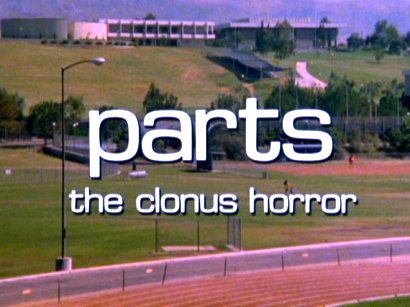
Let’s start things off by taking a look at the 1979 sci-fi conspiracy film, Clonus (a.k.a. Parts, the Clonus Horror).
Clonus opens on a compound the looks a lot like a community college. Living on the compound is a group of people who all appear to be extremely friendly and trusting. Every single one of them has a permanent smile plastered across his or her fresh faces. They spend their spare time jogging, working out, and — well, that’s about it. At the same time, none of them smoke, drink, or do anything else that could possibly cause any damage to their bodies.
So, at this point, you can probably guess that they’re either Mormons or they’re clones. (If you’re not sure, take another look at the film’s title…)
When the clones aren’t busy jogging, they’re talking about how much they hope that, one day, they will be allowed to go to “America.” There’s actually something rather touching about how excited they all get whenever they hear that one of them is getting sent to America. They’re a bit like the rubber aliens in Toy Story, putting all of their faith in “The Claw” and its ability to lift them up to a better life. Of course, what the clones don’t realize is that “going to America” is just a euphemism for being put under sedation and having their organs forcibly removed.
Eventually, one clone (played to awkward blank-faced perfection by Tim Donnelly) starts to question just why exactly he and his friends are being kept on the compound. He eventually escapes and discovers that not only has he been in America all along but that he only exists so that the rich and powerful can harvest his organs. Donnelly meets an idealistic journalist (Keenan Wynn) who happens to be acquainted with the family of a sinister presidential candidate (played by Peter Graves). When Wynn and Donnelly threaten to expose the truth, they find themselves targeted by the U.S. government which, in typical conspiracy-film style, is more than willing to kill to protect its secrets.
If the plot of Clonus sounds familiar, that’s because Michael Bay pretty much remade the film in 2005. In fact, Clonus director Robert Fiveson felt Bay’s The Island was so similar to his film, that he filed a lawsuit for copyright infringement. But whereas The Island was the epitome of a film that was more expensive than memorable, Clonus is an effectively creepy little film that, though dated, is still occasionally even thought-provoking. Though it may have been the result of the film’s budgetary limitations, Clonus eschews flashy effects for atmosphere and even the blandness of some of the locations adds to the film’s sense of low-key but palpable menace. If ever one needed proof that a low budget can occasionally be the best thing to ever happen to a film, Clonus is that proof. The film is generally well-acted and, best of all, it all builds up to one of those wonderfully downbeat endings that appear to have been so popular in the 70s.
Much like another recent and similar film — the excellent Never Let Me Go — Clonus works because it’s disturbingly plausible. It’s a bit of a cliché to say that a film makes science fiction feel like science fact but Clonus is one of those films that accomplishes just that.
 Through the Shattered Lens