Lisa Reviews an Oscar Nominee: Our Town (dir by Sam Wood)


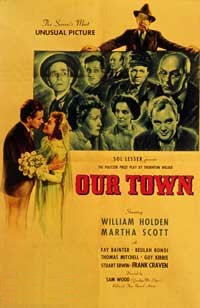
Original_movie_poster_for_the_film_Our_Town_(1940_film)

(SPOILERS BELOW!  THE END OF THIS FILM WILL BE REVEALED!  I will also be revealing who played George Gibbs but that’s probably not as big a spoiler.  It depends how you look at it.)

I was only 15 years old when I first read Our Town.  Because I was a theater nerd, I knew a little about the play.  For instance, I knew it took place in a small town.  I knew that it was narrated by a character known as the Stage Manager.  I knew that the play was meant to be performed on a bare stage, with no sets or props.  What I did not know, as I innocently opened up that booklet, is that Our Town is probably one of the most traumatically depressing plays ever written.

When the stage manager appears at the start of the play and talks about the town of Grover’s Corner, he lulls you into believing that you’re about to see a sentimental, comedic, and old-fashioned celebration of small town life.  We meet the characters and they all seem to be quirky in a properly non-threatening way.  Joe Crowell shows up delivers a newspaper to Doc Gibbs.  The stage manager mentions that Joe will eventually grow up to attend to M.I.T.

“Awwwww!  Good for Joe!” the audience says.

And, the Stage Manager goes on to inform us, as soon as Joe graduates, he will be killed in World War I, his expensive education wasted.

Okay, the audience thinks, that was a dark moment but this play was written at a time when World War I was still fresh on everyone’s mind.  Surely the rest of the play will not be quite as dark…

And fortunately, George Gibbs and Emily Webb show up.  They’re young, they’re likable, and they’re in love!  George and Emily get married and they’re prepared to live a long and happy life in our town!  Good for them!  YAY!

And then Act III begins…

Oh my God, Act III.  Act III begins with almost everyone dead.  Emily died in child birth so she hangs out at the local cemetery and talks to all the other dead people, the majority of whom only have vague memories of their former lives.  Emily relives the day of her 12th birthday and discovers that it’s too painful to remember what it was like to once be alive.  Emily asks the Stage Manager if anyone truly appreciates life.  The Stage Manager replies, “No.”  In the world of the living, George Gibbs sobs over his wife’s grave….

And the play ends!

OH MY GOD!

Seriously, reading Our Town was probably one of the most traumatic experiences of my life!

The 1940 film version of Our Town is a little less traumatic because it changes the ending.  In the film version, Emily doesn’t die.  She nearly dies while giving birth to her second child and the entire third act of the play is basically portrayed as being a near-death hallucination.  But, in the end, she survives and she comes through the experience with a new found appreciation for life.

And it’s certainly the type of happy ending that I was hoping for when I first read the play but, as much as I hate to admit it, the story works better with Emily dying than with Emily surviving.  The play presents death as being as inevitable as life and love and it makes the point that there’s nothing we can do to truly prepare for it.  By allowing Emily to live, the film gives us a ray of hope that wasn’t present anywhere else in Our Town.  The happy ending feels inauthentic.  If Emily could live then why couldn’t Joe Crowell?  For that matter, why did Emily’s younger brother have to die of a burst appendix on a camping trip?

But, other than the changed ending, Our Town is a pretty good adaptation of the stage play.  While the film features an actual set (as opposed to the bare stage on which theatrical versions of Our Town are meant to be performed), director Sam Wood does a good job of retaining the play’s surreal, metatheatrical style.  Making good use of shadow and darkness, Wood and cinematographer Bert Glennon made Grover’s Corner seem like a half-remembered memory or a fragment of a barely cohesive dream.

Frank Craven, who originated the role on Broadway, is properly dry as the Stage Manager and, in the role of Doc Gibbs, Thomas Mitchell is so sober and respectable that it’s hard to believe that, in just 6 years, the same actor would play the delightfully irresponsible Uncle Billy in It’s A Wonderful Life.  Emily and George are played by Martha Scott and an impossibly young William Holden, both of whom give wonderfully appealing performances.

With the exception of that changed ending, Our Town is a worthy adaptation of a classic play.  It was nominated for Best Picture but lost to another literary adaptation, Alfred Hitchcock’s Rebecca.

A Star is Born in Monument Valley: John Wayne in John Ford’s STAGECOACH (United Artists 1939)


gary loggins's avatarcracked rear viewer

stage1

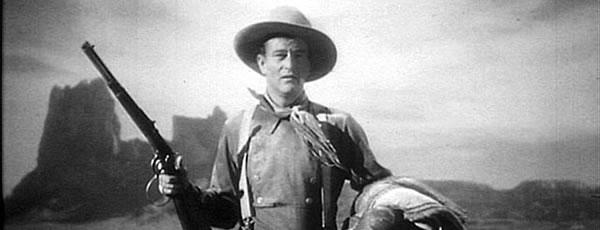
If you think the characters and Western tropes in STAGECOACH are familiar, you’re right. But let’s be clear… STAGECOACH introduced many of these now-clichéd devices to film, and is one of the enduring classics of the American West. Director John Ford was well versed in Westerns, having cut his professional teeth on them during the silent era. This was his first sound Western and Ford was determined to reinvent the genre, with much more adult themes than the usual Saturday matinée kiddie fare. He succeeded with a daring story featuring an outlaw and a prostitute as his heroes, and exceeded his goal by creating a brand new Hollywood star in the process: John Wayne.

stage2

Wayne had been a football player for the USC Trojans when an injury caused him to lose his scholarship. Through some university connections, he was able to gain employment in the film industry as a prop…

View original post 1,029 more words

Sci-Fi Film Review: When the Sky Falls (dir by John L’Ecuyer)


I guess it’s open to debate as to whether or not When The Sky Falls is truly a science fiction movie.  It deals with a huge storm that basically produces extremely powerful lightning and the lightning occasionally appears to have a mind of its own.  I have no idea if there’s any scientific basis for this.  I don’t really understand how lightning works, other than the fact that you don’t want to stand under a tree in a lightning storm and you definitely do not want to get struck.

But, regardless of whether the film is scientifically accurate or not, I still feel like this should be considered a science fiction movie.  First off, there’s the fact that the lightning itself often does seem to be intentionally targeting the film’s heroes.  Though the film never specifically states this as fact, it does seem as if the lightning has developed enough of a personality to hold a grudge against those attempting to escape it.  Secondly, the film’s main character is an ozone researcher and that just seems like an appropriate job for a character in a science fiction film.  And finally, despite the fact that it premiered on the Lifetime Movie Network, the entire film feels like it belongs on the SyFy network.

Seriously, everything about this film — from the acting to the cheap but crudely effective special effects to the environmentalist protagonist — feels reminiscent of a pre-Sharknado SyFy film.  (It’s easy to forget that, before Sharknado, SyFy films pretended to take themselves seriously.)  The plot even follows the standard SyFy formula — a dysfunctional family spends the weekend at a cabin in the woods and end up getting separated once the big lightning storm strikes.  They start out arguing and they end up depending on each other for survival.  And, perhaps most importantly of all, Dad gets to prove that he’s not as lame as everyone thinks.  If Lifetime films all build up to that moment when everyone realizes that mom was correct, SyFy films often celebrate the uncool but capable father figure.

Perhaps the most interesting thing about When The Sky Falls is that it was even on Lifetime Movie Network to begin with.  Compared to more traditional LMN films — like Confessions of a Go-Go Girl and The Perfect TeacherWhen The Sky Falls feels a bit out-of-place.  Perhaps next year, SyFy will return the favor and produce a sequel to Back To School Mom.

But anyway, what about the film itself?  In no way can it compare to either SyFy or Lifetime at its best.  The script is predictable, the actors struggle with some seriously undeveloped characters, and the film never finds a steady pace.  Some parts of the film seem way too slow while others seem to be oddly rushed.  On the plus side, when taken on their own terms, some of the lightning effects are kind of fun and the film was shot in Canada so, at the very least, you get to see some really pretty scenery.

Seriously, I love Canada!

Love you, Canada!

Love you, Canada!

Shattered Politics #4: Mr. Smith Goes To Washington (dir by Frank Capra)


mr-smith-goes-to-washington

So, when you read that I was going to be reviewing 94 political films here at the Shattered Lens, you probably knew that one of them would have to be the 1939 best picture nominee, Mr. Smith Goes To Washington.

So, we all know that story right?  The senator from an unnamed state dies.  The weak-willed Governor (Guy Kibbee) has to appoint a new senator.  Political boss Jim Taylor (Edward Arnold) demands that the governor appoint one of his cronies.  The state’s reformers demand that the Governor appoint a never-seen crusader named Henry Hill (who, whenever I hear his name, makes me think of Ray Liotta snorting cocaine in Goodfellas).  The Governor’s children demand that he appoint Jefferson Smith (James Stewart, of course!), who is the head of something called the Boy Rangers.  The Governor flips a coin.  The coin lands on its edge but it also lands next to a newspaper story about Jeff Smith.

So, of course, Mr. Smith goes to Washington.

Now, as the movie quickly makes clear, Jeff Smith is immediately out-of-place in Washington.  For one thing, he’s actually excited to be there.  He’s convinced that he’s there to make America a better place.  When a bunch of drunken reporters (led by the great Thomas Mitchell) make Smith look foolish, Smith responds by running around Washington and punching them out.  (That whole sequence probably serves as wish fulfilment for a lot of politicians.)  When his cynical legislative aide Saunders (Jean Arthur) tells him that he’s too naive to survive in Washington, he wins her over with the purity of his idealism.  When his mentor, Senator Paine (Claude Rains), is revealed to be a part of Washington’s corrupt culture, Smith is stunned.  When Taylor tries to destroy his political career, Smith responds by giving the filibuster to end all filibusters.  He’s one man standing up against a culture of corruption and…

And there’s a reason why, 76 years later, aspiring political candidates still attempt to portray themselves as being a real-life, modern Jefferson Smith.

This is one of those films that everyone seems to agree is great and, of course, there’s many reasons to love Mr. Smith Goes To Washington.  There’s the lead performance of Jimmy Stewart, of course.  While this may not be his best performance (I prefer the more layered characterization that he brought to It’s A Wonderful Life and Anatomy of a Murder), it is Stewart at his most likable and, most importantly, he makes you feel Jeff Smith’s pain as he discovers that Washington is not the great place that he originally assumed it to be.  Claude Rains was always great when it came to playing good men gone wrong and he’s perfect as Sen. Paine.  Thomas Mitchell and Jean Arthur are perfectly cast and I always enjoy seeing the bemused smile on the face of Vice President Harry Carey as Smith conducts his filibuster.

But I think the best thing about Mr. Smith Goes To Washington is that it actually makes you believe that there are Jeff Smiths out there who actually could make a difference.  And, until Judd Apatow gets around to remaking the film with Adam Sandler, audiences will continue to believe.

http://www.youtube.com/watch?v=sm9qaEJ3MBc

Ghosts of Christmas Past #24: It’s a Wonderful Life


Just in case you somehow missed your chance to see one of the greatest films ever made, here’s Frank Capra’s classic It’s A Wonderful Life.  I’ve seen this movie a countless number of times.  I can recite every line by memory.  And yet, every time I watch it, I still get tears in my eyes.  If you missed it on TV this year, please feel free to watch it below.

Incidentally, I always related to Violet.