An Offer You Can’t Refuse #8: Force of Evil (dir by Abraham Polonsky)


The 1948 film noir, Force of Evil, plays out like a fever dream of dark and disturbing things.

The film begins on the third of July with attorney Joe Morse (John Garfield) telling us that, by the end of the 4th of July, he will have made his first million dollars, something that he describes as being “an important moment in every man’s life.”  Joe has an appreciation of money that one can only get from growing up poor.  By his own admission, Joe spent most of his youth on the streets, committing petty crimes.  It was his older brother, Leo (Thomas Gomez), who held things together back home and who kept Joe from getting into any truly serious trouble.  Now, years later, Joe is an attorney and Leo is a small-time player in New York’s numbers racket.

(The numbers racket, as the film explains, is an illegal lottery in which people — mostly in working class neighborhoods — bet on which three numbers will be drawn at the end of the day.  In this film, those three numbers are the last three digits of “the handle”, the amount race track bettors placed on race day at a major racetrack, published in the major newspapers in New York.)

Joe now works for Ben Tucker (Roy Roberts).  Tucker may look like a respectable businessman and he may operate out of an office building but he’s actually a gangster.  He got his start as a bootlegger and then, after prohibition ended, he moved into the number game.  He and Joe have come up with a scheme to consolidate and take over the entire New York numbers racket.  They’re going to fix the handle so that, on July 4th, everyone who picks “776” as their three numbers will win.  (As Joe explains, a mix of patriotism and superstition leads to thousands of people picking 776 on every Independence Day.)  When the small time operators don’t have the money to pay off the winners, Tucker will loan them the money to stay afloat.  However, by accepting the loan, the operators will now be in debt to Tucker and Tucker will basically control their operations.  Anyone who doesn’t want to work for Tucker will either be out of work or dead.  It’s all strictly business.

The only problem is that Joe knows that the plan will basically bankrupt Leo.  When Joe goes to Leo and tries to warn him, Leo refuses to listen to him.  Leo may be a criminal but he’s an honest criminal and he has no interest in getting involved with someone like Ben Tucker.  Leo watches out for the people working underneath him and treat them fairly, a concept that men like Ben Tucker will never understand.  In fact, the only thing that Leo asks from Joe is that Joe make sure that Leo’s longtime secretary, Doris Lowry (Beatrice Pearson), is taken care of.

Needless to say, things get even more complicated from there….

Force of Evil presents us with a world where everyone — with exception of maybe Doris — is corrupt and where everything — from blackmail to murder — is strictly business.  Greed is the motivator for every action and the more money that comes in, the easier it is to justify every ruthless act.  Joe makes his fortune over the course of one of America’s most sacred holidays but it comes at the expense of his brother.  His brother tries to do the right thing as far as his employee are concerned, just to discover that the Walter Tuckers of the world don’t care what happens to the people who work for them as long as the money keeps coming in.  It’s a dark and cynical movie, a gangster movie were the cops are just as dangerous as the people they’re arresting and where concepts like love and loyalty mean nothing when there’s money to be made.

As directed by Abraham Polonsky, Force of Evil plays out like a filmed nightmare.  Every interior seems to be full of ominous shadows and the exterior scenes always seem to find characters like Leo Morse and his timid accountant (Howland Chamberlain) dwarfed by the city around them.  Gangsters like Ben Tucker and his associates emerge from the darkness, with the film’s final shoot-out taking place in complete darkness and featuring characters shooting at shadows despite not knowing who that shadow might belong to.  It’s a dark and claustrophobic world that Polonsky presents, one that always seems to be closing in on the Morse brothers and the people unlucky enough to be around them.  (The real world would later close in on Polonsky, an unapologetic Marxist whose ideology is obvious in the film’s portrait of crime just being another form of big business.  Polonsky was among those blacklisted in the 50s.  Force of Evil was the first of only three movies that he would ever direct.)

John Garfield plays Joe Morse with a barely contained anger.  Even after he’s made his first million, he’s still angry at the world.  Getting rich is his revenge on a society that predicted that someone like him would never amount to anything.  Roy Roberts is perfectly sleazy as the outwardly respectable Walter Tucker and Marie Windsor has a few wonderful scenes as his vampish wife.  Perhaps the film’s best performance comes from Howland Chamberlain, playing an accountant who soon finds himself in over his head as Tucker makes his move on Leo’s operation.

Tough, violent, and visually unforgettable, Force of Evil is an excellent gangster film and a classic noir.  It’s definitely an offer that you can’t refuse.

John Garfield in Force of Evil

Previous Offers You Can’t (or Can) Refuse:

  1. The Public Enemy
  2. Scarface
  3. The Purple Gang
  4. The Gang That Could’t Shoot Straight
  5. The Happening
  6. King of the Roaring Twenties: The Story of Arnold Rothstein 
  7. The Roaring Twenties


30 Days of Noir #29: Johnny O’Clock (dir by Robert Rossen)


The 1947 film, Johnny O’Clock, invites us to take a behind-the-scenes look at the sleazy and sordid world of casino management.  If that doesn’t intrigue you, just consider that the man character is named Johnny O’Clock.

Seriously, that’s a really kickass name.  I have to admit that, if my last name was O’Clock, I would be tempted to name my child Four Twenty.  But, that said, Johnny is a pretty good name too.  On the one hand, he’s got an all-American name like Johnny but he’s also got a last name — O’Clock — that promises mystery and danger.  Johnny O’Clock is also played by Dick Powell, who was always good at playing tough guys who had a heart of gold.  (Along with appearing in several noir films, Dick Powell was also the first actor to ever play the famed detective, Philip Marlowe.)

Johnny O’Clock is a partner in a casino with Guido Marchettis (Thomas Gomez).  Johnny and Guido are longtime business partners who find the future of their casino threatened when a hat-check girl named Harriet Hobson (Nina Foch) dies under mysterious circumstances.  Even though the crime scene was clearly set up to make it appear as if Harriet committed suicide, it doesn’t take Inspector Koch (Lee J. Cobb) long to figure out that Harriet was actually murdered.

Who killed Harriet?

Was it her boyfriend, Chuck Blayden (Jim Bannon)?  Chuck is a corrupt cop who has been trying to convince Guido to force Johnny out of the casino and instead hire Chuck instead.

Or is the murderer Guido’s wife, Nellie (Ellen Drew)?  Nellie used to be Johnny’s girlfriend and, as soon becomes obvious, she still has feelings for him.  When she attempted to give Johnny a romantic present, Johnny’s response was to give it to Harriet so that Harriet could return it.  Did Johnny’s rejection of Nellie push her over the edge and did she take her anger out on Harriet?

Or maybe the murderer was Guido.  Guido, after all, is a rather shady sort.  Maybe Harriet discovered something that she shouldn’t have.

Then again, you could also say the same thing about Johnny O’Clock….

Inspector Koch isn’t the only person determined to get to the truth!  Harriet’s sister, Nancy (Evelyn Keyes), also shows up and starts to investigate on her own.  Soon, she and Johnny are falling in love but Johnny knows that the situation is too dangerous for either him or Nancy to stick around the casino.  He starts to make plans to flee with her to South America but he’s got just a few things to do before they can leave….

Johnny O’Clock was the first film to be directed by Robert Rossen, who is often credited as being one of the most important filmmaers in development of American film noir.  A year after Johnny O’Clock was released, Rossen’s All The King’s Men would win best picture.  Rossen’s career was derailed when he was accused of being a communist and blacklisted in the 50s.  Like Elia Kazan, Rossen initially took the fifth but he later relented and “named names” to the House UnAmerican Activities Committee.  Though Rossen would later direct the Oscar-nominated The Hustler in 1962, it can be argued that Rossen’s career never recovered from either being blacklisted or from naming names.

Clocking in at 93 minutes, Johnny O’Clock is probably about 20 minutes too long and the murder mystery is never really as intriguing as you might hope it would be.  On the positive side, the casino is stylish and the cast is full of noir talent.  Dick Powell is a likable, if occasionally bull-headed, protagonist and Lee J. Cobb is well-cast as Inspector Koch.  (The film has some fun contrasting the glitz of the casino with the shabbiness of Koch.)  Burnett Guffey’s black-and-white cinematography gives the film a properly noirish look and, while the pace may be slow, the occasional bursts of action are well-handled.  The scene where Johnny is nearly the victim of a drive-by shooting is particularly exciting.  Johnny O’Clock is a flawed noir but the cast is good enough to hold the interest of fans of the genre.

Outside the (Hat) Box: PHANTOM LADY (Universal 1944)


gary loggins's avatarcracked rear viewer

pl1

Interested in a Hitchcockian 40’s thriller full of suspense and noir style? Then PHANTOM LADY is the film for you, a small gem based on a Cornell Woolrich novel and  directed by the talented Robert Siodmak. I wouldn’t go so far as to call this film noir like many do, but it certainly contains many of the stylistic elements of the genre in its gripping murder mystery story. Pretty damn close, though!

The Hitchcock influence clearly comes from Joan Harrison , former secretary and screenwriter for The Master of Suspense, who became one of only three female producers working during Hollywood’s Golden Age. There’s Hitchcock’s famed McGuffin to be found in the form of a “crazy hat” worn by the mysterious woman of the title that’s crucial to the film’s plot. Add the tension ratcheted up by screenwriter Bernard Schoenfeld and you’ve got a Hitchcock movie without Hitchcock.

pl2

The noir elements…

View original post 525 more words

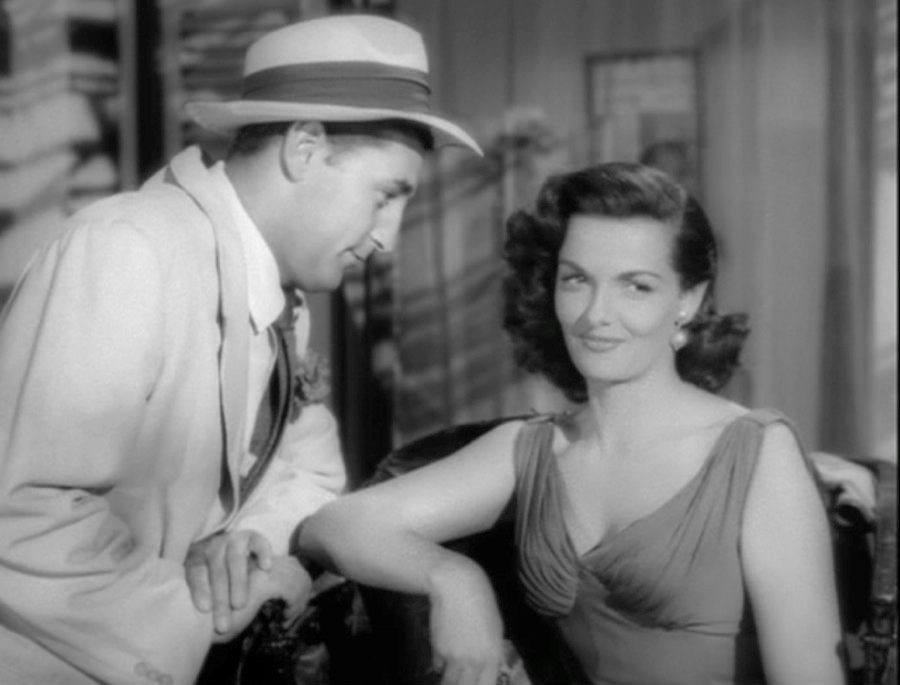
Double Dynamite: Robert Mitchum and Jane Russell in MACAO (RKO 1952)


gary loggins's avatarcracked rear viewer

macao1

Even though 1951’s HIS KIND OF WOMAN lost money (mainly due to studio boss Howard Hughes’ meddling), Robert Mitchum and Jane Russell were reteamed the following year in MACAO. The film was actually sitting on the RKO shelf, having been completed in 1950. Once again, the autocratic Hughes wasn’t pleased with the original version, and fired credited director Josef von Sternberg, replacing him with Nicholas Ray. Mitchum himself even contributed to rewriting some scenes. The result is an entertaining noir that, while not quite as good as HIS KIND OF WOMAN, still manages to hold your interest.

macao3

On a boat from Hong Kong, drifter Nick Cochran (Mitchum) meets grifter Julie Benson (Russell), who lifts his wallet. The pair also meet Lawrence C. Trumble (William Bendix), a salesman specializing in “nylons, pearl buttons, coconut oil, and fertilizer”.  The three are headed to Macao, “The Monte Carlo of the Orient” (actually the RKO backlot), for various reasons…

View original post 265 more words