Retro Television Review: The American Short Story #12: The Man That Corrupted Hadleyburg


Welcome to Retro Television Reviews, a feature where we review some of our favorite and least favorite shows of the past!  On Saturdays, Lisa will be reviewing The American Short Story, which ran semi-regularly on PBS in 1974 to 1981.  The entire show can be purchased on Prime and found on YouTube and Tubi.

This week, we have an adaptation of a Mark Twain novella.

Episode #12: The Man That Corrupted Hadleyburg

(Dir by Ralph Rosenblum, originally aired in 1980)

In this loose adaptation of one of Mark Twain’s darkest novellas, Robert Preston stars as The Stranger.  When we first meet The Stranger, he’s looking down on the small town of Hadleyburg and it’s hard not to notice that he looks a lot like Mark Twain.  The Stranger explains that the people of Hadleyburg consider themselves to be honest and free of sin.  The town’s motto is “Lead us not into temptation!”  The Stranger has a plan to test them.

Riding into town, the Stranger stops at the home of Edward and Mary Richards (Tom Aldredge and Frances Sternhagen).  The Stranger gives them a sack that he claims is filled with $40,000 worth of gold bars.  The Stranger says that he was once a poor man and someone in Hadleyburg gave him $20 and some meaningful advice.  Now that’s he rich, he wants to pay back the person who helped him.  The Stranger explains that there is an envelope inside the sack.  In the envelope, the Stranger has written out the advice he was given by his benefactor.  The Stranger’s instruction is for the man who helped him to write out that advice and give it to Rev. Burgess (Fred Gwynne), who recently lost his church when the citizens of Hadleyburg tired of him calling them out for their hypocrisies.  The honest man who remembers the advice he gave the Stranger will be very rich as a result.  The Stranger then leaves.

News of the sack and the gold travels throughout town and eventually the rest of the nation.  The most powerful families in Hadleyburg, including the Richards family, receive a letter telling them that the advice given to the stranger was “You are far from being a bad man, go and reform.”  Burgess is soon swamped by notes, all featuring that same phrase.  At the town meeting, Burgess reads each note, revealing that everyone wrote down the same phrase and that none of the town leaders is as honest as they claim.

The Man That Corrupted Hadleyburg is one of Twain’s most stinging satires, featuring an ending that is surprisingly dark.  This adaptation takes a much lighter approach to the material, altering Twain’s ending to something much more gentle and friendly.  Unfortunately, changing the ending causes the adaptation to lack the bite of the original short story.  Twain’s portrayal of greed and guilt instead becomes a mild story about a quirky town that learns a lesson.  It’s well-acted, especially by Fred Gwynne, but this adaptation doesn’t honor Twain’s intentions.  It just doesn’t add up to much.

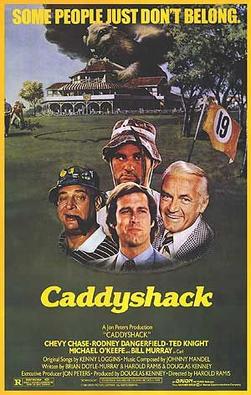
Caddyshack (1980, directed by Harold Ramis)


Whenever I think about Caddyshack, which is one of the funniest moves ever made, I think first of the Gopher, burrowing across the course and dancing to the music.

I then think about Bill Murray, playing the demented groundskeeper and growing his own special grass that you can both play golf on and smoke afterwards.

I remember Rodney Dangerfield dancing on the green while Ted Knight throws a fit.  This was the first film that I ever saw Rodney Dangerfield in.  “It looks good on you, though,” was one of those simple lines that Rodney could turn into a classic.

I remember Ted Knight, appearing in one of his few film roles, and saying, “Well, we’re waiting!” and drawing out every single word.

I remember the scene in the pool.  You know which one I’m talking about.

I remember Chevy Chase, back when he was still funny.

Then I remember how Rodney Dangerfield’s classic last line, “We’re all going to get laid,” was changed to “We’re all going to take a shower!” for television.  Why the censors thought that sounded less dirty than the original, I’ll never know.

I remember the Bishop getting struck by lightning while playing the best game of his life.

And, of course, I remember Cindy Morgan as Lacy Underall.

I remember so many classic moments and funny lines that I’m always surprised when I rewatch the movie and discover that it’s not really about the Gopher, Bill Murray, Rodney Dangerfield, Chevy Chase, or even Lacy Underall.  Instead, the main character in the movie is Danny Noonan (Michael O’Keefe), a teenage caddy at Bushwood Country Club who wants to win a scholarship so he can go to college and avoid having to work in the lumber yard with his father (Albert Salmi).  Danny has a friendly rivalry with caddy Tony D’Annuzio (Scott Colomby) and is dating Maggie (Sarah Holcomb).  Danny has to decide whether to ally himself with the snobs (led by Ted Knight) or the slobs (led by Rodney Dangerfield).

Caddyshack was originally envisioned as being Danny’s story but, once filming started, Harold Ramis (making his directorial debut) realized that the comedic characters were actually more interesting.  The movie went from being a straight-forward coming-of-age story to an almost plotless collection of gags and jokes, with both Bill Murray and Rodney Dangerfield improvising the majority of their dialogue and the Gopher emerging as the film’s true star.  That was bad news for the younger actors playing the caddies, who all found their roles greatly reduced in the film’s final cut but that was good news for audiences.  Caddyshack may not have much of a narrative structure but it does have some of the funniest people who ever lived at the peak of their powers.

Despite a legendarily troubled production, Caddyshack was a huge success with audiences and eventually, the critics came around as well.  Harold Ramis always said that he had a hard time watching it because all he could see were the mistakes that he made.  All audiences could see, though, was a hilariously funny movie that continues to bring people joy to this day.