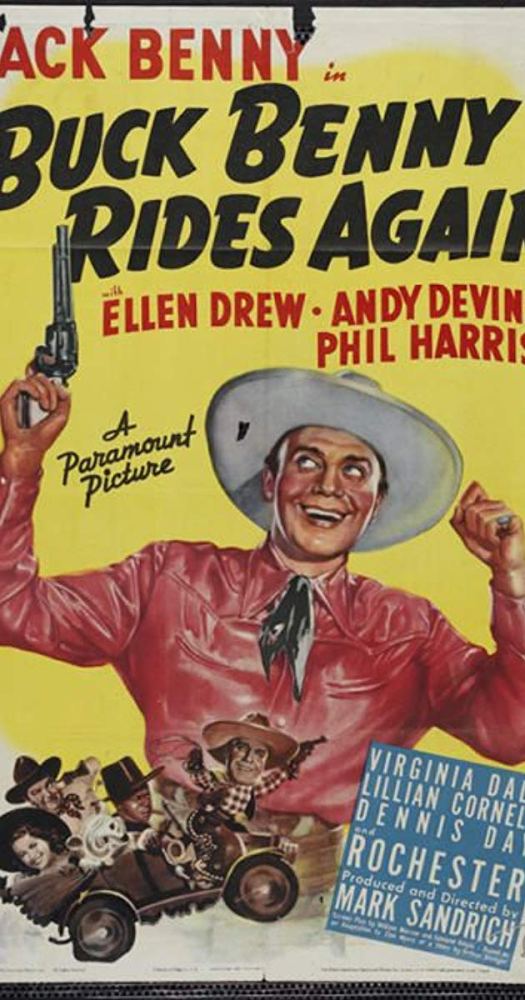
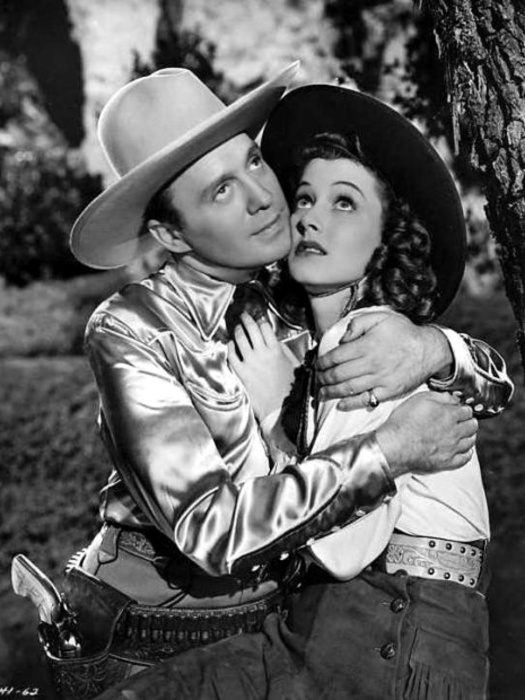
The gang’s all here in BUCK BENNY RIDES AGAIN – Jack Benny’s radio gang, that is! Eddie “Rochester” Anderson, announcer Don Wilson, band leader Phil Harris, comic actor Andy Devine, and crooner Dennis Day all show up for this fun-filled musical comedy romp directed by Mark Sandrich. Even Jack’s radio nemesis Fred Allen is heard (though not seen) cracking jokes at his rival’s expense!
The movie plays like an extended sketch from one of Jack’s radio or TV programs, as the vain Jack falls for pretty Joan Cameron (Ellen Drew), one of a trio of singing sisters (the other two are Virginia Dale and Lillian Cornell) trying to break into show biz. They “meet cute” when Jack accidentally smashes into Joan’s taxi. Jack keeps flubbing his chances with Joan, who only goes for manly, rugged Western types (“I wouldn’t go out with him if he drove up in a sleigh…
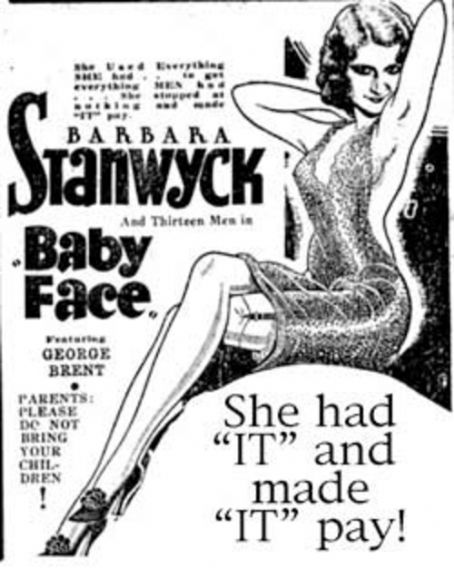
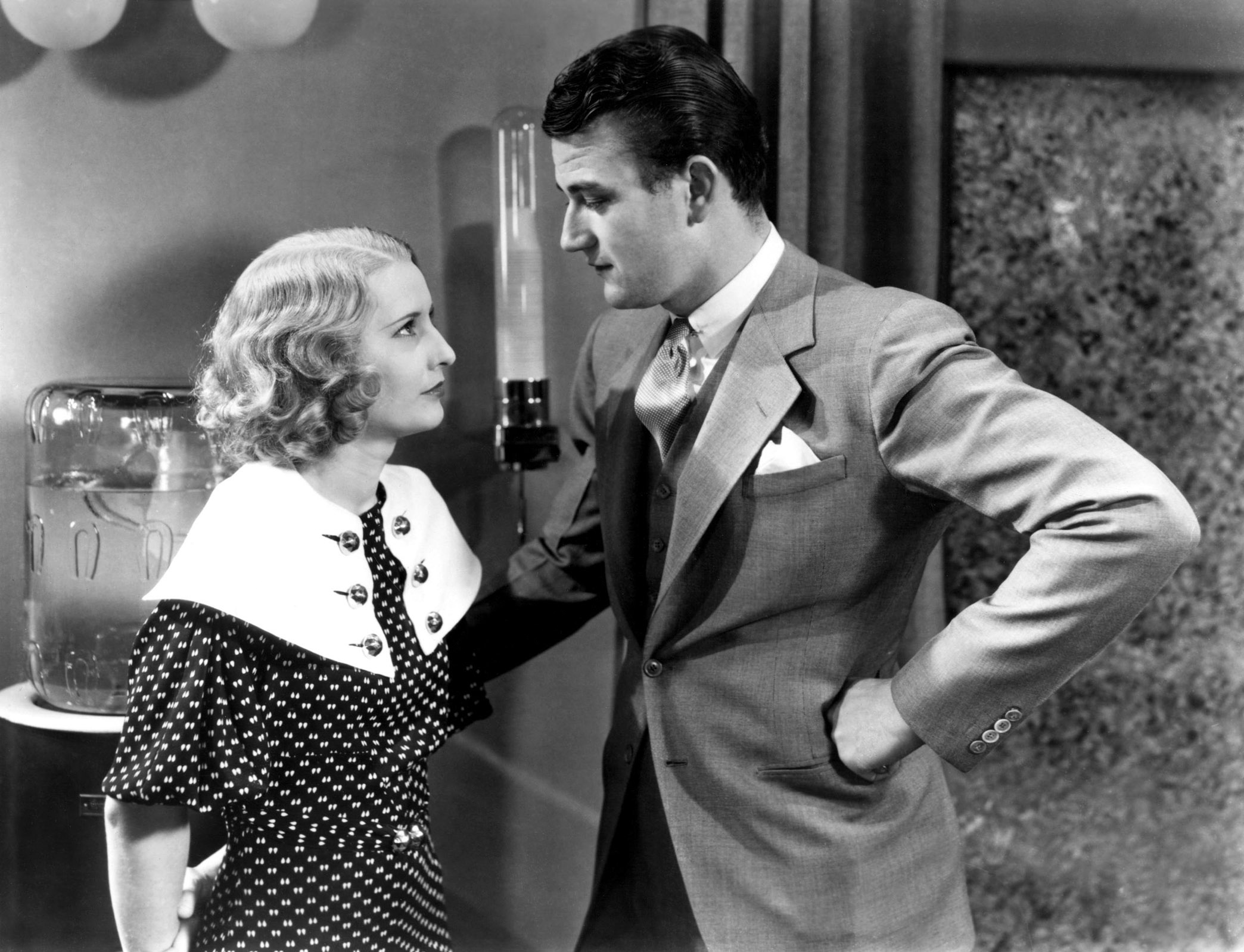
Barbara Stanwyck uses sex as a weapon and screws her way to the top in BABY FACE, an outrageously blatant Pre-Coder that had the censors heads spinning back in 1933. Miss Stanwyck plays Lily Powers, a young woman who works in her Pop’s speakeasy in smog-filled Erie, PA, where Pop’s been pimping her out since she was 14. Lily has a black female friend named Chico who seems to be more than just a friend (though it’s never stated, the implication’s definitely there). All the men paw over her like dogs with a piece of raw meat except the elderly Mr. Cragg, who gives her a book by Fredrich Nietzche along with some advice: “You have power… you don’t realize your potentialities… you must use men, not let them use you… exploit yourself, use men! Be strong, defiant!”.
When Pop’s still blows to smithereens, taking Pop with it, Lily and…
Did you know that up until the year 1936, if a child was born to unwed parents, it was common practice to actually put the word “illegitimate” on that child’s birth certificate? As you all know, I am perhaps the biggest history nerd in the world and, while I knew that there was once a huge stigma associated with being born outside of marriage, I did not know just how institutionalized that stigma was.
I’m also proud to say that my home state of Texas — the state that all the yankees love to bitch about — was the first state to ban the use of the word “illegitimate” on birth certificates. This was largely due to the efforts of Edna Gladney, an early advocate for the rights of children. Along with starting a home for orphans and abandoned children in Ft. Worth, Edna also started one of the country’s first day care centers for the children of working mothers.
That’s right — there was a time when day care was itself a revolutionary concept.
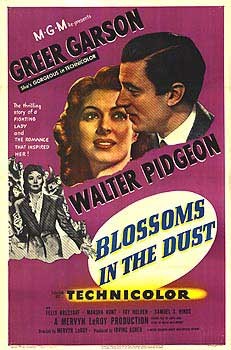
I have TCM to thank for my knowledge of Edna Gladney, largely because TCM broadcast a 1941 biopic called Blossoms in The Dust. According to Wikipedia, the film was a highly fictionalized look at Edna’s life but, to be honest, I would have guessed that just from watching the movie. While Blossoms In The Dust gets the important things right (and it deserves a lot of credit for sympathetically dealing with the cultural stigma of being born to unwed parents at a time when it was an even more controversial subject that it is today), it’s also full of scenes that are pure Hollywood.
In real life, Edna knew firsthand about the challenges faced by children of unwed parents because she was one herself. Apparently, at the time, that was going too far for even a relatively progressive film like Blossoms In The Dust so, in Blossoms, Edna (played by Greer Garson) is given an adopted sister named Charlotte (Marsha Hunt). When the parents of Charlotte’s fiancée discover that she was born outside of marriage, they refuse to allow Charlotte to marry their son. In response, Charlotte commits suicide.
In real life, Edna was born in Wisconsin but, following the death of her stepfather, moved to Ft. Worth to stay with relatives. Edna was 18 at the time and eventually met and married a local businessman named Sam Gladney. In Blossoms in The Dust, Edna is already an adult when she first meets Sam (played by Walter Pidgeon, who played Greer Garson’s husband in a number of films) and they meet in Wisconsin. It’s only after Charlotte dies that Edna marries Sam and it’s only after they’re married that Edna moves to Texas. Whereas the real life Edna had relatives in Texas, the film’s Edna is literally a stranger in a strange land.
That said, the film is actually rather kind to my home state. The film spend a lot of time contrasting the judgmental snobs up north with the more straight-forward people who Edna meets after she moves to Ft. Worth and it’s occasionally fun to watch. (Of course, I would probably feel differently if I was from Wisconsin.)
Blossoms In The Dust was nominated for best picture but it lost to How Green Was My Valley. Greer Garson was nominated for best actress but she lost to Joan Fontaine in Suspicion. However, just one year later, Garson would win an Oscar for her performance in the 1942 best picture winner, Mrs. Miniver. Incidentally, her husband in that film was played by none other than Walter Pidgeon.
Ultimately, Blossoms in the Dust is typical of the type of movies that you tend to come across while watching films that were nominated for best picture. Some best picture nominees were great. Some were terrible. But the majority of them were like Blossoms in the Dust, well-made, respectable, and just a little bit bland. Blossoms in the Dust is not bad but it’s also not particularly memorable. If, like me, you’re a student of history and social mores, Blossoms in the Dust has some historical interest but, when taken as a piece of cinema, it’s easy to understand why it’s one of the more forgotten best picture nominees.
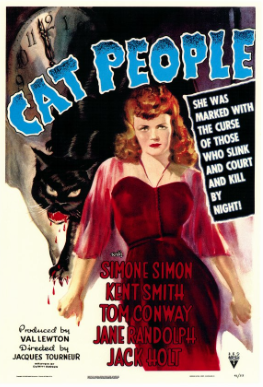
The 1942 horror classic Cat People is often described as being a horror film where, up until the last few minutes, the monsters are mostly psychological. And there is some definite truth to that. The title creatures remain a mystery for the majority of the film and, up until those final minutes, the audience would have every right to wonder whether or not they actually existed. This is a film that seems to take place almost totally in the shadows, a film noir without detectives or gangsters but featuring a memorable and compelling femme fatale.
However, I would argue that there is a monster who is present on-screen long before the audience first sees the shadowy form of a cat person. That monster is named Louis Judd and he’s the true villain of this story. As played by Tom Conway, Louis Judd is a psychiatrist and, from the minute we first see him, we know that he’s not to be trusted. He’s far too smooth for his own good and his soothing tones barely disguise the arrogant condescension behind his words. If his pencil-thin mustache didn’t make him sinister enough, Dr. Judd also keeps a sword concealed inside of his walking stick.
Irena Reed (Simone Simon) is one of Dr. Judd’s patients. A fashion designer from Serbia, Irena has recently married an engineer named Oliver Reed (Kent Smith). Despite the fact that she loves Olivier, she cannot bring herself to be intimate with him. As Dr. Judd discovers, Irena fears that she has been cursed and, if she ever allows herself to become aroused, she will be transformed into a panther. Dr. Judd repeatedly tells her that her belief is just superstition and that her fears are the result of repressed trauma from her childhood. When Irena refuses to accept his diagnosis and continues to insist that she is cursed, Dr. Judd assumes that he can prove her wrong by forcing himself on her. (Big mistake.)
Meanwhile, Oliver loves Irena but her refusal to consummate their marriage is driving him away. He finds himself growing more and more attracted to his co-worker, Alice (Jane Randolph). At first, Irena is upset to discover that Oliver has been telling Alice about their problems. But eventually Irena realizes that all she can do is watch as Oliver and Alice grow closer and closer. Irena knows that she can’t give Oliver what he desires but the confident and outspoken Alice can. As Irena grows more and more jealous, Alice starts to feel as if she’s being watched and followed. She starts to hear growls in the shadows and when she’s at her most vulnerable — swimming alone at night — she is shocked when Irena suddenly appears and demands to know where Oliver is.
And really, that’s what makes Cat People such a great film. It’s not necessarily a scary film, at least not to modern audiences. Sadly, we have seen so much graphic real-life horror and have become so jaded by CGI that we’re no longer scared by the mere cinematic suggestion of a monster. But the film still works because we can relate to both Irena and Alice. When I look over my relationships, I can see times when I’ve been both the insecure Irena and the confident Alice. For a film where the word “sex” is never uttered once, Cat People is a penetratingly honest look at relationships, love, and sexuality.
We started out this day by taking a look at Bette Davis in Of Human Bondage so it seems only appropriate that today’s final entry in Embracing the Melodrama should be another film in which Bette Davis plays a potentially unlikable character who is redeemed by being the most interesting person in the film.
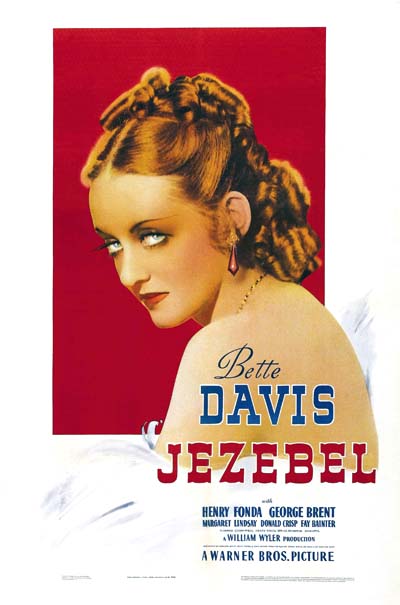
The 1938 best picture nominee Jezebel stars Bette Davis as Julie Marsden, a strong-willed Southern belle who lives in pre-Civil War New Orleans. Julie is looking forward to an upcoming ball but is frustrated when her fiancée, boring old Pres (Henry Fonda), says that he has to work and declines to go shopping for a dress with her. Impulsively, Julie does exactly what I would do. She buys the most flamboyant red dress that she can find.
Back in the old South, unmarried women were expected to wear white to formal balls, the better to let everyone know that they were pure and innocent and waiting for the right man. When Julie shows up in her red gown, it’s a scandal and, upon seeing the looks of shock and disdain on everyone’s faces, Julie wants to leave the ball. However, Pres insists that Julie dance with him and he continues to dance with her, even after the orchestra attempts to stop playing music.
And then he leaves her. At first, Julie insists to all who will listen that Pres is going to return to her but it soon becomes obvious that Pres has abandoned both Julie and Southern society. Julie locks herself away in her house and becomes a recluse.
Until, a year later, Pres returns. At first, Julie is overjoyed to see that Pres is back and she’s prepared to finally humble herself if that means winning back his love. But then she discovers that the only reason that he’s returned to New Orleans is to warn people about the dangers of Yellow Fever.
Oh, and he’s also married.
To a yankee.
For the most part, Jezebel is a showcase for another fierce and determined Bette Davis performance. It’s easy to be judgmental of a character like Julie Marsden but honestly, who doesn’t wish that they could be just as outspoken and determined? It helps, of course, that the film surrounds Julie with a collection of boring and self-righteous characters, the type of people who you love to see scandalized. Henry Fonda gives one of his more boring performances in the role of Pres while Margaret Lindsay, in the role of Pres’s Northern wife, is so saintly that she reminds you of the extremely religious girl in high school who would get offended whenever you came to school wearing a short skirt. In a society as rigid, moralistic, and judgmental as the one portrayed in Jezebel, it’s impossible not to cheer for someone like Julie Marsden.
Add to that, I totally would have worn that red dress too! In a world that insisted that all women had to act a certain way or look a certain way and think a certain way, Julie went her own way and, regardless of what boring old Pres may have thought, there’s a lesson there for us all.
When watching Jezebel, it helps to know a little about film history. Bette Davis very much wanted to play Scarlett O’Hara in Gone With The Wind and was reportedly very disappointed when the role went to Vivien Leigh. Depending on the source, Jezebel is often described as either being Davis’s audition for the role of Scarlett or as being a consolation gift for losing out on the role. Either way, Jezebel is as close as we will ever get to seeing Bette Davis play Scarlett. Judging from the film, Davis would not have been an ideal Scarlett. (Whereas Gone With The Wind works because Leigh’s Scarlett grows stronger over the course of the film, Davis would have started the film as strong and had nowhere left to go with the character.) However, Davis was a perfect Julie Marsden.

 Through the Shattered Lens