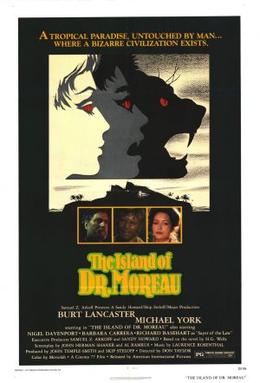
The Island of Dr. Moreau (1977, directed by Don Taylor)


After the ship that he’s working on sinks, engineer Andrew Braddock (Michael York) washes up on an uncharted island. It’s a beautiful island but it quickly proves dangerous as another survivor of the sinking is killed by wild animals. The injured Braddock passes out and when he wakes up, he’s being cared for by a mysterious scientist named Moreau (Burt Lancaster).

Braddock discovers that the island is populated by creatures that are half-human and half-animal. Led by the Sayer of the Law (Richard Basehart), these creatures are the results of experiments conducted by Moreau and his assistant, Montgomery (Nigel Davenport).  Moreau’s experiments are expected to obey Moreau’s laws.  Should they fail, they will be taken to the House of Pain and punished.  When Baddock objects to Moreau playing God, Moreau plots to reverse the experiment on Braddock and turn him into an animal. Even as he falls in love with a former cheetah (played by Barbara Carrera), Braddock realizes that he must escape the Island of Dr. Moeau.

This is the forgotten adaptation of H.G. Wells’s classic novel, as well as being the most faithful. The Island of Lost Souls, from 1932, is considered to be a classic. The third version, directed by John Frankenheimer and starring Marlon Brando and Val Kilmer, is a legendary disaster. This version, though, is usually overlooked. It’s also my favorite of the three but that might be because it was the first version that I ever saw. It’s a straight-forward version of H.G. Wells’s story of science gone mad with director Don Taylor not wasting any time getting the action started. Michael York, always an underrated actor, convincingly portrays Braddock’s outrage and his struggle to maintain his humanity after Moreau starts to experiment on him while Carrera is beautiful and mysterious as Maria. Probably the film’s biggest surprise is Burt Lancaster, who turns out to be ideally cast as Moreau. More subdued than either Charles Laughton or Marlon Brando, Lancaster plays Moreau as a brilliant but callous man who is too arrogant to realize that he’s become as much of an animal as those he claims to be perfecting.  What makes Lancaster’s Moreau so disturbing is that he doesn’t have the excuse of being insane.  Instead, he’s just too stubborn to admit that he’s potentially made a huge mistake.

It may be forgotten but this still the version of The Island of Dr, Moreau that I would recommend.
(Trailer courtesy of Classic Movie Reviews)

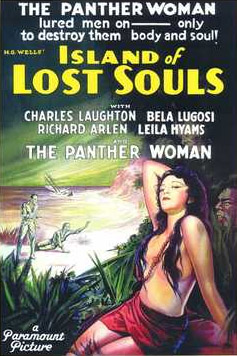
Horror Film Review: Island of Lost Souls (dir by Erle C. Kenton)


islandoflostsouls

In the 1932 film Island of Lost Souls, Ruth Thomas (Leila Hyams) has reason to be concerned.  She’s on the island of Samoa, awaiting the arrival of her fiancée, Edward Parker (Richard Arlen).  When Parker’s boat doesn’t show up, it can only mean one thing.  He’s been shipwrecked!  Did he survive or was he lost at sea?

Well, Ruth need not worry.  Parker did survive being shipwrecked.  He was picked up by a freighter carrying a wide selection of animals to an isolated island.  Unfortunately, when Parker complained about the way that Parker was abusing some of his admittedly odd-looking passengers, the captain responded by dumping Parker on that island as well.

On the island, Parker becomes the guest of Dr. Moreau (Charles Laughton) and his assistant, Montgomery (Arthur Hohl).  Parker also meets and finds himself becoming attractive to the seemingly naive Lota (Kathleen Burke).  Though Moreau seems to be a good host, Parker grows suspicious of him.  It turns out that there’s a room in Moreau’s compound, a room that Lota calls “the house of pain.”  At night, Parker can hear horrifying screams coming from the room.

Initially believing the Moreau is torturing the island’s natives, Parker soon discovers an even more disturbing truth.  Moreau has been experimenting with trying to transform animals into humans.  Lota, it turns out, was once a panther and the woods surrounding the compound are full of other Moreau creations.  Though Moreau claims that his intentions are benevolent, he rules his island like a dictator.  The animal-men are kept in line by the Sayer of the Law (Bela Lugosi) and any transgressions are punished in the House of Pain…

The Island of Lost Souls was the first cinematic adaptation of H.G. Wells’s The Island of Dr. Moreau.  (Perhaps the most famous adaptation came out in 1996 and is the subject of Lost Souls, a fascinating documentary that, I believe, can still be found on Netflix.)  I watched it last night on TCM and I have to admit that I had a mixed reaction to it.  On the one hand, the film’s atmosphere of mystery and danger is palpable and Charles Laughton’s performance definitely set a standard for all misguided scientists to follow.  The human-animals are fantastic creations and  the film’s ending still has some power.  Bela Lugosi’s performance of the Sayer of the Law was superior to his work as Dracula.  (As shown by both this film and Ninotchka, Lugosi was an outstanding character actor.)  Kathleen Burke also does a great job as Lota, which makes it all the more interesting that she was apparently cast as a result of winning a contest that was sponsored by Paramount Pictures.

(On a personal note, I always find it amusing that pre-code films always feature at least one scene of an actress removing her stockings, even if the scene itself has next to nothing to do with the rest of the film.  In this case, the legs belong to Leila Hyams.)

On the negative side, Richard Arlen is not a particularly interesting hero and, from a contemporary point of view, Island of Lost Souls is a rather slow-moving film.  Watching it today requires modern audiences to make a bit of an adjustment to their expectations.

With all that in mind, I still recommend Island of Lost Souls.  Watch it for Charles Laughton and Bela Lugosi.  Watch it as a valuable piece of cinematic history.

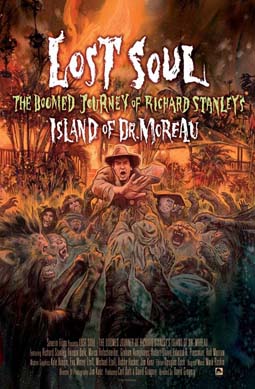
The Things You Find On Netflix: Lost Soul: The Doomed Journey of Richard Stanley’s The Island of Dr. Moreau


lostsoul

I have never actually seen the 1996 film The Island of Dr. Moreau but I certainly have read a lot about it.

It’s one of those films that seems to get mentioned whenever film critics start talking about the worst films of all time and, as a result, the story of the film’s production has become legendary.  The film’s shoot was difficult, for reasons of both nature and human nature.  The film was shot in the inhospitable Australian rain forest and shooting was briefly shut down due to a sudden hurricane.   Richard Stanley, the original director, was unceremoniously fired by New Line Cinema and apparently proceeded to go native in the Australian wilderness, smoking a huge amount of weed while the studio executives feared that he would return and burn down the set.  Veteran director John Frankenheimer was brought in to finish the film and clashed immediately with the film’s notoriously eccentric and difficult stars, Val Kilmer and Marlon Brando.

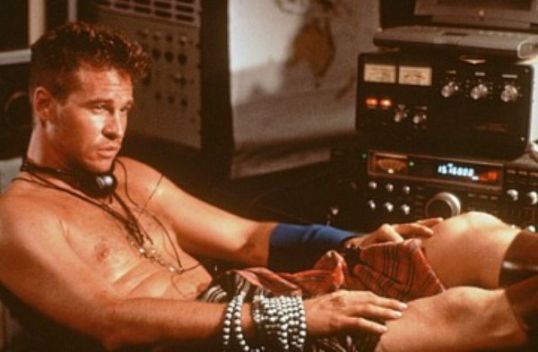
And I have to admit that, every time I read about The Island of Dr. Moreau, there’s a part of me that wants to track down and watch this film and see how bad it could possibly be.  But, every time I find myself too tempted, I think about a shirtless Val Kilmer lounging around in a kilt and I quickly change my mind.

Val

Bleh!

Fortunately, if I want to get a feel for the insanity behind the film’s production, I no longer have to actually watch The Island of Dr. Moreau.  Instead, I can just get on Netflix and watch an entertaining documentary called Lost Soul: The Doomed Journey of Richard Stanley’s The Island of Dr. Moreau.

Lost Soul could have just as easily been called Everybody Hates Val Kilmer.  Val himself declined to be interviewed for the documentary and I have to say that I think that was a huge mistake on his part because literally everyone who did agree to be interviewed appears to absolutely despise Val Kilmer.  It’s not so much that everyone tells a story about Val’s bad behavior as much as the fact that, decades later, everyone still seems to be so traumatized by the experience of having been  anywhere near him.  (German actor Marco Hofschnieder especially seems to take a lot of delight in doing a devastating yet hilarious imitation of Val Kilmer smoking a cigarette and complaining about every line of dialogue, regardless of whether it was his dialogue or not.)

The documentary also includes plenty of crazy Marlon Brando stories but there’s a noticeable difference between the Brando stories and the Kilmer stories.  Brando is portrayed as being an almost tragic figure, a great actor who hated his talent and, as a result, went out of his way to give performances that mocked the very idea of even trying to be good.  As annoyed as everyone seems to have gotten with Brando, there’s still an undercurrent of affection to the Brando stories.  That’s something that is definitely lacking from the Kilmer stories.

(According to the documentary, Brando was not a Val Kilmer fan.  When Kilmer asked Brando if he had visited the Australian reef, Brando replied, “I own a reef,” and reportedly didn’t speak to Kilmer for the rest of the shoot.)

As interesting as the stories about Brando and Kilmer may be, the heart of the film rests with Richard Stanley, the promising young South African director whose brief “mainstream” film career was pretty much derailed by the drama surrounding The Island of Dr. Moreau.  Interviewed at his home in France and captivating the audience with both his intense stare and his mordant sense of humor, Richard Stanley describes both his vision for The Island of Dr. Moreau and the pain of having that vision snatched away from him.  Not only does he confirm that, as has long been rumored, he did sneak back onto the set as an extra but he also explains that the production’s problems were largely due to a mishap involving a warlock named Skip.

Lost Soul makes for an interesting cautionary tale about what happens when an artist has to deal with the establishment.  Watch it with Jodorowsky’s Dune and have yourself a double feature of “what could have been” cinema.