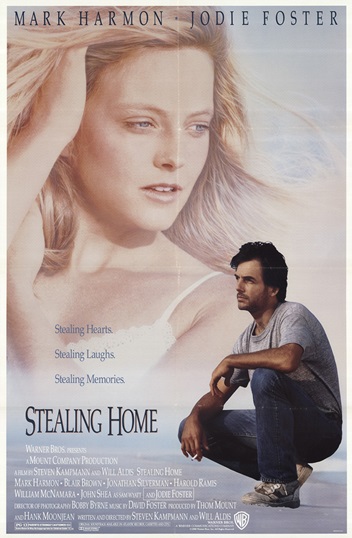
So, I Watched Stealing Home (1988, dir. by William Porter and Steven Kampmann)


Back in December, Lisa agreed to watch a baseball movie with me to make up for making me watch The Catcher in 2023.  The one we picked was Stealing Home, because it starred Mark Harmon and Jodie Foster and it looked like it would be a sweet movie.

Stealing Home opens with Billy Wyatt (Mark Harmon), a minor league baseball player who is getting ready to take the field and who is standing for the National Anthem.  I immediately liked Billy because he was standing for the Anthem and not taking a knee.  I also like aging minor leaguers because they’re still playing the game even though they know they’ve probably missed their window to move up to the majors.  Billy Wyatt loves both the game and his country.

As Billy waits to play ball, he thinks about another type of love, the love that he had for Katie Chandler (Jodie Foster).  Katie was six years older than him and encouraged him to always pursue his dreams, whether it was in baseball or love.  The movie flashes back to Billy living in a motel with a cocktail waitress and getting a phone call from his mother who tells him that Katie has committed suicide and she wants Billy to spread her ashes at a special place.  Billy then flashes back to his childhood and his teen years, in which he’s played by William McNamara who does not look like he could ever grow up to be Mark Harmon.  Billy’s best friend is Alan Appleby, who is played as a teenager by Jonathan Silverman and as an adult by Harold Ramis.  Jonathan Silverman growing up to be Harold Ramis seems even more unlikely than William McNamara becoming Mark Harmon.  Billy remembers losing his virginity to Appleby’s prom date, losing his dad to a car wreck, and a Fourth of July weekend that he spent on the beach with Katie and his mom (Blair Brown).

Only Jodie Foster plays Katie Chandler and we only see Katie thorough Billy’s eyes.  Jodie Foster gives a lively performance as Katie but she always more of a plot device than a fully rounded character.  We never find out why Katie killed herself.  Her father says that Katie was unhappy during her adult life but why?  Even after Billy gets her ashes and tries to figure out where she wanted him to spread them, he never thinks about why she killed herself.  In fact, he hadn’t even talked to her for years.  That really bothered me.

The movie ends with Billy stealing home during a game and proving that he’s still got it as far as baseball goes.  I love baseball but I still felt like Katie’s untold story was probably more interesting than Billy’s.  I liked Mark Harmon’s performance and I really wanted to like Stealing Home more than I did.  I wish the movie had been more about who Katie was instead of being about who Billy thought Katie was.
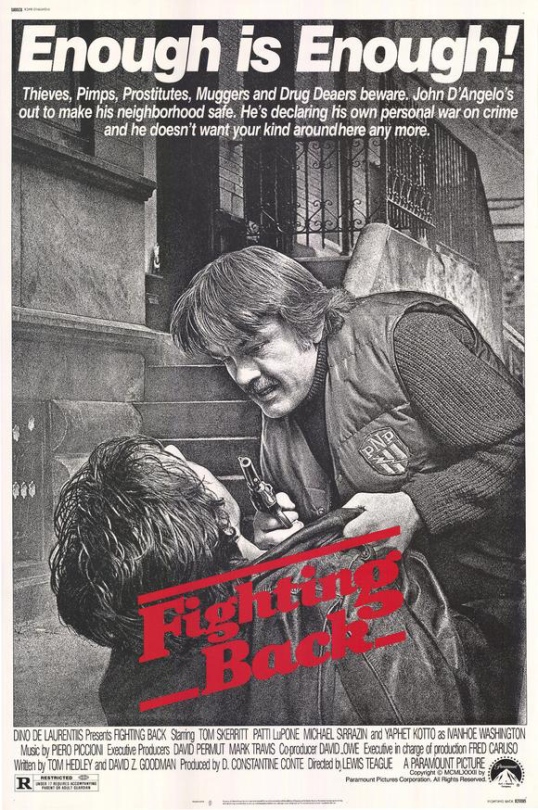
A Movie A Day #38: Fighting Back (1982, directed by Lewis Teague)


fightingbackpost

The time is 1982.  The place is Hell on Earth, also known as Philadelphia.  Crime is out of control and the police are powerless to stop it.  When deli owner John D’Angelo (Tom Skerritt) and his wife, Lisa (Patti LuPone), confront a pimp named Eldorado (Pete Richardson), he rams his car into the back of their car, causing the pregnant Lisa to lose her unborn child.  At almost the exact same time, John’s mother (Gina DeAngles) is mugged by two thugs who chop off her ring finger.

In the grand tradition of Charles Bronson, John decides to fight back.  But he doesn’t go it alone.  With his best friend, a police officer named Vince (Michael Sarrazin), John starts the People’s Neighborhood Patrol.  The PNP is going to clean up Philadelphia, one street at a time.  The media (represented by David Rasche) make John into a celebrity.  The black community (represented by Yaphet Kotto) suspect that John and the PNP are guilty of racial discrimination.  The Mafia wants to bring John over to their side.  John runs for city council but he still has time to drop a grenade in a pimp’s car.

Fighting Back was one of the many urban vigiliante films to come out after the success of Death Wish.  Fighting Back‘s producer, Dino De Laurentiis, also produced Death Wish but made the mistake of later selling the rights to Cannon.  Fighting Back was not the box office success that either Death Wish or its sequels were, even though Fighting Back is actually the better movie.  That’s because Fighting Back was directed by the underrated Lewis Teague.  Teague does a good job of making Philadelphia look like a war zone and the scenes of vigilante justice are enjoyable but, overall, Teague takes a far more ambiguous approach to vigilantism than Michael Winner did when he directed Death Wish.  As vile as Philadelphia criminals may be, John D’Angelo isn’t always that likable himself.  When Kotto accuses John and the all-white PNP of being racially prejudiced, Teague suggests that he has a point.  Tom Skerritt gives a good performance, playing John as a proud, blue collar guy who wants to do the right thing but gets seduced by his newfound celebrity.

Better acted than Death Wish and smarter than The Exterminator, Fighting Back is an underrated vigilante gem.

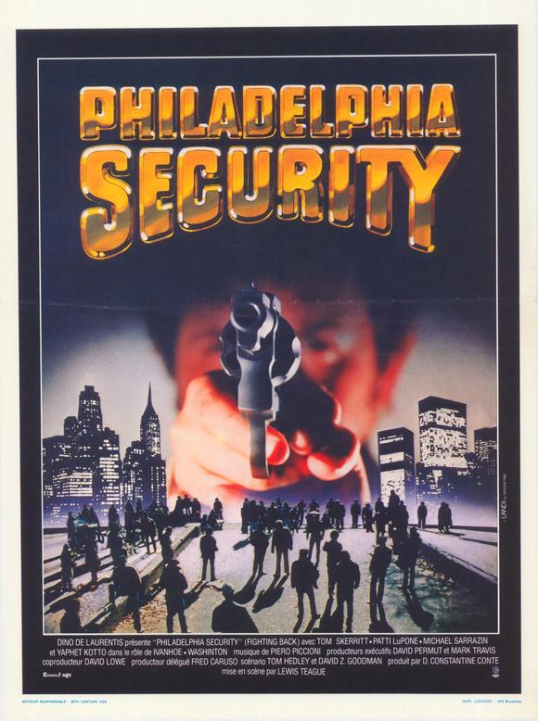
Fighting Back is also known as Philadelphia Security and Death Vengeance.

Fighting Back is also known as Philadelphia Security and Death Vengeance.

The TSL’s Daily Horror Grindhouse: Amityville II: The Possession (dir by Damiano Damiani)


amityville_ii_the_possession

Agck!

The 1982 “prequel” Amityville II: The Possession is a film that is so grimy and icky and yucky and disgusting that you’ll want to take a shower right after you watch it.  And then you’ll probably end up taking two more showers, just to be sure that you’ve washed the film away.

Seriously, this is an amazingly disturbing film.

Claiming to show how that infamous house in Amityville, New York came to be haunted in the first place, this film opens with The Montelli Family moves into a big house with quarter moon windows.  The family patriarch is Anthony (Burt Young), a former cop who walks with a cane.  Anthony is an angry monster, an abusive husband, and a terrible father.  His wife, Dolores (Rutanya Alda), lives her life in denial, insisting that a new house means a new beginning and continually praying that her family will find peace.  Anthony and Dolores have four children.  The two youngest are at the mercy of their angry father.  Teenagers Patricia (Diane Franklin) and Sonny (Jack Magner) are both looking forward to the day that they can escape their family.

As soon as the Montellis move in, strange things start to happen.  It turns out that there’s a strange tunnel in the basement, one that appears to lead to nowhere.  When obscene messages appear on the walls of the house, Anthony starts to beat the youngest children but, fortunately, Sonny grabs a rifle and points it at his father’s head.  When the local priest, Father Adamsky (James Olson), shows up to bless the house, he ends up getting so disgusted at Anthony that he leaves without finishing.

In fact, Father Adamsy is a remarkable ineffectual priest.  When he attempts to talk to Sonny, he simply assumes that Sonny isn’t talking because he’s rude.  What Adamsky doesn’t suspect is that Sonny’s being rude because he’s been possessed by a demon for the basement!  When Patricia confesses that she and Sonny have been having sex, Adamsky doesn’t do anything about it.  When Patricia tries to call him to let him know that her brother appears to be possessed, Adamsky refuses to answer the phone and instead goes skiing for the weekend.

And, of course, while Adamsky is gone, Sonny grabs that rifle and, in a nightmare-inducing series of scenes, kills everyone in the house…

Of course, when Father Adamsky returns, he feels guilty and he decides to perform an exorcism.  MAYBE HE SHOULD HAVE DONE THAT EARLIER!  But no … he had to go skiing…

Anyway, Amityville II: The Possession is a deeply icky film.  It’s undeniably effective and has a lot of scary moments but it’s not an easy film to sit through.  Between Anthony beating his family and Sonny walking into Patricia’s room and asking her to “play a game,” this is a film that really gets under your skin.  You’ll never forget it but, at the same time, you’ll also never want to watch it again.

Interestingly enough, Amityville II was directed by Damiano Damiani, an Italian director who is probably best known for movies like A Bullet For The General and Confessions of a Police Captain, genre films that often featured a subversive political subtext.  Though Amityvile II is not overly political, the film’s portrait of the suburban Montelli family as a ticking time bomb does definitely fit in with Damiani’s other work.  Damiani reportedly set out to make the most disturbing film that he possibly could and he succeeded.