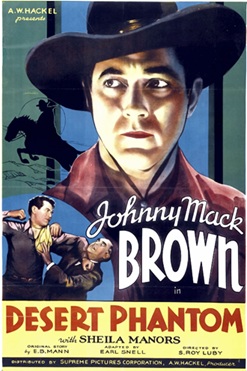
Desert Phantom (1936, directed by S. Roy Luby)


In a frontier town, rancher Jean Halloran (Sheila Bromley) has a big problem.  Someone is shooting and killing all of her ranch hands and sending her notes in which he tells her to give up her ranch and leave town.  When an ammunition salesman and trick shooter named Billy Donavon (Johnny Mack Brown), Jean hires him to serve as a bodyguard and to track down the mysterious Phantom.  Billy, however, has a secret of his own.

Desert Phantom is a remake of an old Harry Carey film.  I don’t know why Poverty Row did remakes since all of their films pretty much had the same plot regardless.  A stranger comes into town and gets involved with a female rancher and a bad guy who is trying to hide his actual identity.  In this one, Nelson McDowell gets to supply the comic relief as a befuddled veterinarian while familiar faces like Ted Adams and Karl Hackett are there to keep us guessing about how the Phantom could actually be.  If you’ve watched enough of these movies, though, you’ll always be able to guess who the bad guy is.

This isn’t the best of Johnny Mack Brown’s movies.  The Phantom’s story seems like it could have been interesting but that would have meant taking more risks than most of the Poverty Row studios were willing to do.  Johnny Mack Brown is as convincing a cowboy as always and is the film’s saving grace.  Brown was a western star precisely because he could make even something like Desert Phantom watchable.
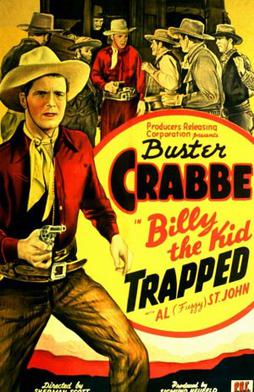
Billy The Kid Trapped (1942, directed by Sam Newfield)


Billy “The Kid” Bonney (Buster Crabbe) and his two buddies Fuzzy (Al St. John) and Jeff (Bud McTaggart) are just trying to mind their own business and make a living in the old west but they keep getting accused of every crime that happens.  This time, they’re sentenced to hang for a crime they didn’t commit.  Luckily, a group of strangers break Billy and his friends out of jail and send them on their way to the next town.  However, the men who broke them out of jail are soon committing crimes while disguised as Billy, Fuzzy, and Jeff!  Billy teams up with Sherriff Masters (Ted Adams) to stop the imposters, who are working for Boss Jim Stanton (Glenn Strange).

One of the joys of Poverty Row westers like this one is that they always featured the same stock company.  Al St. John was everyone’s sidekick.  Ted Adams was often a sheriff.  Glenn Strange was always the criminal mastermind pulling the strings.  Milton Kibbee was always a corrupt judge or ranch owner.  George Cheseboro, Horace B. Carpenter, Jack Curtis, and Budd Buster are amongst the very familiar faces in Billy The Kid Trapped.  It gives each film a homey feel that will be appreciated by fans of the genre.  The hero of the films often changed but the stock company always remained the same.

I like the idea behind Billy The Kid Trapped but the film still feels repetitive, even though it’s less than an hour long.  After Billy captures the men who are imitating him and his friends, a crooked judge sets the men free and the immediately go back to imitating Billy.  Billy has to capture them all over again.  No wonder Billy aged so quickly!  (Buster Crabbe was in his mid-thirties when he was playing The Kid.)  The movie does have all the usual gunfights and horse chases that people watch these movies for.  It’s comforting that, no matter what, the villain is always going to turn out to be Glenn Strange.

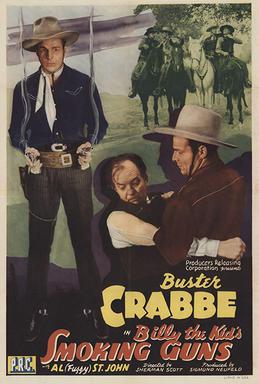
Billy The Kid’s Smoking Guns (1942, directed by Sam Newfield)


It’s a tale as old as time.  During the days when the west was wild, the U.S. Army is planning on setting up a new outpost near a town so the bad guys want to run all the ranchers off of their land so that they can be the ones to sell it.  Sheriff Carson (Ted Adams) is corrupt and working for the bad guys so the ranchers have to turn to Billy the Kid (Buster Crabbe) and his sidekicks, Jeff (Dave O’Brien) and Fuzzy (Al St. John) for help.  When Jeff is wounded in a fight, Fuzzy takes him to Doc Hagen (Milton Kibbee), little suspecting the doctor is actually the leader of the bad guys and using his medical practice to kill anyone who won’t give up their land!

Coming to us straight from Poverty Row, this B-western is interesting in that it seems to take a very cynical view of law enforcement.  Sheriff Carson is corrupt and Billy and his friends are running from the law themselves.  Buster Crabbe’s Billy the Kid films always kept it unclear why Billy was in trouble with the authorities.  Crabbe’s Billy the Kid always seemed to be the nicest guy in the west.  (Of course, Crabbe was also 33 and no longer seemed like he should have been known as “the Kid.”)  Eventually, the series was retconned and Buster Crabbe was no longer playing Billy the Kid but instead he was playing an upstanding citizen named Billy Carson.

Crabbe may not be a convincing outlaw but he is a convincing hero, which is all these films really required.  Billy the Kid’s Smoking Guns is a little bit interesting because of the character of Doc Hagen, whose occupation makes him a little more memorable than typical B-western bad guy.  The film is also interesting in that, for once, there’s no love interest.  Instead, it’s just men in hats shooting at each other.  That probably made the film’s youthful target audience happy.

The real-life Billy The Kid was killed when he was only 21 and after he had been an outlaw for only three years.  Buster Crabbe would g0 on to play Billy (or o some variation of Billy) until he was closing in on 40.


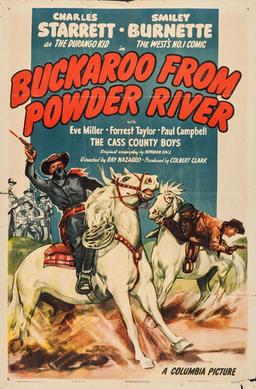
Buckaroo From Powder River (1947, directed by Ray Nazarro)


Pop Ryland (Forrest Taylor) is a frontier outlaw who makes law-breaking a family business.  With his two sons, Pop is planning on flooding the territory with counterfeit bonds.  His stepson, Tommy (Paul Campbell), doesn’t want anything to do with any criminal activity so Pop sends for McCall (Frank McCarroll), an assassin.  In a letter, Pop explains that he wants his stepson murdered.  When federal agent Steve Lacey (Charles Starrett) captures McCall, he finds the letter.  Steve heads into town and goes undercover, pretending to be McCall.  He also uses his other identity, the Durango Kid, to thwart Pop’s plans.

More than usual, this Durango Kid film leans more into the undercover aspect of Steve’s work.  What’s interesting is that, after Tommy fakes his own death, Tommy also disguises himself as the Durano Kid and keeps his stepfather from suspecting that Steve is actually a member of law enforcement.  It’s actually pretty clever, as far as these movies go, and it answers the question of why no one ever wonders why Steve and Durango are never in the same place at the same time.

Smiley Burnette shows up as Steve’s sidekick and he sings a few songs with the The Cass County Boys.  Along with Smiley’s antics, this film has all of the horse chases and gunfights that we expect from a Durango Kid movie.  Most of the usual stock company is present, including Ted Adams and Kermit Maynard.  As always, Charles Starrett looks authentic riding horse and handling a gun.  If you’re not into westerns, this film won’t convert you.  But, for fans of the genre, this is another entertaining outing for the Durango Kid,

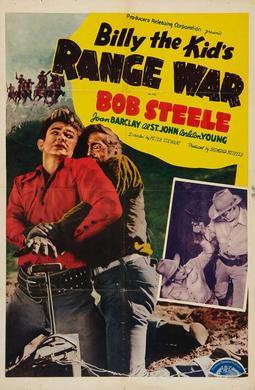
Billy The Kid’s Range War (1941, directed by Sam Newfield)


Billy the Kid was a big damn hero.

At least that’s the claim of Billy The Kid’s Range War, in which Billy (played by middle-aged Bob Steele) is a do-gooder with a comedic sidekick named Fuzzy (Al St. John) and a hankering to help Ellen Gorman (Joan Barclay) bring a new stagecoach line to town.  Williams (Karl Hackett) does want to the Gorman family to success so he hires Buck (Rex Lease) to dress up like Billy the Kid and ride a horse that looks like Billy the Kid’s and commit crimes, like killing Ellen’s father.  Framed for all those crimes that he didn’t commit and with his best friend (Carleton Young) ordered to arrest him, Billy decides to go under cover so that he can clear his good name.  Someone pretending to be Billy the Kid got him into this mess.  Now, Billy’s going to get out of it by pretending to be someone else.

The action is pretty standard for a B-western.  Mostly, it’s interesting to see a movie where Billy the Kid is actually a nice guy who gets framed.  No wonder a whole generation grew up with no idea about true history of the American frontier.  Sam Newfield directed a handful of Billy the Kid films and the capable Bob Steele starred in most of them but this is the only one that I’ve sat down and watched and it actually left me missing the production values of the Johnny Mack Brown films.  For fans of these type of westerns, there’s the promise of seeing familiar actors like George Cheseboro and Ted Adams doing there thing.  Even the outstanding character actor Milton Kibbee makes an appearance.  For those who do not like westerns, this film is not going to change their minds.

Despite the promise of the title, there is no range war in this movie.  There’s just Billy the Kid, trying to clear his good name.

Guns In The Dark (1937, directed by Sam Newfield)


In Mexico, two American cowboys, Johnny Darrel (Johnny Mack Brown) and Dick Martin (Julian Madison) join a poker game to try to win some money and help out their buddy, Oscar (Sid Saylor).  When they discover that cantina owner Manuel Mendez (Ted Adams) has rigged the game, a fight breaks out.  The lights turn off.  In the darkness, several guns are fired.  When the lights come back up, Dick is dead.  Mendez convinces Johnny that he accidentally shot his friend in the fight.  Guilt-stricken, Johnny tosses aside his guns and returns to Texas.

Johnny has sworn that he will never shoot another gun but when he’s hired to work at a ranch owned by Joan Williams (Claire Rochelle), he finds himself in the middle of a range war between Joan and Brace Stevens (Dick Curtis), with Mendez also making an unwelcome return to Johnny’s life.  Even after Johnny discovers the truth about what happened that night at the cantina, he doesn’t pick up a gun.  Instead, Johnny fights the bad guys with lassos and plates.

Guns In The Dark is only 54 minutes long and it features actors who will be familiar to any fan of the old B-westerns.  Sidekcick Sid Saylor’s stuttering schtick gets old quickly but Johnny Mack Brown is as likable as always in Guns In The Dark and he comes across as being an authentic cowboy even when he’s not carrying a gun  Given that this film features even more horse chases than the typical Johnny Mack Brown b-western, it’s good that Brown is so convincing.  What isn’t convincing is how stupid Johnny Darrel is required to be in order for him to fall for Mendez’s lie in the first place.  I appreciated the change of pace from Brown just using a gun to stop the bad guys but I wish the reason behind it had been more convincing.  This isn’t one of Johnny Mack Brown’s more memorable westerns though, as always, it’s easy to see why he was one of the early stars of the genre.


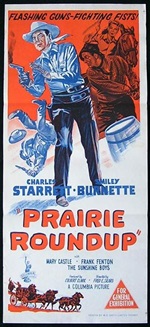
Prairie Roundup (1951, directed by Fred F. Sears)


Steve Carson (Charles Starrett) is wanted for murdering the Durango Kid!

I know that sounds confusing because Steve Carson is the Durango Kid.  The bandit that Carson shot was just disguised as the Durango Kid but actually, he was just a dim-witted outlaw who was set up by Buck Prescott (Frank Fenton), a rustler who was run out of Texas by Steve and who was trying to find a way to stop Steve from investigating his new scheme to cheat a bunch of ranchers in Santa Fe.

Steve is taken to jail but luckily, Smiley Burnette is around to help him break out.  Smiley and Steve head to Santa Fe, where they get jobs working as cowhands at the Eaton Ranch and work to expose Prescott and his gang as being responsible for a series of stampedes.  Smiley sings some songs and Steve resurrects the Durango Kid from the dead.

This was one of the later Durango Kid films.  The range war plot is one that showed up in many Durango Kid films but Prairie Roundup adds something new to the formula but having Steve framed for murdering himself.  Steve could prove his innocence by revealing that he’s actually the Durango Kid but Steve is determined to maintain his secret identity.  I’ve seen several Durango Kid films and I still don’t really understand why Steve felt he needed a secret identity in the first place.  But Prairie Roundup shows the extent to which he’ll go to keep it.

There’s plenty of fight and horse chases, more than enough to keep western fans happy.  Smiley Burnette gets to throw some punches along with singing all of his usual songs.  It’s also nice to see the lovely Mary Castle in the role of Toni Eaton, the daughter of one of the ranchers who has been targeted by Prescott.  Featuring less stock footage than usual, Prairie Roundup is a worthy entry in the Durango Kid series.