Review: Planet Dune (dir. by Glenn Campbell & Tammy Klein)


“We came here for a rescue mission, and now we’re just something on the menu.” — said by someone, maybe.

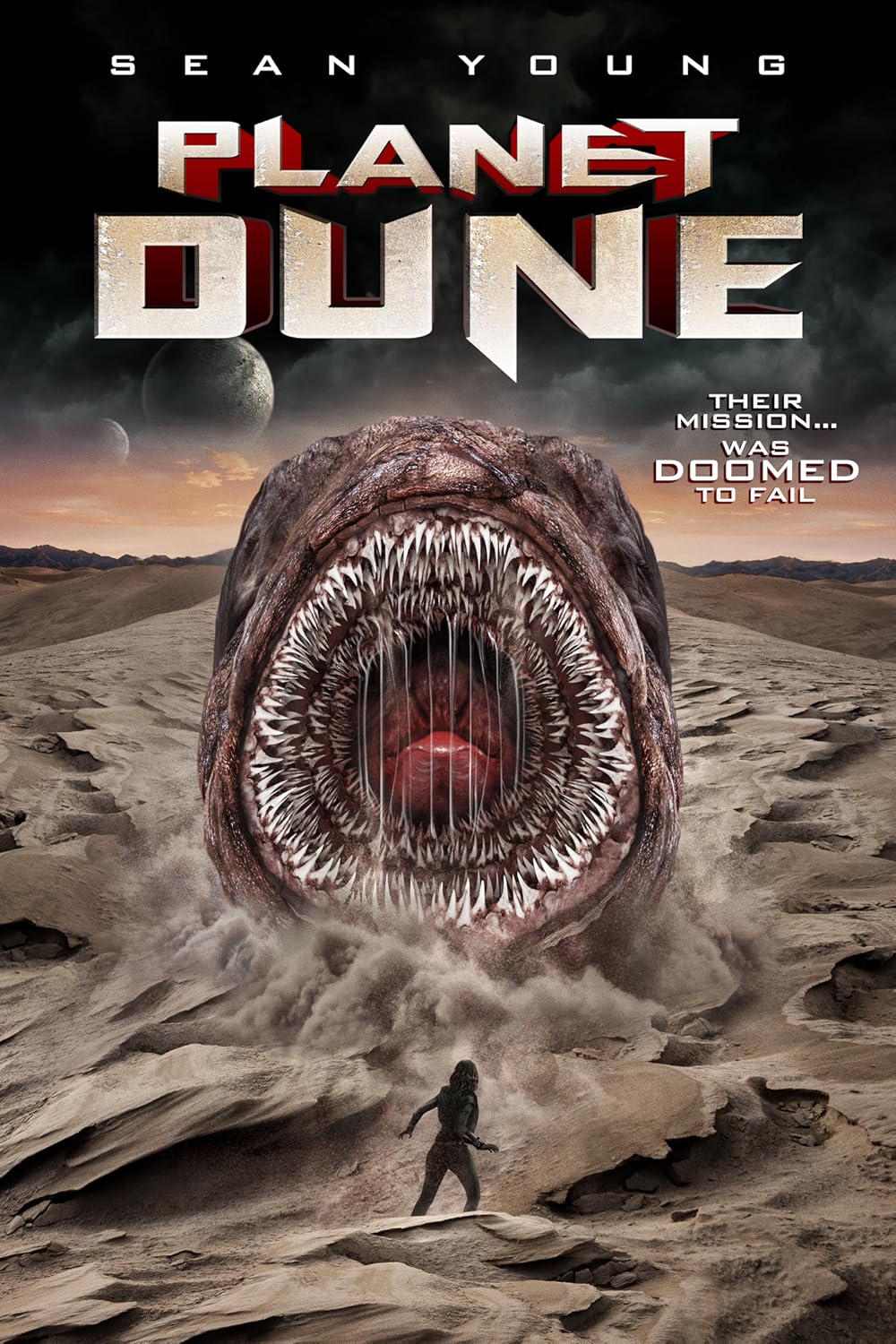
Planet Dune is a scrappy, low‑budget sci‑fi creature feature that knows exactly what it is, and that self‑awareness helps it go down easier. It is not a polished prestige production, but it does deliver a simple survival story, some intentionally goofy monster‑movie energy, and enough visual invention to keep genre fans from completely checking out. It also practically announces itself as another in‑name‑only knock‑off in the vein of The Asylum’s mockbuster factory, clearly trying to ride the coattails of Denis Villeneuve’s Dune: Part One. The timing, the desert‑planet setting, the sand‑worm menace, and the threadbare plot all feel calculated to cash in on the renewed mainstream buzz around the Dune name, rather than to build something original.

From the start, Planet Dune leans hard into its B‑movie identity. The setup is straightforward: a rescue mission heads to a desert planet, only to find itself trapped in a fight for survival against giant sand worms. That premise is thin, but the movie understands the appeal of the concept and does not waste time pretending to be deeper than it is. The result is a film that moves quickly, stays focused on its basic threat, and mostly avoids getting bogged down in overcomplicated mythology. At the same time, every decision feels like a stripped‑down version of choices made in Villeneuve’s Dune—just without the budget, scope, or attention to subtext. It’s the kind of project that exists because someone saw a big‑budget, heavily marketed Dune release and realized they could slap a vaguely similar title on a sand‑worm actioner and sell it to undiscerning genre fans.

What works best is the movie’s commitment to its own absurdity. The sand worms are the obvious attraction, and the film uses them as a constant source of danger rather than saving them for a single big reveal. That gives the story a pulpy urgency, and in a movie like this, momentum matters more than subtlety. The effects are clearly on a modest budget, but they are used with a certain charm, and the film often benefits from embracing cheapness instead of trying to hide it. That kind of approach can make a low‑budget creature feature feel more fun than fake grandeur ever could, even if it never comes close to matching the visual or thematic richness of Villeneuve’s work.

There is also a strange meta‑layer in the casting of Sean Young, who played Chani in David Lynch’s Dune (1984). Her presence turns Planet Dune into a weird echo chamber of the Dune universe: it’s a cheap, micro‑budget knock‑off trading on the name and imagery of a franchise, while also bringing in a legacy face from one of the older big‑screen adaptations. That gives the film a faintly nostalgic, almost self‑aware vibe, as if it’s winking at fans who know the history of Dune on screen, even while it rushes through a script that’s functionally just a monster‑survival thriller with a desert‑planet paint job. It’s a choice that underscores how this movie is less about telling its own story and more about trading on the weight of other people’s Dune work.

The pacing is also one of the movie’s stronger points. A lot of smaller sci‑fi films spend too much time explaining the world or padding out the runtime with empty dialogue, but Planet Dune keeps things relatively lean. It gets in, sets up the threat, and lets the characters deal with one problem after another. That makes it easier to forgive some of the rough edges, because the film does at least understand that the audience is here for monster attacks, not a lecture on space politics. Compared with Villeneuve’s slow‑burn world‑building and political maneuvering, Planet Dune feels like a stripped‑down amusement‑park version of the same concept: same core idea, none of the fuss.

That said, the movie is not above criticism. The biggest issue is that the characters are more functional than memorable. They do what the plot requires, but they are not written with enough personality to make every relationship or loss land with real weight. When the film pauses for emotional beats, those moments can feel undercooked because the script has not given the cast enough room to become more than survival‑movie placeholders. In a genre piece like this, that does not automatically sink the experience, but it does limit the impact, especially when viewers are already thinking of how Villeneuve’s Dune strained and expanded its characters across multiple films.

The performances are mixed in the way you would expect from a project like this. Nobody seems to be phoning it in, and that effort matters, but the material does not always give them much to build on. Some scenes benefit from the actors treating the material seriously, while others feel a little stiff because the dialogue is plainly there to move people from one danger zone to the next. The movie works best when it leans into the adventure and stops pretending it is a character drama. Sean Young gives a more grounded presence, but even that can’t fully offset how thin the script is; her casting feels more like a symbolic nod to Dune’s cinematic history than a way to deepen this particular story.

Visually, Planet Dune has the same plus‑and‑minus quality common to many independent sci‑fi films. The desert setting gives the movie a strong sense of scale, and even when the effects are rough, the barren environment helps sell the idea of isolation. At the same time, there are moments where the limitations are obvious, and the production does not always disguise them elegantly. Still, the film’s look is consistent enough that it rarely becomes distracting in a way that breaks the whole experience. Compared with Villeneuve’s meticulously composed frames and sweeping desert vistas, Planet Dune feels like a backyard‑budget cousin: same basic palette, significantly smaller scale.

There is also a pleasant lack of pretension here. Some genre movies try to compensate for weak writing by becoming self‑important, but Planet Dune seems content to be a monster chase with a space wrapper. That honesty is refreshing. It does not make the movie great, but it does make it easier to enjoy on its own terms. If you approach it like a serious epic, it will probably disappoint you, especially with the memory of Villeneuve’s Dune still fresh in your mind. If you approach it like a scrappy midnight movie—one that exists mainly because someone saw Dune in theaters and figured they could sell a knock‑off soundtrack on the same name—it has a better shot at working.

The film’s weaknesses are still hard to ignore. The story is very familiar, and viewers who have seen enough desert‑planet sci‑fi will recognize the beats immediately. There is also some repetition in how the danger is staged, and not every sequence feels equally inspired. A tighter script and a stronger sense of character could have lifted the whole thing a few notches. As it stands, Planet Dune is more effective as a mood piece and monster showcase than as a fully satisfying drama. It never reaches for the political, religious, or ecological weight of Villeneuve’s Dune, and it never really tries; it’s closer to a DVD‑rack detour for genre fans who just want sand worms and a vaguely Dune‑adjacent name.

What saves it is that it rarely feels cynical. Even when it is clumsy, it is trying to entertain rather than impress. That gives the movie a bit of personality, and personality goes a long way in low‑budget genre cinema. The casting of Sean Young, the desert‑planet premise, and the obvious Dune name‑play all point to a project that knows exactly what it is: a small‑scale, opportunistic creature feature that wants to surf the wave of a bigger franchise without the heavy lifting. It may not be the kind of film that wins over skeptical viewers, but it is also not a total write‑off. For viewers in the mood for a cheap, goofy, sandworm‑infested sci‑fi ride—one that openly trades on the legacy of both Villeneuve’s and Lynch’s DunePlanet Dune gets the job done on its own very modest terms.
Horror Film Review: Planet Dune (dir by Glenn Campbell and Tammy Klein)


Welcome to Planet Dune!

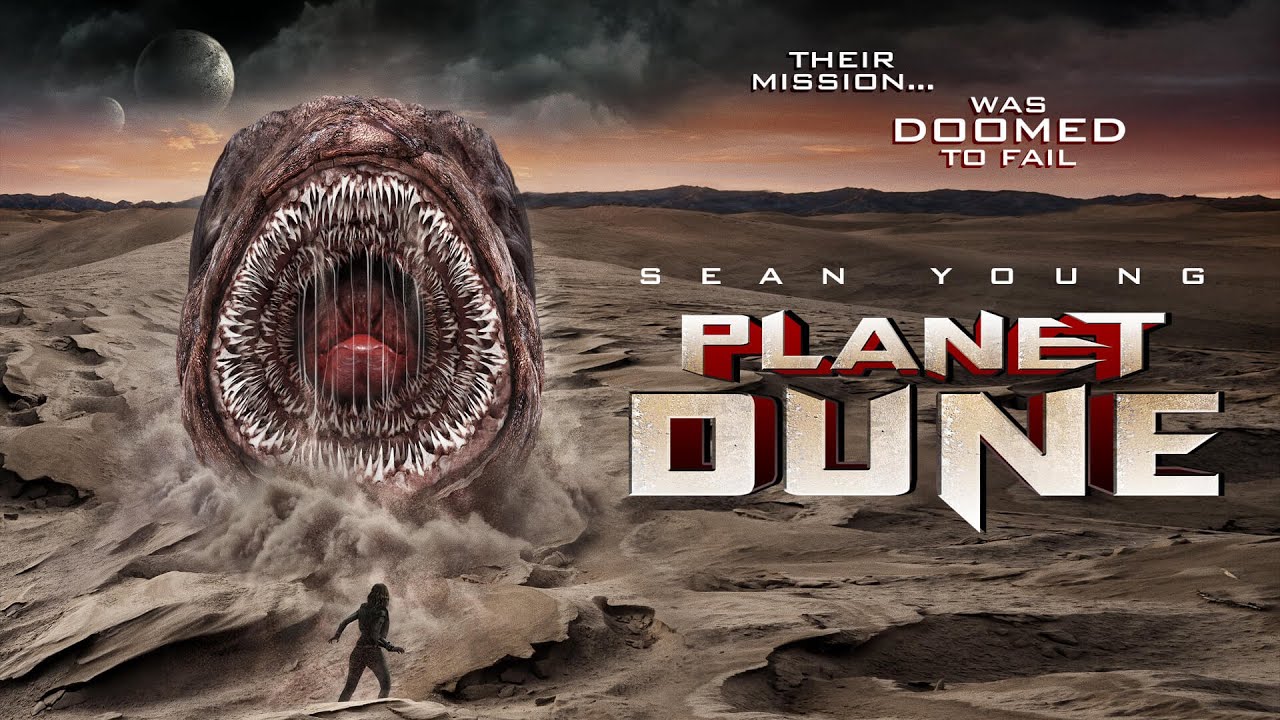
Now, don’t let the name of this 2021 film from the Asylum fool you.  Yes, the planet may be a desert.  And yes, there may be sandworms that burrow under the sand and which attack anyone foolish enough to be caught outside.  And yes, the planet is specifically referred to as being “Dune.”  Well, actually, it’s called Planet Dune but still….

That said, Planet Dune should not be mistaken for any film based on the novels of Frank Herbert.  There’s no spice.  There’s no Fremen.  There’s not intergalactic intrigue or environmental subtext.  There’s none of that nonsense with the Bene Geserits or whatever it is they were called.  There’s no Maud’Dib.  There’s no promised one.  Instead, there’s just a bunch of killer worms.  And really, that’s not so bad.  I mean, the worms are the main reason why people watch Dune, in the first place.  Planet Dune simply removed all of the extra stuff and concentrated on the worms.  Good for the Asylum!  Give the people what they want!

Planet Dune takes place in the far future.  America and Russia are rivals when it comes to conquering space.  After American Lt. Astrid (Emily Killian) defies orders and saves the life of a stranded cosmonaut, she’s put on probation and forced to command a “tug” ship.  She and her new crew are sent to Planet  Dune to rescue a previous expedition to the planet.  At first, Astrid doesn’t get along with her new crew.  They’re especially not happy when Astrid accidentally flies the tug straight into an asteroid field.  Things don’t get any better when, upon arriving on the planet, the crew is promptly attacked by the worms.  Can everyone make it back to the Tug and fly off to safety?  Will Astrid be able to resist her own addiction to — I’m not making this up — her family’s specially-brewed moonshine?  Who will make it back to the ship and what will be left of them?  It would help, of course, if Astrid could get some help but, when she requests backup, she is informed that people on probation are not sent any help, regardless of how bad the situation is.  In the future, the punishment for saving a man’s life is to be sent to a planet inhabited by killer worms.  That’s harsh!

As far as Asylum mockbusters are concerned, Planet Dune isn’t bad.  It’s actually about a hundred times better than anyone would have any reason to expect.  The film makes good use of its low-budget and the special effects are actually a bit charming in their cheapness.  It’s a bit like a live-action comic book and it’s a good deal less portentous than the official Dune movies.  It’s a fun, fast-paced movie about killer sandworms.  Really, what more could you want from a visit to Planet Dune? 

Well, how about a cameo appearance from Sean Young?  Young, of course, appeared in David Lynch’s adaptation of Dune.  In Planet Dune, she plays Astrid’s boss and gets to yell at her for defying the rules.  It’s a nice little inside joke.

2017 in Review: The Best of SyFy


Continuing my look back at the best of 2017, today is the day that I reveal my picks for the best SyFy movies and performances of the previous year!

But before I do that, a plea to the SyFy Network.  I make this plea every year and it never does any good.  It probably won’t do any good this year.  But still, I’m going to make it.  SyFy, give us more original films!  From a business point of view, I can understand why SyFy shifted their focus from movies to episodic television.  But I’m not a business person!  I’m a movie lover, one who has wonderful memories of when every weekend would bring another gloriously over-the-top SyFy movie.

Those were wonderful days and it’s sad that the only time that I get to relive them is either during Shark Week or during October.

Seriously, SyFy — give us more original movies!

With that in mind, here are my picks for the best of 2017 SyFy:

(All credits are based on what’s listed at the imdb.  If anyone has been incorrectly credited or left out, please leave a comment and I will correct the mistake.)

Best PictureHouse of the Witch (produced by Neil Elman, Margaret Huddleston, Bryan Sexton)

This haunted house movie was effectively creepy and featured some unexpectedly starting imagery.  Runners-up (and it was a close race): Trailer Park Shark, Sharknado 5, and The Sandman.

Best Director — Griff Furst for Trailer Park Shark

The idea of sharks attacking a trailer park sounds like a huge joke but Furst crafted it into a compelling and entertaining story that celebrated redneck ingenuity.

Best Actor — Ian Ziering in Sharknado 5

The fifth time is the charm as Ziering gives his best performance so far as the chainsaw-wielding Finn.

Best Actress — Haylie Duff in The Sandman

Duff brings some much-needed gravity to the role of a formerly irresponsible aunt trying to save her niece from a monster made of sand.

Best Supporting Actor — Jason London in Mississippi River Sharks and Dennis Haskins in Trailer Park Shark

As much as I tried, I simply could not make a choice between London’s comedic performance (as himself) and Dennis Haskins’s villainous turn.  So, we have a tie!

Best Supporting Actress — Shae Smolik in The Sandman

As the girl being haunted by the Sandman, Smolik gave a refreshingly realistic performance.

Best Screenplay — Neil Elman for House of the Witch

This is the third year in a row that Neil Elman has won in this category.

Best Cinematography — Dane Lawing for House of the Witch

House of the Witch feature some truly haunting images.  In my review, I raved about one shot in particular, of a pickup truck driving across the desolate landscape in the middle of the night.

Best Costumes — Mary-Sue Morris for Empire of the Sharks and Kendra Terpenning for Neverknock

Another tie.  Empire of the Sharks proved that, just because the world’s ending, that doesn’t mean you can’t look good,  Neverknock’s costumes made good use of the Halloween setting, especially with Lola Flannery’s devil costume.

Best Editing — Anna Florit and Ryan Michelle for Sharknado 5

In 2017, Sharknado 5 took us on a trip around the world, offered up nonstop action, and there was never a boring moment.

Best Makeup — Madeleine Botha for Empire of the Sharks

Again, just because the world’s ending, that doesn’t mean you can’t look good.

Best Score — Andrew Morgan Smith for Trailer Park Shark

The score brought the bayou, the trailer park, and the shark to life!

Best Production Design — Anthony Stabley and Dana Rice for House of the Witch

Seriously, that house was so creepy!

Best Sound — Dylan Blount, Leandro Cassan, Jonathan Iglecias , Mitchell Kohen, Chris Polczinski, Mike Varela for House of the Witch

It wasn’t just the way the house looked in House of the Witch that made it a creepy place.  It was also the way that every sound in the background could have just been someone stumbling around or it could have been the witch about to jump out and rip off someone’s fingers.

Best Visual Effects — Craig Bassuk, Sasha Burrow, Yancy Calzada, Glenn Campbell , Yolanda Charlo Rodriguez, Aine Graham, John Karner, Tammy Klein, Mark Kochinski , Kevin Lane, Christian McIntire, James Payfer, Richard A. Payne, Paul Runyan, Chris Simmons, Scott Wheeler, Aaron Witlin,
Al Magliochetti for Sharknado 5

Keep those sharks flying!

Tomorrow, my look back at 2017 continues with my list of good things that I saw on television last year (not counting, of course, all of the good things that I just mentioned in this post).

Previous entries in the TSL’s Look Back at 2017:

  1. 2017 in Review: Top Ten Single Issues by Ryan C
  2. 2017 in Review: Top Ten Series by Ryan C
  3. 2017 In Review: Top Ten Collected Edition (Contemporary) by Ryan C
  4. 2017 In Review: Top Ten Collected Editions (Vintage) by Ryan C
  5. 2017 in Review: Top Ten Graphic Novels By Ryan C
  6. 25 Best, Worst, and Gems I saw in 2017 by Valerie Troutman
  7. My Top 15 Albums of 2017 by Necromoonyeti
  8. 2017 In Review: Lisa Marie’s Picks For the 16 Worst Films of 2017
  9. 2017 In Review: Lisa Marie’s Final Post About Twin Peaks: The Return (for now)
  10. 2017 in Review: Lisa Marie’s 14 Favorite Songs of 2017