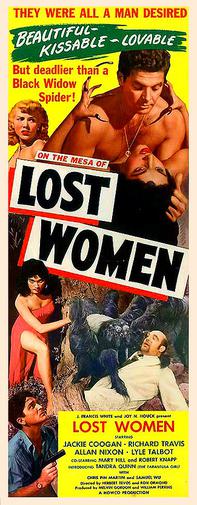
Horror Film Review: Mesa of Lost Women (dir by Herbert Tevos and Ron Ormond)


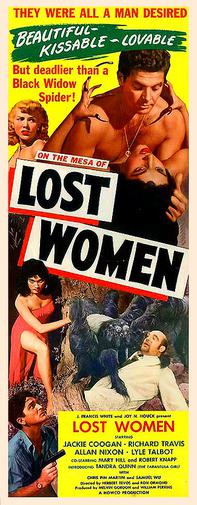
“Have you ever been kissed by a girl like this?” a disembodied voice asks at the start of 1953’s Mesa For Lost Women as a pair hands with claw-like fingernails caresses the face of someone who is later identified as being “Doc” Tucker (Allan Nixon).

Things get stranger from there.  A couple is found lost and dehydrated in the Mexican desert.  Grant Phillips (Robert Knapp) rambles about “super bugs” out in the desert and how they have to be destroyed.  American land surveyor Frank (John Martin) assumes that Grant must be delirious but Frank’s assistant, Pepe (Chris Pin Martin), knows differently.  We know that Pepe knows differently because the narrator tells us that Pepe had heard all about the monsters in the desert but Pepe keeps that information to himself….

Who is this narrator and why is he so condescending?  (For the record, he’s actor Lyle Talbot, who split his career between major, Oscar-winning productions and stuff like this.)  Have you ever noticed that a narrator usually just leaves you feeling even more confused by what you just watched?  There’s a trailer playing right now for a film called Ella McCay that opens with Julie Kavner saying, “Hi, I’m the narrator!” and whenever I hear that line, I’m just like, “Oh, this film is going to be so bad!”

I think it’s because most narrators are added after the fact, in an attempt to give some sort of uniformity to a badly constructed movie.  The narrator is there to tell us stuff that a good movie would be able to show us.  For instance, in the trailer for Ella McCay, Julie Kavner tells us that “I’m nuts about her,” as a way to assure us that Ella McCay is someone worth making a movie about.  Now, ideally, you wouldn’t have to have someone tell you that.  You would just watch the movie and say, “Hey, Ella McCay!  She deserves all the happiness in the world!”  But when your trailer is a bunch of scenes of Ella McCay acting a bit immature for someone who is destined to become “governor of the state you were born and raised in,” you need that narrator to say, “No, she’s likable, I promise!”

By that same logic, Mesa of Lost Women was apparently a mash-up of several different films, none of which had a complete script.  Narrator Lyle Talbot is here to tell us that, despite what we’re seeing, Mesa of Lost Women is an actual movie with an actual story as opposed to just a bunch of random scenes that were haphazardly crammed together.  We get a flashback of a scientist named Masterson (Harmon Stevens) traveling to the laboratory of Dr. Aranya (Jackie Coogan) and discovering that Aranya is creating giant tarantulas and transforming human women into mind-controlled slaves with the instincts of a spider.  Masterson doesn’t think that’s ethical so Aranya’s assistant, Tarantella (Tandra Quinn), gives him an injection that turns him into a simpleton.  Masterson ends up in a mental hospital, though he later escapes.  Meanwhile, an American businessman and his girlfriend (Mary Hill) come to Mexico and witness Tarantella dancing in a bar.  Masterson shows up and shoots Tarantella and then takes everyone hostage so that he can force Grant, who we now discover is a pilot, to fly him to the mesa of lost women …. or something.

Despite the best efforts of the narrator, the film is impossible to follow.  A big problem is that Dr. Aarnya’s plan never makes much sense.  How is creating a giant spider and a bunch of women who think that they’re spiders going to help him conquer the world?  The other problem is that the film had two directors, one of whom was an enigmatic German named Herbert Tevos who got the job by claiming to have directed Josef von Sternberg’s The Blue Angel.  Tevos’s footage of Dr. Aranya, the giant tarantula, and the “lost women” was not enough to secure the film distribution so a second director, Ron Ormond, was brought in to shoot a bunch of new footage to make the film more commercial.  Tevos’s film became an extended flashback in the middle of Ormond’s film and the whole thing is a big mess.

In fact, the film is such a mess that some people insist Ed Wood must have been involved.  It is true that narrator Lyle Talbot also appeared in Plan 9 From Outer Space and Glen or GlendaPlan 9‘s Mona McKinnon appears as a spider woman.  So does Dolores Fuller, who was Wood’s girlfriend at the time.  Wood later “borrowed” Mesa of Lost Women‘s score for Jail BaitMesa of Lost Women was definitely Wood-adjacent but, by all accounts, Wood didn’t actually do any work on the film.  This mess of a film belongs to Tevos and Ormond.

And it is a mess.  It’s a watchable mess, in much the same way that a nuclear meltdown would probably be watchable.  But, nonetheless, it’s still a mess and the incoherence of the plot really does get on one’s nerves, despite the best efforts of Lyle Talbot.  Talbot can’t sell the viewer on Mesa of Lost Women.  Maybe he would have had better luck with Ella McCay.
Horror Film Review: From Hell It Came (dir by Dan Milner)


“And to Hell it can go!” — The Critics

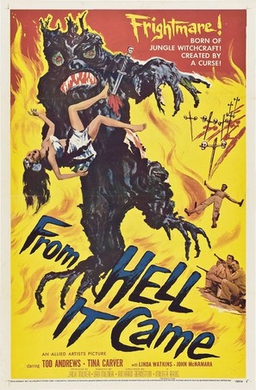
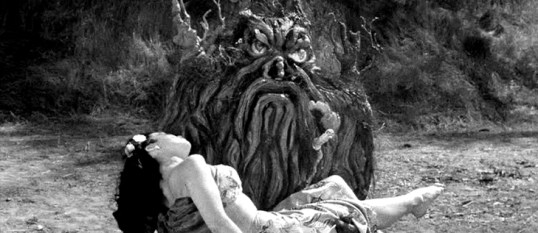
Sometimes, you’ll come across something that simply defies easy description.  It’s something that actually has to be seen to be believed.  I could describe to you the monster at the center of 1957’s From Hell It Came but I don’t know that, even with my extensive vocabulary, I really have the capability to capture just how absurd and weird this thing is.

In this case, a picture says more than a thousand words ever could:

The monster in From Hell it Came is a walking tree that has a rather angry (not to mention immobile) face.  After Prince Kimo is framed for the murder of his father, the chief of a tribe that lives on a South Sea island, he is sentenced to execution.  He announces that he will seek revenge on everyone who framed him.  He’s then stabbed in the heart and encased in the trunk of a hollow tree.  (Apparently, the knife is left in his heart which seems kind of unnecessary but who am I to argue?)  Later, Kimo comes back as a walking tree who tosses his enemies into quicksand.  The knife is still sticking out of the tree, which would suggest that Kimo was physically transformed.  However, the native insist that Kimo has actually become one of their legendary monsters, the fearsome Tabanga.

Along with the natives, there is also a group of American doctors on the island.  They’ve been sent to conduct research and to also give the natives medicine to help them deal with an outbreak of the plague.  The natives don’t trust the medicine.  They trust the magic of their medicine men.  Since this film came out in 1957, the doctors react to this by rolling their eyes and talking down to everyone.  If there’s one thing that has remained consistent over the decades, it’s that the worst way to get people to do anything is to talk down to them.

The doctors are the first to discover the tree stump that will eventually become the Tobanga.  They take the stump back to their laboratory, where they discover that the stump is radioactive due to some nearby atomic tests.  The next day, the stump comes to life and leaves the laboratory.  One of the most interesting things about this film is that the scientists are skeptical about the natives claim that the tree stump is one of their legendary monsters come to life but they are willing to accept that radiation created a walking stump.  Radiation bringing a tree stump to walking life actually makes even less sense than magic doing it.

While the tree is killing its enemies, the American doctors deal with their own drama.  For instance, Dr. Terry Mason (Tina Carver), is a woman and that greatly disturbs her male colleagues, all of whom  can’t understand why she’s not currently married and raising a family.  Meanwhile, Mrs. Mae Kilgore (Linda Watkins, an American actress who played the role with an amazingly bad British accent) owns the local trading post and is not happy about having a killer tree wandering around the island.  Mrs. Kilgore is prone to saying things like, “I saw the bloomin’ thing!”

In the end, the Americans finally figure out how to deal with the murderous tree.  “Your American magic is better,” the current chief of the natives says.  “Hell yeah!” I shout in response, “AMERICA!”  From Hell It Came is a thoroughly ludicrous movie but, once you watch it, you’ll never forget that tree.


Horror on the Lens: Mesa of Lost Women (dir by Herbert Tevos and Ron Ormond)


Today’s Horror on the Lens is the infamous 1953 film, Mesa of Lost Women.  Off in the middle of the desert, Dr. Aranya (Jackie Coogan) is conducting dangerous experiments that are resulting not only in giant spiders but also a master race of superwomen who Aranya is planning to use to conquer the world or something.

Mesa of Lost Women is a bit of a disjointed film.  It was originally filmed by a German director named Herbert Tevos, who claimed to be an associate of Erich Von Stroheim’s and a former collaborator of Marlene Dietrich’s.  However, despite his claims of being well-connected, no one was particularly impressed with Tevos’s first cut of the film so Ron Ormond was brought in to film additional scenes, the majority of them featuring Jackie Coogan as the insane Dr. Aranya.  Jackie Coogan was, at the time, still best-known for playing The Kid in the Charlie Chaplin film of the same name.  After Mesa, he would go on to play Uncle Fester on the original Addams Family.

Anyway, Mesa of Lost Women is one of those B-movies that simply has to be seen and heard to be believed.  (Lyle Talbot provides the narration, which is judgmental even by the standards of the 1950s.)  Enjoy Mesa of Lost Women!

Fabulous Forties #32: Outpost in Morocco (dir by Robert Florey)


Otmorpos

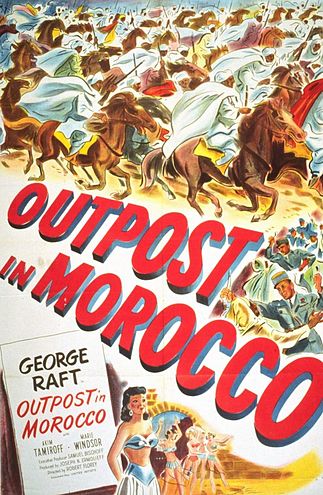
After watching the excellent The Last Chance, I was really hoping that the 32nd film in the Fabulous Forties box set would turn out be a classic as well.  Sadly, that was not the case.  1949’s Outpost in Morocco is a generally forgettable adventure film about the French Foreign Legion.

George Raft plays Capt. Paul Gerard, a captain in the French Foreign Legion.  Now, I happen to like George Raft.  He may not have been the greatest actor of Hollywood’s Golden Age but he did have a roguish charm and he was a great dancer.  Unfortunately, while the role of Paul Gerard did call for a bit of charm, it didn’t call for much dancing.  Instead, Paul Gerard is rather stolid and dependable and a little bit boring.  Needless to say, George Raft was more than a little miscast in the role.

Speaking of miscast, the beautiful but very American Marie Windsor plays Cara, the daughter of the Emir of the Moroccan city of Bel-Rashad.  The French are not allowed to enter the city and there are rumors that the Emir has been using this situation as an opportunity to plot against France.  Since Cara has spent the last few years studying in France, she is willing to go into Bel-Rashad and report on whether or not the rumors are true.  Gerard is assigned to escort her to the city.  Gerard’s superiors suspect that Cara might even fall in love with Gerard and, as a result, will be willing to turn against her father.

And that’s exactly what happens!  It takes exactly 10 days for Cara and Gerard to fall in love.  (We know this because the film is full of excerpts from a journal that Gerard keeps as he escorts Cara across the desert.)  However, once they reach Bel-Rashad, Cara does discover that her father is indeed conspiring against the French.  It is up to Gerard to put down the revolution and defeat the Emir, even if it means potentially sacrificing his love for Cara.

It’s interesting to note that there’s a few scenes where Raft sounds like he’s trying to imitate Humphrey Bogart, which immediately reminded me of how so many of Bogart’s great roles were initially offered to Raft.  I found myself wondering if Raft agreed to do Outpost in Morocco to make up for refusing Bogart’s role in a certain other film that was set in Morocco.

Unfortunately, Outpost in Morocco is no Casablanca.  Whereas Casablanca is a classic that holds up to this day, Outpost in Morocco is best described as being … well, dull.

How boring in Outpost in Morocco?  George Raft looks bored.  Marie Windsor looks bored.  Even the great character actor Akim Tamiroff looks bored!  Portions of the film were shot on location in Morocco so there are a few nice shots of the desert (if that’s your thing) and the ending is a bit darker than you might normally expect for a 1949 adventure film but otherwise, Outpost in Morocco is a fairly forgettable film.