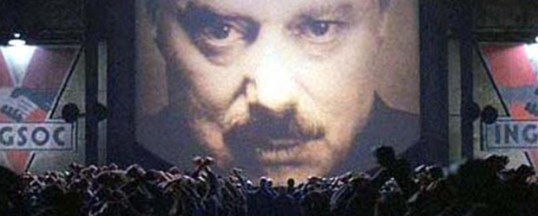
Yesterday, as I was flipping through the channels, I came across a documentary that was being shown on This TV. The documentary was called Nineteen Eighty-Four and it told the story of a low-level British bureaucrat named Winston Smith (who bore a strong resemblance to a youngish John Hurt) who, after having a secret affair with a free-spirited woman, was charged with committing “thought crimes” against the state. As a result, he was tortured by a man named O’Brien (who looked a lot like Richard Burton) until Winston finally came to love the government above all else…
What’s that?
Okay, you caught me.
This movie was not a documentary. Instead, it was an adaptation of George Orwell’s famous novel about a dystopian future Britain (quite cleverly renamed Airstrip One in both the book and the film) where the citizens spend their time giving thanks to Big Brother, a leader who may or may not actually be a fictional creation of the ruling party. It’s a world where everyone knows that “Big Brother is watching you” and every day is scheduled around the “two-minute hates” that are directed towards Big Brother’s enemy, Emmanuel Goldstein (who, much like Big Brother, may or may not actually exist). It’s a world dominated by three separate superstates that are in a state of perpetual war, though we’re also given reason to suspect that the war is just as fictional as Big Brother and Goldstein might be. It’s a world where order is kept by the Thought Police and history is regularly changed for the benefit of the ruling party. It’s a world where people can become unpersons and cease to exist and where all good citizens understand that one plus one equals three if the government says that it does.
So, no, it’s not a documentary.
It just feels like one.
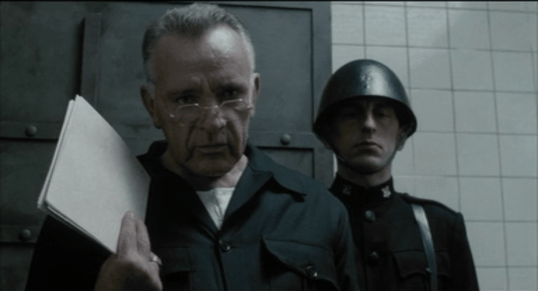
As I watched Nineteen Eight-Four, it was impossible for me not to compare Orwell’s vision of the future (which is faithfully visualized in the film) with our present world. Even though the book was written in 1948 and this film was shot and released in 1984, it was hard not to feel as if Nineteen Eighty-Four could have just as easily been made yesterday. Beyond the obvious NSA-as-Big-Brother comparisons that everyone makes, it was hard not to compare the brainwashed citizens waiting to hear from Big Brother with the people today who slavishly repeat whatever talking points they hear on MSNBC or Fox News. How different, I wondered, was Big Brother railing against Goldstein from our President continually telling us that we’re at war with the “forces of cynicism” and that anyone who disagrees with him is not just expressing an opinion but instead is being unpatriotic? When O’Brien explained how the Party stayed in power by keeping the people perpetually angry at unseen enemies, he might as well have been talking about our own elected officials. And, when the Thought Police finally arrested Winston and Julia, it brought to mind the images of the militarized police force of Ferguson, Missouri.
And that, I think, is why Nineteen Eighty-Four remains so powerful as both a book and a film. We live in a world where we are told more and more often that, regardless of what it does, the government is in charge and must be obeyed. We live in a world where we are currently told that good citizens must obey the law simply because it is the law. We’re told not to question why a police force needs to resemble an invading army. We’re told not to question why a member of the police force might happen to shoot an unarmed black teenager multiple times. We’re told not to question the official history. Instead, we’re just supposed to live in a state of blind obedience and accept, on faith alone, that those in charge are always right. We’re supposed to “respect authority” and not think about the specifics.
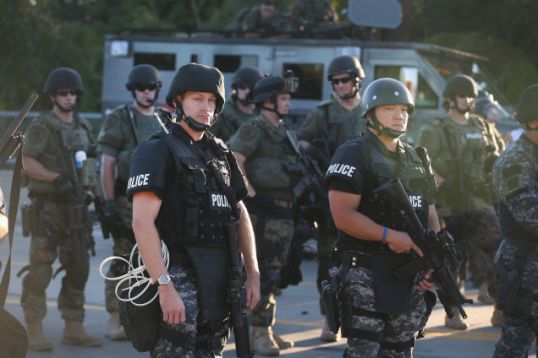
Thought Police or the Ferguson PD?
In short, we’re living in the world of Nineteen Eight-Four whether we realize it or not.
As for the film itself, it’s a powerful and surprisingly faithful adaptation of Orwell’s novel. John Hurt is perfectly cast as Winston Smith and Suzanna Hamilton is sympathetic as Julia. The two of them have a very real chemistry in this film and it makes the inevitable final scenes all the more disturbing and tragic. This was also Richard Burton’s final film. After years of alcoholism, Burton died shortly after filming ended and he looks ill throughout Nineteen Eighty-Four. But his obvious ill-health actually works to the role’s advantage. As played by Burton, O’Brien becomes the perfect embodiment of the morally corrupt ruling Party. The scenes where O’Brien tortures Hurt as difficult to watch, as they should be. But both Hurt and Burton give such committed performances that you can’t look away even when you want to. Finally, Nineteen Eighty-Four was an early job for the great cinematographer Roger Deakins and the film has a memorably bleak look to it. The drabness of Air Strip One perfectly mirrors the empty life of its citizens and it serves as a perfect contrast to the lushness of Winston’s fantasies.
Nineteen Eighty-Four is not an easy film to watch but it’s one that everyone should track down and see. Watch it and ask yourself how different 1984 is from 2014.

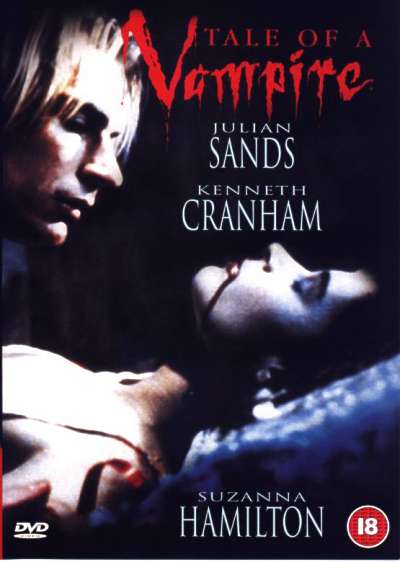 When Anne (Suzanna Hamilton) gets a job at the library, she is immediately attracted to the quiet and studious Alex (Julian Sands) and he to her. Alex claims to be a scholar who is at the library to do research on “religious martyrs” but Anne cannot escape the feeling that she has known him before. What Anne does not immediately realize is that Alex is a vampire and that she was set up with a job at the library through the machination of Edgar (Kenneth Cranham), another vampire who claims to be a doctor. Once, Edgar and Alex were both in love with the same woman, the beautiful Virginia. After circumstances led to Virginia being taken away from both men, Edgar dedicated the rest of his vampiric existence to making Alex miserable. Anne, who looks exactly like Virginia and may even be the reincarnated version of her, is a pawn in Edgar’s latest scheme. When Alex and Anne start to fall in love with each other, Edgar’s plan leads to tragedy.
 Through the Shattered Lens