Film Review: Big Bad Mama (1974, directed by Steve Carver)


Big_bad_mama_movie_posterToday is Angie Dickinson’s 84th birthday.  One of Angie’s best remembered films is Big Bad Mama, an entertaining and fast-paced gangster film that was produced by Roger Corman.

The year is 1932 and the setting is Texas.  Wilma McClatchie (Angie Dickinson) is a poor single mother with two teenage daughters (Susan Sennett and Robbie Lee) to support.  When Wilma’s bootlegger lover, Barney (Noble Willingham), is killed by the FBI, Wilma takes over his route.  Wilma wants her daughters to be rich like “Rockefeller and Capone” and soon, they graduate from bootlegging to bank robbery.  During one robbery, they meet and team up with Fred (Tom Skerritt).  Wilma and Fred are lovers until Wilma meets alcoholic con man, Baxter (William Shatner).  With Fred and Baxter competing for her affections and her youngest daughter pregnant, Wilma plans one final job, the kidnapping of a spoiled heiress (Joan Prather).

Big Bad Mama is one of the many Bonnie and Clyde rip-offs that Roger Corman produced in the 70s.  (Corman also gave us Bloody Mama and Crazy Mama.)  Big Bad Mama is a typical Corman gangster film, with fast cars, blazing tommy guns, Dick Miller, and plenty of nudity.  Angie was in her 40s at the time and, justifiably proud of her body, her full frontal nude scenes created a lot of publicity for the film.  William Shatner also strips down for the film and his sex scene with Angie is just as weird to watch as you would expect it to be.

The whole film changes as soon as William Shatner makes his first appearance.  He may be speaking with a Southern accent and he may be playing a sniveling coward but he is still William Shatner, with all that implies.  Watching Shatner, it is hard not to imagine that Big Bad Mama is actually a lost Star Trek episode where Kirk goes back in the past and meets special guest star Angie Dickinson.  Far more effective is Tom Skerritt, who is thoroughly believable as a Dillinger-style bank robber.

In the style of Bonnie and Clyde, Big Bad Mama presents its outlaws as being counter-culture rebels.  Every authority figure that Wilma meets — from a preacher played by Royal Dano to a corrupt sheriff to Dick Miller’s incompetent FBI agent — is presented as being hypocritical and arrogant.  Angie plays Wilma as a strong-willed and sexually liberated woman who refuses to allow anyone to tell her how to live her life or raise her daughters.  In the gang, both Fred and Baxter are subservient to her.  Big Bad Mama’s tag line was “Hot lead!  Hot legs!  Hot damn!” and that is a perfect description of Angie Dickinson’s performance.

Happy birthday, Angie Dickinson!

Angie and Shatner

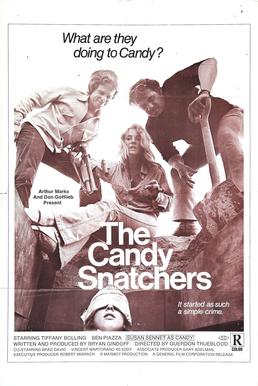
Embracing the Melodrama Part II #48: The Candy Snatchers (dir by Guerdon Trueblood)


The_Candy_Snatchers_Poster

(SPOILER ALERT)

Do you remember how, just last night, I described The Sister-in-Law as being one of the darkest films ever made?  Well, I stand by that description but, believe it or not, there was another low-budget thriller that was released in 1973 and which is even darker than The Sister-In-Law!  Compared to this film, The Sister-in-Law is a life affirming comedy.

The Candy Snatchers begins with Catholic school student Candy (Susan Sennet) walking home.  As a song called “Money Is The Root Of All Happiness” plays on the soundtrack, we watch Candy as she makes her way across the city.  However, we’re not the only ones watching Candy.  There are also three people in a van and they’re slowly following behind Candy.  They’re also wearing fake noses and glasses.

Despite the elaborate disguises, it’s not difficult to tell the three of them apart.  Jessie (Tiffany Bolling) is their leader, a high-strung woman who always seems to be on the verge of an emotional breakdown.  Alan (Brad David) is her brother and brags that he’s killed twelve people so far and he’s looking forward to adding more to the count.  Their partner is Eddy (Vince Martorano), an overly sensitive criminal who wants to make some money but who doesn’t want to hurt anybody.  Their plan is to kidnap Candy.

(Hence, the Candy Snatchers!)

See, they’re under the impression that Candy’s father, Avery (Ben Piazza) owns a jewelry store and, that by kidnapping Candy, they’ll be able to get him to pay them a ransom.  Pulling up beside her while she attempts to hitchhike home, the three kidnappers grab Candy, pull her into the van, and blindfold her.  They drive up to the mountains and bury Candy in a wooden box, leaving her with a breathing tube to make sure that she doesn’t suffocate.  They then call Avery and give him their demands.

The problem is that the kidnappers haven’t done as thorough a research job as they thought they had.  What they did not realize is that Avery doesn’t own the jewelry store.  Instead, he’s just the manager.  Even worse, it turns out that Avery is not Candy’s father.  Instead, he has just recently married Candy’s mother for her money.  As Avery cheerfully explains, with Candy out of the way, he now stands to inherit $2,000,000 when Candy’s mom dies.

In other words, the kidnappers are now stuck with Candy.

After retrieving her from her underground prison, Alan wants to rape Candy while Jessie wants to kill her.  Eddy, however, feels sorry for Candy.  After telling his two partners that he’s going to kill her, Eddy takes Candy back up to the mountains.  Again, he buries her alive but he promises her that he will return to dig her up as soon as he takes care of his partners.

What Alan, Jessie, and Eddy don’t realize is that all of this is being witnessed by Sean (played by Christophe, the actor’s son), an autistic child who apparently cannot speak.  Candy begs Sean to let someone know where she is but every time that Sean tries to get the attention of his loathsome parents, they either ignore him or they beat him.

By the end of the film, Jessie, Alan, and Candy’s mother are all dead.  When Eddy returns to Candy’s grave, he gets into a gunfight with Avery.  Eddy manages to kill Avery but, before he can dig up Candy, he’s shot in the back.  As he turns around, he sees that he’s been shot by Sean, who has picked up Avery’s gun.  Eddy tumbles down the mountain.  Sean goes back to his house and apparently shoots his abusive mother.  The movie ends with the sound of Candy struggling to breathe underground…

AGCK!

Seriously, I am totally claustrophobic so the end of The Candy Snatchers is pure nightmare fuel for me.  To be honest, the whole film is nightmare fuel.  There’s only two likable characters in the entire film and, as the end credits roll, Sean has just killed his mother and Candy is slowly suffocating underground.

As dark as The Candy Snatchers may be, it’s still strangely watchable and compelling.  It’s not a film that I would recommend to anyone getting over a serious bout of depression but still, it’s a well-acted, well-directed, and consistently surprising film.  In fact, I would say that it’s probably one of the best grindhouse films ever made.

That said, you do have to wonder just how depressing life was in 1973.  Between this film and The Sister-in-Law, I’m surprised humanity survived to see 1974.