Retro Television Reviews: The Secret Life of John Chapman (dir by David Lowell Rich)


Welcome to Retro Television Reviews, a feature where we review some of our favorite and least favorite shows of the past!  On Sundays, I will be reviewing the made-for-television movies that used to be a primetime mainstay.  Today’s film is 1976’s The Secret Life of John Chapman!  It  can be viewed on Tubi.
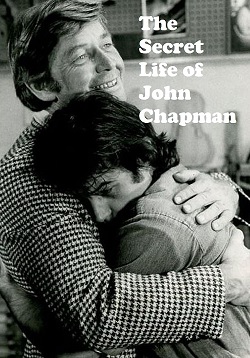
John Chapman (Ralph Waite) is a mild-mannered college president and a recent widower.  Everyone tends to assume that John grew up wealthy but John is actually the son of a bricklayer.  As he puts it, his father literally helped to build the college of which John is now president.  John has felt lost and directionless ever since the passing of his wife.  When his rebellious son (Brad Davis) announces that he’s going to drop out of college and pursue a career as a laborer, John is at first outraged but soon, he’s wondering if perhaps his son has a point.  Has John spent so much time cocooned in his college that he’s lost touch with the rest of the world?

John takes a sabbatical and pursues a career as a blue collar worker.  He discovers that it’s not as easy as he assumed.  Because John doesn’t want to reveal that he’s an academic, John doesn’t really have any references to offer up to potential employers.  Because he’s nearly 50, John is continually told that he’s too old for most of the jobs that he applies for.  When he goes into a bar and attempts to order a dry martini, he quickly realizes that he has no idea what it’s like to be blue collar.

John eventually does get a job, helping to lay water pipes.  His boss is the gruff Gus Reed (Pat Hingle), who John eventually discovers is not quite as fearsome a figure as he originally appears.  Once the pipe job is done, John gets a job in a diner and even pursues a tentative romance with a waitress (Susan Anspach) who, as she points out,  comes from a totally different world than him.  And yet, despite John’s efforts, his son remains unimpressed.  According to his son, John is just slumming.  He has the freedom to quit and return to the college whenever he wants.

Yikes!  John’s son is a bit judgmental and it doesn’t help that he’s played by Brad Davis, who was never a particularly likable actor.  (Davis later starred in Midnight Express, in which director Alan Parker used his lack of likability to good effect.)  Yet, watching the film, you can’t help but feel that John’s son has a point.  At times, it seems like John wants a lot of credit for spending a week working in the type of job that most people take because they don’t have any other option.  Indeed, you could argue that John’s project is basically keeping someone who really needs the money from finding a job.  It’s not like John gives up any of his money when he goes to work.  It doesn’t help that John Chapman narrates his story and his voice-over often feels like a parody of liberal noblesse oblige.

Fortunately, Ralph Waite was a likable actor and he plays John Chapman as being well-intentioned if occasionally a bit condescending.  The made-for-TV movie plays like a pilot and it’s easy to imagine a series in which John Chapman would have worked a different job every week.  It’s a slight but pleasant-enough made-for-TV movie.  Seen today, it works best as a time capsule, a portrait of a society still trying to find its identity in the wake of the turbulence of the 60s.
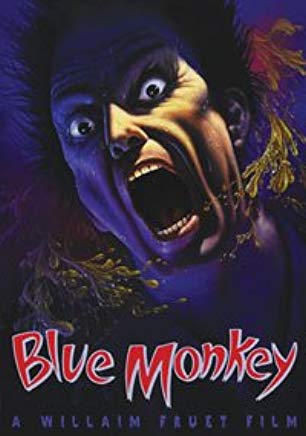
The TSL’s Grindhouse: Blue Monkey (dir by William Fruet)


1987 Blue Monkey

Last night, as I sat down to watch the 1987 Canadian film, Blue Monkey, I found myself singing a song in my head:

How does it feel
When you treat me like you do
And you’ve laid your hands upon me
And told me who you are?

I thought I was mistaken
And I thought I heard your words
Tell me, how do I feel?
Tell me now, how do I feel?

Unfortunately, it turned out that the only thing Blue Monkey had in common with the classic New Order song, Blue Monday, was an enigmatic title.  Just as the song never really mentions anything about Monday, Blue Monkey does not feature a single monkey.  One minor character does mention having a dream about a monkey but, otherwise, there are no monkeys in the film.  Speaking as someone who believes that almost any film can be improved the presence of a monkey, I was disappointed.

(Seriously, Nomadland would have been a hundred times better if Frances McDormand had a pet monkey.)

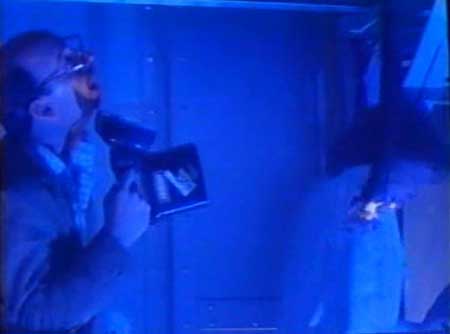
What Blue Monkey does have is a lot of blue.  The characters wear blue shirts and some wear blue uniforms.  Another wears a blue hat.  The film takes place in a hospital where almost all of the walls are painted blue.  Even worse, the majority of the film’s scenes are saturated with blue lighting.  

Here’s just two screenshots:

blue-monkey-1987-movie-image-7Blue-Monkey-1987-movie-William-Fruet-4

Seriously, some scenes were so blue that I was reminded of John Huston’s decision to suffuse Reflections in a Golden Eye with the color gold.  Personally, I think Huston made a mistake when he did that with Reflections but I can still understand the reasoning behind the decision and I can see what Huston was attempting to accomplish.  The blue in Blue Monkey feels like a distraction, as if someone realized, on the day before shooting, that the title didn’t make any damn sense.  “We’ll just make the whole movie blue!”

The problem, of course, is that the film goes so overboard with the blue lighting that it actually becomes difficult to look at the screen for more than a few minutes.  I had to keep looking away, specifically because all of those blue flashing lights were starting to make me nauseous and were on the verge of giving me a migraine.  At times, the image is so saturated in blue that you literally can’t make out what’s happening in the scene.  Of course, once you do figure out what’s happening, you realize that it doesn’t matter.

Blue Monkey takes place in a hospital.  A handyman has been having convulsions after pricking his finger on a plant that came from a mysterious island.  Perhaps that’s because a mutant larvae is now using his body for a host.  The larvae eventually develops into a giant grasshopper — NOT A MONKEY! — who stalks around the hospital and kills a few people.  The Canadian government is threatening to blow up the hospital unless something is done about the blue grasshopper.

It’s a Canadian exploitation film but Michael Ironside isn’t in it so it somehow feels incomplete.  That said, John Vernon plays a greedy hospital administrator and it’s fun to watch him get irritated with everyone.  A very young Sarah Polley has an early role as an annoying child.  There’s actually several children in this film and you’ll want to throw something at the screen whenever they show up, that’s just the type of film this is.  (Some of my fellow movie-watching friends were actually upset that the children survived that film.  I wouldn’t go that far but I still found myself hoping John Vernon would tell them all to shut up and let the adults handle things.)  Susan Anspach plays a doctor, showing that anyone can go from Five Easy Pieces to Canadian exploitation.  The film’s nominal star is Steve Railsback, playing a cop who comes to the hospital to check on his wounded partner and who ends up on grasshopper duty.  Steve Railsback has apparently said that he’s embarrassed to have appeared in this film.  Consider some of the other films that Steve Railsback has appeared in and then reread that sentence.  

In the end, Blue Monkey doesn’t add up too much.  There’s no Michael Ironside.  There’s no monkeys.  There’s just a lot of blue.

Film Review: Blood Red (1989, directed by Peter Masterson)


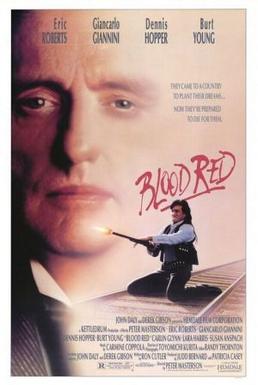
The time is the 1890s.  The place is California.  Sicilian immigrant Sebastian Collogero (Giancarlo Giannini) has just been sworn in as an American citizen and owns his own vineyard.  When Irish immigrant William Bradford Berrigan (Dennis Hopper) demands that Sebastian give up his land so Berrigan run a railroad through it, Sebastian refuses.  Berrigan hires a group of thugs led by Andrews (Burt Young) to make Sebastian see the error of his ways.  When Sebastian ends up dead, his wayward son, Marco (Eric Roberts), takes up arms and seeks revenge.

Have you ever wondered what would have happened if the famously self-indulgent directors Michael Cimino and Francis Ford Coppola teamed up to make a movie about the American Dream?  The end result would probably be something like Blood Red.  Like Cimino’s The Deer Hunter and Heaven’s Gate, Blood Red begins with a lengthy celebration (in this case, in honor of Sebastian’s naturalization ceremony) that doesn’t have much to do with the rest of the film but which is included just to make sure we know that what we’re about to see is more than just a mere genre piece.  Like many of Coppola’s films, Blood Red features a tight-knit family, flowing wine, and a score composed by Carmine Coppola.  The only difference between our hypothetical Cimino/Coppola collaboration and Blood Red is that the Cimino/Coppola film would probably be longer and more interesting than Blood Red.  Blood Red is only 80 minutes long and directed by Peter Masterson, who seems lost.  There’s a potentially interesting story here about two different immigrants fighting to determine the future of America but it gets lost in all of the shots of Eric Roberts flexing his muscles.

For an actor known for his demented energy, Eric Roberts is surprisingly dull as the lead but Blood Red is a film that even manages to make veteran scenery chewers like Dennis Hopper and Burt Young seem boring.  (Hopper’s bizarre attempt at an Irish brogue does occasionally liven things up.)  The cast is full of familiar faces like Michael Madsen, Aldo Ray, Marc Lawrence, and Elias Koteas but none of them get to do much.  Of course, the most familiar face of all belongs to Eric’s sister, Julia.  Julia Roberts made her film debut playing Marco’s sister, Maria.  (Because the film sat on the shelf for three years after production was completed, Blood Red wasn’t released until after Julia has subsequently appeared in Mystic Pizza and Satisfaction.)  She gets three lines and less than five minutes of screen time but she does get to briefly show off the smile that would later make her famous.  Today, of course, that smile is the only reason anyone remembers Blood Red.

Lisa Reviews An Oscar Nominee: Five Easy Pieces (dir by Bob Rafelson)


First released in 1970, Five Easy Pieces tells the story of a lost man named Bobby Dupea (Jack Nicholson).

When we first meet Bobby, he’s working at a California oil field.  He likes to go bowling.  He has a girlfriend named Rayette (Karen Black), who is a country music-obsessed waitress.  His best friend is Elton (Billy “Green” Bush), a friendly redneck with a memorable laugh.  Bobby may have a girlfriend and Elton may be married but that doesn’t stop either one of them from going out at night, getting drunk, and trying to pick up women.

Bobby seems to be just another blue-collar guy with a grudge against the bosses but it doesn’t take long to realize that there’s something different about him.  Bobby may be friends with Elton but it’s obvious that the two of them come from very different background.  No matter how much he tries to hide it, Bobby is smarter than everyone else around him.  When he and Elton get stuck in a traffic jam, Bobby spots a piano sitting on the back of a pickup truck.  Getting out of his car, Bobby yells at everyone who is honking and then climbs up to the piano.  He sits down, he puts his fingers to the keys and he starts to play.  Knowing Bobby, you’re expecting him to just bang the keys and make noise.  Instead, he plays beautiful music.

Later, Bobby steps into a recording studio.  Paritia (Lois Smith), a neurotic woman, is playing the piano.  The recording engineers joke about her lack of talent.  Bobby glares at them, annoyed.  It quickly becomes apparent why Bobby is so protective.  Paritia is Bobby’s sister.

Bobby, it turns out, comes from a wealthy family of musicians.  Everyone in the family has dealt with the pressure to succeed differently.  Paritia continues to play, despite not having much talent.  Bobby’s older brother, the buffoonish Carl (Ralph Waite), plays violin and has staid home with their father (William Challee).  Bobby, on the other hand, ran away from home.  He’s spent his entire life trying to escape from both his talent and his family.  However, when Paritia explains that their father has suffered from two strokes and might not live much longer, Bobby reluctantly decides to return home and try to make some sort of peace with his father.

It’s not as easy a journey as Bobby would have liked.  For one thing, Rayette demands to go with him.  On the drive up to Washington, they pick up two hitchhikers (Helena Kallionetes and Toni Basil), one of whom is obsessed with filth.  In the film’s most famous scene, an attempt to get a simple lunch order modified leads to Bobby losing control.

See, that’s the thing with Bobby.  In many ways, he’s a jerk.  He treats Rayette terribly.  While his family is hardly perfect, the film doesn’t hide from the fact that Bobby isn’t always the easiest person to deal with.  And yet, you can’t help but sympathize with Bobby.  If he seems permanently annoyed with the world … well, that’s because the world’s annoying.  And, to Bobby’s credit, he’s a bit more self-aware than the typical rebel without a cause.  When one of the hitchhikers praises his temper tantrum at the diner, Bobby points out that, after all of that, he still didn’t get the order that he wanted.

In Washington, Bobby tells Rayette to stay at a motel and then goes to see his family.  Bobby seems as out-of-place among his wealthy family as he did hanging out in the oil fields with Elton.  He ends up cheating on Rayette with Carl’s fiancee, a pianist named Catherine van Oost (Susan Anspach).

And then Rayette shows up for dinner…

Five Easy Pieces is a sometimes funny and often poignant character study of a man who seems to be destined to always feel lost in the world.  Bobby spends the whole movie trying to find a place where he can find happiness and every time, reality interferes with his plans.  Nicholson gives a brilliant performance, playing Bobby as a talented guy who doesn’t really like himself that much.  Bobby’s search for happiness leads to a rather haunting ending, one that suggests that some people are just meant to spend their entire life wandering.

Five Easy Pieces was nominated for Best Picture but lost to Patton.