
The 1944 film, Lady in the Death House, tells the tragic and faintly ridiculous story of Mary Kirk Logan (Jean Parker).
The daughter of a small-time criminal, Mary has spent most of her life trying to escape from her family’s legacy of crime. She’s even got a job, working at the same bank that her father once tried to rip off. Of course, at work, everyone knows her as Mary Kirk and they have no idea that her father was the infamous Tom Logan. If that information got out, Mary would lose her job and no longer be able to take care of herself or her younger sister, Suzy (Marcia Mae Jones).
One night, Mary is out on a date with a clumsy man who takes her out to a nightclub and manages to accidentally set Mary’s dress on fire. Luckily, Dr. Brad Braford (Douglas Fowley) is there, having a drink with his friend, the famous criminologist, Charles Finch (Lionel Atwill). Brad jumps into action, extinguishing the fire and saving Mary’s dress. It’s love at first sight.
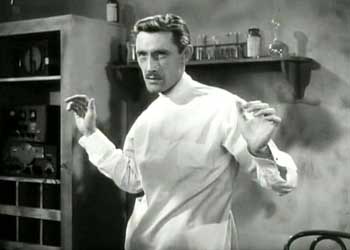
There’s just one problem. Dr. Bradford is studying ways to bring the dead back to life and, in order to raise money for his research, he’s been working as the state’s executioner. When someone goes to the electric chair, Brad is the one who pulls the lever. Mary says that she can only marry Brad if he gives up his electrifying night job.
However, before Brad can turn in his letter of resignation, Mary is arrested for the murder of Willis Millen (Dick Curtis), a crook who once knew her father. Mary swears that she’s innocent but there are two eye witnesses who testify that they not only heard Mary and Willis fighting but that they also saw the shadow of someone hitting Willis over the head with a lamp. It doesn’t take long for the jury to reach a verdict:

I have to admit that, when this newspaper appeared on-screen, I was actually more curious about the “youth” who was arrested for stealing glitter off of campaign signs. However, for whatever reason, the film declines to follow up on that story. Instead, we watch as Mary goes to death row, with the knowledge that she is to die “at the hand of the man I love.”
However, there may still be hope! Charles thinks that Mary is innocent. Though there’s only 24 hours left before Brad is scheduled to execute Mary, Charles launches an investigation of his own. But even if Charles is able to find the evidence that exonerates Mary, will he be able to contact the governor in time? Or will Mary go to the chair?
Well, regardless of what happens, rest assured that this World War II-era film will end with an appeal for all movie goers to do the right thing and buy war bonds.

Lady in the Death House is an entertaining but fairly ludicrous little movie. I mean, realistically, having the executioner execute his own fiancée is a huge conflict of interest. It seems like they could have gotten a substitute executioner, if just for one night. But, if they did that, we wouldn’t get the melodramatic highlight of Mary announcing that she’s scheduled to be killed “by the hand of the man I love.”
Lady in the Death House provides a rare chance to see Lionel Atwill in a heroic role. The British actor played a countless number of mad scientists, killers, and Nazis before his premature death in 1946. (Atwill’s promising career was derailed in 1943, when he accused of hosting orgies at home and was subsequently convicted of perjury. That’s one reason why Atwill turned up in a “poverty row” feature like this one.) Atwill is convincing as Charles Finch. The same superior attitude that made him a good villain also makes him believable as the only person capable of figuring out who murdered Willis Millen.
Taking on its own terms, Lady in the Death House is a fun movie. If nothing else, it provides a lesson on how to get a message to the governor, even if no one’s quite sure where he is for the evening. That’s an important lesson to learn!
 Through the Shattered Lens