The Unnominated #20: The Ninth Configuration (dir by William Peter Blatty)


Though the Academy of Motion Picture Arts and Sciences claim that the Oscars honor the best of the year, we all know that there are always worthy films and performances that end up getting overlooked.  Sometimes, it’s because the competition too fierce.  Sometimes, it’s because the film itself was too controversial.  Often, it’s just a case of a film’s quality not being fully recognized until years after its initial released.  This series of reviews takes a look at the films and performances that should have been nominated but were, for whatever reason, overlooked.  These are the Unnominated.

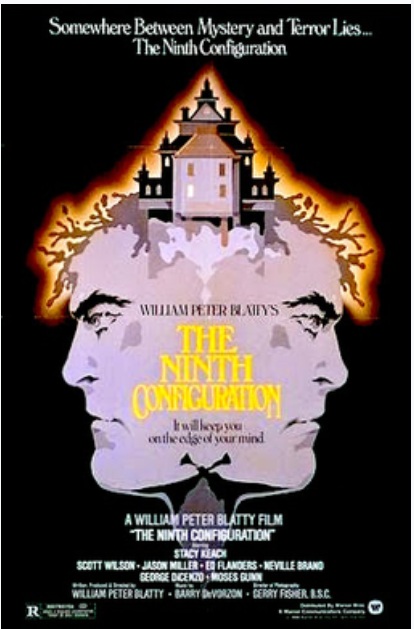
Some films defy easy description and that’s certainly the case with 1980’s The Ninth Configuration.

The film opens with a shot of a castle sitting atop of a fog-shrouded mountain.  A voice over tells us that, in the early 70s, the castle was used by the U.S. government to house military personnel who were suffering from mental illness.  Inside the castle, the patients appear to be left to their own devices.  Lt. Reno (Jason Miller) is trying to teach dog how to perform Shakespeare.  Astronaut Billy Cutshaw (Scott Wilson) is haunted by the thought of being alone in space and refuses to reveal why he, at the last minute, refused to go to the moon.  The men are watched over by weary and somewhat sinister-look guards, who are played by actors like Joe Spinell and Neville Brand.

Colonel Kane (Stacy Keach) shows up as the new commandant of the the castle.  From the first minute that we see Kane, we get the feeling that there might be something off about him.  Though he says that his main concern is to help the patients, the man himself seems to be holding back secrets of his own.  With the help of Colonel Fell (Ed Flanders, giving an excellent performance), Kane gets to know the patients and the guards.  (Despite the objections of the guards, Kane says that his office must always be unlocked and open to anyone who want to see him.)  He takes a special interest in Cutsaw and the two frequently debate the existence of God.  The formerly religious Cutshaw believes the universe is empty and that leaving Earth means being alone.  Kane disagrees and promises that, should he die, he will send proof of the afterlife.  At night, though, Kane is haunted by dreams of a soldier who went on a murderous rampage in Vietnam.

The film start out as a broad comedy, with Keach’s smoldering intensity being matched with things like Jason Miller trying to get the dogs to perform Hamlet.  As things progress, the film becomes a seriously and thoughtful meditation on belief and faith, with characters like Kane, Billy, and Colonel Fell revealing themselves to be quite different from who the viewer originally assumed them to be.  By the time Kane and Cutshaw meet a group of villainous bikers (including Richard Lynch), the film becomes a horror film as we learn what one character is truly capable of doing.  The film then ends with a simple and emotional scene, one that is so well-done that it’ll bring tears to the eyes of those who are willing to stick with the entire movie.

Considering all of the tonal shifts, it’s not surprising that the Hollywood studios didn’t know what to make of The Ninth Configuration.  The film was written and directed by William Peter Blatty, the man who wrote the novel and the script for The Exorcist.  (The Ninth Configuration was itself based on a novel that Blatty wrote before The Exorcist.)  By most reports, the studio execs to whom Blatty pitched the project were hoping for another work of shocking horror.  Instead, what they got was an enigmatic meditation on belief and redemption.  The Ninth Configuration had the same themes as The Exorcist but it dealt with them far differently.  (Because he wrote genre fiction, it’s often overlooked that Blatty was one of the best Catholic writers of his time.)  In the end, Blatty ended up funding and producing the film himself.  That allowed him complete creative control and it also allowed him to make a truly unique and thought-provoking film.

The Ninth Configuration was probably too weird for the Academy.  Though it received some Golden Globe nomination, The Ninth Configuration was ignored by the Oscars.  Admittedly, 1980 was a strong year and it’s hard to really look at the films that were nominated for Best Picture and say, “That one should be dropped.”  Still, one can very much argue that both Blatty’s script and the atmospheric cinematography were unfairly snubbed.  As well, it’s a shame that there was no room for either Stacy Keach or Scott Wilson amongst the acting nominee.  Keach, to date, has never received an Oscar nomination.  Scott Wilson died in 2018, beloved from film lovers but never nominated by the Academy.  Both of them give career-best performances in The Ninth Configuration and it’s a shame that there apparently wasn’t any room to honor either one of them.

The Ninth Configuration is not a film for everyone but, if you have the patience, it’s an unforgettable viewing experience.
Previous Entries In The Unnominated:
  1. Auto Focus 
  2. Star 80
  3. Monty Python and The Holy Grail
  4. Johnny Got His Gun
  5. Saint Jack
  6. Office Space
  7. Play Misty For Me
  8. The Long Riders
  9. Mean Streets
  10. The Long Goodbye
  11. The General
  12. Tombstone
  13. Heat
  14. Kansas City Bomber
  15. Touch of Evil
  16. The Mortal Storm
  17. Honky Tonk Man
  18. Two-Lane Blacktop
  19. The Terminator

Late Night Retro Television Review: CHiPs 4.11 “11-99: Officer Needs Help”


Welcome to Late Night Retro Television Reviews, a feature where we review some of our favorite and least favorite shows of the past!  On Mondays, I will be reviewing CHiPs, which ran on NBC from 1977 to 1983.  The entire show is currently streaming on Prime!

This week, Ponch fixes everything.

Episode 4.11 “11-99: Officer Need Help”

(Dir by Phil Bondelli, originally aired on January 18th, 1981)

Three criminals are stealing trucks from a trucking company.  One of the criminals works for the company but he gets fired, not for his thievery but because he accidentally put a cate of corrosive chemicals on the wrong truck.  Now, the highway patrol has to track down the chemicals and also stop the criminals.

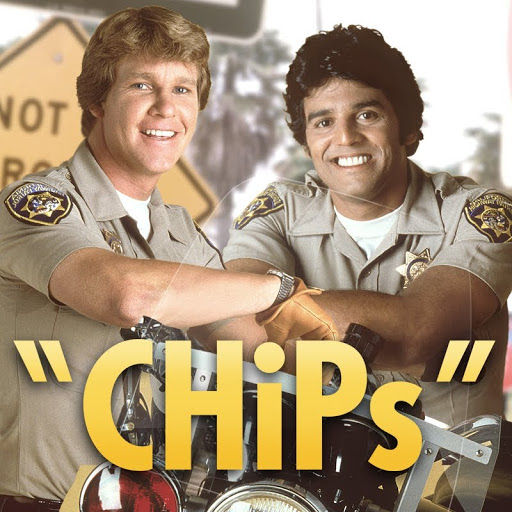
It’s a typical episode of CHiPs.  A man loses his job after he’s wrongly accused of being the thief.  The man’s son (Greg Bradford) helps Jon and Ponch catch the real criminals.  There’s a subplot about all of the members of the high patrol carrying a new device that sends out of a signal whenever an officer’s down.  Grossman accidentally pushes the button while chasing a lost dog.  The emphasis here is on everyone working together and the Highway Patrol going out of their way to always have the best equipment to do their job.  In the end, this is such a typical episode that the whole thing is kind of boring.

Really, for me, the only interesting thing about this episode is that it featured a subplot about a new police dispatcher who spoke with a stammer and who had trouble sending out instructions over the radio.  I had a lot of sympathy for Kathie Lark (Katherine Moffat) because I had a pretty pronounced stammer up until I was about twelve years old.  (It now only comes out if I’m extremely tired or stressed.)  That said, considering just how important the dispatchers are when it comes to the Highway Patrol, I was a bit surprised that Kathie got the job in the first place.  Kathie mentioned that she had previously been a dispatcher in a small town and again, I wondered how she got that job.  To me, it seemed like the Highway Patrol was basically setting Kathie up for failure.

The good thing is that eventually someone gives Kathie some advice that helps her to overcome her nervousness and become an excellent dispatcher.  Do you want to guess who gave her the advice?  Seriously, I dare you to guess who, out of the show’s cast of characters, magically knew exactly the right thing to say to help Kathie out.  If you’re thinking that Ponch was responsible for Kathie becoming a badass on the airwaves, you are exactly right!  Is there no problem that Ponch can’t solve?  Ponch’s advice, by the way, was that Kathie should always imagine that she was speaking directly to him.  The next time that I find myself tripping over a word that starts with B, I’ll try the same thing.

It’s the Ponch Show!  Seriously, there’s nothing that Ponch can’t do!  Beyond that, this was a boring episode.  The California scenery was nice to look at but otherwise, this episode felt like CHiPs on autopilot.

Retro Television Review: Fantasy Island 5.8 “Lillian Russell/The Lagoon”


Welcome to Retro Television Reviews, a feature where we review some of our favorite and least favorite shows of the past!  On Tuesdays, I will be reviewing the original Fantasy Island, which ran on ABC from 1977 to 1984.  Unfortunately, the show has been removed from most streaming sites.  Fortunately, I’ve got nearly every episode on my DVR.

Episode 5.8 “Lillian Russell/The Lagoon”

(Dir by Don Weis, originally aired on November 28th, 1981)

Tattoo is in this episode, which means that Julie only appears long enough to tell Mr. Roarke that she’s going to busy exploring the island with a bunch of hunky professors.  (It says a lot about how poorly the Julie character has been developed that I couldn’t tell if Julie was supposed to be naive or clever when it came to going off with the men.) 

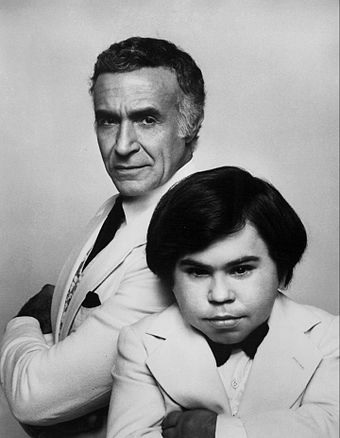
At this point, it’s obvious that Julie was only added to the show to act as insurance in case Herve Villechaize walked off the set.  Early on in the season, when Herve was apparently negotiating for a better contract, Julie had a few episodes where she was Roarke’s main assistant while Tattoo was described as being elsewhere on the island.  But in the episodes where Tattoo is present, Julie always has to go do something else for the weekend.  Ironically, Julie is such a bland and unnecessary character that it actually proves Herve Villechaize’s point about how important Tattoo was to the success of the show.  By having Julie always leave whenever Tattoo is present, the show really only reminds the viewer that Roarke only needs on assistant and it’s Tattoo.

As for this week’s fantasies, they both have to do with the past.

Calvin Pearson (Claude Akin) has just spent years in prison for a crime that he didn’t commit.  He’s finally been released and, understandably, he really doesn’t want to have much to do with the rest of the world.  When he was a child, he spent a summer on a nearby island with his father.  His father was fisherman and Calvin claims that he once caught a fish that could sing.  Calvin wants to spend the weekend on the Island and he wants to catch the same serenading fish.

Sound like a pretty simple fantasy, right?  Well, Calvin is not happy to discover that the he’s not alone on “my island.”  There’s now a trading post, run by Jake Dutton (Broderick Crawford) and his daughter, Mira (Pamela Susan Shoop).  Even worse, there are some recently escaped convicts (led by Glenn Corbett) who want to kidnap Mira!  At first, Calvin refuses to get involved.  He just wants to fish.  But, in the end, he finally does the right thing and saves the Duttons.  

What about the “serenading fish?”  Calvin may not have caught a fish but he did capture the heart of Mira, who hums a tune that she says she once heard out on the lagoon.  Calvin leaves the Island alone but he tells Roarke that he plans to return so that he can work at the trading post with the Duttons.

This fantasy was a bit predictable and you really do have to wonder why Roarke insists on nearly getting his guests killed every week.  It seems like that would lead to a lawsuit.  But the fantasy does feature a good performance from Claude Akin as a man who manages to conquer his own bitterness.

As for the other fantasy, it features Phyllis Davis as a writer named Lilly Martin who wants to write a book about the singer Lillian Russell.  Roarke sends her back to 1890s New York and literally transforms Lilly into Lillian Russell, complete with singing talent and two notorious suitors, “Diamond Jim” Brady (Gene Barry) and Peter Whiting (Craig Stevens).  This fantasy was enjoyable eye candy, with Lilly getting to dress up as Lillian Russell and getting to wear all sorts of jewels.  Unfortunately, it’s also a fantasy that ends with a poker game.  I’ve never been able to follow poker and I always groan a little whenever the plot of a show hinges on the outcome.  Whenever people start talking about “bluffing” and “royal flushes,” and all that, my eyes just glaze over and that was the case here.

That said, at least Mr. Roarke got to take part in Lilly’s fantasy, popping up not once but three times to see how everything was going!  In fact, Mr. Roarke and Tattoo also popped up in Calvin’s fantasy.  It’s always fun when Roarke drops in.

The poker game aside, this was an enjoyable trip to the Island.  Season 5 has been a bit uneven but this was one of the better episodes.