A Movie A Day #133: American Ninja 2: The Confrontation (1987, directed by Sam Firstenberg)


Duuuuuuuuude!  The American Ninja is back!

In this sequel to the first American Ninja, ninja Joe (Michael Dudikoff) and sidekick Jackson (Steve James) are now Army Rangers.  They have been assigned to provide security at an embassy on a small Caribbean island.  At first, it seems like an easy gig but then Joe discovers that a large number of Marines have recently vanished.  According to the only witness, they were abducted by men dressed in black.  Joe and Jackson know what that means!

The Marines are being set up by a traitor in their own ranks, Tommy Taylor (played by Miguel Ferrer look-alike Jonathan Pienaar).  Taylor is being blackmailed by a master criminal known as, I kid you not, Leo the Lion (Gary Conway, who also co-wrote the script).  Leo is brainwashing the Marines, shooting them up with all sorts of drugs and transforming them into zombie-style ninjas.

Doing away with any pretense towards reality, American Ninja 2 is pure comic book action.  A bad guy even says, “It’s the American Ninja!” when he sees Joe.  It’s a strange film.  On the one hand, it is full of goofy humor and it even has a streetwise kid sidekick, all things that would indicate that it was made to appeal to kids.  On the other hand, the first cut was reportedly so violent that it got a dreaded X-rating.  The final version still has enough impalings, decapitations, and throwing stars to the head to earn its R.

With its combination of nonstop action and Steve James one-liners, American Ninja 2 is both a worthy sequel and a worthy addition to the Cannon library.  Still, it bothers me that at least a few of the ninjans that Joe and Jackson killed were probably just brainwashed Marines.  That amounts to a lot of innocent victims being killed by our heroes.

The life of an American ninja is never an easy one.
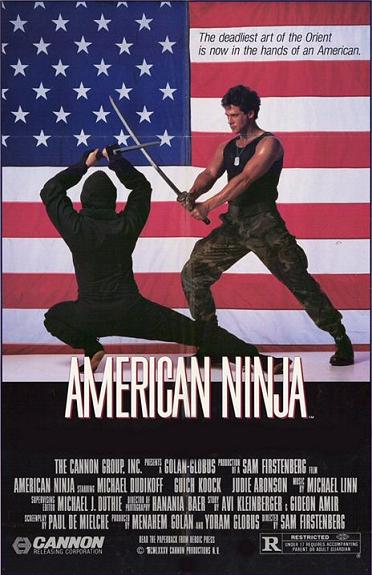
A Movie A Day #132: American Ninja (1985, directed by Sam Firstenberg)


Hell yeah!

From Yoram Globus and Menahem Golan, the duo who were responsible for producing the coolest films of the 1980s, comes American Ninja!

Private Joe Armstrong (Michael Dudikoff) is the newest arrival on an American army base in the Philippines.  A former member of a street gang, he has been forced to enlist in the army in order to keep himself out of jail.  Because he keeps to himself, the other soldiers do not like him.  Colonel Hickock (Guich Kook) is angry that his daughter, Patricia (Judie Aronson), likes Joe and conspires to have Joe court martialed.  Joe’s only friend is Corporal Jackson (Steve James), who starts out as an enemy but changes his ways after Joe shows off some sweet martial arts moves.  Because Joe is an amnesiac, he does not know where or why he learned how to fight.  He just knows that he can.

It’s good that he can because the local black marketer, Ortega (Don Stewart) has hired the legendary Black Star ninjas to help him steal supplies from the base.  Ortega has even allowed the ninjas to set up a training camp in his back yard.  When Joe prevents the ninjas from kidnapping Patricia, the ninjas swear revenge.

As if there could possibly be any doubt, American Ninja was made and distributed by Cannon Films.  It is about as pure an example of the Cannon aesthetic as anyone could hope to find.  Find a star — in this case, Michael Dudikoff — who was credible without being expensive.  Give him a love interest who was easy on the eyes and who could get held hostage during the film’s climax.  Toss in slow motion stunt work, big explosions, and Steve James.  Come up with a title that would appeal to both NASCAR-loving patriots and drive-in movie fans.  End result: American Ninja!

As a film, American Ninja get the job done and then some.  The fights are well-choreographed and the movie does not allow things like character development or subtext to get in the way of showcasing plenty of ninja action.  There are enough weird details, especially after Joe dons the black pajamas of the American Ninja, to keep the move interesting.  At one point, a ninja literally vanishes and what’s cool is that no one acts surprised when it happens.  Long before Crouching Tiger, Hidden Dragon, American Ninja showed that there’s nothing a ninja can’t do!

One final note: Keep an eye out for my favorite scene, in which a slow-moving jeep bumps into a tree and explodes with all the force of a planet that’s just been zapped by the Death Star.

AMV of the Day: Dazzling Inferno (Little Witch Academia)


The latest “AMV of the Day” is about this cute, little anime called Little Witch Academia that first began as a short anime film then a sequel that was much longer.

“Dazzling Inferno” combines sequences from both the Little Witch Academia films with the song “Warrior” by Steve James (feat. LIGHTS). It focuses very much so on the character of Akko who (unlike Harry Potter) stumbles, mistakes her way through magical adventures in the titular academy and despite her failings never faltering in her joy at being a witch-in-training.

There’s now an anime series currently airing in Japan that continues that adventures of Akko and her misfits friends and schoolmates. What better way to whet one’s appetite for the series than an anime music video that highlights a major theme in the anime.

Anime: Little Witch Academia

Song: “Warrior” (feat. LIGHTS) by Steve James

Creator: Radical Yue

Past AMVs of the Day

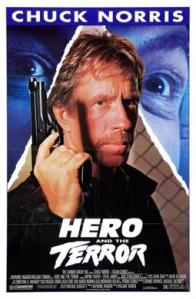
A Movie A Day #42: Hero and The Terror (1988, directed by Steve Tannen)


hero_and_the_terror_posterDanny O’Brien (Chuck Fucking Norris!) is a tough Los Angeles cop who has been nicknamed Hero.  Danny hates it when people call him “Hero.”  Maybe if Danny knew what people usually call cops, he would not complain so much about his nickname.  Three years ago, Danny captured Simon Moon (Jack O’Halloran), a neck-breaking serial killer nicknamed “The Terror.”  After he was captured, The Terror faked his own death and disappeared.  He ended up living in a deserted theater and not bothering anyone until the Mayor of Los Angeles (Ron O’Neal, Superfly himself!) decides to tear down his new home.  The Terror does not take kindly to urban renewal and goes on another killing spree.  Can Hero track down and beat the The Terror while also making it to the hospital in time to see his girlfriend give birth to their baby?

Not surprisingly, Hero and the Terror is one of the films that Chuck made for Cannon Films in the late 80s and, along with Chuck and Ron O’Neal, it features Cannon regulars Steve James and Billy Drago.  (Billy Drago actually plays a good guy, for a change.)  It’s obvious that Chuck was trying to broaden his horizons with Hero and the Terror: with the exception of the final confrontation between Hero and the Terror, there’s less kung fu action than in his previous films and a lot of the movie is dedicated to his relationship with his girlfriend and his struggle to handle her pregnancy.  That’s all good and well and the Chuck Norris of Hero and The Terror is a much better actor than the Chuck Norris who could barely deliver his lines in Breaker, Breaker but, ultimately, a Chuck Norris movie with more human interest and less roundhouse kicks just feels wrong.

(On Netflix, there’s a whole documentary about how Chuck Norris’s roundhouse kicks led to the collapse of Nicolae Ceaușescu’s communist dictatorship in Romania.  It’s called Chuck Norris vs. Communism.  Communism didn’t have a chance.  Hopefully, Chuck will never turn against capitalism because, if he does, it’ll probably lead to another stock market crash.)

I once read an interview with Gene Hackman, in which he was asked to name his least favorite of the movies that he had made.  Hackman selected March or Die.  “I can’t believe I was in something called March or Die,” Hackman said.  If he thought March or Die was a bad title, he should be happy that he didn’t end up in Hero and The Terror.  Give Chuck Norris credit.  Even if he’s not Gene Hackman and even if the movie does not really work, he is the only actor who could credibly star in something called Hero and the Terror.

Everybody Goes Home!: P.O.W. The Escape (1986, directed by Gideon Amir)


Pow_the_escape_posterP.O.W. films were all the rage in the 1980s.  For a country just starting to get back its confidence, refighting the Vietnam War onscreen was a way to deal with the lingering trauma of that conflict.  In Rambo: First Blood Part II, Sylvester Stallone asked, “Do we get to win this time?” and for a while, the answer was yes.  By sending action stars like Stallone and Chuck Norris to rescue American soldiers still being held captive in Asia, we would win this time (if only in our dreams).
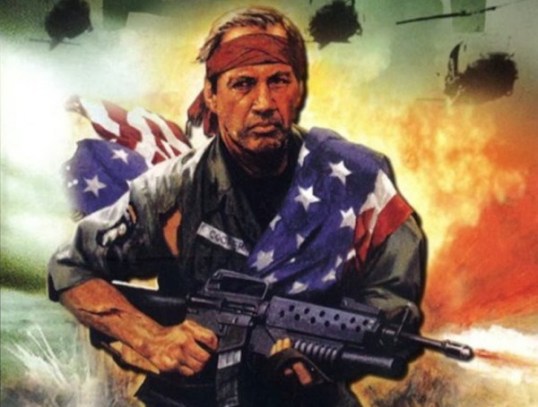
P.O.W.: The Escape (also known as Behind Enemy Lines and Attack Force ‘Nam) is one of the many P.O.W. films that was produced by Menahem Golan and Yoram Globus during their legendary time at Cannon Films.  In place of their usual star, Chuck Norris, P.O.W.: The Escape stars David Carradine as Col. James Cooper.  Cooper is a U.S. Airborne commando who, in 1973, is sent to North Vietnam on a special missions to rescue the soldiers behind held in a POW camp.

Why has Cooper been selected for this mission?

As one officer puts it, “Aside from being the best, he’s got one rule and it’s never been broken.  Everybody goes home!”

When the rescue mission goes awry, Cooper is himself captured and sent to the POW camp.  He gets his fellow prisoners back into fighting shape and, when the cowardly Sparks (Charles R. Floyd) challenges his leadership, Cooper reminds him of who the senior officer in charge is.  When the camp commandant, Vinh (Mako), offers to help Cooper escape in return for Cooper helping Vinh reach the United States, Cooper simply responds with his name, rank, and serial number.  When Vinh threatens to kill the prisoners unless Cooper helps him, Cooper agrees on one condition: “Everybody goes home!”

When Sgt. Johnston (played by perennial action sidekick, Steve James) learns of the plan, he argues that “Everybody goes home is a slogan, not a religion!”

“Speak for yourself,” Cooper replies.

Even, if like Sparks, they betray you and run off with a cache of gold, the religion of Everybody Goes Home means that no one gets left behind.  Even if it means having to trek through the jungle and going over a waterfall in a canoe, everybody goes home.  That is something that Sparks only comes to realize as he watches a prostitute undress and starts to have flashbacks to earlier scenes in the movie.  Suddenly, Sparks understands that everybody goes home and it gives him an opportunity for some last minute redemption.

Even though it is not as well-known as Missing in Action or First Blood Part II, POW: The Escape is enjoyably mindless entertainment in the legendary Cannon style.  As the world’s least likely paratrooper, David Carradine gets to show off some sweet kung fu moves.  By the end of the movie, Carradine is literally wearing an American flag.  Nothing about POW: The Escape is subtle but what’s important is that “Everybody goes home!”

ATTACK-FORCE-NAM-1986-600x455

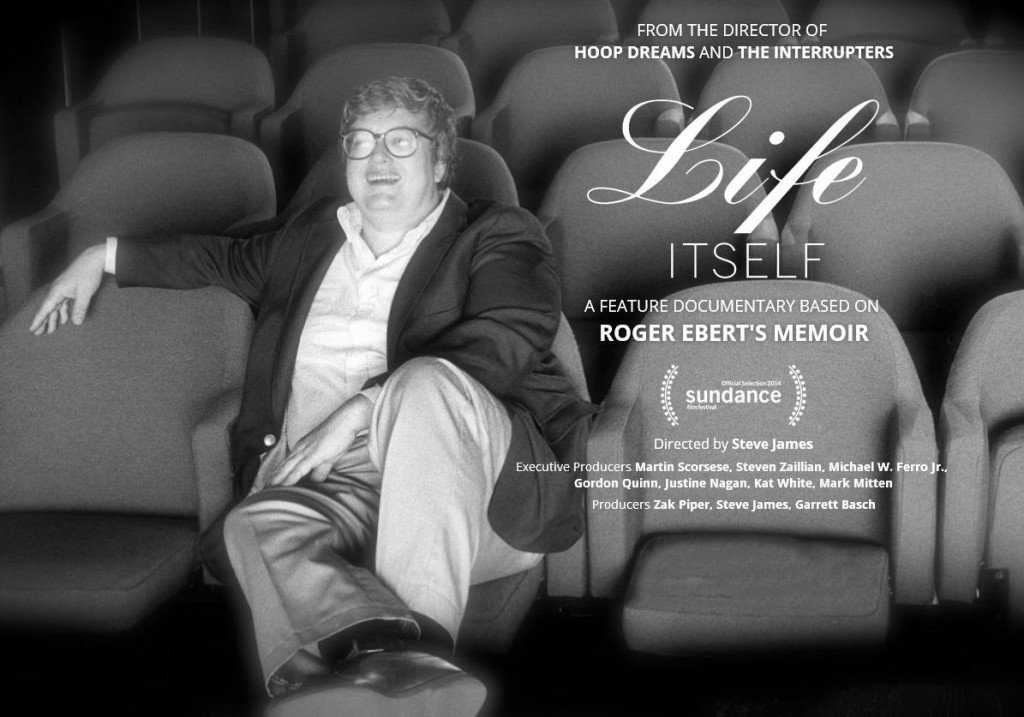
‘Life Itself’ Review (dir. Steve James)


Life-Itself-poster-1024x7171

“We all are born with a certain package. We are who we are: where we were born, who we were born as, how we were raised. We’re kind of stuck inside that person, and the purpose of civilization and growth is to be able to reach out and empathize a little bit with other people. And for me, the movies are like a machine that generates empathy. It lets you understand a little bit more about different hopes, aspirations, dreams and fears. It helps us to identify with the people who are sharing this journey with us.” – Roger Ebert

I’ve enjoyed film for pretty much all my life, but I didn’t truly come to appreciate and love it as an art form – as something more than simply entertainment – until my first year of college (I know, how cliché). I didn’t just come to love watching film, but (as you can obviously see as I write this) I came to love reviewing and discussing the medium with others as well. The first critic who introduced me to film criticism was Roger Ebert. His reviews were the first to really click with me. It wasn’t because I always agreed with him (because I definitely didn’t); but it was because I truly, truly admired his love of film. It was a contagious sort of love, a passion I never knew could be had for motion pictures. Following his example I too began writing about films and discussing them on forums and blogs. These discussions opened up the door really, and I charged head first, exploring the medium more deeply than I ever imagined I could.

It became a journey that I can honestly say made me the person I am today. Film was, and always will be, what I turn too when I am happy, bored and most importantly when I am sad. The best example I have of this was when my grandfather passed away years ago. It was a special sort of hurt, and no discussions with family or friends could do much to quell that pain. I remember sitting down the night it happened, alone in my dark room, and deciding to watch ‘Amelie’. It is a film I adored, one of the few films that truly moved me with every viewing. When it ended, as it had done many times before, I had a huge smile on my face. It did it again. Film did it again; it was once again one of the few things in my life that could heal, or overshadow, any hurt I happened to be feeling. I don’t think I would have known about or adored ‘Amelie’ if not for the journey my love for film had created – a love that wouldn’t have blossomed without the analysis and discussions I had about them – discussions I would never have started if I hadn’t read Roger’s reviews religiously and decided to start writing some myself.

That is why I was deeply saddened when Roger Ebert passed away. He is one of those rare people for me who although I never actually met or spoke with him, he still managed to have a profound effect on my life. An effect that still moves me, as I learned today as I finally watched ‘Life Itself’. I shamefully had put it off for far too long, partly because I think I knew the sort of emotional response I would have towards it. But as the quote I began this posts says, film helps us “identify with the people who are sharing this journey with us”, and it was about time I took a look at the journey that was the life of Roger Ebert.

And boy, was it rough. It did bring me to the verge of tears, as I expected, but I loved every minute of it. ‘Life Itself’ is an honest and in depth portrait of a man who wasn’t without his faults. But no matter what battles he encountered – either with alcohol, his colleagues, or cancer – he still faced everyday ready for what came next. He had a passion for life that was reflected in his passion for film – or maybe the other way around. This for me is what shined through the documentary, handled with such care and attention by Steve James. It is an affectionate tribute to a man who moved so many, generating the very same empathy that Ebert himself loved about film, and for that I think it deserves two big thumbs up.

———–

More of my nonsense on Twitter.