Lisa Watches An Oscar Nominee: Father of the Bride (dir by Vincente Minnelli)


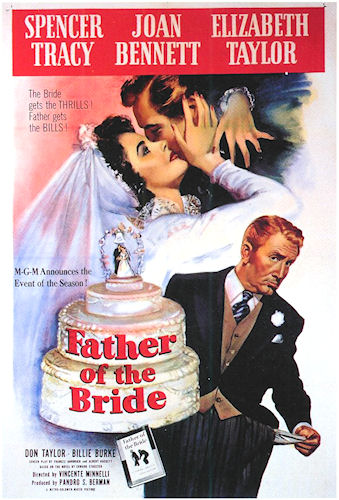
FatheroftheBride1950

After I watched King Solomon’s Mines, I watched yet another 1950 best picture nominee, Father of the Bride.

In Father of the Bride, Spencer Tracy plays a lawyer named Stanley Banks.  As you might expect of any character played by Spencer Tracy, Stanley Banks is a no-nonsense type of guy.  He’s set in his ways and not particularly enthusiastic about the idea of change.  Stanley has worked hard to get a good job and a nice house in the suburbs.  He loves his wife, Ellie (Joan Bennett) and is a firm but good father to his two boys, Tommy (Russ Tamblyn) and Ben (Tom Irish).  If Stanley does have a soft spot, it’s for his daughter, Kay (17 year-old Elizabeth Taylor).  Stanley admits that he’s always given Kay everything that she’s ever wanted and that she is his favorite of all his children.

However, Kay has been acting strangely as of late.  She just seems to be so happy!  Stanley can tell that she’s in love, though he has no idea with whom.  (He is, however, happy that it’s probably not the bespectacled political radical who Kay apparently dated at some point in the past.)  Finally, during an otherwise typical family dinner, Kay announces that not only is she in love but she’s also engaged to be married!

His name is Buckley (Don Taylor, who would later direct Escape From The Planet of the Apes and Damien: Omen II) and, at first, Kay refuses to even introduce him to her parents.  Eventually, however, Stanley does meet Buckley and he’s happy to discover that not only does Buckley come from a wealthy family but he also owns a small business of his own.

However, just because Buckley is the perfect 1950 man, that doesn’t mean that the wedding is going to be easy.  As a befuddled Stanley watches, the wedding grows more and more elaborate (not to mention, expensive!).  All of the expected complications ensue: Buckley and Kay have a fight, a wedding planner makes things difficult, and Stanley does not immediately get along with Buckley’s parents.  But, for the most part, Father of the Bride is about Stanley struggling to accept that his daughter has grown up and is ready to start a life of her own.

Father of the Bride is a sweet little comedy, though it seems a bit out-of-place as a best picture nominee.  It’s definitely a film of its time.  For all of the scenes of Stanley worrying about the extravagance of modern weddings, there’s not a subversive moment to be found in Father of the Bride.  (One can only imagine what Nicholas Ray or Douglas Sirk would have done with the material.)

Fortunately, this is also a Spencer Tracy film and whatever gravitas that the film may have comes from Tracy’s honest and straight forward performance.  Tracy never begs for laughs but he gets them anyway, because of the honesty that he brings to the character.  Perhaps his best moment comes after Buckley and Kay have had a fight.  After comforting his daughter, Stanley discovers that Buckley is at the front door.  At first, the protective Stanley tells Buckley that Kay doesn’t want to see him.  Suddenly, Kay comes running down stairs and embraces Buckley.  Between sobs and kisses, Buckley and Kay dramatically swear to each other that they will never fight again.  The camera pans over to Stanley, standing a little to the side and listening.  At first, Stanley seems befuddled by how overdramatic the two of them are acting over a relatively minor fight but there’s also just a hint of sadness in Stanley’s eyes as he realizes that his daughter truly has moved on.

Father of the Bride was nominated for best picture but it lost to the far more subversive All About Eve.
Lisa Watches An Oscar Nominee: San Francisco (dir by W.S. Van Dyke)


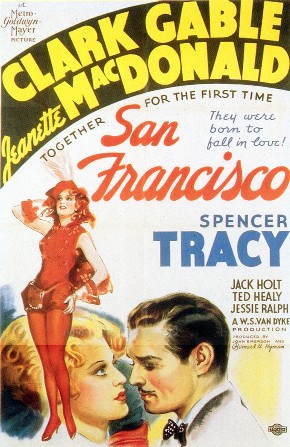
San_Francisco_(film)_poster

As I sit here writing this, I’m snowed in, my asthma’s acting up, and our cat is quickly losing patience with me.  On the plus side, however, this weather has given me an opportunity to watch some more of the old best picture nominees that I had saved up on my DVR.

For instance, I just finished watching the 1936 best picture nominee, San Francisco.

San Francisco was one of the first disaster films, a film that follows a group of characters as they attempt to survive the 1906 earthquake that destroyed the town of San Francisco.  And it has to be said that, nearly 80 years after the film was first released, the climatic earthquake remains effective and scary.  San Francisco, of course, was made long before there was any such thing as CGI.  Many of the film’s sets were built on special platforms that were designed to shake back and forth, just like in an actual earthquake.  When you see walls and buildings collapsing in San Francisco, you know that those walls are breaking apart and collapsing for real and the extras running for their life are literally doing just that.  After the earthquake, Clark Gable, as the film’s hero, walks through the ruins of San Francisco with the haunted look of a true survivor.  Gable was such a confident actor that it’s still jarring to see him looking overwhelmed.

Unfortunately, before you get to that spectacular earthquake, you have to sit through the rest of the film.  It’s a massive understatement to say that the pre-earthquake portion of San Francisco drags.  Clark Gable is Blackie Norton, a notorious gambler and saloon keeper.  Blackie may be a rogue but he’s a rogue with a heart of gold.  His childhood friend, Father Tim (Spencer Tracy), wants Blackie to run for the board of supervisors.  Blackie, however, is more interested in Mary Blake (Jeanette MacDonald), the newest singer at his club.

From the minute she first appears to the very end of the film, Jeanette MacDonald is singing.  Even when she’s not at the center of the scene, you can often hear her singing in the background.  And, after a little while, you just want her to stop singing.  But, whenever that happens, she tries to act and you realize that the only thing more boring than Jeanette MacDonald singing is Jeanette MacDonald acting.

Anyway, the film goes through all of the expected melodrama.  Blackie wants to reform.  Blackie decides not to reform.  Father Tim believes that there’s good in Blackie.  Father Tim gives up on Blackie.  Father Tim decides to give Blackie another chance.  Mary loves Blackie.  Mary fears Blackie.  Mary leaves Blackie.  Mary comes back to Blackie.  Mary leaves Blackie again.  Mary sings.  And sings and sings and sings…

But then, just when you’re about to fall asleep, the city starts to shake and all is forgotten in the wake of a natural disaster.  Even earthquakes serve a purpose…

San Francisco was a huge box office success.  It was nominated for best picture.  Somehow, Spencer Tracy received a nomination for best actor, despite the fact that he’s really not that impressive in the film. (His role is primarily a supporting one and he’s consistently overshadowed by Gable.)  The only Oscar that San Francisco won was for best sound recording and it must be said that, after all these years, the earthquake still sounds terrifying.

As for the film itself, I’d suggest skipping ahead to the earthquake.  That, after all, is the main reason anyone would be watching the film and, by skipping ahead, you’re spared having to sit through an hour and a half of Jeanette MacDonald singing.

Shattered Politics #14: The Last Hurrah (dir by John Ford)


Last_Hurrah

Down here in Dallas, we have a county commissioner named John Wiley Price.  Even if you don’t live in Texas, you might have heard about him.  A few years ago, Price stormed out of a commissioners meeting while shouting, “All of you are white!  Go the Hell!”  It was a popular YouTube video for a while and attracted all of the usual type of comments that you see online.  It even made the national news.

Nobody down here in Dallas was surprised by Price’s outburst.  To us, that was just John Wiley being John Wiley.  For that matter, nobody was particularly surprised when it was reported that he was being investigated by the FBI.  Everyone always took it for granted that John Wiley Price was taking bribes and receiving kickbacks.  That’s just the way that things are done down here in Dallas, by politicians both white and black.  (Of course, most of the white politicians who do it don’t get publicly investigated by the FBI.)

Now, if you ask the majority of people in Dallas county what they think about John Wiley Price and they’ll probably say something negative.  I’ll admit that I would probably be among them.  But the thing is — John Wiley Price’s constituents love him.  John Wiley Price was first elected to the commissioner’s court before I was even born and, as long as he’s on the ballot, he will be reelected.  Even if Price is convicted on corruption charges, he will still be reelected.

I can still remember the night that it was announced that John Wiley Price was on the verge of being arrested by the FBI.  All across his district, emergency meetings were held in churches and ministers stood behind the pulpit and, while the TV cameras rolled, they called upon everyone to pray for John Wiley Price.  In Price’s district, he’s known as “our man downtown,” the idea being that John Wiley Price is standing up to the rich and white Dallas establishment and, if he makes some money for himself in the process, so be it.  As long as he’s doing right for the people who elected him, who cares how he does it?

And, as much as we may want to judge the John Wiley Prices of the world, the fact that of the matter is that he’s a part of a long American political tradition.  That political tradition is also the driving force behind today’s final entry in Shattered Politics.

First released in 1958 and directed by John Ford, The Last Hurrah tells the story of Frank Skeffington (Spencer Tracy), the mayor of an unnamed city in New England that’s obviously meant to be Boston.  Skeffington is the flamboyant head of a large and powerful (but, as the film makes clear, aging) Irish-American political machine.  He’s preparing to run for his fifth term for mayor, a campaign that he says will be his last.

Whether Frank Skeffington is a good mayor or not depends on who you ask.  The poor and the disenfranchised love him.  Skeffington, after all, is the son of Irish immigrants.  He was born poor.  His mother worked as a maid and was even fired by a member of the wealthy and influential Force family.  They know that Skeffington has had to cut corners and that he’s gone out of his way to reward his cronies but they also know that Skeffington is on their side.  Though the phrase is never used in the film, Skeffington is “their man downtown.”

Meanwhile, the wealthy and the upper class see Frank Skeffington as being a crook, a man who has run a corrupt administration and who uses class warfare to keep the city divided against itself and to make himself and his cronies rich.  Newspaper editor Amos Force (John Carradine) has thrown his considerable influence between Skeffington’s opponent, a wealthy but dull man named Kevin McCluskey.

Reporter Adam Caulfield (Jeffrey Hunter) is in an interesting position.  On the one hand, he is Skeffington’s nephew.  On the other hand, as a journalist, he works for Amos Force.  Skeffington invites Adam to follow and record his final campaign for posterity.

It’s interesting to compare The Last Hurrah to films like The Boss or All The King’s Men.  Whereas those two films came down squarely on the sides of the reformers, The Last Hurrah is firmly on the side of Frank Skeffington.  It presents Skeffington as being a sentimental figure, the type of old-fashioned, populist politician who won office by going out and meeting the people face-to-face and personally giving them a reason to vote for him.  As Skeffington himself points out, he’s the type of politician that will soon be made obsolete by television and modern campaigning.

And it’s impossible not to enjoy The Last Hurrah‘s refusal to pass judgment on its lead character.  It helps, of course, that Spencer Tracy plays Skeffington with a twinkle in his eye while all of his opponents are played by villainous and aristocratic character actors like John Carradine and Basil Rathbone.  Yes, the film says, Skeffington may have been corrupt but at least he wasn’t boring!

Finally, I enjoyed the film because all of the “good” guys were Irish Catholic and all of the bad guys most definitely were not.

So, with that last hurrah, we conclude Shattered Politics for today.  We’ll be back tomorrow, when we’ll start to get into the 1960s.

Sláinte!

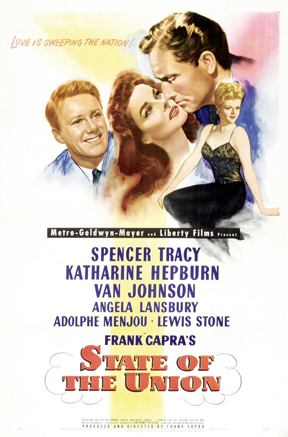
Shattered Politics #9: State of the Union (dir by Frank Capra)


Sotu1948

“Politicians have remained professionals only because the voters have remained amateurs!” — State of the Union (1948)

Does anyone remember the Americans Elect fiasco of 2012?

Americans Elect was an organization set up by a bunch of businesspeople, attorneys, and out-of-office politicians.  Their stated goal was to challenge the political establishment, shake up the two-party system, and elect a president.  The idea was that the party would hold a nationwide primary.  Any registered U.S. voter could go online and cast their vote on what they thought should be in the party’s platform and who they thought should be the Americans Elect presidential candidate.  Whoever won this nationwide primary would be required to 1) run on the platform and 2) pick a vice presidential candidate from the opposite party.

And all would be right with the world, right?

Right.

Anyway, I did register as an American Elect delegate, just because I was curious to see who was getting votes in the nationwide primary and who wasn’t.  (And yes, I did cast a vote.  I voted for Dallas County Commissioner Elba Garcia.)  Looking over the site, I saw that all of the usual suspects were getting votes — Ron Paul, Hillary Clinton, Michael Bloomberg, Donald Trump, and even Barack Obama.  None of the big vote getters were exactly nonpartisan or independent figures.  With the possible exception of Ron Paul, all of them were members of the very establishment that Americans Elect was claiming to challenge.

Anyway, Americans Elect ended up nominating no one for President and, as we all know, the 2012 election came down to choosing between two candidates who both received money from the same millionaires and, in the end, the status quo was upheld.

To be honest, everyone should have realized that Americans Elect was a sham as soon as the New York Times printed a column praising the effort.  Any truly independent political organization would never be praised by the New York Times.  Instead, like most so-called independent political organizations, Americans Elect was just a case of certain members of the establishment slumming.

So, the lesson of American Elect would seem to be that any attempt to run outside of the mainstream will, in the end, simply lead you back to the mainstream.  That was an expensive lesson for all of the volunteers who devoted their time to getting Americans Elect on the ballot in 28 states.  It was a lesson that they could have learned much more easily by watching the 1948 film, State of the Union.

In State of the Union, newspaper publisher Kay Thorndyke (Angela Lansbury) wants to make her lover, Grant Matthews (Spencer Tracy), President of the United States.  Grant is a no-nonsense, plain-spoken businessman who is quick to explain that he loves and cares about his country but that he hates partisan politics.  (In many ways, it’s impossible not to compare Grant to … well, to just about every single wealthy businessman who has ever run for public office while claiming to essentially be nonpolitical.  The big difference is that Grant actually means it.)  However, by subtly appealing to both his ego and his patriotism, Kay convinces Grant to run.  With the help of sleazy Jim Conover (Adolphe Menjou) and the sardonic Spike McManus (Van Johnson), Kay uses her money and her newspapers to turn Grant into a viable candidate.

The only problem is that Grant is separated from his wife Mary (Katharine Hepburn) and, since this movie was made in the 1940s, everyone knows that Grant has to be seen as being a family man if he’s going to be elected.  For the election, Mary and Grant pretend to be happily married.

As the primary season continues, Grant finds himself being more and more manipulated by Kay and Jim.  Eventually, Grant is forced to make a decision between his campaign and his integrity…

Following Mr. Smith Goes To Washington and Meet John Doe, State of the Union was the third part of director Frank Capra’s political trilogy.  Based on a play (which, itself, was supposedly inspired by the 1940 Republican presidential candidate, Wendell Willkie), State of the Union never quite escapes its stage-bound origins.  Add to that, the film was probably a bit more shocking when it was first released in 1948.  In 2015, we’re used to idea of politicians being controlled by money.  But, in 1948, audiences were perhaps a little bit more innocent.

But, that said, State of the Union is still an entertaining film.  Needless to say, Spencer Tracy and Katharine Hepburn have a wonderful chemistry together and Hepburn gets a great drunk scene.  (Hepburn had such an aristocratic presence that it’s always fun to watch her do comedy.)  Angela Lansbury also does well, playing a character who could very well grow up to be the role she played in The Manchurian Candidate.

67 years after it was first released, State of the Union remains an entertaining film that makes some good and still relevant points.  In 2016, when you’re tempted to get involved with the latest version of Americans Elect, watch State of the Union instead.

Film Review: Judgment At Nuremberg (dir by Stanley Kramer)


I previously posted a review of the 1967 best picture nominee Guess Who’s Coming To Dinner that was somewhat critical of Stanley Kramer as a filmmaker.  In retrospect, I feel like I may have been a bit too dismissive of Stanley Kramer.  When one looks over the list of every film that has ever been nominated for best picture, one comes across the name Stanley Kramer (as a producer, a director, or both) far too many times to just blindly dismiss him for the sin of being old-fashioned.  While Kramer made his share of well-intentioned misfires like Guess Who’s Coming To Dinner, he was also responsible for some films that remain important and watchable today.  Judgment at Nuremberg is one of those films.

Judgment at Nuremberg opens in 1947, with one car being driven through the ruins of Nuremberg, Germany.  Inside the car is Dan Haywood (Spencer Tracy), a judge from Maine who has been appointed chief of a military tribunal that will be passing judgment on four German judges who are accused of crimes against humanity for their legal rulings during the Nazi regime.  As Haywood quickly learns,  many people don’t feel that the Nazi judges should be held as accountable for their actions as men like Hitler, Goebbles, and Goering should have been.  It’s up to Haywood to determine whether the accused were simply doing their job or if they had a responsibility to defy the laws that they had sworn to uphold.

Judgment at Nuremberg almost feels like two films.  The first film is a courtroom drama, where the Nazi judges (the main one of which is played by Burt Lancaster) are prosecuted by the fiery Col. Tad Lawson (Richard Widmark) and defended by the idealistic Hans Rolfe (Maximilian Schell).  While Lawson approaches the case and regards the defendants with righteous anger, Rolfe takes a more cerebral approach to defending the undefensible.  Rolfe argues that the judges were following the laws of Germany and that if the tribunal finds them guilty than it will be finding the entire nation of Germany guilty.  (In a rather clever twist, director Kramer and screenwriter Abby Mann initially make the German defense attorney a far more likable character than the American prosecutor.)  During the trial, we also hear heart-wrenching testimony from two people (played by Montgomery Clift and Judy Garland) who were victimized by the Nazi regime and the judges who gave legal legitimacy to the regime’s crimes.

The second film deals with Haywood adjusting to working in Germany and trying to understand how the Nazis could have come to power in the first place.   Haywood asks several Germans to tell him about life under the Nazis and every time, he is met with bland excuses.  (“We were not political,” he is told more than once.)  The film’s strongest scenes are the ones where Haywood simply walks alone through the ruins of Nuremberg.  Spencer Tracy was a uniquely American actor and, much as he did in Guess Who’s Coming To Dinner, Tracy here stood in for every American who was struggling to make sense of a changing world.

In his book Pictures At A Revolution, Mark Harris correctly points out that Stanley Kramer started out as a producer and, even after he started directing, he still approached filmmaking like a producer.  While that approach led to many uninspiring films, it was also the right approach for Judgment at Nuremberg.  Perhaps realizing that Judgment at Nuremberg was a long and talky movie about a disturbing subject manner, Kramer made the very producer-like decision to fill Judgment at Nuremberg with recognizable faces.  While this approach has proven disastrous for many films, it works quite well in Judgment at Nuremberg.

This is one of the most perfectly cast films of all time, with all of the actors bringing both their characters and the issues that they’re confronting to vivid life.  As the main defendant, Burt Lancaster brings a combination of intelligence and self-loathing to his role, playing him in such a way to reveal that even he can’t believe the evil he upheld as a judge.  Meanwhile, Spencer Tracy is perfectly cast as a world-weary man who is simply trying to figure out what justice means in the post-war world.  Maximilian Schell plays his role with so much passion that it’s impossible not to listen to him even when you despise the argument he’s making.  Marlene Dietrich has an extended cameo where she plays the widow of Nazi general who befriends Judge Haywood but still refuses to admit that she knew anything about what Adolf Hitler was doing.  Even William Shatner shows up, playing a small role as Haywood’s chief military aide and yes, he does deliver his lines in that Shatner way of his.

First released in 1962, Judgment at Nuremberg won Oscars for Best Actor (Maximilian Schell) and Best Adapted Screenplay (Abby Mann) and was nominated for 9 more: Best Picture, Best Director, Best Actor (Spencer Tracy), Best Supporting Actor (Montgomery Clift), Best Supporting Actress (Judy Garland), Best Black-and-White Art Direction, Best Black-and-White Cinematography, Best Black-and-White Costume Design, and Best Film Editing. While it’s hard to argue with the victory of West Side Story in that year’s Oscar race, Judgment at Nuremberg remains a watchable and thought-provoking film.

Film Review: Guess Who’s Coming To Dinner (directed by Stanley Kramer)


Sometimes, you just had to be there.

That was my reaction as I watched the 1967 Best Picture nominee Guess Who’s Coming To Dinner.  While this film may have been topical and even controversial when it was first released, when watched today it seems to be rather mild and tame.

In Guess Who’s Coming To Dinner, Spencer Tracy plays Matt Drayton.  Matt’s a San Francisco newspaper publisher, a respected member of the upper class establishment.  His wife, Christina (Katharine Hepburn), owns a trendy art gallery and Matt spends his spare time playing golf with Monsignor Ryan (Cecil Kellaway).  He’s the father of the free-spirited Joey (Katharine Houghton, who was Hepburn’s niece in real life).  He’s also, as we’re told repeatedly by every other character in the film, a liberal who supports the civil rights movement.

As the film begins, Joey is returning from a vacation in Hawaii and she has big news.  While in Hawaii, she met and fell in love with the widowed John Prentice, a highly succesful doctor who is literally on the verge of winning a Nobel Peace Prize.  Though he’s 16 years older than her and they’ve only known each other for 10 days, Joey and Prentice are planning on getting married.  While Joey thinks that she’s bringing Prentice to San Francisco just so her parents can meet their future son-in-law, Prentice has specifically come to ask Matt’s permission to marry Joey.  As Prentice explains to Matt, he’ll call the marriage off if Matt doesn’t approve.

John Prentice, by the way, is played by Sidney Poitier and that is the source of the film’s conflict.  Will Matt give his daughter permission to marry a polite, considerate, wealthy, saintly, world-renowned doctor despite the fact that he happens to be black?

Watching Guess Who’s Coming To Dinner was a bit of a culture shock to me, both because I’m the result of an interracial marriage myself (my mom was Spanish and my dad’s white) and because several of my friends are either in or have been a part of an interracial relationship or marriage.  For people my age, it’s not a big deal.  We take it for granted that if you find someone to be attractive, you can have a relationship with him regardless of whatever race he may happen to be.

While I was doing research on Guess Who’s Coming To Dinner, I was reminded that this wasn’t always the case.  When Guess Who’s Coming To Dinner was first released in 1967, interracial marriage was still illegal in 17 states.  In that same year, U.S. Secretary of State Dean Rusk offered to resign when his daughter married a black man.  When Guess Who’s Coming To Dinner was first released, interracial marriage still a controversial subject and when Spencer Tracy struggled with his feelings about it, he stood in for countless Americans who, though they may  have taken pride in how tolerant they were, still weren’t sure what they would do if a black man tried to join their family.

As you can probably guess, Guess Who’s Coming To Dinner is far more interested in teaching a lesson than telling a story.  It’s perhaps not surprising that the film was directed and produced by Stanley Kramer.  Kramer was one of the most prominent filmmakers of the 1960s.  He specialized in making big films that dealt with big issues, the type of films that were regularly nominated for an academy award but rarely honored with an actual win.  In many ways, Guess Who’s Coming To Dinner is a prototypical Kramer picture — its heart is in the right place but the film itself is so conventional and free of ambiguity that it never manages to truly challenge the status quo that it claims to be criticizing.*

In his excellent look at the 1967 nominees for best picture, Pictures At A Revolution: Five Movies And The Birth of The New Hollywood, Mark Harris provides a fascinating behind-the-scenes look at the filming of Guess Who’s Coming To Dinner.  Harris quotes Kramer as explaining that the character of John Prentice had to be perfect because, if the character had any flaws, then bigots in the audience would have seized on those flaws as the reason why Prentice and Joey should not be allowed to marry.  As Kramer explains it, the entire film was set up to make it clear that the only possible reason that Matt could have to object to Prentice would be the color of his skin.

To an extent, I can see Kramer’s point (and again, it’s hard to judge what was necessary to make a point in 1967 from the perspective of 2013) but, as I watched Guess Who’s Coming To Dinner, it was hard not to feel that the main problem with the film was that Prentice was just too perfect.  Certainly, he was too perfect to be in love with Joey who, as played by Houghton, simply seemed to be too naive and foolish to be a good match for a man who is on the verge of winning a Nobel Prize.  Even more importantly, it’s hard to escape the fact that this accomplished, confident black man still needs to get the permission of a well-meaning white liberal before he can marry the woman he claims to love.

Ultimately, despite the film’s noble intentions, it feels more than a bit condescending.  At no point is Prentice allowed to show any anger or frustration at having to prove himself.  There’s even a scene where Prentice criticizes his own father for being too hung up on racism.  “Not until you and you’re whole lousy generation lay down and die will the weight of you be off our backs … You think of yourself as a colored man … I think of myself as a man!” Prentice tells him, as if his success was due to ignoring racism as opposed to defying it.

If Guess Who’s Coming To Dinner has dated badly as a look at race relations in the United States, it remains watchable because of the performances of Katharine Hepburn and Spencer Tracy.  This was their 9th and final film together and the love that these two accomplished actors felt for each other shines through every scene.  Tracy was seriously ill while making the film (and died before it was released) but he gave one of his best and most heartfelt performances here.  He was nominated for a posthumous Oscar but lost to Rod Steiger, who co-starred with Poitier in the film that beat Guess Who’s Coming To Dinner for best picture, In The Heat of the Night.

In the Heat of the Night is best-remembered for the scene in which Poitier angrily declares, “They call me …. MISTER TIBBS!”  This line epitomized the righteous anger that he was not allowed to display in Guess Who’s Coming To Dinner.  If only Guess Who’s Coming To Dinner had its own “MISTER TIBBS” moment, it might be remembered as something other than a film that seems curiously out-of-place as a nominee for best picture.

* That said, Kramer’s post-Guess films were actually pretty interesting and a bit more daring.  Some day, I’ll have to get around to reviewing his 1970 campus unrest film, R.P.M.