I can’t say that any entertainment franchise has given me more cause to think than Ghost in the Shell. It presents a mid-21st century post-apocalyptic earth in which society has more or less stabilized. Events revolve around Public Security Section 9, a counter-terrorism agency focused on investigating cyberterrorism, which is rather interesting because the original manga by Masamune Shirow launched in 1989, before cyberterrorism actually existed (or the modern internet, for that matter). Throughout their investigations, the team deals with the social and philosophical issues that arise in an age where society is fully integrated across a world-wide network and technology has been integrated directly into the body, rendering people intimately vulnerable to hacks and computer viruses.
I am as guilty as most of having never read the original manga. I became acquainted with Shirow’s world through Ghost in the Shell (1995) and Ghost in the Shell 2: Innocence (2004), both directed by Mamoru Oshii, and the 2002 anime series Ghost in the Shell: Stand Alone Complex, by Kenji Kamiyama. While the two directors take rather different aesthetic approaches–the movies present Section 9 as a harsh, disenchanted unit in a somewhat dystopian world, whereas the television series is lively and a bit cartoonish–both remain dedicated to questioning the impact of highly integrated technology.
 Stand Alone Complex lies much closer to the root of my music series, because some of the key issues it tackles have since arisen online in the real world. Everyone is well familiar with the use of V for Vendetta-styled Guy Fawkes masks in protests originating from the internet, but there is a decent chance you have also caught a glimpse of an odd blue smiley face among the rabble. The Laughing Man image originates from Stand Alone Complex, where it functions as a mask employed anonymously by individuals taking public action independently of each other. At first, an advocate for social justice uses it to disguise himself while committing a ‘terrorist’ act, but the image quickly overreaches his motives. Others commit unrelated political sabotage under the guise. Corporations employ it to discredit their competitors. Pranksters use it as a sort of meme, forming the shape with chairs on a rooftop and cutting it into a field as a crop circle, for instance. The image has no concrete meaning, and everyone who uses it essentially ‘stands alone’, but the public perceive the Laughing Man as a single individual.
The actual anime gives a fairly shallow interpretation of this. The creator of the image, Aoi, explains that he never intended the mask to become a social phenomenon, and that its arbitrary usage dislodged the image from its original meaning. He sums this up by asking “Who knew that copies could still be produced despite the absence of an originator?” The ‘profoundness’ of this ties back to a long history of bad philosophy which assumes that signs have universal objective meaning in some sort of fundamental way which mystically transcends subjectivity of the mind. Basically, certain Greek ideas saw a resurgence of popularity in the late 19th and early 20th centuries, probably as a consequence of high society’s fascination with antiquities at the time. The plethora of ready-at-hand counterexamples to these archaic notions provided easy meat for countless grad students to earn their PhDs, so long as they did not throw the baby out with the bath water and ruin the game for everybody else.
But I digress. While the intended idea behind “Stand Alone Complex” is a bit naive, the Laughing Man does represent a unique sort of game that can only be played in the information age. To the public, the Laughing Man was a single individual, or at most a closely coordinated group, but the participants knew better. They knew that there was no real ‘Laughing Man’, but their independent actions were performed under the expectation that they would be written into ‘his’ public profile. The game was exclusive; you had to be aware of the mask in order to dawn it. The game also had rules; an action totally out of line with the Laughing Man’s pattern of behavior would be perceived as a fraud. (You could not, for instance, reveal the truth behind the Laughing Man.) By playing, you added a little piece of yourself to the puzzle, and it might slowly assimilate you in turn.
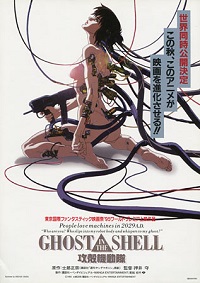 Ghost in the Shell has remained a uniquely relevant franchise in science fiction because it got so many ideas right. In 1989, at a time when internet was still a novelty of college libraries, the manga offered a world of total connectivity, where every human and device belonged to a global network. In 2002, Stand Alone Complex introduced the Laughing Man, and shortly afterwards the real world knew an equivalent. Whether this bodes well for the franchise’s dabblings into cyborg technology, only time can tell, but history has certainly made an inherently fascinating fictional world all the more compelling. In the Ghost in the Shell universe, science has fully bridged the gap between computers and neural systems, allowing electronic implants to directly convert wireless digital information into stimuli compatible with the senses. The average citizen possesses visual augmentations which allow them to directly browse the internet via voice command. More complex technology delves deeper, creating a sort of sixth sense whereby users can engage a network through thought command. Some individuals, especially accident victims with the means to afford it, might have their entire bodies replaced by neurally triggered machine components.
The 1995 Ghost in the Shell film gets especially creative in tackling this–enough that it became the chief inspiration for The Matrix four years later. It revolves around brain-mapping technology and its implications regarding sentience and identity. From the start of the film, the ability to copy and read brain data appears to be common. Presumably, these digital copies would remain stagnant until encoded back into a neural network, but as the government develops better software for interpreting and editing the massive content at its disposal, funny things start to happen. The software gains a sort of temporary sentience while performing its complex tasks, and eventually it uploads itself to a cyborg body in an act of self-preservation. This new entity possesses the capacity to read other augmented brains and incorporate them into its internal network. At least, that is how I’ve interpreted it. The movie does leave a lot to the imagination. Perhaps it is recycled from earlier science fiction, and far-fetched besides–I wouldn’t really know–but Ghost in the Shell presents it all as if it were right around the corner, not lost in a distant galaxy of Star Trek.
Ghost in the Shell is so steeped in ideas that it’s a wonder I don’t forget it is a collection of animations, not a book series. Stand Alone Complex is presented as rather typical–and relatively forgettable–anime, but the 1995 movie definitely denies dismissal. It is a real work of art. The city is dirty and a bit washed-out without feeling downright destitute; the masses still lead normal lives. Emptiness expands upward; the characters are perpetually surrounded by massive, sort of dusty-looking structures that feel vacant despite signs of life. The music is simultaneously vast and minimalistic. Generally, the artistic direction projects a feeling that the protagonists are isolated–cut off from the massive world surrounding them–perhaps by the knowledge they possess.
The score Kenji Kawai (川井憲次) crafted for Ghost in the Shell ranks among the best soundtracks I’ve ever encountered. Without it, the film might easily unravel. The plot really does take a lot of creative liberties. What amount of entertainment value could convince people to open up their brains to potential hacking? Or, if they are doing it to maintain memory backups, why is a brain hack so devastating? Can’t you just resume from your last save? Why would a hacker go to the trouble of replacing an entire memory system in the first place, if they could just encode an impulse into an existing one? To these questions, I say “shhhh!”, because Kawai has so utterly convinced me that my cyborg brain will be shipping in from Japan any day now. The music shrouds the film in imminent mystery. It is a moment of quiet awe, before the very foundations of human experience become uprooted and replaced by a higher state of computer-enhanced perception.
‘Interesting’ nerd note on Kawai: while the majority of his discography appears in anime and film, he is credited with arranging the TurboGrafx-16 port of Sorcerian, one of Yuzo Koshiro and Takahito Abe’s better 1980s NEC PC-8801 projects. I am pretty excited to dig that one up. Aren’t you? …Bueller?

 Through the Shattered Lens