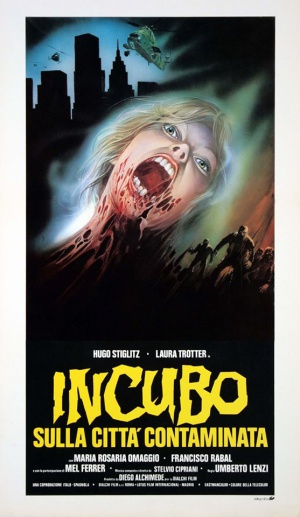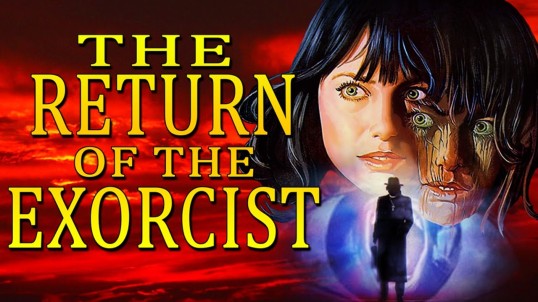
Horror Film Review: The Return of the Exorcist (dir by Angelo Pannaccio and Luca Damiano)


The 1975 Italian film, The Return of the Exorcist, opens with a disjointed series of flashbacks that gradually reveal why a young man named Piero (Jean-Claude Verne) is currently bound in a bed in a monastery.  What the flashbacks do not reveal is why Piero features one of the most fearsome mullets to ever been seen in an Italian film.  Seriously, I get that this film was shot in 1975 but it’s a little bit hard to be intimidated by someone who obviously spends hours a day obsessing over his mullet, regardless of what may or may not have possessed him.

Piero, we learn, is 17 years old and his troubles started when he was outside with his camera and he came across a naked woman (Mimma Biscardi) standing in the middle of a lake.  Piero took her picture and the woman laughed at him.  When Piero’s friends approached, the woman suddenly vanished.  When Piero developed the pictures, the woman was not in them.  He went back to the lake and discovered a medallion which, rather foolishly, he chose to wear.

Of course, because of the film’s flashback structure, we already know that the woman was previously sacrificed at a Satanic orgy and that her body was possessed by a succubus and, because Piero was stupid enough to put on that medallion, the succubus has now entered him.  Piero is soon acting strangely.  When he insults his girlfriend, Sherry (Sonia Viviani), she abandons him and eventually ends up at a club where she dances the night away.  Meanwhile, in his bedroom, Piero has a vision of the woman mocking him.  Piero grabs a knife and slashes it across the woman’s throat.  While this doesn’t effect the woman, it does lead to Sherry dying at the club.

The strangeness continues and Piero’s actions become progressively more and more disturbing.  After Piero attempts to assault both his mother (Francoise Prevost) and his sister, a nun named Elena (Patrizia Gori), the decision is made to call in an Exorcist.  The Exorcist arrives at the monastery and….

IT’S BARZINI!
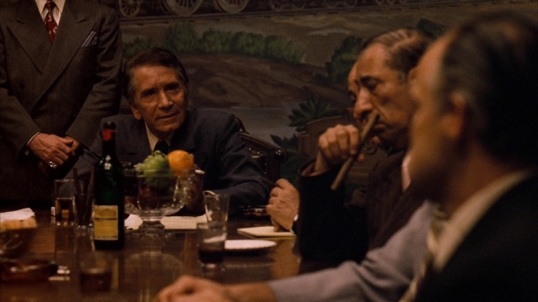
Well, no, actually The Exorcist does not have a name.  In the credits, he is simply listed as “Exorcist.”  One can guess from the film’s title that the plan was to trick audiences into thinking that the character was either Father Merrin or Father Karrras from The Exorcist but anyone who has seen that film know that would be impossible.  The important thing is that this film’s Exorcist is played by Richard Conte, who previously played Barzini in The Godfather.

(For the record, Richard Conte actually had a pretty long career and played a lot of roles before he was cast as Barzini.  In fact, Conte was prominent enough that he was initially considered for the role of Don Vito Corleone.  Before The Godfather, Conte appeared in films like Ocean’s 11, The Greatest Story Ever Told, The Big  Combo, Tony Rome, and Lady in Cement.  After The Godfather, Conte appeared in several Italian films, like this one.  The Exorcist was actually his final film role, as he died of a heart attack shortly after shooting.)
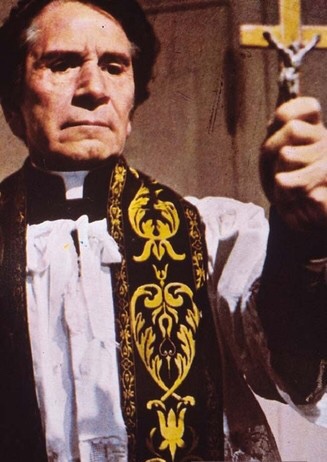
What type of exorcist is Richard Conte?  He’s a very tough one.  As opposed to the scholarly Merrin and the conflicted Father Karras, Conte’s Exorcist comes across as if he’s ready to step into that bedroom and just literally slap the Hell right out of Piero.  And considering just how annoying a character Piero was, I don’t think anyone would have objected.

Anyway, Conte really doesn’t show up in the film until it’s close to being over and the Exorcism plays out pretty quickly.  The majority of this film is made up of scenes of Piero imagining the Succubus naked or the Succubus taking over Piero’s body so that it can go after his girlfriend, his mother and his sister.  There’s reason why this film is also known as Naked Exorcism.  It’s unapologetically sleazy, as many of the Italian Exorcist films were.  It’s also a bit boring, mostly because Piero is such a doofus that you really don’t care what happens to him.  They should have just tossed him in the lake and tested whether he weighed more than a duck.  Conte is a tough exorcist but the film itself is forgettable.

Cleaning Out The DVR Yet Again #30: The Adventures of Hercules (dir by Luigi Cozzi)


(Lisa recently discovered that she only has about 8 hours of space left on her DVR!  It turns out that she’s been recording movies from July and she just hasn’t gotten around to watching and reviewing them yet.  So, once again, Lisa is cleaning out her DVR!  She is going to try to watch and review 52 movies by the end of Tuesday, December 6th!  Will she make it?  Keep checking the site to find out!)

her1

On November 10th, I recorded 1985’s The Adventures of Hercules off of the Encore Family channel.

Let’s see if I can explain exactly what this film is about.  Bear with me because this is going to be a strange one.  For that matter, you might also want to bare with me because The Adventures of Hercules is all about displaying the physique of body builder Lou Ferrigno.  Ferrigno plays the legendary Greek demigod Hercules.  Or I should say that he provides Hercules’s body and occasionally a facial expression or two.  Since The Legend of Hercules was an Italian film, the entire cast is obviously and frequently awkwardly dubbed.  That includes Ferrigno.  Though Hercules doesn’t say much, when he does speak, he does so in a voice that really doesn’t go with his body, his personality, or anything that seems to be happening on screen.

Anyway, I guess I should try to explain the plot.  I should mention that The Legend of Hercules is a sequel to another Hercules film.  I haven’t seen the first Hercules film.  Maybe the Legend of Hercules would have made more sense if I had, though I somehow doubt it.

Basically, bad things are happening on Earth.  Why?  Well, it appears that four of the Gods have gotten together and stolen Zeus’s 7 Mighty Thunderbolts.  They’ve hidden the Thunderbolts across the planet, entrusting them with various monsters.  As a result of Zeus no longer having his thunderbolts, the Moon is now on the verge of colliding with Earth and human sacrifices are also being committed to a monster that looks a lot like the ID Monster from Forbidden Planet.  

What does a Mighty Thunderbolt look like?  Here you go.

What does a Mighty Thunderbolt look like? Here you go.

Two sisters, Urania (Milly Carlucci) and Glaucia (Sonia Vivani), appeal to Zeus for help but, of course, Zeus is powerless without his thunderbolts.  However, he can still sends his son Hercules (Lou Ferrigno) to Earth.  Working with the sisters, Hercules goes on a quest for the thunderbolts.  This basically amounts to a series of scenes in which Hercules battles various people in rubber suits.  Whenever Hercules throws a punch, he’s filmed so that appears that he’s punching the camera.  Whenever Hercules’s fist makes contact, there’s a flash of red.  Whenever anyone is knocked off their feet by Hercules, they flip around in slow motion.  This happens every ten minutes or so.

Now, I don’t want to spoil the movie but I simply have to tell you about this.  There is a scene, towards the end of the film, in which Hercules literally grabs hold of the Moon and prevents it from crashing into the Earth.

Anyway, the plot makes no sense and that’s a huge part of this film’s enthusiastic, if frequently inept, charm.  As directed by the famed Italian director, Luigi Cozzi, The Adventures of Hercules has this cobbled together feeling to it that is undeniably likable.  Much as with Cozzi’s best-known film, Starcrash, The Adventures of Hercules is a film that wins you over by pure determination.  Cozzi set out to make a mythological epic and he wasn’t going to let something like a complete lack of budget stop him.

How strange an experience is The Adventures of Hercules?  Check out some of these randomly assembled screen shots:

adventures-of-hercules-1985

hercules2

margiaphroditeimpressed

adventuresofhercules2

hercules-2

adventuresofhercules3

b0056924_577cbcc1c68aa

herc-02

The other fun thing about The Adventures of Hercules is that, since this was a Luigi Cozzi film, the cast is full of Italian exploitation vets, the majority of whom were best known for appearing in far less family-friendly fare.

Here’s just a few of the performers you’ll find in The Adventures of Hercules:

Sonia Vivani, who plays Glaucia, also played the doomed sculptor in Umberto Lenzi’s infamous Nightmare City.

William Berger, who plays the villainous King Minos, appeared in several classic Spaghetti westerns, including Sabata.  Sadly, his promising career was cut short when he was framed for drug possession and spent several years in an Italian prison.  When he was finally freed, he ended up doing movies like The Adventures of Hercules.

Zeus was played by Claudio Cassinelli, an acclaimed actor who appeared in several giallo films.  He also co-starred in 1978’s infamous Mountain of the Cannibal God.

The evil High Priest was played by Venantino Venantini whose credits include everything from The Agony and the Ecstasy to Lucio Fulci’s City of the Living Dead to Umberto Lenzi’s Cannibal Ferox.

Aphrodite is played by Margit Newton, who somewhat infamously starred in what is generally considered to be the worst zombie film of all time, Hell of the Living Dead.

Serena Grandi played Euryale (a.k.a. Medusa).  Grandi is probably most remembered for his grotesque death scene in  Antropophagus.  She was also the star of one of my personal guilty pleasures, Lamberto Bava’s Delirium.

And finally, the mad scientist Dedalos was played by Eva Robbins, who achieved immortality by playing the Girl on the Beach in Dario Argento’s Tenebrae.

The Adventures of Hercules might not be “technically” a good film but it’s definitely (and rather compulsively) watchable.

The TSL’s Daily Horror Grindhouse: Nightmare City (dir by Umberto Lenzi)


incubo-sulla-citta-contaminata

Since Case just reviewed 28 Days Later, this seems like the perfect time to say a few words about the 1980 Italian horror film, Nightmare City!  Though Nightmare City has never been as critically acclaimed or as popular with audiences, it is regularly cited as probably being one of the main inspirations for 28 Days Later.

Now, don’t get me wrong.  I can’t say for sure whether it was an influence or not.  I listened to the entire Danny Boyle/Alex Garland commentary track on my DVD of 28 Days Later and neither of them ever mentioned Nightmare City.  As well, there are some pretty big differences between Nightmare City and 28 Days Later.  For one thing, 28 Days Later is a hyperkinetic Danny Boyle film whereas Nightmare City is obviously an Umberto Lenzi film, filled with over the top gore, gratuitous nudity, and nonstop violence.  For that matter, the Infected in 28 Days Later still look human whereas all of the infected humans in Nightmare City are covered with what appears to be burned oatmeal.  (I’m going to guess that it’s meant to be radiation scarring.)

And yet, despite all of that, it’s impossible to watch Nightmare City without thinking about 28 Days Later and vice versa.  Both Nightmare City and 28 Days Later are commonly mislabeled as being zombie films, despite the fact that both of them are about people who have been driven mad by a military accident/experiment.  Where you really see the influence that Nightmare City had on 28 Days Later is in the scenes in which various “infected” humans run through the streets, savagely attacking and killing anyone that they come across.  For all the attention that was given to 28 Days Later‘s “fast zombies,” Nightmare City got there first.  Call them human, call them infected, or call them zombies, the monsters in Nightmare City are relentless, unstoppable, and blood thirsty.  Whatever flaws the movie may have, Nightmare City‘s zombies truly do belong in a nightmare.

(Except for that one scene in which a zombie extra is seen to be kicking a soccer ball while a dog chases after him but you have to look closely to notice…)

But before I say too much more about Nightmare City, I’m going to ask you to watch this tribute to the hero of Nightmare City, journalist Dean Miller:

Dean Miller was played by Spanish actor Hugo Stiglitz.  (If that name sounds familiar, it may be because Quentin Tarantino named a character after him in Inglourious Basterds.)  To be honest, the first time I ever saw Nightmare City, I thought that Stiglitz’s performance was one of the worst in the history of horror cinema.  No matter how violent or bloody the film gets, Stiglitz rarely seems to react.  He might occasionally arch an eyebrow.  But, for the most part, he doesn’t seem to care.  But, after subsequent viewings, I’ve come to respect the fact that, while everyone else in the film was overacting, Siglitz distinguished himself by refusing to act at all.

Nightmare City is a relentless and nonstop film.  It starts out with Dean Miller being sent down to the local airport.  His job is to cover the arrival of a scientist who has been assigned to investigate a recent nuclear accident.  From the minute that the plane lands and a horde of hatchet-wielding zombies stream out onto the tarmac, Nightmare City is nonstop mayhem.

And, quite frankly, a lot of it doesn’t make much sense.  At one point, the zombies enter a television studio and attack what appears to be the most boring dance show in the world and, as bloody and borderline disgusting as the action got, I still couldn’t get over how boring the dance show was before the zombies showed up.  The other thing that struck me about that scene was that nobody at the television studio seemed to be that upset about a bunch of radiation-scarred zombies literally massacring hundreds of people on camera.  Dean may have arched an eyebrow but even he didn’t seem that concerned.

(Fortunately, Dean manages to escape by grabbing a TV and throwing it at the zombies.  Apparently, televisions explode if you throw them, even if they’re not plugged in at the time.)

Then the zombies attack a hospital and it’s the hospital attack that always disturbs me.  There’s a scene where a nurse comes across a zombie raiding a blood bank and he shakes his head almost apologetically.  Oddly, almost all of the doctors turn out to be self-defense experts.  One elderly doctor even throws a scalpel at a zombie with all the skill of an Agent of SHIELD (or perhaps even …. HYDRA!)

Meanwhile, the military is supposed to be doing something but I’m not sure what.  We get a lot of scenes of a general (played by Lenzi regular Mel Ferrer) staring down at a model of the city but he doesn’t ever actually seem to do anything.  His assistant, meanwhile, is worried about his sculptor girlfriend being at home alone.  He should be since there are two zombies in the basement, though we’re never quite sure how they got there without anyone else in the house noticing.

And the mayhem continues.  There’s a zombie priest.  There’s a zombie attack at an amusement park.  There’s many scenes of Hugh Stiglitz staring off in the distance.  At one point, his girlfriend falls off a roller coaster and we are briefly amazed at the sight of an obviously fake dummy crashing to the pavement below.  But fear not because … it’s all a dream!

That’s right, Dean Miller wakes up in bed!

OH MY GOD, LISA, YOU JUST SPOILED THE MOVIE!

No, I didn’t.  Believe it or not, the movie’s nowhere close to being over yet…..

Nightmare City is a hard film to review because, while it might not be good in any traditional sense, it’s also very much a one-of-a-kind movie.  This is one of those relentless and shameless exploitation films that works despite itself.  It’s preposterous, it’s silly, it’s often offensive, and yet it’s never less than watchable.  If you’re into Italian horror, you have to see this film.  If you’re into zombie cinema, you have to see this film.  (If you’re not into either, you probably stopped reading this review a while ago.)

And, while you watch it, I dare you not think about 28 Days Later

(This trailer is NSFW so watch at your own risk…)