20 Horror Films For The Weekend (10/3/25)


Welcome to Horrorthon!  Here’s 20 films to help get you into that October mood!

The Dreams of Jean Rollin

I have been a fan of the French director Jean Rollin ever since I first watched Night of the Hunted on one rainy night.  His dream-like film were often both frightening and, in their way, rather touching.  At heart, Rollin was a poet and a romantic, along with being a cinematic rebel.  This October is the perfect time to get caught up on Rollin.

The Nude Vampire (1970) opens at night, with a woman wearing an orange nightgown being chased down a street by three men wearing bird-like masks.  The woman runs into a man named Pierre.  Pierre watches as the woman is shot in the back and then carried into what appears to be a secret club.  Pierre follows and soon finds himself in the middle of a surreal world featuring cults, vampires, and one of Rollin’s trademark trips to the beach.  This was Rollin’s second film.  It’s surreal trip into an undergouns world and it owes more than a little to the serials that Rollin enjoyed as a young man.  The Nude Vampire can be viewed on Shudder.

The Shiver of the Vampires (1971) is Rollin’s tribute to the old Universal haunted house films.  A newlywed couple visits a castle that was owned by the wife’s cousins.  Upon arriving, they are told that the cousins are dead and the house is now occupied by two mysterious young women.  Over the course of the night, the couple discovers that the castle is also home to vampire named Isolde.  This atmospheric film is best-remembered the scene with Isolde emerges from a grandfather clock.  It was an image that Rollin liked so much that he reused it in several later films.  Shiver of the Vampires can be viewed on Tubi.

Requiem for a Vampire (1971) tells the story of two young girls who, having committed some sort of crime while wearing clown makeup, wander through the French countryside until they come across a castle that is occupied by a sickly vampire and his servants.  Atmospheric, dream-like, and sexually-charged, Requiem for a Vampire is a mix of horror, crime, and melodrama.  “Let’s go to the cemetery!”  Requiem for a Vampire is available on Shudder.

Lips of Blood (1975) mixes two of Rollin’s favorite themes: vampires and memory.  A man sees a picture of a ruined seaside castle and becomes convinced that he’s visited it in the past.  His search for castle leads not just to vampires but also a meditation on the act of remembering and how people are always trying to recapture an idealized moment of time.  A truly beautiful film, Lips of Blood can be found on Shudder.

The Living Dead Girl (1981) is one of Rollin’s best films.  A toxic spill brings a young woman back to life.  She has only vague memories of her past life but she also has an insatiable need for blood.  When her childhood friend discovers that the woman has come back to life, she tries to keep her fed.  It soon becomes clear that, even though the title character would rather be allowed to return to the peace of death, her friend is determined to keep her alive.  This film is a bloody, gory, and ultimately very moving examination of love and friendship.  How far would you go?  The Living Dead Girl can be found on Tubi.

Hacking Away At October

Graduation Day (1981) is one of my favorite of the early 80s slasher, an entertainingly lowbrow film about a killer who is seeking revenge on the high school track and field team.  Christopher George is the hard-pushing coach.  Michael Pataki is the ineffective principal.  Linnea Quigley, who was reportedly cast as the last minute after one of the actresses walked off the set, is the closest thing the film has to a likable character.  Vanna White is a high school student.  The music is incredible!  Felony performs a 10-minute version of Gangsters of Rock.  Graduation Day can be viewed on Tubi.

If you enjoyed Christopher George in Graduation Day, you’ll definitely want to follow up with Mortuary (1983), in which he plays the creepy owner of a funeral home.  When he’s not embalming, he’s yelling at his socially awkward son (Bill Paxton).  Someone is committing murder in the suburbs.  Could it have something to do with the weird cult that occasionally meets in the mortuary’s back room?  Christopher’s wife, Lynda Day George, plays the widow with a secret.  Be sure to yell, “We can see you breathing!” during the later embalming scenes.  Mortuary can be viewed on Tubi.

Christopher George and Lynda Day George also appear in Pieces (1982), one of the goriest slasher films ever made.  The film’s tag line was “You don’t have to go to Texas for a chainsaw massacre” and this film proves it by setting the action in Boston.  This film divides it’s time between genuinely disturbing gore and scenes that are so bizarre and misconceived that you can’t help but wonder if the director was trying to satirize the slasher genre.  The random kung fu fight is an obvious example, as is the scene where the killer casually steps into an elevator while carrying his chainsaw.  The film’s goriest scene is disturbing up until the moment that Lynda Day George starts screaming, “BASTARD!” at the sky.  Pieces can be viewed on Tubi.

Hell Night (1981) may not feature Christopher and Lynda Day George but it does feature Linda Blair, Vincent Van Patten, and the absolutely dreamy Peter Barton as part of a group of fraternity and sorority pledges who spend the night in a supposedly haunted house.  Uh-oh — it turns out the house really is haunted!  Though the plot features the usual slasher hijinks, Hell Night is a well-acted movie that makes good use of its location and which features a few moments of wit to go along with all the death and horror.  It can be viewed on Prime.

Even by the standards of director Jim Wynorski, Sorority House Massacre 2 (1990) is a trashy film.  Four sorority girls try to clean up their new house, which basically translates to taking showers, wearing lingerie, and playing with a Ouija board.  Their creepy neighbor, Orville, tries to warn them that they’ve moved into the old Hockstader Place but he just keeps getting stabbed for his trouble.  The film is pure exploitation but it’s also cheerfully self-aware.  It’s so shameless and the story plays out with so much energy that it becomes entertaining in its own very stupid way.  Gail Harris and Melissa Moore give surprisingly committed performances.  Peter Spellos is the neighbor who wants to help but keeps freaking everyone out.  The film’s ending is oddly effective.  It can be viewed on YouTube.  

Supernatural Creeps

Ulli Lommel’s The Boogeyman (1980) has an intriguing premise.  What if a mirror stored the evil that it once reflected?  It also has a lot of ominous country atmosphere and a good performance from Lommel’s then partner, Suzanna Love.  There’s a disturbing dream sequence that still freaks me out whenever I see it.  It’s also an often ludicrous film that doesn’t always make a lot of sense but it’s still the best of Lommel’s American films.  John Carradine shows up as a psychiatrist.  It can be viewed on Tubi.

Burial Ground: Nights of Terror (1981) is an Italian film about what happens when a bunch of decadent, sex-crazed rich people find themselves trapped in a villa by a bunch of zombie.  The zombie effects are surprisingly effective.  There’s a lot of gore and also a political subtext of sorts.  (The dead peasants rise from the dead and use the tools of their life — like scythes — to attack the rich.)  That said, most people remember this film for Peter Bark’s bizarre performance of Michael, who is supposed to be a young teenager and who has a taboo scene with his mother (played by Mariangela Giordano) that seems to come out of nowhere.  There’s some debate over whether or not Bark was an actual teenager or an elderly little person.  I still have to cover my eyes during the finale.  It can be viewed on Tubi.

Zombie 5: Killing Birds (1988) is another Italian zombie film.  Ignore the “Five” in the title, this film isn’t an actual sequel to anything.  A group of college students head to down to steamy bayous and find themselves besieged by the living dread.  Birds may or may not be involved.  Robert Vaughn hams it up as a blind man.  There’s a genuinely frightening nightmare sequence.  It can be viewed on Tubi.

Shock Waves (1977) also features zombies.  In this case, they’re living underwater, off the coast of Florida for some reason.  Shock Waves is a truly scary film.  The zombies are relentless and brutal and the scene where they emerge from the water is a 100 times more frightening than it has any right to be.  Brooke Adams plays the tourist who screams a lot.  Peter Cushing is a mad scientist.  John Carradine is a crusty old boat captain.  Shock Waves can be viewed on Tubi.

Count Dracula (1970) stars Christopher Lee in a version of the Dracula story that sticks closer to the original Bram Stoker novel than any of the Hammer films.  This version was directed by Jess Franco and features none other than Klaus Kinski as Renfield.  Lee’s refined, aristocratic Dracula is quite a contrast to the feral version of the character that he often played for Hammer.  Lee always cited this as the only Dracula film that he took pride in.  It can be viewed on Tubi.

They’re Coming To Get You

Chopping Mall (1986) features the latest in mall security.  Instead of security guards, the mall will now be patrolled by security robots.  It’s all good and well until the robots malfunction and start chasing down the hot young employees who foolishly decided to spend the night in their store.  Directed by Jim Wynorski and featuring Kelli Maroney, Russell Todd, Gerrit Graham, Barbara Crampton, and Dick Miller, Chopping Mall is a lot of fun.  I don’t know if Wynorski has ever topped the exploding head scene.  The film can be viewed on Tubi.

Hellmaster (1992) features John Saxon as a crazed and apparently immortal professor-turned-cult-leader who injects his followers with drugs that turn them into mindless zombies.  David Emge, who was in Dawn of the Dead, plays the reporter who is haunted by Saxon’s crimes.  Saxon is certainly intent on turning people into zombies but the film never really explains why.  Still, the film has an intensity to it that I appreciate.  John Saxon makes for a strong villain.  The film can be viewed on Tubi.

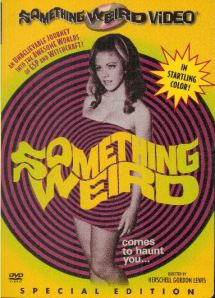
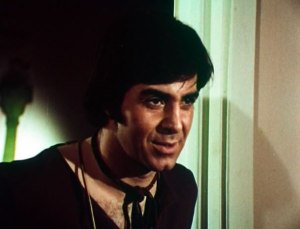
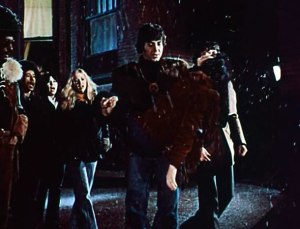
Something Weird (1967) tells the story of Mitch.  He gets electrocuted, which leaves him both psychic and disfigured.  While his best friend wants to Mitch’s psychic abilities to defeat the communists, Mitch instead accepts a deal with a witch.  She takes away his disfigurement and soon, Mitch is a celebrity.  However, the witch doesn’t do anything for free.  Eventually, Mitch takes LSD to try to strengthen his powers.  Director Herschell Gordon Lewis was better-known for his gore films but Something Weird lives up to its title.  With its mix of witches, ESP, and LSD, it’s a true horror time capsule.  The film can be viewed on Tubi.

Terror At London Bridge (1985) features Jack The Ripper time traveling to Arizona.  Can David Hasselhoff stop him!?  Watch the film on Tubi to find out.  The film will probably be best appreciated by David Hasselhoff fans but hey, who isn’t a fan of the Hoff?

Track of the Moon Beast (1976) is a film that is so much a product of the 70s that it deserves to be put in a museum.  Come for the story of an innocent man transformed into a monster by a moon rock and stay for the lengthy performance of California Lady.  Watch the film on YouTube!

Check out my previous week’s movies by clicking here!

4 Shots From 4 Horror Film: Special Herschell Gordon Lewis Edition


4 Shots From 4 Films is just what it says it is, 4 shots from 4 of our favorite films. As opposed to the reviews and recaps that we usually post, 4 Shots From 4 Films is all about letting the visuals do the talking.

Today, on what would have been his birthday, the Shattered Lens remembers director Herschell Gordon Lewis.  It’s time for…..

4 Shots From 4 Herschell Gordon Lewis Films

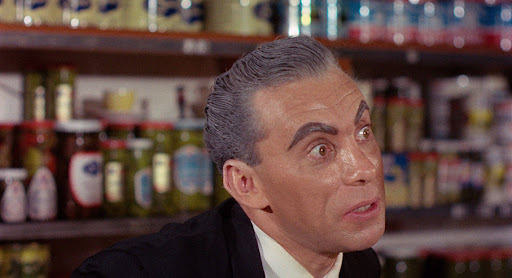
Blood Feast (1963, dir by Herschell Gordon Lewis, DP: Herschell Gordon Lewis)

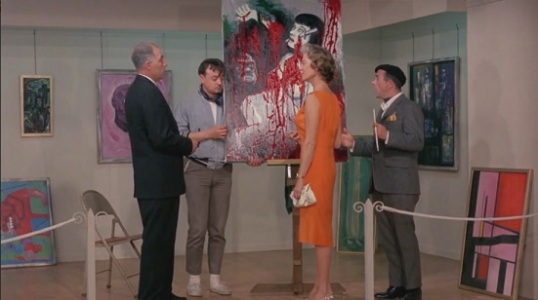
Color Me Blood Red (1965, dir by Herschell Gordon Lewis, DP: Herschell Gordon Lewis)

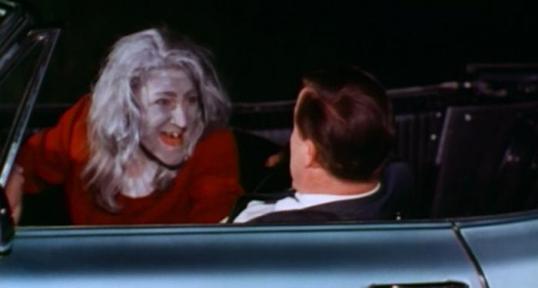
Something Weird (1967, dir by Herschell Gordon Lewis, DP: Andy Romanoff)

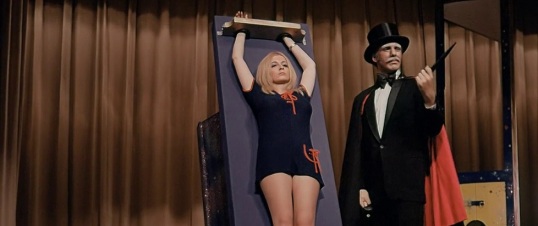
The Wizard of Gore (1970, dir by Herschell Gordon Lewis, DP: Alex Ameri and Daniel Krogh)

4 Shots From 4 Films: Special 1967 Edition


4 Shots From 4 Films is just what it says it is, 4 shots from 4 of our favorite films. As opposed to the reviews and recaps that we usually post, 4 Shots From 4 Films lets the visuals do the talking!

Today, we take a look at a classic cinematic year.  It’s time for….

4 Shots From 4 1967 Films

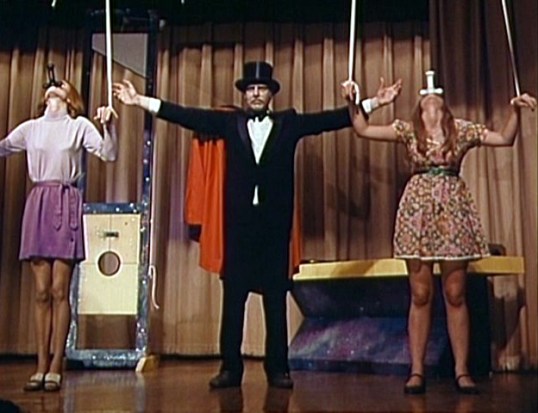
Something Weird (1967, dir by Herschell Gordon Lewis, DP: Andy Romanoff)

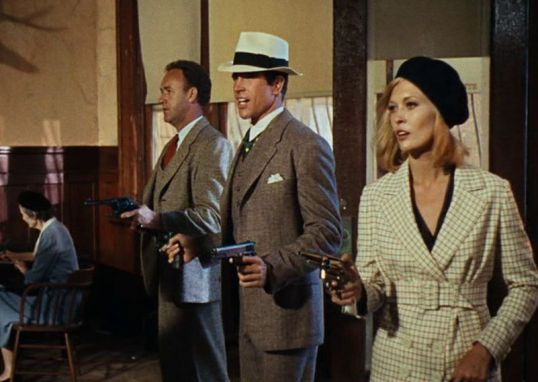
Bonnie and Clyde (1967, dir by Arthur Penn, DP: Burnett Guffey)

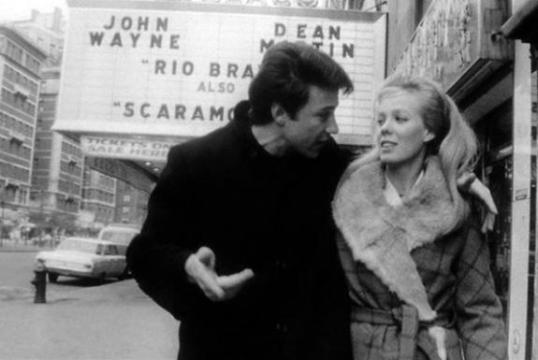
Who’s That Knocking On My Door (1967, dir by Martin Scorsese, DP: Michael Wadley and Richard Coll)

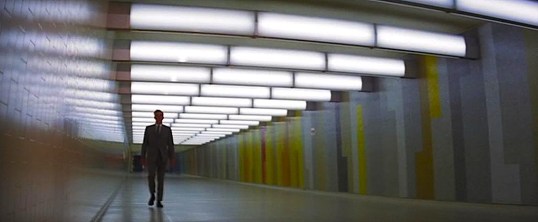
Point Blank (1967, dir by John Boorman, DP: Philip H. Lathrop)

4 Shots From 4 Horror Film: Special Herschell Gordon Lewis Edition


4 Shots From 4 Films is just what it says it is, 4 shots from 4 of our favorite films. As opposed to the reviews and recaps that we usually post, 4 Shots From 4 Films is all about letting the visuals do the talking.

Today’s director is the Godfather of Gore himself, Herschell Gordon Lewis!

4 Shots From 4 Herschell Gordon Lewis Films

Blood Feast (1963, dir by Herschell Gordon Lewis, DP: Herschell Gordon Lewis)

Two Thousand Maniacs! (1964, dir by Herschell Gordon Lewis, DP: Herschell Gordon Lewis)

Something Weird (1967, dir by Herschell Gordon Lewis, DP: Andy Romanoff)

The Wizard of Gore (1970, dir by Herschell Gordon Lewis, DP: Alex Ameri and Daniel Krogh)

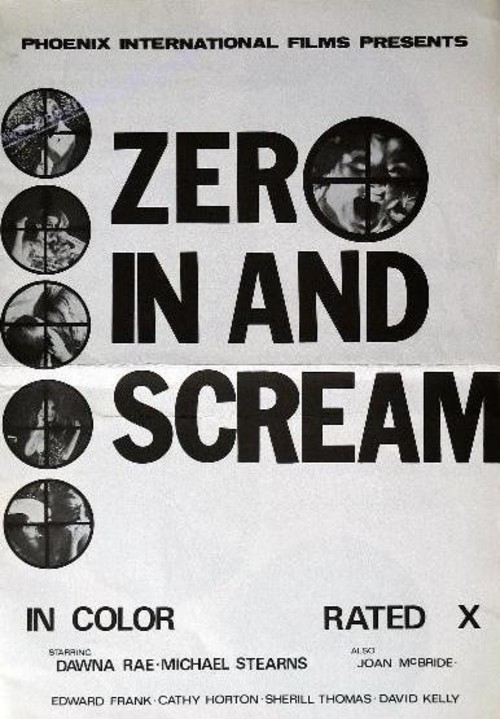
The Daily Horror Grindhouse: Zero in and Scream (dir by Lee Frost)


zas

I have to admit that there’s one very simple reason why I decided to watch and review the 1970 thriller/horror/softcore/sniper mayhem film, Zero In And Scream.  And that reason was that the movie is only 63 minutes long.  Seriously, when you’re writing for 7 different sites while working during the day and living during the night, there are times when you simply have to say, “That 4-hour epic from the Ukraine looks like it’s a great movie but I’ve only got time for an hour-long, low-budget excursion into cinematic obscurity.”

Zero In and Scream (and that’s great title, by the way) is about Mike (Michael Stearns).  Mike has really impressive hair and a deep tan.  (Perhaps the scariest part of this film comes when Mike undresses and we are confronted with his pasty white tan lines.)  I was going to comment on the fact that Mike also spends a good deal of the film wearing a really ugly and really wide tie but then again, this movie was made in 1970, so I guess that’s to be expected.

Mike has some issues that go beyond questionable fashion choices. He simply cannot get a girlfriend.  Maybe it’s because he’s an extremely moralistic jerk who says things like, “When a man climbs on top of a woman, she becomes ugly!”  Or maybe it’s because he spends almost all of his spare time holding and stroking a very phallic rifle.  Whenever Mike spots a couple making love, he shoots the man and allows the woman to remain pure.

Mike spends his spare time at the local strip club where, for reasons that aren’t quite clear, one of the dancers (Dawna Rae) decides that she likes this weirdo and she invites him to come to a party at her place.  The party is tres decadent in a 1970 softcore sort of way so, as you can imagine, Mike freaks out.

Will Mike be able to control his homicidal urges?  Will he listen to the radio reporter who, at one point, begs the killer to turn himself in because, “It’s obvious that you’re not in control of yourself!”  Or will he just continue to just wander around with his rifle while having flashbacks?

For the most part, Mike’s issues are just an excuse to get as many naked bodies on screen as possible, with a good deal of the film’s 63 minutes being taken up by a surprisingly well-shot underwater orgy scene.  Zero In and Scream doesn’t really work as horror film or as a thriller but I’m still recommend it for all of my fellow history fanatics.  Like many a worthy grindhouse film, Zero In and Scream is a time capsule of the era in which it was made.  Until we get our hands on a time machine, films like this are as close as we will ever come to personally experiencing the 70s.

Add to that, Zero In and Scream is worth watching for its abrupt but clever final shot.  It may not be a particularly good film but it has a great ending!

(In case you hadn’t already guessed, Zero In And Scream is available from Something Weird Video.)

Embracing The Melodrama #15: You’ve Ruined Me, Eddie! (dir by R. John Hugh)


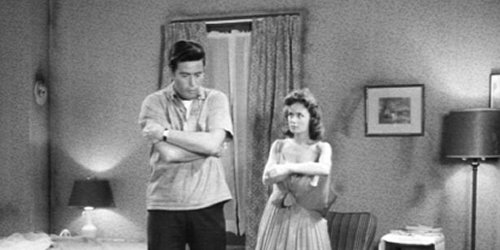
Patty and EddieFilmed down in Florida and originally released in 1959, You’ve Ruined Me, Eddie! was originally known as Touch of Flesh.  Of the two titles, I prefer You’ve Ruined Me, Eddie!  While I’m sure that Touch of Flesh, as a title, was good for convincing horny teenager boys at Southern drive-ins to contribute to the film’s the box office, it’s also a rather boring title.  You’ve Ruined Me, Eddie!, however, is properly histrionic and over-the-top.  It’s the perfect title for a perfectly pulpy film.

You’ve Ruined Me, Eddie! takes place in Dentonville, Florida, which is one of those small Southern towns where you can sit out on your porch and watch the mist hang over the bayous while you attempt to survive both the humidity and the crazy rednecks who apparently make up the entire population of the town.  Dentonville is the home of the wealthy Dr. Denton (Charles Martin), a casually corrupt man who rules with the help of a dim-witted sheriff.

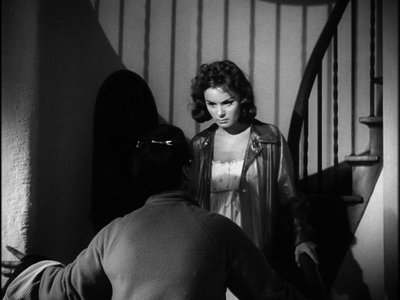
Dr. Denton has a daughter named Joan (Jeanne Rainer), a spoiled and promiscuous hedonist who spends all of her spare time seducing boys from the wrong side of the tracks.  When Joan gets together with the dumb but decent Eddie (Ted Marshall), the end result is that Joan gets pregnant.  Joan announces that she’s going to get an abortion but guess who wants to both be a father and have an oppurtunity to become a part of the most powerful family in town?  Even after Joan tells him that she has no interest in getting “fat and sick and ugly,” Eddie demands that she not abort her child.

Dr. Denton reacts by having Eddie framed for a crime and thrown in jail.  However, Eddie’s friend Vicky (Sue Ellis) knows a lawyer who can get Eddie out of jail.  So, what choice does Joan have but to grab a gun and chase Eddie through the swamps while shooting at him?

You’ve Ruined Me, Eddie! is a wonderfully odd and sordid piece of Southern gothic.  Along with featuring everything that you might expect from a film like this — overheated dialogue, unapologetic overacting, and over-the-top plotting, You Ruined Me, Eddie! is distinguished by Jeanne Rainer’s ferocious performance as Joan.  Whether she’s taunting Eddie or dancing around her bedroom in her underwear or demanding that her father help her find the best abolitionist in Tampa, Jeanne Rainer turns Joan into such a determined force of nature that she becomes the unexpected heroine of the film.  By the end of it, you can’t blame her for wanting to get boring old Eddie out of her life.  He would only slow her down.

You’ve Ruined Me, Eddie! is not an easy film to find.  However, it has been released on DVD by Something Weird Video as a double feature with The Shame of Patty Smith, a film that will be reviewed in a future installment of this melodramatic series.

Joan

Film Review: Something Weird (dir. by Herschell Gordon Lewis)


Now that I’ve finished reviewing the Friday the 13th series, I can finally take the time to make a few comments about a film that I’ve been meaning to review for a while here on the Shattered Lens: Herschell Gordon Lewis’s 1967 film Something Weird.

How to describe Something Weird?  Well, I could tell you that it was one of the first films to realize that ESP, witchcraft, and LSD made for a potent combination.  I could also point out that everyone’s favorite company — Something Weird Video — took their name from this film.  However, I think the best (and maybe only) way to tell you about this film is to simply tell you what happens.

The film starts out brilliantly with ten minutes of vaguely connected and disjointed images.  We start out with a close-up of a pair of legs that apparently belong to someone being chased down a city street.

Cut To: 

Two guys practicing karate.  One of them we will never see again.  The other one is a doughy-faced guy named Alex Jordan (William Brooker).  The one we will never see again explains to Alex that he’s not actually that talented when it comes to the martial arts.  Alex looks annoyed.

Cut to:

Alex is fooling around with a blonde that we’ll never see again and who will never be mentioned again for the rest of the film.  “You’re electrifying,” she tells him.

Cut to:

Some random guy is electrocuted by a downed power line.  Cronin “Mitch” Mitchell (Tony McCabe) runs over to help him and gets hit in the face by the same power line.  He falls to the ground while a group of random people wander over.  “Has anybody called an ambulance yet?” someone calmly asks.

Suddenly, there’s a man in a suit kneeling down by the two bodies and apparently, he’s some sort of medicine man because, while looking at the first man, he says, “I’ll have to call the coroner on this man.”  

However, Mitch is still alive so he’s put into the back of a station wagon and driven to the local hospital.  As we watch Mitch being pulled out of the back of the car, the camera pans up to the cloudy sky and suddenly, a narrator comes out of nowhere and starts rambling about “the sixth sense, ESP!”  The narrator is also nice enough to let us know that Alex — the guy from the Karate lesson — is apparently a government scientist who is in charge of figuring out how to use ESP against America’s enemies.

This all happens in the first 10 minutes of the film and, unfortunately, the remaining 70 minutes of the film struggles to live up to the surrealistic brilliance of this little montage.

Anyway, Mitch is alive but now he’s got both a scar on his face and the ability to see the future.  As one of his doctor’s puts it, “He’s a different man since the accident … cynical.  Maybe even morbid!”  Once he’s released from the hospital, Mitch takes to wearing a black bandana over the lower half of his face and becomes a professional psychic.


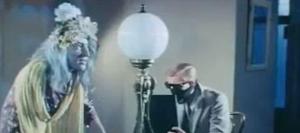
He finds a little success but, as we’ve been told, he’s now “cynical…maybe ever morbid!”  However, things change for Mitch when he’s approached by a grotesquely ugly woman with a blue face and a cackling laugh.  She explains that she’s a witch and she’s willing to restore his face but only if he takes her as his lover.  Mitch reluctantly does this and his scars suddenly vanish.

Soon, Mitch is a celebrity, appearing on television.  Everywhere he goes, the witch is on his arm.  The rest of the world sees her as a beautiful woman named Ellen Parker (Elizabeth Lee) but whenever Mitch looks at her, he sees her in her true blue-faced form. 

Meanwhile, there’s a serial killer preying on the woman of Jefferson, Wisconsin and the chief of police (played by Lawrence Wood, the man who gave the infamous “fire sale” monologue in Lewis’s Scum of the Earth) invites Mitch and Ellen to come help with the investigation.  The government meanwhile sends Alex (remember him?) to the town to investigate Mitch and perhaps recruit Mitch into the service of his country.

Alex is, at first, skeptical of Mitch but then he sees Mitch exorcising a disgruntled spirit from a local church and he starts to think that Mitch might have some psychic abilities after all.  Mitch might just need a little help and Alex is there to provide it.

Meeting with Mitch in the police chief’s office (and with the entire police force looking on), Alex produces two white pills from his pocket and says, “I have a drug here — LSD.  Ever hear of it?”  Alex proceeds to echo many real-life MK-Ultra conspiracy theories as he explains that LSD will increase Mitch’s psychic abilities to the extent that he’ll be able to catch the killer.   Mitch replies, “I’ve never taken the drug before but I’ll be glad to, doctor.”

Well, needless to say, the LSD produces the typical cinematic red-tinged, desert-themed trip but it still ends with Mitch figuring out who the killer is. It also allows Mitch to understand that the killer is sane “98% of the time.”  However, there’s a problem because now that killer is out to kill Mitch and Alex has fallen in love with Ellen, the blue-faced witch…

To be honest, Something Weird is not one of Herschell Gordon Lewis’s best films.  Even by typical Lewis standards, the plot doesn’t make much sense and the acting is incredibly bad.  Whereas other Lewis films (like Blood Feast) featured performances that were deliberately over the top, the cast of Something Weird comes across as if they were as confused while making Something Weird as the audience would later be while watching it.  (However, it should be noted that Elizabeth Lee at least seems to be having fun in the role of the constantly cackling witch.) 

However, I still love Something Weird because, unlike so many other movies, it actually lives up to its name.  This is a movie that promises to be weird and that’s exactly what it is.  There’s just so much to love in this film.  Check out the way that Mitch’s “facial scars” never look the same from scene-to-scene.  (At one point, the scars cover his entire face but, in the next scene, they can be easily hidden by a bandana.)  Watch in amazement as the same set is used and re-used for almost every scene in the movie, with just the furniture occasionally being rearranged depending on whether the scene is supposed to take place in an office or a hotel room. 

Ultimately, my love for this film comes down to the little details.    I love how the ambulance at the start of the film is just an old school station wagon (complete with wood paneling) with a siren on top of it.  Even better is how the police captain’s office is decorated with a faded pictures of George Washington and Abraham Lincoln that literally appear to have been ripped out of an old history textbook.

In the greatest tradition of the grindhouse, there is no other movie like Something Weird and, for that reason alone, it’s worth watching.

6 Trailers In Search Of a Title


Without further delay, here’s the latest edition of Lisa’s favorite grindhouse and exploitation trailers.

1) Something Weird (1967)

I just had to start out with this because it represents everything that I love about these old school exploitation trailers.  It’s just so shameless and cheerful about it all.  This film is from Herschell Gordon Lewis and it features ESP, a really kinda scary witch, and a random LSD trip.  The title of this film also inspired the name of one of my favorite companies, Something Weird Video.  (I make it a point to buy something from Something Weird every chance I get.  My most recent Something Weird video is a film from the 60s called Sinderella and the Golden Bra.  Haven’t gotten a chance to watch it yet but with a title like that, how could it be bad?)

2) Fade to Black (1980)

This is actually a really, really bad movie and I think the trailer goes on for a bit too long but it does have a few vaguely effective moments — i.e., when Dennis Christopher stares at the camera with half of his face painted.  Plus, you can catch a young Mickey Rourke acting a lot like Michael Madsen. 

3) Monster Shark (1984)  

Now you may think that since this Italian film was directed by Lamberto Bava (credited here as John Old, Jr. because his father, Mario, was occasionally credited as John Old, Sr.) and has the word “shark” in the title that it’s yet another rip-off of Jaws.  Well, joke’s on you because, as they state repeatedly in the trailer, “It’s not a shark!”  Even if you didn’t know this was an Italian film before watching the trailer, it wouldn’t be hard to guess.  First off, there’s the dubbing.  Then there’s the scene of the film’s main character wandering around aimlessly.  (Most Italian horror trailers feature at least one scene of someone just walking around.)  And finally, there’s the fact that this is yet another trailer that uses a sped-up version of Goblin’s Beyond The Darkness soundtrack for its background music.  While I haven’t seen this film yet, I plan to just to find out who Bob is.

 4) Van Nuys Boulevard (1979)

Originally, I was planning on including the trailer for a Ted V. Mikels’ film called The Worm Eaters right here but I reconsidered because, quite frankly, The Worm Eaters is one of the most disgusting, stomach-churning things I’ve ever seen.  I’m going to wait until I find five other equally disgusting trailers to feature it with and then I’m going to put them all up under the heading: 6 Trailers To Inspire Vomit.  Until then, enjoy a far more pleasant trailer — Van Nuys Blvd.  This trailer rhymes!  I’m tempted to say that I could have written it but then again, I only write free verse poetry.  Anyway, where was I?  Oh yeah, Van Nuys Blvd.

5) Vice Squad (1982)

However, there was a darker side to Van Nuys Blvd. and here it is: Vice Squad, starring Wings Hauser.  Eventually, I’ll review this film but until I do, check out our new friend Trash Film Guru’s review.

6) Crosstalk (1982)

We’ll conclude with the only thing scarier than Wings Hauser in Vice Squad — a computer that has not only witnessed a murder but enjoyed it!

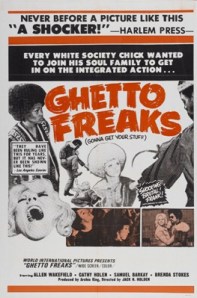
Review: Ghetto Freaks (dir. by Robert J. Emery)


During my freshman year of college, my roommate Kim often used to tell me that we were born several decades too late.  If only, she often lamented, we could have grown up in the 1960s and been part of that legendary counter-culture.  Her logic was that we both considered ourselves to be anti-establishment, we both felt society needed to be changed, and we both liked to get high on occasion.

I can see her point but honestly, I would never had made it as a hippy or, for that matter, even as a quasi-hippy.  For one thing, I hate being outdoors.  I’ve got too many allergies and crickets freak me out.  While I support free love, I don’t support practicing it with people who don’t shower on a regular basis.  I’m not going to argue with any woman who feels the need to burn her bra but quite frankly, I don’t want to wake up one day and discover that I can touch my boobs with my big toe.  Actually, that whole idea of running around day after day without any underwear on is just gross.  I don’t even want to think about it.

So, no, I could never have been a member of the 60s counter-culture.  But that doesn’t mean that I can’t watch the hundreds of films — some well-known but most incredibly dated and obscure — that have been made about and during that era.  Indeed, whatever knowledge I have the 1960s pretty much comes from my movie collection and movies like Ghetto Freaks.

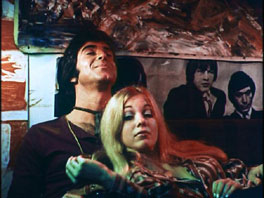
The production history of Ghetto Freaks is rather obscure.  Just to judge from the clothes and the dated lingo, it was originally filmed in 1969 or 1970.  The film, which is nearly plotless, was shot in Cleveland, Ohio.  I’ve never been to Cleveland (or Ohio, for that matter) and Ghetto Freaks — with its cold and gray urban landscape — hardly makes it look inviting.  Still, the fact that it was shot on location and that no attempt was made to hide the decay there, does bring an unexpected rawness to the movie.  Whether it was by intention or just the result of a low budget, director Robert Emery does manages to make the film’s ugliness oddly compelling.

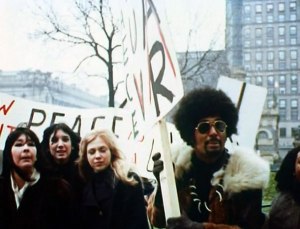
The movie opens up with a bunch of hippies talking to a bunch of older people.  If you’ve seen any of the protest films of the 60s or 70s then you’ve already seen this scene a hundred times.  The hippies are told to get haircuts.  The hippies make the standard response about Jesus having long hair.  Fortunately, the cops arrive before the scene turns into the 2nd act of Bye Bye Birdie

This is the 1st of many awkward, predictable scenes in Ghetto Freaks.  Fortunately, this movie was smart enough to follow its bad scenes with good ones.  So, once the pigs have released him, the head of the hippies (a ruggedly handsome former drug dealer named Sonny) spends his night hanging out at a rather dingy club.  

How to describe the Club Sequence?  Well, you really have to see it to understand why I can’t get it out of my head but it all comes down to the a rather hyperactive singer who performs at the club.  This singer performs two songs.  The first features the immortal lyrics “My name is Mousey and I feel lousy.”  The second is an odd cover of the MC 5’s seminal “Kick Out The Jams,” (though, in the film, the song is kicked off by the singer shouting “Kick out the jams, brothers and sisters!” as opposed to the actual “Kick out the jams, motherfucker!”)  The two musical performances are energetic and — as opposed to the earlier “protest” scene — entertaining to watch and the singer’s flamboyance contrasts interestingly with the club’s drabness.

Of course, there’s more going on in the bar than just the music.  Sonny talks to the other members of his hippy commune.  He also turns down a chance to return to his old career of dealing drugs on the street.  These conversations have a rather nice, breezy air to them.  For the most part, the actors all give surprisingly natural performances and the dialogue — no longer full of platitudes — is occasionally even memorable.

One other important thing happens at the bar.  Sonny spots a pretty young woman named Diane who is fighting with her obviously upper class parents.  Sonny finds the time to invite her to drop by the old commune before she is dragged away by mom and dad.

Later that night, Diane makes her way to the hippie pad currently occupied by Sonny and 14 other hippies.  She and Sonny have a long talk about why Sonny and friends live the way that they do.  And I do mean long.  The conversation seems to drag on forever and it doesn’t help that everything Sonny says is a platitude along the lines of “War is bad for children and other living things.”  Fortunately, this scene is made barely tolerable by the fact that Sonny and Diane are both played by likable performers.  Sonny’s has a rugged charisma about him and Diane comes across as sincerely nice.  I haven’t ever seen either one of these actors (or for that matter, anyone in Ghetto Freaks) in any other movies and that’s a shame because the movie does boast some memorable performances.

Anyway, even as Sonny explains his world view to her, Diane is dropping acid for the first time.  Naturally this leads to a huge orgy in which the members of the commune dance around naked while Sonny and Diane make love on the floor.

(I have to admit I got a little bit jealous of Diane here because, back when I used to do that sort of thing, I never had a trip that resulted in an orgy.  I saw my face melting occasionally but never an orgy.  It makes me wish I had a “I Dropped Acid and All I Got Was A Lousy Flashback” t-shirt.)

As you might guess, the Ghetto Freaks orgy is the film’s best known scene.  Along with all the nude hippies dancing (and, credit to the film, all the hippies are seen nude and not just the females), we also get a lot of dark blue lighting and psychedelic music playing the background.  While undeniably erotic, there’s also something rather disturbing about the whole scene.  First off, with all the weird camera angles and nude onlookers, the scene immediately made me think about the Satanic “dream” sequence from Rosemary’s Baby.  Secondly, seen today, it’s painfully obvious that the film’s hero is essentially taking the virginity of a girl who has been drugged. 

Oh, there’s one other interesting thing about the orgy sequence.  Are you wondering yet why this movie about a bunch of white hippies is called Ghetto Freaks?  Well, it’s because of what happens towards the end of the orgy.  Suddenly, we’re no longer watching Sonny rape Diane while a bunch of nude hippies dance.  Instead, we’re confronted with the image of a tall, glowering black man who handles a knife while several women we’ve never seen before parade past him.  I don’t know how to explain just how odd and jarring this two-minute sequence is.  Beyond the fact that we’ve never seen any of these characters before (and we won’t see them after), the scene itself is obviously shot on completely different film stock from the rest of the movie.  The only thing that connects it to anything we’ve seen before is that droning orgy music which continues to play (albeit in rather muted form) in the background.  Yes, this sequence was inserted into the movie after it had already been filmed.  The producers, obviously wondering how they’d ever make their money back, inserted this scene featuring this unnamed black man so that they could then market this nearly entirely white film as a blaxploitation film.  That man and his “followers” are the Ghetto Freaks of the title and they’re in the film for all of two minutes.

Following the orgy, we are treated to a day in the life of a hippy commune.  Diane accompanies Sonny, Mousey, and the whole gang on a day full of passing out an underground newspaper, panhandling, and getting harassed by the pigs.   Meanwhile, the neighborhood drug dealers, angry that Sonny won’t agree to push their drugs, are plotting their own revenge on our counter-culture Adonis.  If you think all of this eventually leads to a tragedy you can see coming from miles away, you’re right.

Even though it’s hard (actually impossible) to top a drug-induced orgy sequence, the second part of the film does feature two memorable scenes.  The 1st one features the members of the commune (what should one call them?  Communers, maybe?  Communists?) standing out in the street, trying to convince people to give them money for copies of a free, underground paper.  Shot in a documentary,cinéma vérité -style, this scene is appears to unscripted and features the cast interacting with actual human beings.  As such, the reactions (most negative but some surprisingly positive) are authentic as opposed to idealized.  The cast themselves turn out to be surprisingly skilled at improvisation and this sequence features the film’s best dialogue (which could be considered back-handed praise when you consider that the scene was unscripted).  It helps that the scene was obviously shot on a very cold day and the cast was obviously suffering for their “art.” (Diane, in a surprisingly endearing moment, keeps asking people to look at how blue her frozen hands are.)  I’m not a big fan of panhandlers in general but this film does succeed in making it look like very hard work.

The 2nd sequence occurs at the end of the film, even as the end credits are rolling.  If the panhandling sequence represents the best of Ghetto Freaks, this 2nd sequence represents, perhaps, the worst.  Following the film’s sudden violence of the movie’s “tragic” conclusion, the actors suddenly go from grim-faced to smiling like a bunch of Broadway understudies who have just learned that the entire cast of the latest Grease revival was aboard a plane that crashed while landing.  They start hugging each other (except, of course, for the character who dies at the end of the film.  She just keeps lying there on the sidewalk) and giving each other high fives as the camera pulls back to reveal — yes, you guessed it! — the movie’s director and his crew.  There’s a forced whimsy to this and it’s hard not to imagine the director smirking as he talks about how much he loves Jean-Luc Godard.  Reminding the audience that they’re actively watching a movie (as opposed to reality) was, of course, one of the French New Wave’s major contributions to the language of cinema.  Unfortunately, in Ghetto Freaks, it just feels like a forced attempt at trendiness.  (If Ghetto Freaks was made today, it would be in 3-D.)

As I stated previously, my entire knowledge of the 60s counter-culture pretty much comes from how it was depicted in the movies of the era.  One of the things that I’ve always found interesting about these movies is that, regardless of whether the movie is a classic like Easy Rider or a big budget misfire like Getting Straight or even a Roger Corman B-movie like Psych-Out, they are all essentially so middle class in their attitude towards women.  Again and again, the message of many of these films seems to be that everyone should be allowed to “do their own thing” as long as they don’t have a vagina.  However, those of us who do were continually portrayed in much the same way that we were portrayed in almost every film released before and after 1967.  To be female means that you can either be worshipped or you can be punished but never dare to be an individual.  (For the most obvious example of this, check out Getting Straight, a film in which activist Elliott Gould pretty much spends two hours screaming at Candice Bergen for daring to have opinions of her own.)

This is a trend that continues in Ghetto Freaks.  For all the talk about how Sonny and his commune are all about freedom and allowing people to be themselves, it doesn’t change the fact that the female members are pretty much there to be pretty and sexually available to whoever wants them for the night.  Diane is accepted into the group not because she rejected the values of society but because she has sex with Sonny.  Add to this a scene earlier in the film in which our hero Sonny jokes about how his best friends “big-titted” sister was raped by a black man (“She was asking for it,” Sonny assures her brother who eventually agrees) and you end up with a very contradictory message.  I don’t necessarily have problem with the characters themselves being sexists.  To be honest, I prefer an honest sexist to a liberated liar.  What’s annoying is that this movie, like a lot of other so-called “counter-culture” films, does not seem to be aware of the double standard.

In true exploitation film-tradition, Ghetto Freaks was released and re-released under several different names.  Seeing as how much of the film plays out like a community theater production of Hair, the film originally had the much more appropriate title of The Age of Aquarius.  When that title didn’t exactly work wonders, the film was retitled The Love Commune.  Again, this was an appropriate (if rather banal) title that failed to attract an audience.  Finally, the film’s producers spliced that footage into the middle of the orgy scene and, hoping to appeal to the blaxploitation audience, renamed the movie Ghetto Freaks.

And it worked.

When it comes to exploitation, freaks will beat lovers any day.

Ghetto Freaks was released on DVD by one of my favorite companies, Something Weird Video.  As is typical with SWV, the DVD is actually a double feature.  The second movie is an earlier, drug-centered movie called Way Out.  Technically, it’s a far better movie than Ghetto Freaks but it’s also a lot less fun.