Horror Film Review: The Masque of the Red Death (dir by Roger Corman)


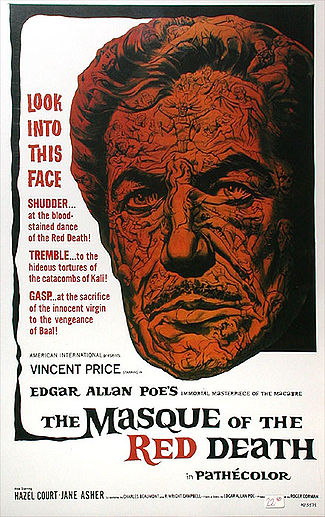
In 1964’s The Masque of the Red Death, Vincent Price stars as Prospero.

Prospero is a nobleman in medieval Italy, a decadent tyrant who rules his villages with an iron hand and who proudly and openly worships Satan.  When an old woman in one of the villages dies of the plague, Prospero orders the village to be burned to the ground.  He returns to his castle where, with his mistress (Hazel Court), he plans to throw a masquerade for the local nobility.  His plan is for everyone to hide out in the castle until Death has passed.  The problem, of course, is keeping Death from sneaking into the castle and claiming everyone within.

Prospero also abducts three villagers, Ludovico (Nigel Green), his daughter Francesca (Jane Asher), and Francesca’s boyfriend, Gino (David Weston).  The three villagers find themselves in a decadent world, where Prospero and his attendants are motivated by their own greed and petty jealousies.  Keeping Death from entering the castle would probably be a lot easier if the people in the castle would stop trying to kill each other.  It’s an odd atmosphere within the castle.  Everyone fears Death and yet, everyone seems to be doing all that they can do invite it in with them.  Can anyone, even a worshipper of the Damned liked Prospero, truly escape Death?

The Masque of the Red Death is not only the best of Roger Corman’s Edgar Allan Poe adaptations but it’s also the best film that Corman ever directed.  Working with cinematographer Nicolas Roeg (who was himself destined to have quite a career as a director of enigmatic films), Corman fills the screen with vivid colors and scenes of medieval decadence.  Price gives one of his best performances, playing Prospero as someone who is in love with his own amoral nature but whose arrogance quickly gives way to fear when he starts to suspect the Death has somehow managed to enter the castle.  The inhabitants of the castle are all memorably eccentric and, in many cases, evil.  A man in an ape costume is burned to death and hardly anyone seems to notice or care.  Prospero and his nobles think that they’re above death because of their wealth and their place in society but, of course, no one can escape Death.

David Weston and Jane Asher are both well-cast as the two lovers, though Asher is clearly more a product of the swinging sixties than medieval Italy.  Patrick Magee and Skip Martin are both memorable as members of Prospero’s court, with Skip Martin giving an especially diabolical performance as a murderous court jester.  In the end, though, this film truly belongs to Price, Corman, and Roeg.  Roeg’s cinematography is dazzling, with the use of red foreshadowing his later film, Don’t Look Now.  Corman’s direction puts the viewer right in the center of Prospero’s court.  And Vincent Price gives one of his best performances as the self-amused but unashamedly evil Prospero.  The Masque of the Red Death remains a classic of 60s pop art and the best of Corman’s many films.

The TSL’s Daily Horror Grindhouse: Vampire Circus (dir by Robert Young)


One of the greatest Hammer vampire films didn’t even star Christopher Lee.  In fact, it wasn’t even a Dracula film.  Instead, it was the story of a circus.

1971’s Vampire Circus tells the dark story of a Serbian village called Stetl.  Early in the 19th century, the children of Stetl are dying.  The superstitious villagers believe that Count Mitterhaus (Robert Tayman) might be responsible.  In fact, they suspect that Count Metterhaus might be a vampire!  Why?  Well, first off, he only seems to be around during the night.  Secondly, he lives in a big spooky castle.  Third, he’s a count and don’t all counts eventually become vampires?

Now, it would be nice to say that all this turned out to be a case of the villagers letting their imaginations get the better of them but nope.  It turns out that they’re pretty much right.  One night, the local teacher, Albert Muller (Laurence Payne), sees his own wife, Anna (Domini Blythe) leading a child towards the dark castle.  It turns out that Anna has fallen under the spell of Count Mitterhaus.  The villagers promptly drive a stake through the Count’s heart, though he manages to do two things before dying.  First off, he curses the town and announces that the blood of their children will give him new life.  Secondly, he tells Anna to escape and track down his brother.

Fifteen years later and, as one might expect, Stetl is a town under siege.  However, the town is not being attacked by vampires.  (Not yet anyway.)  Instead, the town has been hit by the plague and, as a result, it’s been isolated from the outside world.  Men with guns have surrounded the town and are under orders to kill anyone who tries to leave or enter.  Some in the village believe that this is the result of the Count’s dying curse while others just see it as more evidence of man’s inhumanity to man.  Regardless, it’s not good situation.

Fortunately, escape arrives in the form of the Circus of the Night!  That’s right, a gypsy carnival suddenly appears in town.  How did it manage to slip by the blockade?  Who knows and who cares?  What’s important is that the villagers, especially their children, need an escape from their grim existence and the Circus seems to offer something for everyone.  There are dancers.  There are acrobats.  There’s the mysterious tiger woman.  There’s a mirror that makes you see strange things.  And, of course, the are vampires….

That’s not really a shock, of course.  The name of the film is Vampire Circus, after all.  What always takes me by surprise is just how ruthless and cruel the vampires are in this film.  Even by the standards of a 1970s Hammer film, this is a blood-filled movie but, even beyond that, the vampires almost exclusively seem to target children.  Fortunately, all of Stetl’s children tend to be a bit obnoxious but it’s still a shock to see two fresh-faced boys get lured into a mirror where they are both promptly attacked by a vampire.  (And don’t even get me started on what happens when one of the vampires comes across a boarding school.)  Make no mistake, this circus is not made up of the type of self-tortured, romanticized vampires that have dominated recent films.  These vampire are utterly viscous and without conscience.  In other words, these vampires are actually frightening.

The members of the circus are, themselves, a memorable bunch.  David Prowse is the hulking strongman.  Lalla Ward and Robin Sachs are the achingly pretty, innocent-faced twin acrobats who greedily drink the blood of anyone foolish enough to wander off with them.  Some members of the circus can transform into animals.  What’s interesting is that not all of the members of the circus are vampires.  Some of them, I guess, are just groupies.

Featuring the reddest blood that you’re ever likely to see and a cast of memorably eccentric character actors, Vampire Circus often feels more like an extremely dark fairy tale than a typical Hammer vampire film.  Clocking in at 87 minutes, Vampire Circus is a briskly paced dream of carnivals and monsters.


Horror on The Lens: The Masque of the Red Death (dir by Roger Corman)


MasqueOfTheRedDeath(1964film)

So here we are, 24 days into October, and I have yet to share an old Vincent Price film!  It’s not October without at least a little contribution from Vincent.  Well, allow me to correct that with today’s horror on the lens, the 1964 Roger Corman film The Masque of the Red Death.

Based on the classic story by Edgar Allan Poe, this film features Vincent Price giving one of his best performances as the doomed and decadent Satanist Prince Prospero.  The film’s cinematographer was future director Nicolas Roeg and The Masque of the Red Death is probably one of the most visually impressive of all of Corman’s films.

Enjoy!

http://www.youtube.com/watch?v=uCazBlhBs_Q