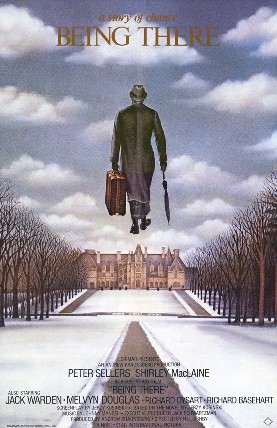
Shattered Politics #43: Being There (dir by Hal Ashby)


Original_movie_poster_for_Being_There

As a general rule, I don’t watch the news.  However, a few nights ago, I made an exception and I watched CNN.  The reason was because it was snowing in New York City and apparently, CNN anchorman Don Lemon was broadcasting from something called the Blizzardmobile.  I just had to see that!

Well, the Blizzardmobile turned out to be huge letdown.  I was hoping for something like the Snowpiercer train but instead, it just turned out to be a SUV with a camera crew and a pompous anchorman who hilariously kept insisting that he was knee-deep in a blizzard when even a Texas girl like me could tell that the Blizzardmobile was only encountering a few snow flurries.

So, I flipped around to see if any of the other news stations had anyone in a blizzardmobile.  What I discovered was that only CNN had a blizzardmobile but one thing that every news station did have was a panel of experts.  An anchorperson would say something like, “What does the future look like?” and the panel of experts would tell us what the future looked like to them.  What I found interesting was that I had no idea who these experts were but yet I was supposed to just believe that their opinions were worth considering.

I mean, for all I knew, those experts could have just been people who were spotted wandering around New York at night.  But, because they were introduced as experts and looked directly at the camera whenever they spoke, they were suddenly authoritative voices.

Oddly enough, the very next night, I watched a movie from 1979 that dealt with the exact same issue.

Being There tells the story of Chance (Peter Sellers), a dignified, middle-aged man who lives in Washington, D.C. and works as a gardener for a wealthy older man.  Chance cannot read.  Chance cannot write.  Chance goes through life with a blank smile on his face.  Chance has never experienced the outside world.  Instead, he spends all of his time working in the old man’s garden and obsessively watching TV.  When the old man dies, Chance finds himself exiled from the house.  Wandering around Washington D.C., Chance asks a random woman to make him dinner.  He politely speaks with a drug dealer who pulls a knife on him.  Finally, he finds himself entranced by a window display of televisions.  Backing away from the window, Chance stumbles into the street and is struck by a car.

Though he’s not seriously injured, the owner of the car, Eve Rand (Shirley MacClaine), insists that Chance come back to her mansion with him so that he can be checked out by her private physician (Richard Dysart).  As they drive back to the house, Eve asks Chance for his name.

“Chance the Gardner,” Chance replies.

“Chauncey Gardiner?” Eve asks.

Chance blankly nods.

Back the house, Chance meets Eve’s husband, Ben (Melvyn Douglas).  Ben is a wealthy industrialist who is dying of leukemia.  Ben takes an immediate liking to Chance.  Because Chance is wearing the old man’s suits, everyone assumes that Chance is a wealthy businessman.  When Chance says that he had to leave his home, they assume that his business must have failed due to government regulation.  When Chance talks about his garden, everyone assumes that he’s speaking in metaphors.

Soon, Ben is introducing Chance to his friend, Bobby (Jack Warden).  Bobby happens to be the President and when he quotes Chance in a speech, Chance the Gardner is suddenly the most famous man in the country.  When he appears on a TV talk show, the audience mistakes his emotionless comments for dry wit.  When he talks about how the garden reacts to different seasons, they assume that he’s an economic genius.  By the end of the film, Bobby has become so threatened by Chance’s popularity that he’s been rendered impotent while wealthy, rich men plot to make Chance the next President of the United States.
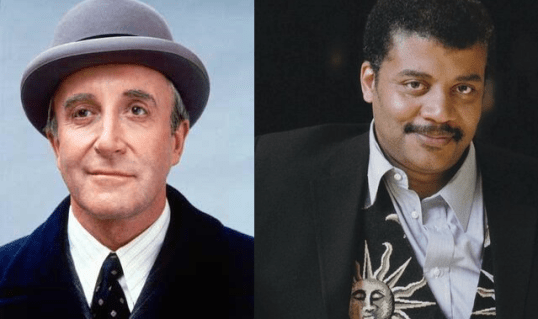
Chance and Neil

In many ways, Chauncey Gardiner was the Neil deGrasse Tyson of his era.

Being There is a one joke film and the idea of someone having no emotional skills beyond what he’s seen on television was probably a lot more mind-blowing back in 1979 than it is in 2015.  But I still enjoyed the film.  Peter Sellers gave a great performance as Chance, never sentimentalizing the character.  As well, the film’s point is still relevant.  If Being There were made today, Chance would be the subject of clickbait articles and Facebook memes.  (Chauncey Gardiner listed his ten top movies and number 8 will surprise you!  Or maybe This boy asked Chauncey Gardiner about his garden and his response was perfect.)

At its best, Being There is a film that will encourage you to question every expert you may see.  Especially if he’s just stepped out of a blizzardmobile…
 

Lisa’s Homestate Reviews: Texas and Bernie


I recently realized something while I was working on my autobiography.  By the time I turned 12, I had really been around!

When I was growing up, my family moved around a lot.  By the time that my mom, my sisters, and I moved back to Texas for the final time, I had lived in a total of 6 states: Texas, Arkansas, New Mexico, Oklahoma, Colorado, and Louisiana.  Whenever I’m asked which one of those six states was my favorite, I always say — without a moment of hesitation — Texas.  Don’t get me wrong — those other five states are all wonderful but I’m a Texas girl.  It’s where I was born, it’s where the majority of my family lives, and it’s where I attended and graduated from college.  I love traveling and I love seeing the world but, in my heart, I know that I’ll always return to Texas.

Unfortunately, the rest of America rarely seems to love my homestate as much as I do.  It never ceases to amaze me how many people — who have obviously never even been here! — consider themselves to be an expert on Texas.  They talk about George W. Bush.  They talk about the Kennedy assassination.  They talk about Rick Perry and Ted Cruz.  They talk about oil.  They talk about guns.  They talk about these things as if a state as huge and populous as Texas can be defined by only a few issues or citizens.  That may be true of a tiny state like Vermont but there’s a lot more variety to Texas than any outsider will ever be able to understand.

Movies rarely get Texas right.  I’ve lost count of the number of films that have tried to portray north Texas as being a desert or having mountains.  And don’t even get me started on how terrible most actors sound when they try to imitate our accent!  Fortunately, Texas has its own set of native filmmakers, true artists who are capable of making movies that both criticize and celebrate Texas without descending to the level of elitist caricature.  One of the best of them is Richard Linklater and 2012’s Bernie is one of his best films.

Bernie tells the true story of Bernie Tiede.  In 1996, Bernie (played, quite well, by Jack Black) was perhaps the most popular citizen of Carthage, Texas.  Along with being the leader of the church choir (which is always an important position in small town Texas), Bernie was also an assistant funeral director who was known for always saying exactly the right thing to a grieving family.  As a 38 year-old bachelor, Bernie was also the center of a lot of small town gossip, especially after he became the constant companion of the town’s richest (and, some would say, meanest) woman, 81 year-old Marge Nugent (played, in the film, by Shirley MacClaine).

When Bernie announces that Marge has had a stroke and is currently away in a hospital, the people of Carthage have no reason to doubt him.  Since Marge was usually such an unpleasant person to be around, most are just fine with not having to deal with her personally.  They’re even happier when Bernie suddenly starts to donate large sums of money to his neighbors, local businesses, and the church.

However, Marge’s accountant has his doubts about Bernie’s claims.  With the help of Marge’s previously estranged family, he convinces the local police to search Marge’s house.  That’s where they discover Marge’s body in a freezer, dead as a result of being shot four times in the back with an armadillo gun.  A tearful Bernie confesses to the murder, saying that Marge was just so mean to him that he eventually snapped.

District Attorney Danny Buck Davidson (played by a hilariously slick Matthew McConaughey) charges Bernie with first degree murder but soon discovers that — despite the fact that Bernie has confessed — it might not be so easy to get a conviction.  The people of Carthage may have hated Marge but, even more importantly, they absolutely loved Bernie.  Danny Buck is forced to file a motion to move the trial to nearby San Augustine County (which is, as the film correctly points out, the squirrel-hunting capitol of the world) and the citizens of Carthage wait to see if their most beloved citizen is convicted of murder.

Bernie was one of my favorite films of 2012 but I have to admit that, when it came to write this review, I was a little worried about rewatching it.  If there’s anything that often suffers upon repeat viewing, it’s quirkiness and Bernie is nothing if not quirky.  However, I’m happy to say that Bernie was just as effective on a second viewing as it was on the first.  Jack Black’s performance remains the best of his career and, in the role of Marge, Shirley MacClaine deftly brought to life a type that should be familiar to anyone who has ever lived in a small town.  When I first saw the film, it seemed like Matthew McConaughey occasionally went a bit overboard in the role of Danny Buck Davidson but, on a second viewing, it was obvious that, as flamboyantly as McConaughey played the role, he never allowed Danny Buck to become a caricature.  The film’s unique structure — which is made up of a combination of scenes with actors and interviews with the actual citizens of Carthage — also held up surprisingly well.  Those interviews are the key to the film’s success because, otherwise, it’s doubtful that anyone would believe that this story actually happened.

But ultimately, I think the reason that Bernie worked the first time I saw it and why it continued to work when I watched it again is because Richard Linklater is from Texas.  Can you imagine if an outsider had come down here and tried to make a movie out of the story of Bernie Tiede?  It probably would have ended up being one of the most condescending movies ever made, full of actors from up north trying to sound Texan.  And that would have been a shame because Bernie is a uniquely Texan story and, as such, it’s a story that could only be properly told by someone who knows the state.

Don’t get me wrong.  There’s definitely some pointed humor to be found in Bernie‘s portrayal of life in small town Texas.  The sequence where various citizens of Carthage are asked whether or not Bernie was gay (“That dog don’t hunt,” one woman says after explaining that Bernie couldn’t be gay because he led the church choir) is just one example.  But the difference between Linklater’s approach and the approach that one might expect from a non-Texan is that Linklater allows the citizens of Carthage to have their dignity even as he pokes some gentle fun at them.  As a native Texan, Linklater portrays our state — flaws and all — honestly, without any of the elitist posturing that we’ve come to expect from northern filmmakers.

And, as a result, Bernie is one of the best films ever made about both Texas and small town life.

As for the real life Bernie Tiede, he was released from prison in May of this year, under the condition that he live with Richard Linklater in Austin.

Bernie

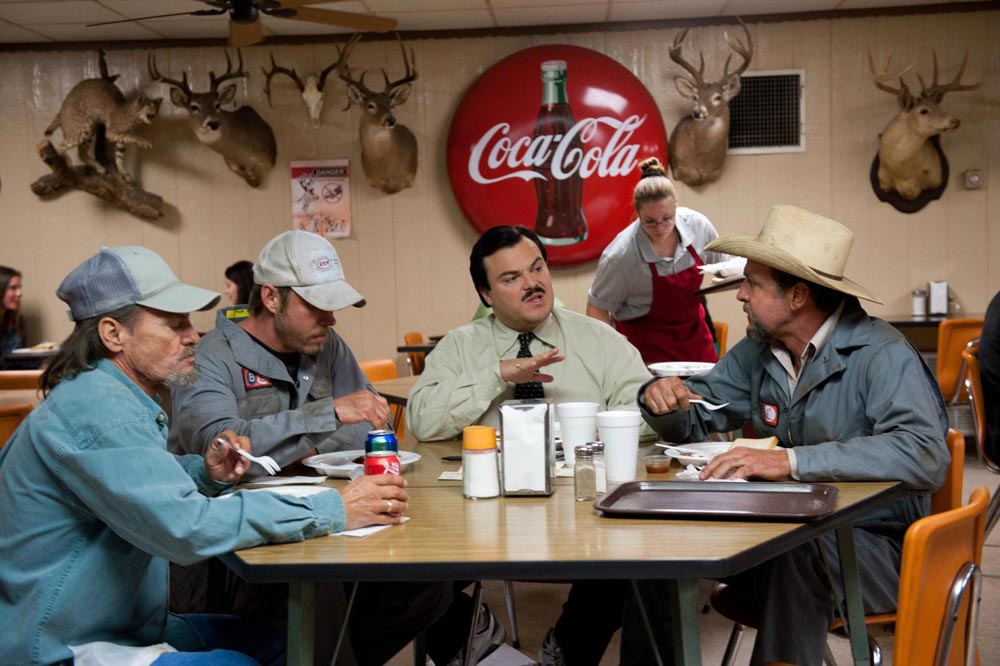
Bernie and friends