Catching Up With The Films of 2018: The Last Movie Star (dir by Adam Rifkin)


Vic Edwards (Burt Reynolds) was once the biggest movie star in the world.

At times, that’s hard to believe.  Vic may have started out as a stunt man before moving on to star in westerns and action movies but Vic is now 80 and he moves slowly and with a permanent slouch.  At times, he appears to be so frail that you wonder how he even manages to get out of bed in the morning.  Though he still possesses the acerbic wit for which was once famous, the words now come out a lot slower and his voice is tinged with pain that is both physical and emotional.  It’s been a while since Vic appeared on a movie set.  After years of being a self-described asshole, Vic now spends most of his time alone.  His only friend appears to be his aging agent, Sonny (Chevy Chase).

When Vic receives an invitation to attend a film festival in Nashville and accept a career achievement award, Vic goes in hopes of not only getting his ego stroked but also visiting some of the places where he grew up.  It’s only once Vic has arrived that he discovers that the film festival is basically a group of wannabe hipsters hanging out in the back of a bar.  Under the direction of Doug (Clark Duke), the film festival has previously given lifetime achievement awards to everyone from Al Pacino to Robert De Niro.  Vic’s the first recipient to actually show up.

After a night of watching a younger version of himself and answering inane questions about his career and his turbulent personal life, Vic comforts himself by getting drunk and yelling at Doug and his friends.  The next day, while the film festival continues, Vic get Doug’s sister, Lil (Ariel Winter), to drive him around Tennessee.  Vic wants to visit the places of his youth.  As for Lil, she just wants to get rid of her cranky passenger so that she can deal with her emotionally abusive boyfriend.

As you probably already guessed, in The Last Movie Star, Burt Reynolds may have been cast as a character named Vic Edwards but he was basically playing himself.  (Director Adam Rifkin has said that he would have abandoned the film if Reynolds had turned down the role)  When Vic watches himself onscreen, the clips are from Burt Reynolds’s old movies.  When Vic falls asleep and has a dream in which he confronts his younger self, the film uses footage from Deliverance and Smoky and the Bandit.  (“Slow down!” Vic yells as the cocky, younger version of him speeds down a country road.)  When Vic considers his own mortality, it’s obvious that the aging and frail Reynolds was doing the same thing.

At the start of the film, both Vic and Reynolds seem so infirm that you wonder how he’ll ever make it through the weekend.  But, as the film progresses, an interesting thing happens.  Before our eyes, both Vic and the actor playing him become stronger.  His confidence returns and, as Vic confronts the past, we finally start to see some hints of the old charisma that once made him the world’s biggest film star.  As we watch the film, we realize that his body may be weak but his mind is still sharp.  We come to realize that Vic now understands that he will die someday but he’s still not going to give up.  He may accept his own mortality but he’s not going to surrender to it.

That Burt Reynolds passed away just a few month after The Last Movie Star was released adds an extra poignance to his performance in the film.  The Last Movie Star has its flaws.  The pacing is inconsistent and, when it comes to Vic relationship with Lil, the film too often falls back on anti-millennial clichés.  In the end, the film works best as a tribute to its star.  The film argues, quite convincingly, that if anyone deserved to be known as the last movie star, it was him.

Embracing the Melodrama #57: Winter’s Bone (dir by Debra Granik)


winters-bone

I can still remember what it felt like, back in 2010, as I stepped out of the theater where I had just watched Winter’s Bone.  I had just spent 100 minutes engrossed in that film’s world and it was somewhat jarring to suddenly find myself back in my world.  The air around me was still.  The clear sky above me seemed to be a totally new shade of blue.  The sounds of passing cars and overheard conversations echoed in my head.  When I walked, I felt as if I was moving at a different, dreamier pace than everyone else, as if I was still only partially back in my world.

That’s the type of film that Winter’s Bone is.  It’s a film about life on the fringes, a portrait of a very real part of America that a lot of people don’t even realize exists.  It’s a film that sticks with you and dares you to try to forget the people who it has introduced you to and the stories that it tells.

Winter’s Bone takes place in the Ozarks, a society and world that is dominated by meth and secrets.  Speaking as someone who still has family who live on the outskirts of the world depicted here, I can say that Winter’s Bone gets both the big picture and the little details right.  Everything from the unbreakable cycle of poverty to the defiant resilience of the people is depicted just as it is.  Make no mistake about it — the people in Winter’s Bone may not have much but they do have their pride.  It’s portrayed best in the scene where meth head Teardrop (John Hawkes) glares down the county sheriff (Garret Dillahunt), letting him know that, regardless of who is wearing the uniform, this is Teardrop’s world.

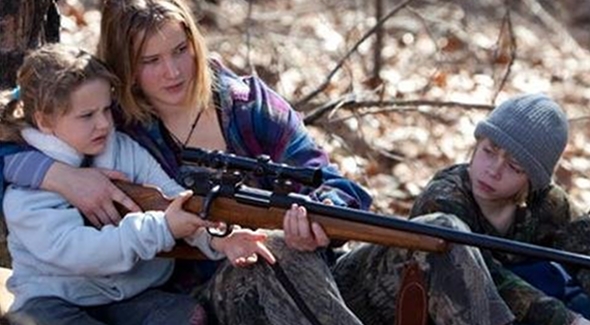
Teardrop is the uncle of 17 year-old Ree Dolly (Jennifer Lawrence), who is considering joining the army once she graduates from high school but, for now, spends all of her time taking care of her mentally ill mother and her two younger siblings.  Her father, who is one of the county’s best meth cooks, was recently arrested and has a court date approaching.  However, he has apparently skipped bail and disappeared.  When Ree is told that, unless her father shows up for his court date, she and her family will lose their house, Ree sets out to try to find him.

05_Flatbed_1 - JANUARY

Ree, however, knows that her father would never have jumped bail and she also knows that there’s no way he died in a meth lab fire, as some people are claiming.  She knows that her father has been murdered but, unlike Teardrop, Ree has no interest in getting revenge.  She just wants to find his body so she can prove that he’s dead and her family can keep their home.  Unfortunately, even this brings Ree into conflict with the local crime boss.

Taking place on a blasted landscape of dilapidated farms, rusty pickups, and the burned ruins of abandoned meth labs, Winter’s Bone is an unusually powerful piece of Southern gothic. It’s also a film that — unlike a lot of other acclaimed movies — actually gets better with repeat viewings.  When you first see it, you’re overwhelmed by the film’s bleakness.  When it ends, you’re not sure if you should be happy or sad.  The second time, however, you can better appreciate the skill with which director Debra Granik tells her story, the way she frames Ree against the landscape as if Ree was the lone hero in a classic western and how the scenes where Ree searches for her father in a swamp are full of shadows and menace.  The third time, you can better appreciate the performances of characters actors like John Hawkes, Garret Dillahunt, and especially Dale Dickey.  The fourth time, you no longer have any doubts.  Winter’s Bone is one of the best films that you’ve ever seen.

And, through it all, Jennifer Lawrence is there and reminding you why she became a star in the first place.  She may have won her Oscar for Silver Linings Playbook and she may be best known for being the face of The Hunger Games franchise but Winter’s Bone remains Jennifer Lawrence’s best and bravest performance.  Without a hint of vanity or reluctance, Lawrence portrays Ree as a resilient and unsentimental survivor and you can’t help but cheer her on as she refuses to back down to any authority, legal or otherwise.  By the end of the film, you know that Ree is probably as trapped as anyone but you can’t help but hope that she’ll somehow find something better.

If you haven’t seen Winter’s Bone, you need to.

Target Practice