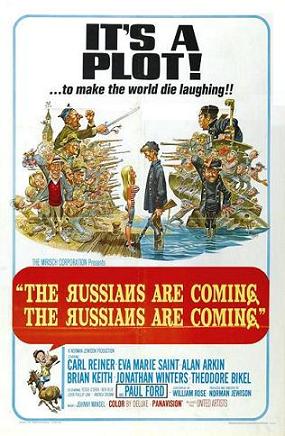
Earlier tonight, I watched a 1966 film called The Russians Are Coming, The Russians Are Coming.
It’s a cheerful comedy about what happens when the captain (played by Theodore Bikel) of a Russian submarine decides that he wants to take a look at the United States. Though he was only planning to look at America through a periscope, he accidentally runs the submarine into a sandbar sitting near Gloucester Island, which itself sits off the coast of Massachusetts. The captain sends a nine man landing party, led by Lt. Yuri Rozanov (a youngish Alan Arkin, making his film debut and receiving an Oscar nomination for his efforts), to the island. Their orders are simple. Yuri and his men are too either borrow or steal a boat that can be used to push the submarine off the sandbar. If they run into any locals, they are to claim to be Norwegian fisherman.
Needless to say, things that don’t quite go as planned. The first Americans that Yuri and his men meet are the family of Walt Whitaker (Carl Reiner), a vacationing playwright. Walt’s youngest son immediately identifies the Norwegian fisherman as being “Russians with submachine guns.” When Walt laughingly asks Yuri if he’s a “Russian with a submachine gun,” Yuri produces a submachine gun and promptly takes Walt, his wife (Eva Marie Saint), and his children hostage.
Yuri may be a Russian. He may officially be an enemy of America. But he’s actually a pretty nice guy. All he wants to do is find a boat, keep his men safe, and leave the island with as little drama as possible. However, the inhabitants of the island have other plans. As rumors spread that the Russians have landed, the eccentric and largely elderly population of Gloucester Island prepares for war. Even as Police Chief Mattocks (Brian Keith) and his bumbling assistant, Norman Jonas (Jonathan Winters), attempt to keep everyone calm, Fendall Hawkins (Paul Ford) is organizing a militia and trying to contact the U.S. Air Force.
Meanwhile, Walt’s babysitter, Allison (Andrea Dromm) finds herself falling in love with one of the Russians, the gentle Alexei Kolchin (John Phillip Law).
As I said at the start of this review, The Russians Are Coming, The Russians Are Coming is a cheerful comedy, one with a rather gentle political subtext, suggesting that the majority of international conflicts could be avoided if people got to know each other as people as opposed to judging them based on nationality or ideology. There’s a rather old-fashioned liberalism to it that probably seemed quite daring in 1966 but which feels rather quaint today. Sometimes, the comedy gets a bit broad and there were a few times that I found myself surprised that the film didn’t come with a laugh track. But overall, this is a well-acted and likable little movie.
As I watched The Russians Are Coming, The Russians Are Coming (and, as someone who is contractually obligated to use a certain number of words per review, allow me to say how much I enjoyed the length of that title), I found myself considering that the film would have seemed dated in 2013 but, with all the talk of Russian hacking in the election and everything else, it now feels a little bit more relevant. Not a day goes by when I don’t see someone on twitter announcing that the Russians are coming. Of course, if the film were released today, its optimistic ending would probably be denounced as an unacceptable compromise. Peaceful co-existence is no longer as trendy as it once was.
Another interesting thing to note about The Russians Are Coming, The Russians are Coming: though the film was written by William Rose (who also wrote another example of mild 1960s feelgood liberalism, Guess Who’s Coming To Dinner), it was based on a novel by Nathaniel Benchley. Benchley was the father of Peter Benchley, the author of Jaws. It’s easy to see the eccentrics of Gloucester Island as distant cousins of the inhabitants of Amity Island.
As previously stated, The Russians Are Coming, The Russians Are Coming was nominated for best picture but it lost to the far more weighty A Man For All Seasons.
 Through the Shattered Lens