4 Shots From 4 Films is just what it says it is, 4 shots from 4 of our favorite films. As opposed to the reviews and recaps that we usually post, 4 Shots From 4 Films lets the visuals do the talking!
John Frankenheimer was born 95 years ago today, in New York City. He got his start working in live television and went on to become one of the best directors of thrillers around. After getting off to a strong start in the 60s, directing several classic films (many of which had a political subtext), Frankenheimer struggled in the 70s (though even that decade saw him directing the classic Black Sunday) before making a comeback in the 90s. (1998’s Ronin is regularly cited as having one of the best car chases ever captured on film.) He was also one of the first film directors to make the transition to regularly working for cable channels like TNT and HBO. Indeed, the films that he made for HBO played no small part in establishing HBO’s reputation as being a “prestige” network.
It’s time for….
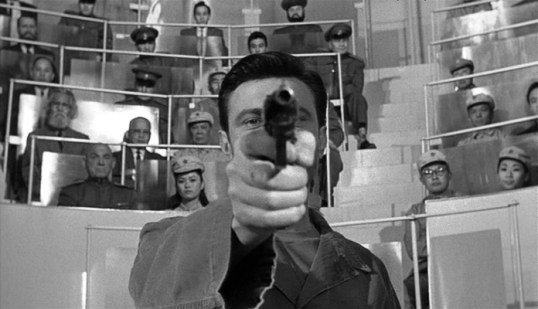
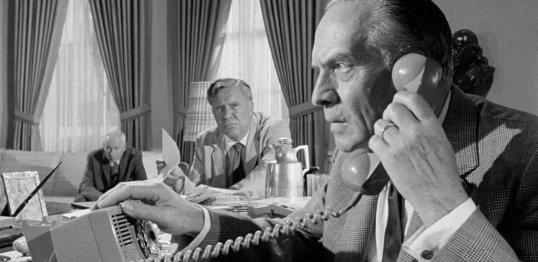
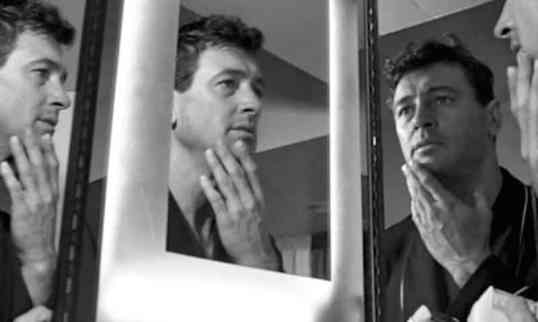
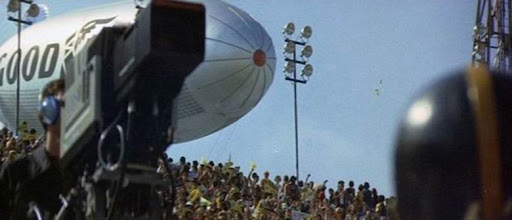
4 Shots From 4 John Frankenheimer Films
The Manchurian Candidate (1962, dir by John Frankenheimer, DP: Lionel Lindon)
Seven Days In May (1964, dir by John Frankenheimer, DP: Ellsworth Fredericks)
Seconds (1966, dir by John Frankenheimer, DP: James Wong Howe)
Black Sunday (1977, dir by John Frankenheimer, DP: John A. Alonzo)
For today’s entry in the 44 Days of Paranoia, let’s take a look at the 1964 political thriller, Seven Days In May.
Directed by John Frankenheimer (who also directed the conspiracy classic, The Manchurian Candidate), Seven Days In May opens with unpopular President Jordan Lyman (Fredric March) on the verge of signing a treaty with the Russians. The chairman of the joint chiefs-of-staff, Gen. James Scott (Burt Lancaster), is opposed to the treaty and feels that Lyman’s actions will lead to the collapse of the U.S. When Scott’s aide, Jiggs Casey (Kirk Douglas), thinks that he’s come across evidence that Scott is planning a military coup, he takes his suspicions to the White House. Working with an alcoholic Senator (Edmond O’Brien) and a cynical political aide (Martin Balsam), the President launches his own investigation into Scott’s activities.
When it was first released, Seven Days In May was very successful with both critics and audiences. Edmond O’Brien even received an Oscar nomination for best supporting actor. When viewed today, however, Seven Days In May feels rather quaint. A good deal of the film’s suspense was meant to be generated by the question of whether or not Gen. Scott is actually planning a coup. However, for the modern viewer, it’s really not a question worth asking. For us, it’s easy to watch this film and shout, “Of course he’s planning on overthrowing the government! He’s the most obviously villainous character in the entire film!” The idea of a military conspiracy to overthrow the U.S. government was perhaps shocking back in 1964 but today, we take the existence of such conspiracies for granted.
Seven Days In May is definitely a product of its time. Unlike John Frankenheimer’s other well-known conspiracy film, The Manchurian Candidate, there’s no sly undercurrent of satire or subversion running through Seven Days In May. Instead, Seven Days In May epitomizes everything that we think of when we think about the early 60s. The film’s politics are liberal but not radically so. The President is such an honorable leader that he won’t resort to the politics of personal destruction and reveal that Scott has a mistress. Casey explains that he disagrees with the President’s politics but that he is bound by duty to reveal Gen. Scott’s subversion. Indeed, by the end of the film, it’s obvious that we’re meant to condemn Scott not because he might overthrow the President but because he would subvert the democratic process to do so. Seven Days In May is a film that tells viewers to support and respect their elected leaders, whether they be good or evil and whether they’re played by Fredric March or Burt Lancaster.
When I listened to Casey explain why he was informing on a man who he claimed to admire and agree with, I was reminded of some of the recent political debates that we’ve had deal with her in America. All of those debates can pretty much be summed up by whether we, as citizens, are obligated to support a law even if we personally don’t agree with it or to respect a leader even if we do not agree with him. The answer, according to Seven Days In May, would appear to be yes.
While Seven Days In May is often a bit too ponderous for its own good, it’s still a well-made and watchable film. If you’re a history nerd like me, you’ll enjoy the film as a portrait of its time. John Frankenheimer directs as if the movie is a film noir and the film’s shadowy black-and-white cinematography looks great. Finally, if you’re a fan of the old school movie stars, how can you not enjoy a film that features Kirk Douglas, Fredric March, and Burt Lancaster?
 Through the Shattered Lens