Retro Television Review: The American Short Story #12: The Man That Corrupted Hadleyburg


Welcome to Retro Television Reviews, a feature where we review some of our favorite and least favorite shows of the past!  On Saturdays, Lisa will be reviewing The American Short Story, which ran semi-regularly on PBS in 1974 to 1981.  The entire show can be purchased on Prime and found on YouTube and Tubi.

This week, we have an adaptation of a Mark Twain novella.

Episode #12: The Man That Corrupted Hadleyburg

(Dir by Ralph Rosenblum, originally aired in 1980)

In this loose adaptation of one of Mark Twain’s darkest novellas, Robert Preston stars as The Stranger.  When we first meet The Stranger, he’s looking down on the small town of Hadleyburg and it’s hard not to notice that he looks a lot like Mark Twain.  The Stranger explains that the people of Hadleyburg consider themselves to be honest and free of sin.  The town’s motto is “Lead us not into temptation!”  The Stranger has a plan to test them.

Riding into town, the Stranger stops at the home of Edward and Mary Richards (Tom Aldredge and Frances Sternhagen).  The Stranger gives them a sack that he claims is filled with $40,000 worth of gold bars.  The Stranger says that he was once a poor man and someone in Hadleyburg gave him $20 and some meaningful advice.  Now that’s he rich, he wants to pay back the person who helped him.  The Stranger explains that there is an envelope inside the sack.  In the envelope, the Stranger has written out the advice he was given by his benefactor.  The Stranger’s instruction is for the man who helped him to write out that advice and give it to Rev. Burgess (Fred Gwynne), who recently lost his church when the citizens of Hadleyburg tired of him calling them out for their hypocrisies.  The honest man who remembers the advice he gave the Stranger will be very rich as a result.  The Stranger then leaves.

News of the sack and the gold travels throughout town and eventually the rest of the nation.  The most powerful families in Hadleyburg, including the Richards family, receive a letter telling them that the advice given to the stranger was “You are far from being a bad man, go and reform.”  Burgess is soon swamped by notes, all featuring that same phrase.  At the town meeting, Burgess reads each note, revealing that everyone wrote down the same phrase and that none of the town leaders is as honest as they claim.

The Man That Corrupted Hadleyburg is one of Twain’s most stinging satires, featuring an ending that is surprisingly dark.  This adaptation takes a much lighter approach to the material, altering Twain’s ending to something much more gentle and friendly.  Unfortunately, changing the ending causes the adaptation to lack the bite of the original short story.  Twain’s portrayal of greed and guilt instead becomes a mild story about a quirky town that learns a lesson.  It’s well-acted, especially by Fred Gwynne, but this adaptation doesn’t honor Twain’s intentions.  It just doesn’t add up to much.
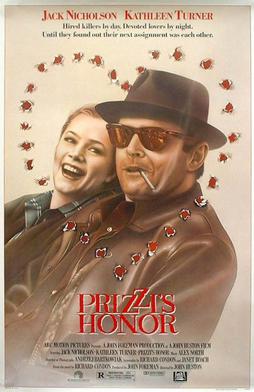
Lisa Reviews An Oscar Nominee: Prizzi’s Honor (dir by John Huston)


First released in 1985, Prizzi’s Honor tells the story of Charley Partanna (Jack Nicholson), a blue collar guy who lives in Brooklyn and who is a hard-working hit man for the Prizzi crime family.  Charley is the son of Angelo (John Randolph), who is the right-hand man to the family’s elderly but still ruthless Don (William Hickey).  In the past, Charley came close to marrying the Don’s daughter, Maerose Prizzi (Anjelica Huston), and he is almost as much a member of the family as the Don’s two sons, Eduardo (Robert Loggia) and Dominic (Lee Richardson).

While attending a family wedding, Charley meets and is immediately infatuated with a woman named Irene Walker (Kathleen Turner).  Later, when Charley is sent to California to kill a man who robbed one of the family’s Vegas casinos, he is shocked to discover that the man is Irene’s husband.  Irene swears that she didn’t have anything to do with the casino theft and, after a whirlwind courtship, Charley and Irene get married in Mexico.  What Charley doesn’t know (but eventually discovers) is that Irene is herself a professional killer.  While Charley and Irene try to balance work and love, Maerose conspires to turn the family against Irene and win Charley back.

Directed by the legendary John Huston, Prizzi’s Honor is pitch black comedy about two hard-working people who kill for a living.  (The film’s big set piece is an extended sequence in which Charley and Irene’s attempt to pull a job together goes wrong in every way and they end up arguing about their relationship while dragging dead bodies from one room to another.)  Though Prizzi’s Honor was released long before the series premiered on HBO, the film feels almost like a companion piece to The Sopranos, full of mobsters who are not as clever as they think they are and who struggle to uphold the old ways in an increasingly complicated world.  Particularly when compared to the gangster who populate a film like The Godfather, the Prizzis are defined by their pettiness.  If Don Corleone epitomized wisdom and honor, Don Prizzi epitomizes someone who holds onto power solely for power’s sake.

Prizzi’s Honor is one of those films that probably seemed a bit more revolutionary when it was first released than it does today.  At this point, we’ve seen so many films about hired killers who have quirky conversations while carrying out their work that the mix of violence and dark humor can feel almost like a cliché.  As well, there are certain parts of the film, like the opening wedding sequence, that feel as if they go on for just a few minutes too long, as if John Huston himself was not always comfortable with the balance between the dark drama and the comedy of mob manners.  That said, Jack Nicholson, Kathleen Turner (who gives a performance worthy of the great femme fatales of film noir), Anjelica Huston, John Randolph, and especially William Hickey all give strong enough performances to hold the audience’s attention and the film’s finale cuts to the point in such a way that it leaves you reconsidering everything that you’ve previously seen.  Prizzi’s Honor has its flaws but Nicholson and Turner have such chemistry that the film’s ending sticks with you.

Prizzi’s Honor was nominated for 8 Oscars, including Best Picture, Best Director, Best Actor, and Best Supporting Actor for William Hickey.  (Oddly, Kathleen Turner was not nominated for playing Irene.)  In the end, it only won one Oscar that year, for supporting actress Anjelica Huston.  The Oscars that year were dominated by a far more convention love story, Out of Africa.