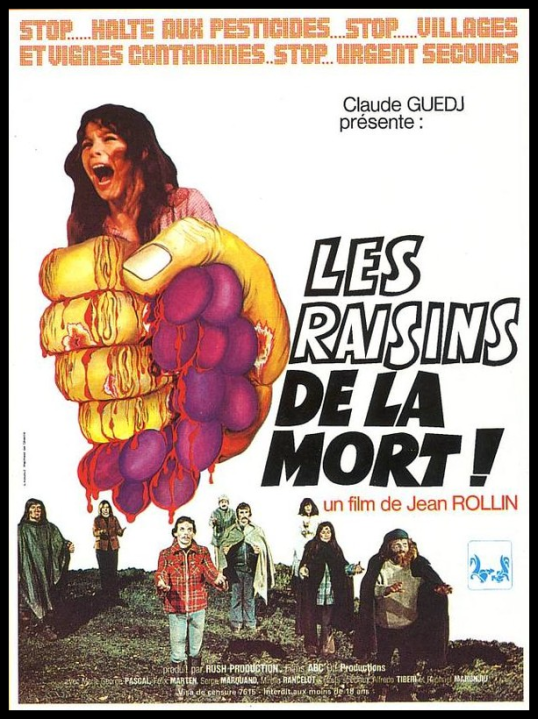
Horror Film Review: The Grapes of Death (dir by Jean Rollin)


1978’s The Grapes of Death is a zombie film that moves at a relentless place, combining effective body horror with an ominous atmosphere that leaves you feeling as if anyone could be the next victim of the zombie horde.

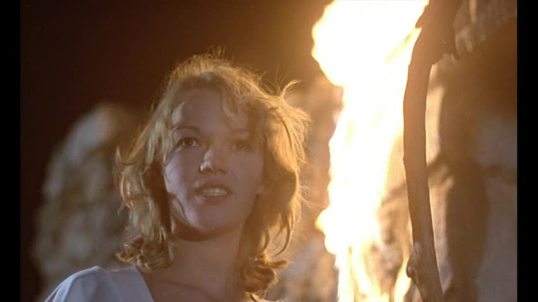
At a vineyard, a worker complains about the new pesticides that are being used and is told, by his smug manager, not to worry so much.  Later, when that worker stumbles aboard a train, his face is pulsing with hideous ulcers.  He kills one woman and chases another, Elizabeth (Marie-Georges Pascal), off the train.  Elizabeth, who is just trying to visit her boyfriend in a nearby village, makes her way across the French countryside, meeting men and women who have been infected by something and who are now going mad.  They may not technically be the undead but, with their nonstop pursuit and their obsession with killing everyone that they come across, they are definitely zombies.

The Grapes of Death is also one of the most French films ever made.  In this film, the zombies are not the creation of a voodoo curse or outer space radiation or even there no longer being room in Hell.  (In fact, it becomes fairly obvious that The Grapes of Death takes place in a world in which there is no Heaven or Hell.)  Instead, this film features people who are transformed into zombies because they drank contaminated wine at an annual festival.  When Elizabeth does eventually meet two men who have not been turned into zombies, they are both revealed to be beer drinkers.  One could actually argue that, despite the film’s grim atmosphere and all of the violence committed and the blood shed and the philosophical discussions that occur, The Grapes of Death is ultimately a satire of French culture.  Only in France could a bad crop of wine lead to the zombie apocalypse.

The Grapes of Death was one of the more commercially successful films to be directed by the great Jean Rollin.  Rollin is best-known for his surreal and dream-like vampire films.  In an interview, he stated that The Grapes of Death was his attempt to make a commercial horror film and that, when he was writing the script, he closely studied the structure of Night of the Living Dead.  While the film does have its similarities to Romero’s classic zombie film, The Grapes of Death is still definitely the work of Jean Rollin.  The lingering shots of the fog-shrouded French countryside and the ancient French villages, with blood staining the cobblestone streets, could have come from any of Rollin’s vampire films.  The film also uses the same serial structure that Rollin used in many of his film, with Elizabeth going from one adventure to another and almost always managing to narrowly escape danger.  Elizabeth goes from fleeing the infected man on the train to finding herself a near prisoner in an isolated house to protecting a blind girl (Mirella Rancelot) for her crazed boyfriend to being menaced by the mysterious Blonde Woman (played by frequent Rollin collaborator Brigitte Lahaie).  There’s a new cliffhanger every fifteen minutes or so.

(Rollin said that he originally envisioned contaminated tobacco as being the cause of the zombie outbreak but he ultimately went with wine instead.  Not everyone smokes but, in France, just about everyone drinks wine.)

First released as Les raisins de la mort, The Grapes of Death has been described as being “France’s first zombie film.”  I don’t know if it was the first but it’s certainly one of the best, a relentless chase through the French countryside that ends on a proper note of downbeat horror.  This film made me happy that I’m not a wine drinker.
(Be sure to read Arleigh’s thoughts here!)

Short Horror Film Review: Spirits of the Dead — Metzengerstein (dir by Roger Vadim)


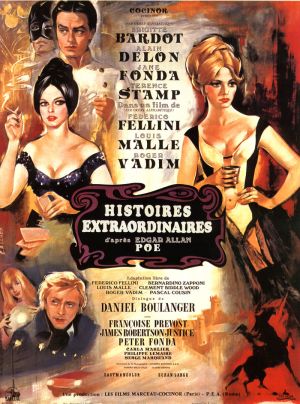
First released in 1968, Spirits of the Dead is an anthology film, one in which three famous international directors (Roger Vadim, Louis Malle, and Federico Fellini) each took a shot at adapting a short story by Edgar Allan Poe.  By their very nature, anthology films tend to be uneven and that’s certainly the case with Spirits of the Dead.

Consider the first story in the film, Roger Vadim’s adaptation of Metzengerstein.  Vadim was best known for his visually lavish films, the majority of which starred whoever he happened to be romantically involved with at the time.  Vadim’s films were sexually charged and decadent but it was a very specific, late 60s type of decadence.  They may have seemed wild when they were first released but, seen today, his films seem rather quaint (not to mention dated).

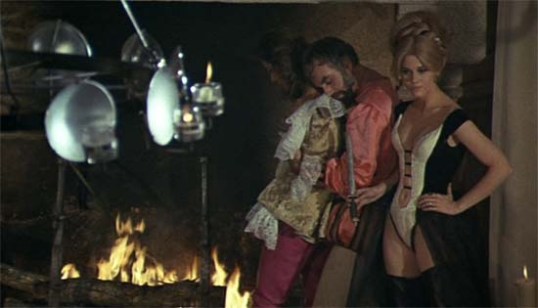
Anyway, when Vadim was hired to shoot his part of Spirits of the Dead, he was married to Jane Fonda so, of course, she stars as Countess Frederique Metzengerstein (Jane Fonda).  That Countess Frederique is evil is obvious from the start.  In between having tastefully shot orgies, she torments her servants.  She even has one servant boy hung so that she can see if she can shoot an arrow through the rope.  (Fortunately, for the servant boy, she can.)  It’s an evil, spiritually empty life but, as can be seen in the picture above, her clothes are to die for.

(Though Metzengerstein appears to be taking place in the 19th century, everyone looks like they’ve just flown over from swinging London.  There’s a lot of miniskirts, sideburns, and tinted glasses.)

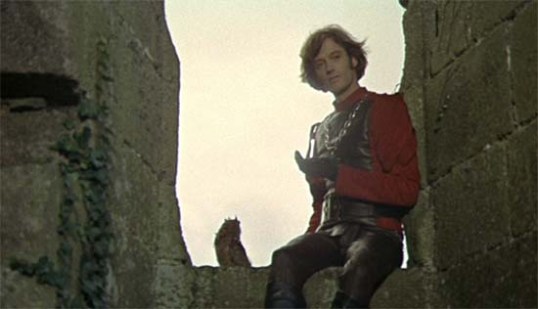
Anyway, things change for Frederique when she meets her virtuous cousin, Wilhelm.  She immediately falls into lust with him but he wants nothing to do with her and her evil ways.  (Her cousin, I might add, is played by Peter Fonda, brother of Jane.)  Upset over being rejected, Frederique sets his stables on fire.  Wilhelm dies in the inferno.

After Wilhelm’s death, a new horse suddenly appears outside of Frederique’s castle.  Convinced that Wilhelm’s spirit has inhabited it, Frederique grows obsessed with the horse.  Soon, Frederique is spending all of her time riding the horse.  With no more time to be evil, Frederique becomes less feared.

But, in the distance, there are always flames calling out to her…

So, let’s just start with the obvious.  There is a huge ick factor to be found in Metzengerstein.  Just as Frederique spends the first half of the movie in love with her cousin, Jane Fonda spends the first half of the movie pretending to be in love with Peter Fonda.  Wilhelm, of course, rejects Frederique but still, it just feels undeniably … creepy.  What’s odd is that it’s difficult to tell if Vadim was trying to make the audience uncomfortable or if this casting was just a case of Peter having some time to kill while visiting his sister and brother-in-law.  For all the attention that he pays to the film’s lush visuals, Vadim is such a detached storyteller that it’s hard to guess what his intention was.

Jane Fonda gives a good performance as the cruel Frederique but otherwise, everyone else in the film is just a part of the scenery.  That’s the thing with Metzengerstein.  It’s a gorgeous film but, ultimately, it’s all scenery that adds up to nothing.


Shattered Politics #37: Rosebud (dir by Otto Preminger)


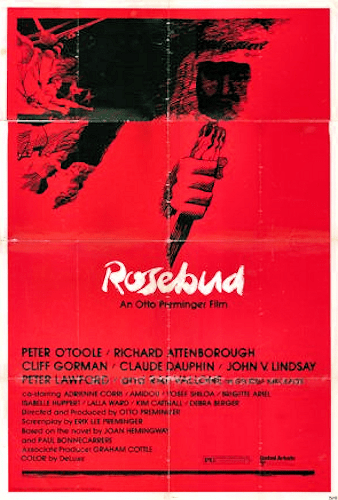
Rosebud_-_1975_-_Film_Poster

Before I review the 1975 film Rosebud, allow me to tell you about how I first discovered the existence of this particular film.

The greatest used bookstore in the world is located in Denton, Texas.  It’s called Recycled Books and it is three stories of pure literary goodness!  (Plus, there are apartments on the top floor where I attended some pretty interesting parties but that’s another story….)  When I was attending the University of North Texas, I used to stop by Recycled Books nearly every day.  One day, I happened to be searching the Film and TV section when I came across a beat-up paperback called Soon To Be A Major Motion Picture.

This book, which was written by Theodore Gershuny, told the story of how the previously acclaimed director Otto Preminger attempted to make a film about terrorism.  Starting with the attempts of Preminger’s son, Erik Lee Preminger, to come up with a workable script and then going on to detail how Peter O’Toole came to replace Robert Mitchum as the star of the film and ending with the film’s disastrous release, Soon To Be A Major Motion Picture proved to be a fascinating read.

After finishing the book, I simply had to see Rosebud for myself.  Unfortunately, at that time, Rosebud had not yet been released on Blu-ray or DVD.  So, I actually ended up ordering an old VHS copy of it.  The tape that I got was not in the best condition but it played well enough and I can now say that, unlike the majority of people in the world, I’ve actually seen Rosebud!

Which is not to say that Rosebud is any good.  It’s not the disaster that I had been led to expect.  In fact, it probably would have been more fun if it had been a disaster, as opposed to being just a forgettable film from a director who was probably capable of better.  Preminger started his career in the 30s and was considered, at one point, to be quite innovative.  He directed Laura and Anatomy of a Murder, two great films.  Unfortunately, there’s really nothing innovative about his direction of Rosebud.  In Gershuny’s book, Preminger comes across like an intelligent and thoughtful man who was too set in his ways to realize that what was shocking in 1959 was no longer that big of a deal in 1975.  (And, needless to say, it’s even less of a big deal in 2015.)

As for what Rosebud‘s about, it’s about a man named Sloat (Richard Attenborough), a former journalist who now lives in a cave in Israel and dreams of establishing a worldwide terrorist network.  Under Sloat’s direction, terrorists storm a yacht named the Rosebud and take the girls on board hostage.  The girls are wealthy and privileged.  Their fathers are judges, senators, and businessmen.  CIA agent Larry Martin (Peter O’Toole) is tasked with tracking down and rescuing the girls.  If it sounds like an action film — well, it’s not.  This is not a prequel to Taken.  Instead, it’s a very talky film that has a few isolated good moments and performances but otherwise, is fairly forgettable.

That said, the film does have an interesting cast.  Peter O’Toole seems bored by his role (and who can blame him?) but Attenborough briefly livens things up in the role of Sloat.  As for the girls being held hostage, they’re not given much to do.  One of them is played by a young Isabelle Huppert.  Long before she would play Samantha on Sex and the City, Kim Cattrall plays a hostage here.  The English hostage is played by Lalla Ward, who is now married to Richard Dawkins.

And then there’s the girl’s parents, who are played by an odd assortment of character actors.  Raf Vallone, an Italian, plays a Greek.  (His daughter, meanwhile, is played by the French Isabelle Huppert.)  Peter Lawford, looking somewhat dazed, shows up as Lalla Ward’s father.  (One of the sadder scenes in Gershuny’s book deals with Lawford’s attempts to remember his lines.)  And than, in the role of Cattrall’s father, we have a very distinguished looking man named John Lindsay.

John Lindsay was the former mayor of New York City, a man who ran for President in 1972 and, three years later, attempted to launch a new career as an actor.  Rosebud was his both his first and final film.  (Rumor has it that Martin Scorsese attempted to convince Lindsay to play Senator Palatine in Taxi Driver but Lindsay turned the role down.)  Lindsay is not particularly memorable in Rosebud.  It’s not so much that Lindsay gives a bad performance as much as it’s just the fact that he has a very bland screen presence.  That blandness probably served him well as a politician but, as an actor — well, let’s just say that John Lindsay was apparently no Fred Thompson.

And so that’s Rosebud.  It’s a film that, much like Maidstone, you can only appreciate if you know what went on behind the scenes.  I can’t really recommend Rosebud but, if you ever come across a battered old copy of Soon To Be A Major Motion Picture in a used bookstore, be sure to buy it!

Seriously, you will not be sorry.

The Daily Grindhouse: Le Raisins de la Mort (dir. by Jean Rollin)


The latest pick for the Daily Grindhouse should delight fellow site contributor Lisa Marie. I say this because I know of no one else who loves all things Jean Rollin as much as she does. I also picked this particular grindhouse flick because it has the lovely Brigitte Lahaie in it. Those who know need no explanation as to why that coulnts a lot in my pick and for those not in the know will just have to figure it out themselves.

I picked Jean Rollin’s Le Raisins de la Mort (also known as The Grapes of Death) because the title just spoke to me. A zombie (or at least zombie-like) flick with the word “raisins” in the title. What’s not to love and, not to continue repeating myself, it has the lovely Brigitte Lahaie in it even if for just a supporting role. A role that definitely shows her best front, sides and back (I’m a guy so sue me).

If there was ever a reason Jean Rollin has my undying props it’s for always finding a reason to cast Brigitte Lahaie in his films. Now, if Steven Soderbergh can just follow his lead and just keep casting Sasha Grey in all his future films then he’ll have my undying support as well.

This particular grindhouse pick definitely doesn’t make for a good way to promote France’s great wine traditions and their fabulous vintages. What it does promote is France’s own particular take on the zombie genre of the 70’s. Where zombie flicks were always seen as American and Italian provinces of the horror scene other countries had their hand in pushing the genre, but France (with some help from Rollin himself) added their own spin on it by shamelessly (one I applaud and am thankful for) keeping the lovely female performers in them in differing modes of undress.

For that I just have to say one thing: Vive la France!