Playing Catch-Up: Room (dir by Lenny Abrahamson)


Room_Poster

Have you seen Room yet?

I ask because I’m debating how much information I should share in this review.  Room came out a few months ago and I’ve been late in reviewing it because watching the film was such an emotionally overwhelmingly experience that I wasn’t sure where to begin.  Now, all of this time has passed and I’m in a hurry to review this film because it’s obviously going to be nominated for some Oscars on Thursday morning and I’m wondering how much I can reveal without spoiling the movie.

It’s always tempting to say “Spoilers be damned!” but I’m not going to do that this time.  Room is a great film and it’s one that deserves to be discovered with a fresh mind.  I imagine that many people who missed the film the first time will see it once Brie Larson has been nominated for Best Actress.  Out of respect for those people, I am going to hold off from going into too much detail about the film’s plot.

Of course, this means that, if you haven’t seen the film, you’re going to have to have a little bit of faith in me.  You’re going to have to trust me.  When I tell you that this is an amazing film that will take you by surprise, you’re just going to believe me.  Because if I ruin those surprises … well, then they won’t be surprises anymore, will they?

When I first heard all the Oscar talk swirling around Room, my initial instinct was to make a joke about Tommy Wiseau finally getting the credit he deserves.  But then I saw Room and, within a few minutes of the film, I was in tears.  It’s hard for me to think of any other film this year that made me cry as much as Room.

Room is narrated by Jack (Jacob Tremblay), a 5 year-old boy whose hair is so long that he is frequently mistaken for being a girl.  Jack lives in a filthy room with Ma (Brie Larson).  The tiny room has only a toilet, a sink, a bed, a small kitchen area, and a cheap television.  There’s also the small closet where Jack sleeps and a skylight in the ceiling.  As quickly becomes apparent from his narration, Jack has never been outside of the room.  All he knows about the outside world comes from TV and the stories told to him by Ma.

Occasionally, a nervous man named Old Nick (Sean Bridgers) enters the room.  Whenever Old Nick shows up, Ma orders Jack to hide in the closet.  However, even in the closet, Jack listens to Ma and Nick talking in the room.  Ma talks about how Nick kidnapped her when she was 17.  Nick talks about how he has recently lost his job and may not be able to continue to take care of his two prisoners.  Fearful for her life, Ma humors the self-pitying Nick.  Nick, meanwhile, plays the victim and complains about how difficult it is to keep her and Jack prisoner.  It quickly becomes apparent that Jack is Nick’s child.

Now that Jack is five, Ma knows that he’s old enough that she can tell him about her plan to escape from Nick.  However, escaping means exposing Jack to a world that he’s never experienced and that Ma fears she no longer remembers.

Meanwhile, Ma’s parents wonder what has happened to their missing daughter.  (It’s from her parents that we learn that, much like a character played by fellow Oscar contender Jennifer Lawrence, Ma’s name is Joy.)  Ma’s mother, Nancy (Joan Allen), is now divorced from Joy’s emotionally repressed father (William H. Macy).  Nancy is now married to the kind and appealingly disheveled Leo (Tom McCamus).  However, still hoping that her daughter will someday return, Nancy hasn’t even touched Joy’s old bedroom.

Finally, the opportunity comes for Ma and Jack to escape and…

…and that’s all I can tell you without spoiling the film.  Room is an emotionally exhausting film, one that will make you cry but which will also leave feeling strangely hopeful for the future.  Brie Larson gives a courageously vulnerable and emotionally raw performance as Joy while Jacob Tremblay is perfectly cast as Jack.  Since Larson and Tremblay are both getting a lot of attention as possible Oscar nominees, I want to take a few minute to single out one member of the cast who, so far, has been overshadowed.  Tom McCamus doesn’t have a lot of screen time but he makes the most of every second he gets, turning Leo into the ideal father figure.

Room made me cry and cry and I can’t wait to see it again.
Talking About Love: The Best of Me (dir by Michael Hoffman) and The One I Love (dir by Charlie McDowell)


The_Best_of_Me_poster

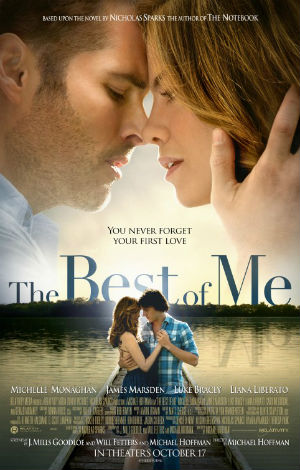
When I wrote my review of The Theory of Everything, I mentioned that Stephen Hawking’s A Brief History of Time made a brief, if important, appearance in another film released earlier this year.  That film, of course, was the latest Nicholas Sparks adaptation, The Best Of Me.  

Now, I have to admit that The Best Of Me was one of those forgettable films that I kind of suspected most of our readers would not mind me never getting around to reviewing.  It came out two months ago, it got terrible reviews, and it didn’t do much business at the box office.  I didn’t even enjoy it and I’m the girl who always ends up defending the Twilight films whenever the boys here at the Shattered Lens start to make fun of them.  You can tell the impression that the Rest Of Me made on me by the fact that I just got the name wrong and I didn’t even bother to correct my mistake.

But here’s the thing.  January is rapidly approaching and, with January, comes my annual 16 worst films of the year list.  And chances are that The Best Of Me will appear on that list and I’d like to be able to link to a review.

It’s probably not a shock to hear that The Best Of Me is not a good film.  With the exception of The Notebook, the novels of Nicholas Sparks are not known for inspiring good films.  Instead, they are known for inspiring films about achingly pretty people who meet on the beach, have a melodramatic secret in the past, and ultimately end up falling in love.  And dying, of course.  Somebody always has to die.  The familiar Nicholas Sparks formula actually works pretty well when you’re the one reading his prose and visualizing the story in your head.  That’s largely because you can always imagine yourself as the heroine and maybe James Franco, Bradley Cooper, or Ryan Gosling as the hero.  But, when it comes to making movies out of his books, the end results are often so predictable and uninspired that the Nicholas Sparks drinking game had to be legally banned after scores of single women fell ill with alcohol poisoning.

(Yes, that actually did happen!  Google it! …. or don’t.  Actually, don’t.)

The Best Of Me is, without a doubt, the most Nicholas Sparksian Nicholas Sparks adaptation ever made.  Seriously, it has everything that you would expect from a Nicholas Sparks film and it presents it all so predictably that watching the movie is a bit like watching a checklist.  We’ve got two former high school lovers who are reunited 20 years later.  We’ve got melodrama that comes out of nowhere.  We’ve got multiple flashbacks.  We’ve got soft focus cinematography.  And, of course, we’ve got an ending that is meant to be both tragic and inspiring but it’s neither because, since this is a Nicholas Sparks movie, we already knew that the ending was going to try to be both tragic and inspiring.

What we don’t have is much chemistry between the two lead actors.  James Marsden and Michelle Monaghan are both pretty in the way that people in Nicholas Sparks films often are but you never get the feeling that they have much affection for each other.  Even worse, in the flashbacks, their characters are played by two actors (Luke Bracey and Liana Liberato) who look absolutely nothing like James Marsden or Michelle Monaghan.  In particular, it’s impossible to believe that Luke Bracey could ever grow up to look like James Marsden.  I found myself half-expecting a huge twist where Marsden would reveal that he was an intruder.

And you know what?

That would have been a lot more interesting than what we got!  Somebody help me get in touch with Nicholas Sparks!  I’ve got some ideas for his next book!

The One I Love

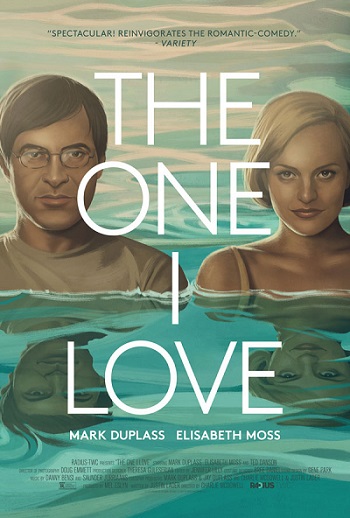
For a far more memorable look at love and relationships, allow me to suggest The One I Love, a film that was obviously made for a lot less money than The Best of Me but which is also a lot more thought-provoking.

In The One I Love, Mark Duplass and Elisabeth Moss play a couple whose marriage is on the verge of breaking up.  At the suggestion of their friendly-yet-creepy marriage counselor (Ted Danson), they agree to spend a weekend at a beautiful but remote house.  Danson assures them that they will be the only couple at the house. Duplass and Moss agree and, at first, the weekend seems to be working.  However, soon both of them start having conversations and encounters that the other claims to not remember.  Duplass and Moss discover that they are not alone at the house…

And to tell you anything else about the plot would be unfair.  The One I Love is one of those films that works best when the viewer discovers its mysteries at the same time as the characters.  To spoil the film would be a crime.  Let’s just say that there is a twist that will leave you reconsidering everything that you’ve previously seen in the movie.

Beyond that twist, however, The One I Love works for the exact reason that The Best of Me does not.  Moss and Duplass have the chemistry that the leads in The Best Of Me lack.  You believe them both as individuals and as a couple.

So, when it comes time to consider what we talk about when we talk about love, check out The One I Love and leave The Best Of Me behind.