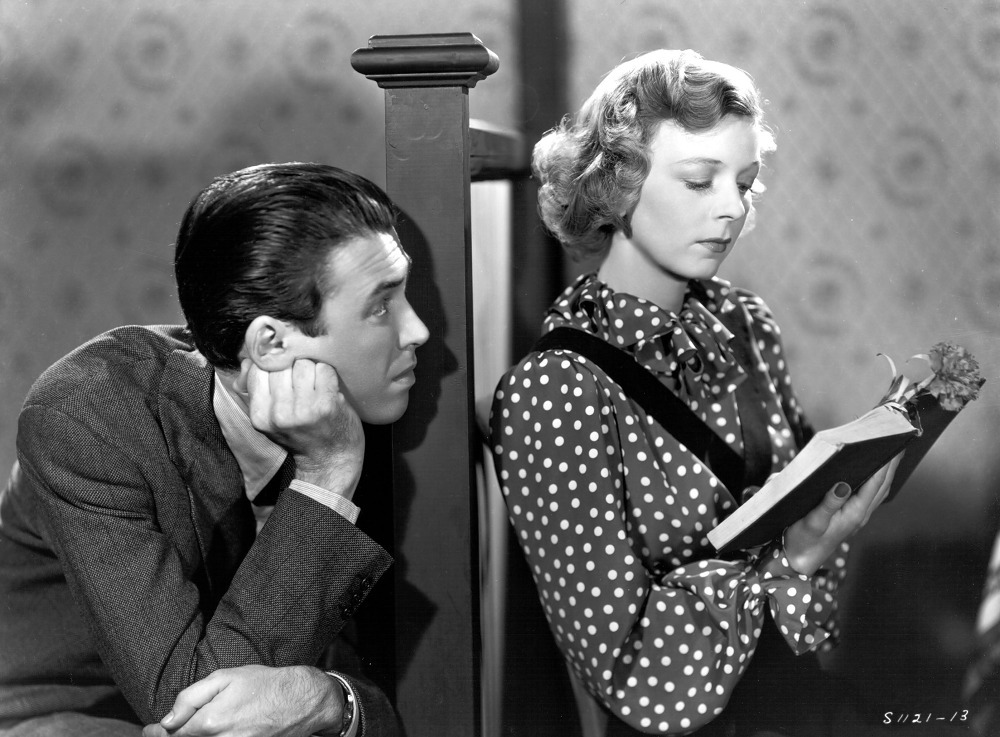
Brad reviews THE SHOP AROUND THE CORNER (1940), starring James Stewart and Margaret Sullavan!


Set in Budapest, Hungary, we meet Alfred Kralik (James Stewart), the dependable head clerk at a retail establishment named Matuschek and Company. In walks Klara Novak (Margaret Sullavan), an attractive young lady who’s desperately in need of a job, so Mr. Matuschek (Frank Morgan) hires her as a new salesgirl. Alfred and Klara immediately take a disliking to each other and give each other quite a hard time at work. As we get to know Alfred and Klara, we find out that each of them is involved in a treasured “pen-pal” relationship with a mysterious someone who truly seems to understand their heart and soul. Wouldn’t you know it, even though they get on each other’s last nerves at the shop, Alfred and Klara are each other’s secret pen-pal! While navigating unexpected drama at work, mainly involving Mr. Matuschek, his wife, and a duplicitous employee, Alfred eventually discovers that Klara is his mystery correspondent without her knowing it. As he tries to reconcile the actions of the lady he knows from work with the heart of the person who wrote those letters, Alfred decides to show Klara who he really is to see if they can fall in love in real life!

THE SHOP AROUND THE CORNER is one of my very favorite romantic comedies, and I’d guess the lead performance of James Stewart is probably the main reason. He’s just perfect in the role of Alfred Kralik… earnest, proud, awkward, vulnerable, and above all else, decent. Stewart’s ability to portray characters with believable decency separate him as one of the all-time greats and that quality is well on display here. Margaret Sullavan, as Klara Novak, matches him perfectly. Known to have a good relationship off screen as well, the chemistry between Stewart and Sullavan is off the charts and their scenes together are quite powerful. Mostly known by me for his performance as the Wizard of Oz, Frank Morgan is also incredible as Mr. Matuschek, at times jealous, volatile, and ultimately benevolent.

Director Ernst Lubitsch, known for his “Lubitsch touch,” has made a movie that has stood the test of time because of its core of emotional truth. Even though it was made well before the days of social media or online dating, THE SHOP AROUND THE CORNER understands just how differently we present ourselves when writing (or online, or on social media), compared to how we actually behave in person. Maybe it’s because THE SHOP AROUND THE CORNER was made in 1940, but I love the way its time-tested story idea is used for comedy and sweet romance, without becoming cynical. That lack of cynicism leaves room not only for comedy and romance but also a genuine compassion for its characters as they deal with the very real emotions of loneliness, pride, jealousy, and fear.

All in all, THE SHOP AROUND THE CORNER may be 85 years old, but its tender and romantic payoff set on Christmas Eve still gets me every time. As far as I’m concerned, this is about as close to perfect as a romantic comedy can get!  

(Author’s note: I’m also a fan of the 1998 remake, YOU’VE GOT MAIL, starring Tom Hanks and Meg Ryan, but I rate it below Lubitsch’s film.)
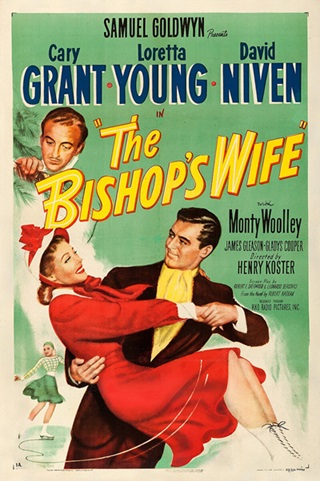
Lisa Marie Review An Oscar Nominee: The Bishop’s Wife (dir by Henry Koster)


In 1947’s The Bishop’s Wife, Cary Grant stars as Dudley.

We first see Dudley walking down the snow-covered streets of a city that is preparing for Christmas.  He watches Julia Broughman (Loretta Young), the wife of the local Anglican bishop.  He stops to talk to Prof. Wutheridge (Monty Woolly), a secular humanist who is close to Julia and her husband, despite being irreligious himself.  Dudley seems to know all about the professor, even though the professor is not sure who he is.  The professor mentions that he was fired from a university because he was considered to be a “radical,” even though he has no interest in politics.  The professor says that the town’s church has seen better days, especially since the Bishop is more interested in raising money from the rich to build a grand new cathedral than actually meeting with the poor who need help.

The last person that Dudley visits is Bishop Henry Broughman (David Niven).  Dudley reveals to Henry that he’s angel and that he’s come in response to Henry’s prayers.  Henry has been frustrated in his attempts to raise money for a new cathedral.  Dudley has come to provide guidance.

With only the Bishop knowing the truth about Dudley, Dudley becomes a houseguest of the Broughmans.  The Bishop has become so obsessed with his new cathedral that he’s not only been neglecting his diocese but also his family.  While Dudley tries to show Henry what’s really important, he also helps Julia and her daughter Debby (Karolyn Grimes) to fit in with the neighborhood.  (Bobby Anderson, who played the young George Bailey in It’s A Wonderful Life, makes an appearance as a boy having a snowball fight who says that Debby can’t play because no one wants to risk hitting a bishop’s daughter with a snowball.)  The Bishop becomes jealous of Dudley and perhaps he should be as Dudley finds himself falling in love with Julia and considering not moving on to his next assignment.

(And now we know where Highway to Heaven got the inspiration for 75% of its episodes….)

The Bishop’s Wife is an enjoyable film, one that is full of not just Christmas imagery but also the Christmas spirit as well.  The Bishop finally realizes that his planned cathedral is more of a gift to his ego than to the men and women who look to him for guidance and comfort in difficult times.  David Niven is, as always, likable even when his character is acting like a jerk.  That said, this is pretty much Cary Grant’s show from the start.  Suave, charming, and gently humorous, Grant joins Claude Rains and Henry Travers in the ranks of great cinematic angels.  Never mind that Grant’s character is a bit pushy and has his own crisis of faith.  From the minute that Grant appears, we know that he’ll know exactly the right way to answer Henry’s prayers.

Cary Grant was not nominated for Best Actor for his performance here.  Undoubtedly, this was another case of Grant making it all look so easy that the Academy failed to realize just how good of a performance he gave.  Interestingly enough, The Bishop’s Wife was one of two Christmas films nominated for Best Picture that year, along with Miracle on 34th Street.  Both films lost to Gentleman’s Agreement.

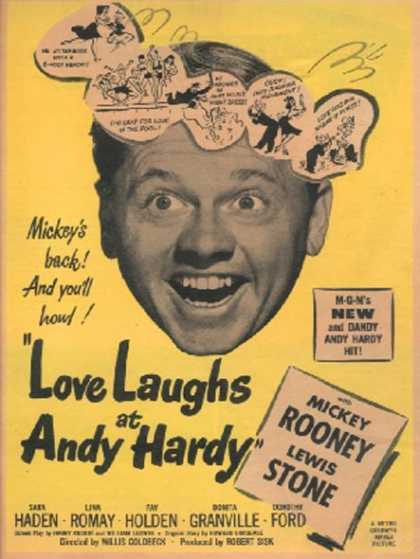
The Fabulous Forties #45: Love Laughs At Andy Hardy (dir by Willis Goldbeck)


LLAAH

I cringed a little when I saw that the 45th film in Mill Creek’s Fabulous Forties box set was 1946’s Love Laughs At Andy Hardy.  

This was because I had never seen an Andy Hardy film before but I did know enough to know that, starting in the 1930s, MGM made a series of films that featured Mickey Rooney in the role of a “nice, young man” named Andy Hardy.  Andy was a well-meaning kid who grew up in Middle America under the watchful eye of his father, Judge Hardy (Lewis Stone).  What little I had heard of the Andy Hardy films led me to suspect that they were very much a product of their time and had not aged particularly well.

Having now watched Love Laughs At Andy Hardy … well, I can confirm that it is a product of its time.  And it is definitely an uneven film, though perhaps I would have felt differently if I had seen any of the other Andy Hardy films.  (Love Laughs was the 15th film about Andy Hardy and it pretty much assumes that the viewer already knows who Andy and all of his friends and family are.)  But I will say this: Mickey Rooney was a really good actor.  In fact, as I watched Love Laughs At Andy Hardy, I was shocked by just how good a performance Rooney gave.  When I think of Mickey Rooney — well, to be honest, it’s rare that I ever do.  But when I do, it’s usually in relation to the exploitation films he made after he was a star.  These were movies like The Manipulator or Silent Night Deadly Night 5, all of which feature an elderly and obviously unwell Mickey acting up a storm.  In contrast to those film, in Love Laughs At Andy Hardy, Mickey gives a totally empathetic and, at times, even subtle performance.   Even by contemporary standards, his performance feels real and, as I watched, I started to understand how there actually could have been 16 separate films about Andy Hardy.  You really do find yourself caring about the little guy,

As for this film, it opens with Andy returning from serving in World War II.  Apparently, he left college to enlist in the army.  Now that he’s back in America, he’s ready to return to college and ask his old girlfriend, Kay (Bonita Granville) to marry him.  However, to Andy’s shock and disappointment, Kay has moved on and has other plans.  Why, it’s almost enough to make Andy want to drop out of school, give up his dreams of becoming an attorney, and try to find work as an engineer in South America!

Fortunately, Judge Hardy is there to talk some sense into his son.

It’s all fairly predictable and, as I said before, definitely uneven.  I get the feeling that a lot of the scenes in Love Laughs At Andy Hardy were meant to serve as call backs to previous films in the series.  Watching this film without a context can lead to a lot of confusion.  But, again, it’s all saved by Mickey Rooney’s performance.  While I can’t really give this film a strong recommendation, I imagine if you’re fan of Rooney’s or the Andy Hardy films, you’ll enjoy it.

Perhaps the best scene in the film comes when Andy is set up on a blind date with a girl named Coffy (Dorothy Ford).  When Andy goes to Coffy’s dorm to pick her up, he can’t understand why all the other girls keep looking at him and laughing.  However, once Coffy shows up, it quickly becomes obvious.  Coffy is 6’2 while Andy is a full foot shorter.

However, when Andy and Coffy arrive at the college dance, they defy all the laughs and the snide remarks.  Instead of surrendering to the expectations of snarky society, they perform a dance to end all dances and I’m going to conclude this review by sharing it below.

Enjoy!