The First Police Story: Slow Boy (1973, directed by William A. Graham)


Long before The Wire, Homicide, Chicago PD, NYPD Blue, or even Hill Street Blues, there was Police Story.

Co-created by cop-turned-writer Joseph Wambaugh, Police Story aired on NBC from 1973 to 1978.  It was an anthology series, with each episode following a different member of the LAPD as they deal with crime and social issues in Los Angeles.  For its time, it was ground-breaking in its realistic approach to the life and work of the police.  Interestingly, the show wasn’t always blindly pro-cop.  Often the cops featured were deeply flawed and the war on crime was frequently portrayed to be unwinnable.  Over the course of its run, Police Story was a regular Emmy nominee and won the award for Best Drama Series in 1976.

Police Story started, in 1973, with a two-hour TV movie.  At the time it aired, the pilot was called Stakeout but it has since aired in syndication under the title Slow Boy.  Vic Morrow stars as Sgt. Joe LaFrieda, a plainclothes detective who can’t keep his marriage together but who can take criminals off the street.  LaFrieda is the second-in-command of a special squad of detectives who specialize in watching and taking down high-profile criminals.  Their methods frequently come close to entrapment but they usually work.  Their current target is Slow Boy (Chuck Conners), the son of a mafia chieftain, who enjoys robbing stores.  When LaFrieda’s first attempt to put Slow Boy in jail is thwarted by a liberal judge and departmental bureaucracy, he and the squad come up with a second, less-than-legal plan to take Slow Boy down.

Considering the involvement of Joseph Wambaugh, it’s no surprise that plot is secondary to exploring the day-to-day lives of the blue-collar cops trying to take Slow Boy down.  The heart of the movie is in the scenes of the cops shooting the breeze and trying to keep each other amused during length shakeouts.  Their humor is often grim and the fascinating dialogue is cynical, dark, and, even by today’s standards, surprisingly raw.  One of the detectives (played by Harry Guardino, who specialized in loud-mouth city cops) is an unapologetic racist.  Though he gets a comeuppance of sorts, the way the film and the rest of his squad handle his racism will undoubtedly make modern audiences uncomfortable, even if it is authentic to the era in which Slow Boy was made.

The underrated Vic Morrow gives one of his best performances as the tough but sympathetic LaFrieda, who is bad at everything but his job.  He is ably supported by a host of familiar character actors.  Ed Asner plays LaFrieda’s reactionary lieutenant while Sandy Baron is great in the role of an informant.  Diane Baker was also perfectly cast as LaFrieda’s potential girlfriend.  (She first meets the detective while Slow Boy is holding a gun to her head.)  Finally, Chuck Conner is as intimidating as always as the sadistic Slow Boy.

Slow Boy is a tough and uncompromising police procedural and it provided a great start for Police Story.  Reruns of Police Story currently air on H&I on Sunday morning.

And To All A Good Fright: THE MUNSTERS SCARY LITTLE CHRISTMAS (TV Movie 1996)


gary loggins's avatarcracked rear viewer

If you grew up in the “Monster Kid” generation like me… well, you’re old! That is, old enough to remember THE MUNSTERS, the silly 60’s sitcom about a family of monsters adjusting to life in suburbia. The show ran two seasons and inspired a feature film, 1966’s MUNSTER, GO HOME!, with Fred Gwynne (Herman, the Frankenstein’s Monster surrogate), Yvonne DeCarlo (Lily, a vampire resembling Carroll Borland in MARK OF THE VAMPIRE), Al Lewis (Grandpa, aka Count Dracula himself!), and Butch Patrick (Eddie, a wolf-boy) reprising their roles. The Munsters returned in a 1981 TV Movie THE MUNSTERS’ REVENGE with Gwynne, DeCarlo, and Lewis, then as a 1988-91 syndicated sitcom THE MUNSTERS TODAY, this time starring John Schuck (Herman), Lee Meriweather (Lily) and Howard Morton (Grandpa).

The fright family have proved durable, and were trotted out yet again for a 1996 holiday TV Movie, THE MUNSTERS SCARY LITTLE CHRISTMAS. I’m usually…

View original post 501 more words

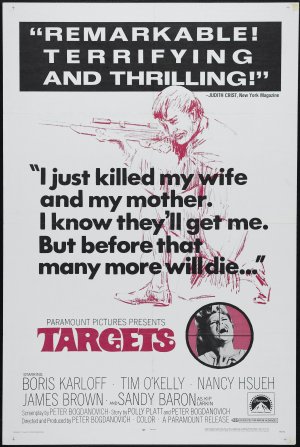
Horror Film Review: Targets (dir by Peter Bogdanovich)


targetsposter

The year was 1968 and legendary producer Roger Corman had aging horror star Boris Karloff under contract.  Karloff still owed Corman two days of work and Corman was never one to let an opportunity pass him by.  Corman approached film critic Peter Bogdanovich and made him an offer.  Corman would finance any film that Bogdanovich wanted to make, on the condition that he stayed under budget, used Boris Karloff, and included some scenes from The Terror.  Bogdanovich agreed and the end result was one of the best films of Karloff’s long career.

Karloff plays Byron Orlok.  Orlok (named, of course, after the vampire in Nosferatu) is a veteran horror star who now finds himself working almost exclusively in B-movies.  When the film starts, he’s just announced his retirement.  Orlok is bitter that Hollywood never fully appreciated his talents but, beyond that, he’s come to believe that horror movies can never hope to compete with the horrors of the real world.  People have become so desensitized to horror that it’s impossible to scare them, he believes.  Orlok plans on making one final promotional appearance at a drive-in that will be showing his final film.  (His final film, of course, is The Terror.)

Meanwhile, there’s a man named Bobby Thompson (Tim O’Kelly) and he’s about to shock the world.  Bobby has just recently returned from Vietnam.  He works as an insurance agent and his cheerfully bland countenance hides the fact that Bobby is going insane.  He is struggling to pay the bills and he resents the fact that his wife is now working and that they have to live with his parents.  His strict and taciturn father continues to criticize him, especially after Bobby points a rifle at him during target practice.  Bobby, incidentally, loves his guns.  After he murders both his wife and his mother, Bobby uses that gun to start shooting at strangers.

Bobby starts his rampage by shooting at cars on the freeway but eventually, he ends up at the drive-in.  While The Terror plays out on the big screen, Bobby shoots at the men, women, and children who have gathered to watch the movie, proving Orlok’s point that cinematic horror cannot hope to match the horror of everyday life…

Even though it was made 48 years ago, Targets is a film that feels extremely relevant today.  As I watched the film, I couldn’t help but think about not only James Holmes’s 2012 rampage in Aurora, Colorado but also the more recent sniper attacks in my hometown of Dallas.  For me, it was interesting to see that apparently this stuff was going on even in 1968.  (We tend to think of mass shooting as being a recent phenomena.)  Targets is an open plea for gun control (which, again, is something that we tend to think of as being a relatively new thing).  I’ll leave the political debate for others to consider and instead just say that Targets is a chilling portrait of both madness and violence.

However, Targets also works brilliantly as a tribute to Boris Karloff.  Though he may have never been as bitter as Orlok, Karloff is basically playing himself in Targets.  He’s portrayed as a cultured and kindly man who just happened to be very good at playing scary characters and Karloff gives perhaps his best performance in the role. Some of the best scenes in Targets are the scenes where Orlok (and, by extension, Karloff) discusses his career with his friend, Sammy Michaels (played by Bogdanovich).  You find yourself really wishing that you could have hung out on the set of Targets just to hear the stories that were told while the cameras weren’t rolling.

(Incidentally, Sammy Michaels was named after famed director Sam Fuller, who helped to write the film’s screenplay and provided a good deal of free advice to Bogdanovich.)

Targets works as both a horror film and a tribute to a great actor.  If for no other reason, watch it for Boris.