There’s trouble in Phantom Valley. The ranchers who founded the town are increasingly at odds with the newly arrived homesteaders. Each side blames the other for the tensions. Marshal Steve Collins (Charles Starrett) is sent to investigate who is responsible for all of the trouble but, when two people are murdered, it is up Steve’s alter ego, the masked Durango Kid, to investigate and solve the murders. Helping him out is his ever-loyal sidekick, Smiley Burnette. Smiley compares himself to Sherlock Holmes, walks around with a magnifying glass, and sings a few songs.
This Durango Kid film opens with a exciting montage of cattle stampedes, shoot-outs, floods, and horse chases. Even though it’s almost all stock footage that appeared in a countless number of other B-movies, it’s still exciting to watch. Despite the opening montage, there’s still less stock footage than usual in Phantom Valley. The emphasis is instead on the Durango Kid as a detective, trying to solve a stone-cold whodunit. It makes for an interesting change of pace and the Durango Kid gets to show off his intelligence along with his shooting and horse riding skills. Charles Starrett is convincing as a detective. Even if he is trying to solve the case a century before finger printing, The Durango Kid knows that hand-writing is just as easy a way to identity a culprit. Smiley Burnette, as usual, handles the comedic relief and the singing. I could have done without the songs but Smiley trying to use a magnifying glass and losing his temporary position as the town’s marshal to a child will always be good for a laugh.
Phantom Valley was a welcome change of pace for the Durango Kid. Western fans will find much to appreciate.
When the invention of the telegraph puts the Pony Express out of business, two veteran riders — John Blair (John Wayne) and Larry Adams (Lane Chandler) — decide to start their own stagecoach line. The richest man in Buchanan City, “Honest” Cal Drake (Douglas Cosgrove), sells them the line to nearby Crescent City. Though initially grateful, Blair and Larry soon discover that Crescent City is now a ghost town that serves as home to exactly two inhabitants. Rather than give up, Blair and Larry set up their stagecoach and they suddenly get lucky as settlers start to find themselves in Crescent City. Blair is even able to convince the local telegraph company to run the wire though Crescent City, which leads to an influx of even more people. Now, Blair just needs to land the contract delivering mail for the area. To do that, he’ll have to win a stagecoach race against Drake, who turns out to not be very honest at all.
Winds of the Wastelands is one of John Wayne’s better pre-Stagecoach programmers. While it has the western action that most people would expect from a B-western, it also has a lot more comedy than some of Wayne’s other poverty row productions. For instance, a skunk tries to turn the stagecoach into his home and, of course, shows up at a key moment during the big race. When one of bad guys tries to convince Blair to take his donkey to Crescent City in the stagecoach, Blair asks if there are any other “jackasses” who want a ride while casting a look at Drake’s men. The movie takes a more serious turn when Drake goes to extreme methods to try to stop Blair and, as a result, Larry is wounded in a gunfight. Doc Forsythe (Sam Flint), the founder of Crescent City, has to rediscover his confidence to perform the operation that can save Larry’s life. Fortunately, the doctor’s daughter (Phyllis Fraser) is there to both help him out and to fall in love with John Blair.
This 55-minute programmer featured John Wayne playing the type of character for which he best known, the level-headed westerner who wasn’t going to let anyone push him around but who still fought fair. Watching this movie, it’s easy to see why, just three years later, John Ford used him in Stagecoach.
The 1944 film, Lady in the Death House, tells the tragic and faintly ridiculous story of Mary Kirk Logan (Jean Parker).
The daughter of a small-time criminal, Mary has spent most of her life trying to escape from her family’s legacy of crime. She’s even got a job, working at the same bank that her father once tried to rip off. Of course, at work, everyone knows her as Mary Kirk and they have no idea that her father was the infamous Tom Logan. If that information got out, Mary would lose her job and no longer be able to take care of herself or her younger sister, Suzy (Marcia Mae Jones).
One night, Mary is out on a date with a clumsy man who takes her out to a nightclub and manages to accidentally set Mary’s dress on fire. Luckily, Dr. Brad Braford (Douglas Fowley) is there, having a drink with his friend, the famous criminologist, Charles Finch (Lionel Atwill). Brad jumps into action, extinguishing the fire and saving Mary’s dress. It’s love at first sight.
There’s just one problem. Dr. Bradford is studying ways to bring the dead back to life and, in order to raise money for his research, he’s been working as the state’s executioner. When someone goes to the electric chair, Brad is the one who pulls the lever. Mary says that she can only marry Brad if he gives up his electrifying night job.
However, before Brad can turn in his letter of resignation, Mary is arrested for the murder of Willis Millen (Dick Curtis), a crook who once knew her father. Mary swears that she’s innocent but there are two eye witnesses who testify that they not only heard Mary and Willis fighting but that they also saw the shadow of someone hitting Willis over the head with a lamp. It doesn’t take long for the jury to reach a verdict:
I have to admit that, when this newspaper appeared on-screen, I was actually more curious about the “youth” who was arrested for stealing glitter off of campaign signs. However, for whatever reason, the film declines to follow up on that story. Instead, we watch as Mary goes to death row, with the knowledge that she is to die “at the hand of the man I love.”
However, there may still be hope! Charles thinks that Mary is innocent. Though there’s only 24 hours left before Brad is scheduled to execute Mary, Charles launches an investigation of his own. But even if Charles is able to find the evidence that exonerates Mary, will he be able to contact the governor in time? Or will Mary go to the chair?
Well, regardless of what happens, rest assured that this World War II-era film will end with an appeal for all movie goers to do the right thing and buy war bonds.
Lady in the Death House is an entertaining but fairly ludicrous little movie. I mean, realistically, having the executioner execute his own fiancée is a huge conflict of interest. It seems like they could have gotten a substitute executioner, if just for one night. But, if they did that, we wouldn’t get the melodramatic highlight of Mary announcing that she’s scheduled to be killed “by the hand of the man I love.”
Lady in the Death House provides a rare chance to see Lionel Atwill in a heroic role. The British actor played a countless number of mad scientists, killers, and Nazis before his premature death in 1946. (Atwill’s promising career was derailed in 1943, when he accused of hosting orgies at home and was subsequently convicted of perjury. That’s one reason why Atwill turned up in a “poverty row” feature like this one.) Atwill is convincing as Charles Finch. The same superior attitude that made him a good villain also makes him believable as the only person capable of figuring out who murdered Willis Millen.
Taking on its own terms, Lady in the Death House is a fun movie. If nothing else, it provides a lesson on how to get a message to the governor, even if no one’s quite sure where he is for the evening. That’s an important lesson to learn!
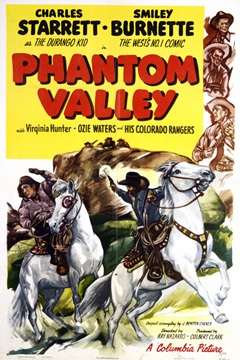 There’s trouble in Phantom Valley. The ranchers who founded the town are increasingly at odds with the newly arrived homesteaders. Each side blames the other for the tensions. Marshal Steve Collins (Charles Starrett) is sent to investigate who is responsible for all of the trouble but, when two people are murdered, it is up Steve’s alter ego, the masked Durango Kid, to investigate and solve the murders. Helping him out is his ever-loyal sidekick, Smiley Burnette. Smiley compares himself to Sherlock Holmes, walks around with a magnifying glass, and sings a few songs.


 Through the Shattered Lens