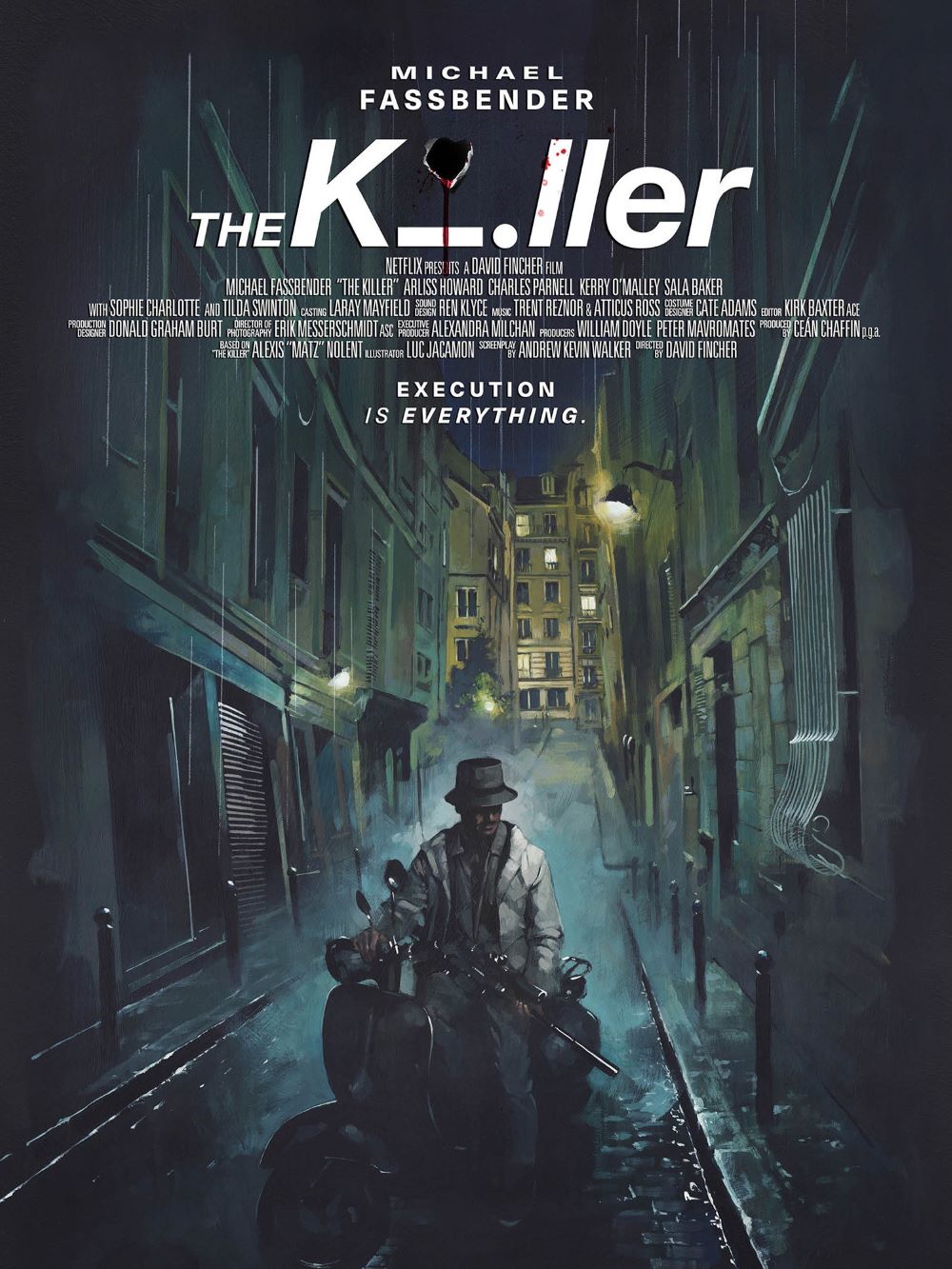
Review: The Killer (dir. by David Fincher)


“Stick to your plan. Anticipate, don’t improvise. Trust no one. Never yield an advantage. Fight only the battle you’re paid to fight. Forbid empathy. Empathy is weakness. Weakness is vulnerability.” — The Killer

David Fincher’s The Killer lands like a perfectly aimed shot: clean, methodical, and laced with just enough twist to make you rethink the whole trajectory. At its core, the film follows an elite assassin—brilliantly played by Michael Fassbender—who suffers a rare professional failure during a high-stakes hit in Paris. After days of obsessive preparation in a WeWork cubicle, complete with hourly surveillance checks, yoga breaks, protein bar sustenance, and a nonstop loop of The Smiths, he pulls the trigger only to miss his target entirely.

This one slip shatters his world of ironclad redundancies and contingencies. Retaliation soon hits close to home, striking his secluded Dominican Republic hideout and drawing in his girlfriend. What begins as a routine job quickly escalates into a personal cleanup mission, spanning cities like New Orleans, Florida, New York, and Chicago. Fincher transforms these stops into taut, self-contained vignettes, layering precise bursts of violence over the protagonist’s gradual psychological fraying—all while keeping major reveals under wraps to maintain the film’s coiled tension.

The structure dovetails perfectly with Fassbender’s commanding performance. He embodies a man radiating icy zen on the surface, while a relentless machine churns underneath. His deadpan voiceover delivers self-imposed rules like a deranged productivity gospel—”forbid empathy,” “stick to your plan,” “anticipate, don’t improvise”—even as he slips seamlessly into civilian guises: faux-German tourist, unassuming janitor, casually ordering tactical gear from Amazon like it’s toothpaste.

The result is darkly hilarious, conjuring a corporate bro reborn as high-functioning sociopath, where bland covers clash absurdly with lethal intent. Yet as stakes mount, subtle cracks appear: split-second hesitations, flickers of unexpected mercy that betray buried humanity. Fassbender nails this evolution through sheer minimalism—piercing stares, economical gestures, weaponized silence—morphing the killer from untouchable elite into a flawed, expendable player in the gig economy’s brutal grind.

These nuances echo the film’s episodic blueprint, quintessential Fincher territory. On-screen city titles act as chapters in a shadowy assassin’s handbook, with tension simmering through drawn-out prep rituals: endless surveillance, gear assembly, contingency mapping that drags just enough to immerse you in the job’s soul-numbing tedium. The Paris mishap ignites the chase—he evades immediate pursuit, sheds evidence, and races home to fallout, then pursues leads through handlers, drivers, and rivals in a chain of escalating confrontations.

Fincher deploys action sparingly but with devastating impact. A standout brawl erupts in raw, prolonged chaos—captured in extended, crystal-clear shots with improvised weapons and no shaky-cam crutches—perfectly embodying the killer’s ethos even as it splinters around him. Each sequence builds without excess, from tense interrogations to standoffs that flip power dynamics, underscoring how the world’s rules bend unevenly.

This kinetic progression meshes flawlessly with Fincher’s visual command. Cinematographer Erik Messerschmidt crafts a hypnotic palette of cool desaturated blues, sterile symmetries, and digital hyper-reality, evoking unblinking surveillance feeds into an emotional void. Tactile details obsess: the rifle case’s satisfying zip, suppressed gunfire’s sharp snick, shadows creeping across WeWork pods, dingy motels, and gleaming penthouses—all mirroring the killer’s frantic grasp for order amid encroaching disarray.

Sound design heightens every layer, sharpening ambient clacks of keyboards, hallway breaths, and gravel footsteps to a razor’s edge. Integral to the immersion is the minimalist electronic score by Trent Reznor and Atticus Ross, Fincher’s trusted collaborators from The Social Network to Mank. Their eerie ambient drones and ominous rhythmic pulses bubble like a suppressed heartbeat—swelling subtly in stakeouts, throbbing through violence, threading haunting motifs into voiceovers. It mirrors the protagonist’s inner turmoil without overwhelming the chill precision, turning silences between notes into weapons as potent as any sniper round.

This sonic and visual restraint powers the film’s bone-dry irony, which methodically punctures the protagonist’s god-complex. He preaches elite status among the “few” lording over the “many sheep,” yet reality paints him as sleep-deprived, rule-bending, and perpetually improvising—empathy leaking through denials in quiet, humanizing beats. Fincher weaves these into his signature obsessions—unmasked control freaks, dissected toxic masculinity, exposed capitalist churn—but with playful lightness, sidestepping the heavier preachiness of Fight Club or Seven.

The killer’s neurotic Smiths fixation injects quirky isolation amid globetrotting nomadism; their melancholic lyrics (“How Soon Is Now?”) punctuate stakeouts and flights like wry commentary on his fraying detachment. It all resolves in a low-key homecoming: no grand redemption or downfall, just weary acknowledgment that even “perfect” plans crack under chaos’s weight.

This sleight-of-hand elevates The Killer beyond standard assassin tropes into a sharp study of elite evil’s banality. Supporting roles deliver pitch-perfect economy: Tilda Swinton’s poised, lethal rival in mind-game restaurant tension; Arliss Howard’s obliviously entitled elite; Charles Parnell’s wearily betrayed handler; Kerry O’Malley’s poignant bargainer; Sala Baker’s raw, physical menace. Under two hours, Fincher packs density without bloat—layered subtext, rewatchable craft everywhere.

Gripes about its procedural chill or emotional distance miss the sleight entirely: this is a revenge thriller masking profound dissection of a borderless mercenary world, where pros prove as disposable as their untouchable clients. Fans of methodical slow-burns like ZodiacThe Game, or Gone Girl will devour the razor wit, process immersion, and unflinching thematic bite.

Ultimately, The Killer crystallizes as a sly late-period Fincher gem, fusing pitch-black humor, visceral horror, and surprising humanism into precision-engineered sleekness. It dismantles mastery illusions in unforgiving reality, leaving Fassbender’s killer stubbornly human: loose ends mostly tied, slipping back to obscurity as a survivor adapting. In a flood of bombastic action sludge, it offers bracing cerebral air—proving restraint, dark laughs, and surgical insight remain the filmmaker’s deadliest tools. For obsessive breakdowns of the human machine at its breaking point, it’s Netflix essential.

The Eric Roberts Collection: 69 Parts (dir by Ari Taub)


I’m going to guess that there’s quite a backstory to the production of the film …. well, I’m really not even sure what to call the film.

The version that I just watched on Tubi was called 69 parts and it clocked in at a little over 90 minutes.  It’s the story of gangsters, cops, and one hapless law student in 1979 New York.  Jack (Ryan O’Callaghan) needs money to go to law school.  His best friend, gambling addict Gino (Johnny Solo), arranges for Jack to get a loan from his uncle, Dennis (Aidan Redmond).  However, Gino swears that he can double the loan if Jack goes with him to the tracks.  Unfortunately, Gino’s hot tip turns out to be a bust so now Jack is broke and can’t pay back the money.  So, Dennis forced Jack to marry Dennis’s mistress so that she can get her green card but then Dennis gets jealous and decides to kill Jack but then he discovers that Jack is the son of an imprisoned criminal associate (Eric Roberts).  It’s all a bit too complicated for its own good and the use of multiple narrators, many of whom sound exactly alike, doesn’t make the film any easier to follow.

Tubi claims that 69 Parts was released in 2022.  However, on the IMDb, there’s a film called 79 Parts, which is listed as being a few minutes shorter than 69 Parts but it has the exact same cast and the exact same plot.  This version was released in 2016, six years before 69 Parts.  And then there’s 79 Parts: The Directors Cut, which clocks in at over two hours and which was released in 2019.  In short, there appears to be multiple versions of this film and really, I have to be a little bit impressed by the determination necessary to keep re-editing, re-titling, and re-releasing the film.

As for the film itself, the version I saw was a bit too busy and difficult to follow but I appreciated the work that went into recreating the 70s.  That obviously take some effort.  Aidan Redmond was properly avuncular and menacing as Dennis but Jack was such a wimpy character that it was difficult to really care about him.  As for Eric Roberts, he appears for about five minutes and is even less impressed with Jack than I was.  Maybe Eric gets to do more in the director’s cut.

Previous Eric Roberts Films That We Have Reviewed:

  1. Star 80 (1983)
  2. Runaway Train (1985)
  3. Blood Red (1989)
  4. The Ambulance (1990)
  5. The Lost Capone (1990)
  6. Love, Cheat, & Steal (1993)
  7. Voyage (1993)
  8. Love Is A Gun (1994)
  9. Sensation (1994)
  10. Dark Angel (1996)
  11. Doctor Who (1996)
  12. Most Wanted (1997)
  13. Mercy Streets (2000)
  14. Raptor (2001)
  15. Rough Air: Danger on Flight 534 (2001)
  16. Wolves of Wall Street (2002)
  17. Mr. Brightside (2004)
  18. Six: The Mark Unleased (2004)
  19. We Belong Together (2005)
  20. Hey You (2006)
  21. Amazing Racer (2009)
  22. In The Blink of an Eye (2009)
  23. Bed & Breakfast (2010)
  24. Enemies Among Us (2010)
  25. The Expendables (2010) 
  26. Sharktopus (2010)
  27. Beyond The Trophy (2012)
  28. The Dead Want Women (2012)
  29. Deadline (2012)
  30. The Mark (2012)
  31. Miss Atomic Bomb (2012)
  32. Assault on Wall Street (2013)
  33. Bonnie And Clyde: Justified (2013)
  34. Lovelace (2013)
  35. The Mark: Redemption (2013)
  36. The Perfect Summer (2013)
  37. Self-Storage (2013)
  38. A Talking Cat!?! (2013)
  39. This Is Our Time (2013)
  40. Inherent Vice (2014)
  41. Road to the Open (2014)
  42. Rumors of War (2014)
  43. Amityville Death House (2015)
  44. Deadly Sanctuary (2015)
  45. A Fatal Obsession (2015)
  46. Las Vegas Story (2015)
  47. Stalked By My Doctor (2015)
  48. Enemy Within (2016)
  49. Joker’s Poltergeist (2016)
  50. Prayer Never Fails (2016)
  51. Stalked By My Doctor: The Return (2016)
  52. The Wrong Roommate (2016)
  53. Dark Image (2017)
  54. Black Wake (2018)
  55. Frank and Ava (2018)
  56. Stalked By My Doctor: Patient’s Revenge (2018)
  57. Clinton Island (2019)
  58. Monster Island (2019)
  59. The Reliant (2019)
  60. The Savant (2019)
  61. Seven Deadly Sins (2019)
  62. Stalked By My Doctor: A Sleepwalker’s Nightmare (2019)
  63. The Wrong Mommy (2019)
  64. Exodus of a Prodigal Son (2020)
  65. Free Lunch Express (2020)
  66. Her Deadly Groom (2020)
  67. Top Gunner (2020)
  68. Deadly Nightshade (2021)
  69. The Elevator (2021)
  70. Just What The Doctor Ordered (2021)
  71. Killer Advice (2021)
  72. Night Night (2021)
  73. The Poltergeist Diaries (2021)
  74. The Rebels of PT-218 (2021)
  75. A Town Called Parable (2021)
  76. Bleach (2022)
  77. My Dinner With Eric (2022)
  78. D.C. Down (2023)
  79. Aftermath (2024)
  80. Bad Substitute (2024)
  81. Devil’s Knight (2024)
  82. The Wrong Life Coach (2024)
  83. When It Rains In L.A. (2025

Film Review: The Killer (dir by David Fincher)


The Killer open with the film’s title character (played by Michael Fassbender) in an abandoned office in Paris.

He spends every day sitting in front of a window, watching the the luxury hotel across the street from him.  As is evident from the film’s title and the character’s voice-over narration, the man is a professional killer.  Sometimes, he kills up close-and-personal.  Sometimes, he kills in a way that makes the death look like it occurred naturally.  In Paris, he’s just waiting in an abandoned WeWork office with a sniper rifle.  The Killer informs us that a good deal of his time is spent waiting and getting bored.  Sometimes, he passes the time by listening to the Smiths.  Sometimes, he takes a moment or two to glance at all of the “normies” living their lives with no idea about what’s happening in the otherwise empty office above their heads.  The Killer spends a lot of time thinking about his philosophy of life and how that effects the way he does his job.  Through his voice-over narration, he talks about the huge amount of people in the world.  He talks about how an assassin should never improvise and how an assassin should never allow any feelings of empathy for other people.

That may sound like the beginning of a rather grim movie and certainly, there have been a lot of recent assassin films that have taken themselves way too seriously.  Indeed, when the movie started with the Killer going on and on and on about how he prepares for a job, I started to have unwelcome flashbacks to Andrew Dominik’s mind-numbingly pretentious Killing Them Softly.  (Really, I can only assume that everyone who was shocked by the mean-spirited ugliness of Blonde must have previously blocked Killing Them Softly from their memory.)

I need not have worried.  Fortunately, The Killer is directed by David Fincher and Fincher is far too clever a director to take any the character’s nonsense seriously.  The Killer may be obsessed with his inner monologue but Fincher clearly is not.  From the start, Fincher pokes fun at the Killer’s self-importance by having him do things like use the names of sitcom characters whenever he has to buy a plane ticket.  More often than not, the Killer’s narration is interrupted by someone proving that, despite what he may believe, the Killer does not have complete control over every situation.  All of the character’s philosophizing is ultimately his way of denying that, just like the people that he is hired to kill, he is also subject to the whims of fate.

For instance, in Paris, the job gets botched.  The Killer does not kill his target and, when he calls his handler (Charles Parnell), he’s informed that there probably will be consequences for his failure.  When the Killer returns to his home in South America, he discovers that his girlfriend has been assaulted and left near death by two other assassins.  The Killer heads to America, to confront the people that he holds responsible.  Some of those people are professionals who have offices and who live in the suburbs.  Some of them live on the fringes of society.  But all of them, like the Killer, exist in a shadowy and amoral world that makes sense to only them and which is invisible to most of the people around them.

It’s a revenge plot, the type that has been popular for decades.  (Indeed, one could easily imagine The Killer being made in the 70s with Charles Bronson playing the title role.)  The story may not be unique but the action plays out with Fincher’s signature visual style and a welcome amount of wit.  The Killer travels from Paris to South America to New Orleans to Florida to New York and eventually Chicago and each location has its own unique feel.  As always, Fincher has a terrific eye for detail and this film is at its strongest when it captures the feel of everyone else’s life going forward while The Killer remains focused on his mission.  Even the worst characters are allowed moments that humanize them.  Meanwhile, The Killer is so coldly determined that he often becomes as frightening as the people that he is pursuing.

The film is dominated by Fassbender, who is in every scene and who brings a feral intensity to the character.  The Killer may have a friendly smile but the viewer only has to look at his eyes to see just how shut off from any sort of human warmth that he actually is.  (Indeed, the Killer only seems to genuinely care about his girlfriend and, even then, we don’t learn much about his relationship with her.)  Over the course of the film, Fassbender shares scenes with Tilda Swinton, Charles Parnell, Arliss Howard, and an actress named Kerry O’Malley, who gives a sympathetic performance as a secretary who knows too much.  Everyone makes a strong impression, bringing the world of The Killer to life.

The Killer can be viewed on Netflix.  It’s a triumphant exercise in pure style.