1889. The Oklahoma Territory. A former lawman-turned-cattleman named Jed Cooper (Clint Eastwood) is falsely accused of working with a cattle thief. A group of men, led by Captain Wilson (Ed Begley) lynch him and leave Cooper hanging at the end of a rope. Marshal Dave Bliss (Ben Johnson) saves Cooper, cutting him down and then taking him to the courthouse of Judge Adam Fenton (Pat Hingle). Fenton, a notorious hanging judge, is the law in the Oklahoma territory. Fenton makes Cooper a marshal, on the condition that he not seek violent revenge on those who lynched him but that he instead bring them to trial. Cooper agrees.
An American attempt to capture the style of the Italian spaghetti westerns that made Eastwood an international star, Hang ‘Em High gives Eastwood a chance to play a character who is not quite as cynical and certainly not as indestructible as The Man With No Name. Cooper starts the film nearly getting lynched and later, he’s shot and is slowly nursed back to health by a widow (Inger Stevens). Cooper is not a mythical figure like The Man With No Name. He’s an ordinary man who gets a lesson in frontier justice as he discovers that, until Oklahoma becomes a state, Judge Fenton feels that he has no choice but to hang nearly every man convicted of a crime. (Judge Fenton was based on the real-life hanging judge, Isaac Parker.) Over the course of this episodic film, Cooper becomes disgusted with frontier justice.
Hang ‘Em High is a little on the long side but it’s still a good revisionist western, featuring a fine leading performance from Clint Eastwood and an excellent supporting turn from Pat Hingle. The film’s episodic structure allows for Eastwood to interact with a motley crew of memorable character actors, including Bruce Dern, Dennis Hopper, L.Q. Jones, Alan Hale (yes, the Skipper), and Bob Steele. Hang ‘EmHigh has a rough-hewn authenticity to it, with every scene in Fenton’s courtroom featuring the sound of the gallows in the background, a reminder that justice in the west was often not tempered with mercy.
Historically, Hang ‘Em High is important as both the first film to be produced by Eastwood’s production company, Malpaso, and also the first to feature Eastwood acting opposite his soon-to-be frequent co-star, Pat Hingle. Ted Post would go on to direct MagnumForce.
Tonight, I watched the 1969 winner of the Oscar for Best Picture, Midnight Cowboy.
Midnight Cowboy is a movie about Joe Buck. Joe Buck is played by an impossibly young and handsome Jon Voight. Joe Buck — and, to be honest, just calling him Joe seems wrong, he is definitely a Joe Buck — is a well-meaning but somewhat dumb young man. He lives in Midland, Texas. He was raised by his grandmother. He used to go out with Annie (Jennifer Salt) but she eventually ended up being sent to a mental asylum after being raped by all of Joe Buck’s friend. Joe Buck doesn’t have many prospects. He washes dishes for a living and styles himself as being a cowboy. Being a Texan, I’ve known plenty of Joe Bucks.
Joe Buck, however, has a plan. He knows that he’s handsome. He’s convinced that all women love cowboys. So, why shouldn’t he hop on a bus, travel to New York City, and make a living having sex with rich women?
Of course, once he arrives in the city, Joe Buck discovers that New York City is not quite as inviting as he thought it would be. He lives in a tiny and dirty apartment. He can barely afford to eat. Walking around the city dressed like a cowboy (and remember, this was long before the Naked Cowboy became one of the most annoying celebrities of all time) and randomly asking every rich woman that he sees whether or not she can tell him where he can find the Statue of Liberty, Joe Buck is a joke. Even when he does get a customer (played, quite well, by Sylvia Miles), she claims not to have any money and Joe Buck feels so sorry for her that he ends up giving her his money.
As I watched the first part of the movie, it stuck me that the main theme of Midnight Cowboy appeared to be that, in 1969, New York City was literally Hell on Earth. But then Joe Buck has flashbacks to his childhood and his relationship with Annie and it quickly became apparent that Midland, Texas was Hell on Earth as well. Towards the end of the film, it’s suggested that Miami might be paradise but not enough to keep someone from dying on a bus.
Seriously, this is a dark movie.
Joe Buck eventually meets Ratso Rizzo (Dustin Hoffman). Ratso’s real name is Enrico but, after taking one look at him, you can’t help but feel that he’s a perfect Ratso. Ratso is a con man. Ratso is a petty thief. Ratso knows how to survive on the streets but New York City is still killing him. As a child, Ratso had polio and now he walks with a permanent limp. He coughs constantly, perhaps because he has TB. Ratso becomes Joe Buck’s manager and roommate (and, depending on how you to interpret certain scenes and lines, perhaps more) but only after attempting to steal all of his money.
Unfortunately, Ratso is not much of a manager. Then again, Joe Buck is not much of a hustler. Most of his customers are men (including a student played by a young but recongizable Bob Balaban), but Joe Buck’s own sexual preference remaining ambiguous. Joe Buck is so quick to loudly say that he’s not, as Ratso calls him, a “fag” and that cowboys can’t be gay because John Wayne was a cowboy, that you can’t help but suspect that he’s in denial. When he’s picked up by a socialite played by Brenda Vaccaro, Joe Buck is impotent until she teases him about being gay. In the end, though, Joe Buck seems to view sex as mostly being a way to make money. As for Ratso, he appears to almost be asexual. His only concern, from day to day, is survival.
Did I mention this is a dark movie?
And yet, as dark as it is, there are moments of humor. Joe Buck is incredibly dense, especially in the first part of the movie. (During the second half of the film, Joe Buck is no longer as naive and no longer as funny. It’s possible that he even kills a man, though the film is, I think, deliberately unclear on this point.) Ratso has a way with words and it’s impossible not to smile when he shouts out his famous “I’m walking here!” at a taxi. And, as desperate as Joe Buck and Ratso eventually become, you’re happy that they’ve found each other. They may be doomed but at least they’re doomed together.
There’s a lengthy party scene, one that features several members of Andy Warhol’s entourage. I was a bit disappointed that my favorite 60s icon, Edie Sedgwick, was nowhere to be seen. (But be sure to check out Ciao Manhattan, if you want to see what Edie was doing while Joe Buck and Ratso Rizzo were trying not to starve.) But, as I watched the party scene, I was reminded that Midnight Cowboy is definitely a film of the 60s. That’s both a good and a bad thing. On the positive side, the late 60s and 70s were a time when filmmakers were willing to take risks. Midnight Cowboy could only have been made in 1969. At the same time, there’s a few moments when director John Schlesinger, in the style of many 60s filmmakers, was obviously trying a bit too hard to be profound. Some of the flashbacks and fantasy sequences veer towards the pretentious.
Fortunately, the performances of Voight and Hoffman have aged better than Schlesinger’s direction. Hoffman has the more flamboyant role (and totally throws himself into it) but it really is Voight who carries the film. Considering that he’s playing a borderline ludicrous character, the poignancy of Voight’s performance is nothing short of miraculous.
Midnight Cowboy was the first and only X-rated film to win best picture. By today’s standards, it’s a PG-13.
So, earlier today, I got off work early so I could go to Noon Mass with my sister and we both got our ashes. And I’m sure that will take some people by surprise because I’m not exactly the most faithful or devout of Catholics. But what can I say? I love the ornate ritual of it all.
And, as a part of my own personal ritual, I washed my forehead before I left the church. Erin and I had a great vegetarian lunch at Cafe Brazil and then we came home and I turned on the TV and what should be finishing up on TCM but the 1959 best picture nominee, The Nun’s Story. Fortunately, I had already set the DVR to record The Nun’s Story and so, on this most Catholic of days, I was able to watch this most Catholic of best picture nominees.
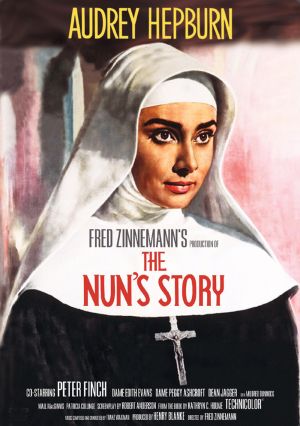
The Nun’s Story tells the story of Gaby (Audrey Hepburn), the daughter of a famous Belgian doctor (Dean Jagger). At the start of the film, Gaby has entered a convent because she wants to become a missionary nursing sister in the Belgian Congo. However, before Gaby can go to the Congo, she has to learn to give up her own rebellious streak and individual independence. Taking the name Sister Luke, she excels at her medical training but, because it is felt that she is still too independently minded, she is not sent to the Congo but instead assigned to work in a mental hospital. It’s there that her independent streak nearly gets her killed when she is fooled by a dangerous patient who claims to be the Archangel Gabriel. It is only after she takes her final vows that Sister Luke is finally sent to the Congo and it is there that she’s forced to work with the abrasive agnostic Dr. Fortunati (Peter Finch). Of course, as Sister Luke goes through her own spiritual struggles, the world inches closer and closer to the start of a second world war. When war does break out, Sister Luke finds herself torn between her vow of obedience (which includes remaining political neutral) and the realities of living in a country that’s been occupied by the Nazis.
1959 was apparently a good year for religious films. Not only did Ben-Hur win best picture, but The Nun’s Story also received 8 nominations. Reportedly, The Nun’s Story was the most financially successful film to be released by Warner Bros, up to that point. If Wikipedia is to be believed, it was also Audrey Hepburn’s personal favorite of the many movies that she made.
When seen today, probably the first thing that people notice about The Nun’s Story is that it’s extremely long and occasionally rather slow. The film follows Gaby from the minute she enters the convent to the moment that she makes her final choice about whether to be obedient to herself or to her vows and, during that time, it examines every single detail of her life in glorious Technicolor. A lot of emphasis is put on the rituals that Sister Luke goes through on her way to taking her final vows. Now, if you’re like me, all of the rituals are fascinating to watch and produce a whole host of conflicting emotions. Even as I found myself admiring Sister Luke’s dedication and her sacrifice, I still kept wondering — much as she did — if it was all really worth giving up her independence. But, I also have to admit that I found myself wondering if someone from a Protestant background would feel the same way.
To a certain extent, I really hate to say that you probably have to come from a Catholic background to truly enjoy any film. But I certainly think that’s the case with The Nun’s Story. But, even Protestants and skeptics will appreciate Audrey Hepburn’s wonderful lead performance. She keeps this film grounded and makes her mostly internal conflict of faith compelling. In a career that was full of great performance, this is one of Audrey’s best.
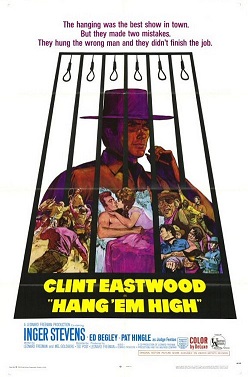 1889. The Oklahoma Territory. A former lawman-turned-cattleman named Jed Cooper (Clint Eastwood) is falsely accused of working with a cattle thief. A group of men, led by Captain Wilson (Ed Begley) lynch him and leave Cooper hanging at the end of a rope. Marshal Dave Bliss (Ben Johnson) saves Cooper, cutting him down and then taking him to the courthouse of Judge Adam Fenton (Pat Hingle). Fenton, a notorious hanging judge, is the law in the Oklahoma territory. Fenton makes Cooper a marshal, on the condition that he not seek violent revenge on those who lynched him but that he instead bring them to trial. Cooper agrees.


 Through the Shattered Lens