Made-For-Television Movie Review: Skokie (dir by Herbert Wise)


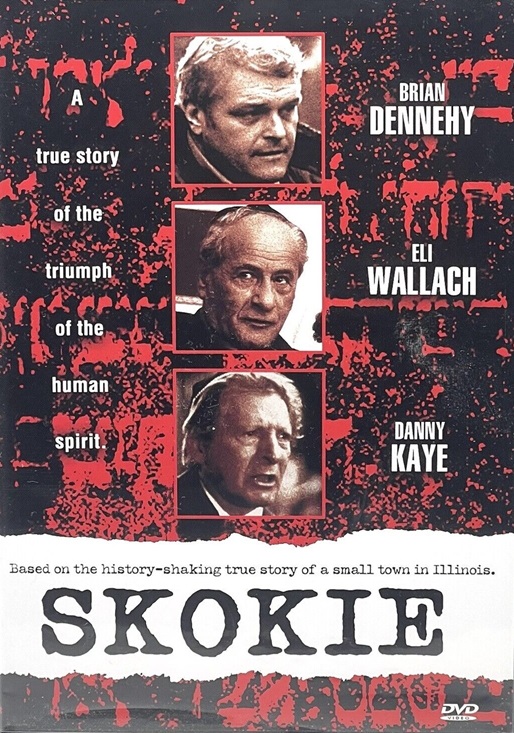
Skokie, a 1981 made-for-television movies, opens in a shabby Chicago office.

A group of men, all wearing brownshirts and swastika armbands, listen to their leader, Frank Collin (George Dzundza).  Collin says that they will be holding their next rally in the town of Skokie.  Collin explains that Skokie has a large Jewish population, many of whom came to the United States after World War II.  Collin wants to march through their town on Hitler’s birthday.

If not for the swastika and the brownshirt, the overweight Collin could easily pass for a middle-aged insurance salesman, someone with a nice house in the suburbs and an office job in the city.  However, Frank Collin is the head of the American National Socialist Party. a small but very loud group of Nazis who specialize in marching through towns with large Jewish populations and getting fee media attention as a result of people confronting them.  Making Frank Collin all the more disturbing is that he isn’t just a character in a made-for-television movie.  Frank Collin is a real person and Skokie is based on a true story.

The Mayor (Ed Flanders) and the police chief (Brian Dennehy) of Skokie are, needless to say, not happy about the idea of modern-day Nazis marching through their city.  Though they inform Collin that he will have to pay for insurance before he and his people will be allowed to hold their rally, they know that the courts have been striking down the insurance requirement as being a violation of the First Amendment.  While the mayor and the police chief worry about the political fallout of the rally, the Jewish citizens of Skokie debate amongst themselves how to deal with the Nazis.  Bert Silverman (Eli Wallach) and Abbot Rosen (Carl Reiner) argue that the best way to deal with Collin and his Nazis is to refuse to acknowledge them, to “quarantine” them.  As Rosen explains it, Collin is only marching to get the free publicity that comes with being confronted.  If he’s not confronted, he won’t make the evening news and his rally will have been for nothing.  However, many citizens of Skokie — including Holocaust survivor Max Feldman (Danny Kaye) — are tired to turning their back on and ignoring the Nazis.  They demand that the Nazis be kept out and that, if they do enter the city, they be confronted.

With the support of the ACLU, Collin sues for his right to march through Skokie.  The ACLU is represented by Herb Lewishon (John Rubinstein), a Jewish attorney who hates Collin and everything that he stands for but who also feels that the First Amendment must be respected no matter what.  When Lewishon is asked how he, as a Jew, can accept a Nazi as a client, Lewishon relies that his client is the U.S. Constitution.

Skokie is a thought-provoking film, all the more so today when there’s so much debate about who should and should not be allowed a platform online.  (Indeed, Collin and his Nazis would have loved social media.)  Lewishon argues that taking away any group’s First Amendment rights, regardless of how terrible that group may be, will lead to slippery slope and soon everyone’s First Amendment rights will be at risk.  Max Feldman, and others argue that the issue isn’t free speech.  Instead, the issue is standing up to and defeating evil.  The film gives both sides their say while, at the same time, making it clear that Frank Collin and his Nazis are a bunch of fascist losers.  It’s a well-acted and intelligently written movie, one that rejects easy answers.  Needless to say, at a time when so many people feel free to be openly anti-Semitic, it’s a film that’s still very relevant.

As for the real Frank Collin, he would eventually be charged with and convicted of child molestation.  After three years in prison, he changed his name to Frank Joseph and became a writer a New Age literature.  He’s looking for Atlantis but I doubt they’d want him either.
The Fabulous Forties #41: The North Star (dir by Lewis Milestone)


The North Star

The 40th film — wait a minute, I’m finally up to number 40!?  That means that there’s only ten more movies left to review!  And then I’ll be able to move on!  It’s always exiting for me whenever I’m doing a review series and I realize that I’m nearly done.

Anyway, where was I?

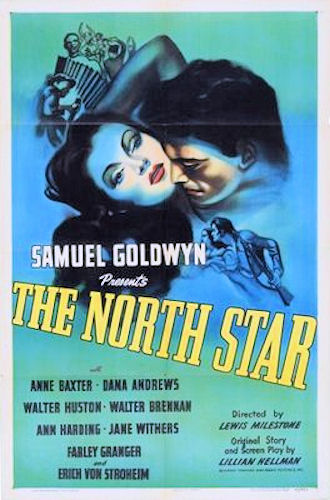
Oh yeah — the 40th film in Mill Creek’s Fabulous Forties box set was the 1943 war epic, The North Star.  This is one of the many war films to be included in the Fabulous Forties box set and I have to admit that they all kind of blend together for me.  Since these films were actually made at a time when America was at war, there really wasn’t much room for nuance.  Instead, every film follows pretty much the same formula: the Nazis invade, a combination of soldiers and villagers set aside their individual concerns and/or differences and team up to defeat the Nazis, there’s a big battle, a few good people sacrifice their lives, the Nazis are defeated, and the allies promise to keep fighting.

It’s a pretty predictable formula but that’s okay because it was all in the service of fighting the Nazis.  Could I legitimately point out that the villains in these movies are always kind of two-dimensional?  Sure, I could.  But you know what?  IT DOESN’T MATTER BECAUSE THEY’RE NAZIS!  Could I point out that the heroes are often idealized?  Sure, but again it doesn’t matter.  Why doesn’t it matter?  BECAUSE THEY’RE FIGHTING NAZIS!

That’s one reason why, even as our attitude towards war changes, World War II films will always be popular.  World War II was literally good vs evil.

Anyway, The North Star was a big studio tribute to America’s then ally, the Soviet Union.  When a farm in the Ukraine is occupied by the Nazis, the peasants and the farmers refuse to surrender.  They disappear into the surrounding hills and conduct guerilla warfare against the invading army.  It’s all pretty predictable but it’s also executed fairly well.  It doesn’t shy away from showing the brutality of war.  There’s a haunting scene in which we see the bodies of all of the villagers — including several children — who have been killed in a battle.

The Nazis are represented by Erich Von Stroheim.  Von Stroheim plays a German doctor who continually claims that he personally does not believe in the Nazi ideology and that he’s just following orders.  When wounded Nazi soldiers need blood transfusions, he takes the blood from the children of the village.  His rival, a Russian doctor, is played by all-American Walter Huston and indeed, all the Russians are played by American stars, the better to create a “we’re all in this together” type of spirit.  When Huston tells Von Stroheim that he is even worse than the committed Nazis because he recognized evil and chose to do nothing, he’s speaking for all of us.

Unfortunately, before the Nazis invade, The North Star devotes a lot of time to showing how idyllic life is in the communist collective and these scenes are so idealized that they totally ring false.  Everyone is so busy singing folk songs and talking about how happy they are being a part of a collective (as opposed to being an individual with concerns that are not shared by the other members of the collective) that it’s kind of unbearable.  Not surprisingly, The North Star was written by Lillian Hellman, who wrote some great melodramas (like The Little Foxes) but who was always at her most tedious when she was at her most overly political.

(Watching the opening of The North Star, I was reminded that I would be totally useless in a collectivist society.)

So, I have to admit, that I was rather annoyed with the villagers at first.  But then the Nazis invaded and I realized that we’re all in it together!  As I said earlier, you can forgive your heroes almost anything when they’re fighting Nazis.

The North Star is an above average war film and a below average piece of political propaganda.  See it as a double feature with The Last Chance.

In Memory of Robin Williams #3: Awakenings (dir by Penny Marshall)


Awakenings

The 1990 Best Picture nominee Awakenings is exactly the type of film that seems to have been designed to make me cry.

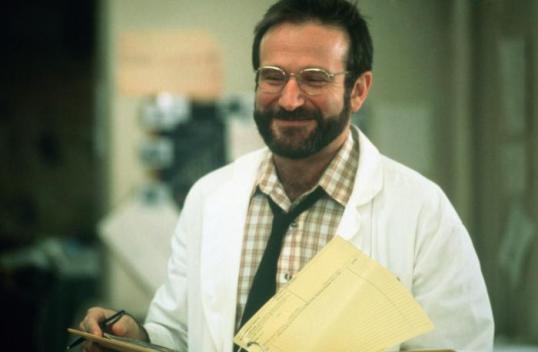
Taking place in 1969 and based (very loosely, I assume) on a true story, Awakenings features Robin Williams as Dr. Malcolm Sayer.  Dr. Sayer is a dedicated and caring physician but he also suffers from an almost crippling shyness.  He’s at his most comfortable when he’s dealing with a group of patients who have spent the last 40 years in a catatonic state, suffering from a tragic disease known as encephalitis lethargica.  (One thing that I learned from watching this film was that, from 1917 to 1928, there was an epidemic of this disease, with millions either dying or being left catatonic.)  While the rest of the medical establishment (led by John Heard, who always seems to be the embodiment of the establishment in films made in the 90s) assumes that the patients are destined to spend the rest of their lives in a vegetative state, Dr. Sayer is convinced that the patients can be awakened.  He soon discovers that, even in their catatonic state, the patients will react to certain stimulii.  One woman can catch a baseball.  Another appears to react well to music.  And finally, Leonard Lowe (Robert De Niro) — who fell ill with this disease when he was a child — tries to communicate with a Ouija board.

Over the objections of his supervisors, Dr. Sayer treats the patients with an experimental drug.  Leonard is the first one to get the drug and is also the first one to wake up.  While the rest of the patients wake up, Dr. Sayer tries to help Leonard adjust to the 1960s.  At first, everything seems to be going perfectly.  Leonard even manages to strike up a sweet romance with a woman named Paula (Penelope Ann Miller).  However, it soon becomes obvious that the awakening is only going to be a temporary one as Leonard and all the other patients start to descend back into their catatonic states…

It’s easy to criticize a film like Awakenings for being manipulative and sentimental.  And the fact of the matter is that the film is manipulative and it is sentimental and undoubtedly, it probably is a massive simplification of the true story.  (The character played by John Heard is such an obvious villain that he might as well have a mustache to twirl.)  And yes, you know even before it happens that there’s eventually going to be a montage of an amazed Leonard staring at a girl in a miniskirt while Time of the Season plays on the soundtrack.

But, no matter!  It’s a tremendously effective film and it earned the tears that I shed while watching it.  Both De Niro and Williams give excellent performances which add a good deal of depth to scenes that could otherwise come across as being overly sappy.  De Niro has the more showy role but it really but it’s the performance of Robin Williams that really carries the film.  As played by Williams, Dr. Sayer is a fragile soul who hides from the world behind his beard and his professional determination.  When he finally asks a nurse (Julie Kavner) out to dinner, it’s impossible not to cheer for him.

It’s also impossible not to cheer a little for Awakenings.

MCDAWAK EC015