Renegade Girl (1946, directed by William Berke)


Missouri in 1864.  The Civil War is raging and the state is divided between those who support the Union and those secretly support the Confederate guerillas led by Willian Quantrill (Ray Corrigan).  The Union’s Major Baker (Jack Holt) is determined to track down rebel Bob Shelby (Jimmie Martin) and he enlists the Native American Chief Whitecloud (played by Chief Thundercloud) to help find him.  Whitecloud has a personal vendetta against the Shelby family and, when he finds Bob, he executes him in cold blood.  Bob’s sister, Jean Shelby (Ann Savage), is also a Confederate sympathizer and she seeks revenge.  Complicating things is that Jean has fallen in love with Union Captain Fred Raymond (Alan Curtis).

One of the many B-westerns produced by Robert L. Lippert and directed by William Berke, Renegade Girl packs a lot of plot into just 65 minutes.  The action is nonstop and fans of westerns will find all of the horse chases, gunfights, and threats of hanging that they could want.  The main thing that distinguishes Renegade Girl from other B-westerns is the fierce performance of Ann Savage as Jean Shelby, a woman who will not stop until she gets her revenge.  While the film’s portrayal of the Quantrill and Chief Whitecloud definitely goes against modern sensibilities, Ann Savage’s performance feels ahead of her time.  No one is going to stand in Jean Shelby’s way.

Chief Thundercloud’s real name was reportedly Victor Daniels, though his past is shrouded in mystery.  He claimed to be a Cherokee from Arizona, though he was listed as being Mexican on a marriage record that was filed before he started his film career.  As Chief Thundercloud, he was a mainstay in westerns from the 30s to the time of his death in 1955.  He was the first actor to play the Lone Ranger’s Tonto and he also played Geronimo in a 1939 Paramount film of the same name.  His final film role was a posthumous appearance in John Ford’s The Searchers.

30 Days of Noir #14: Shoot to Kill (dir by William Berke)


The 1947 film, Shoot to Kill (also known as Police Reporter), opens with both a bang and a crash.

The police are chasing a car down one dark and lonely road.  When that car crashes, the police are shocked to discover who was inside of it.  Two men and one woman, all well-dressed.  The men are both dead but the woman is merely unconscious.  The police identify one of the men as being the notorious gangster, Dixie Logan (Robert Kent).  It makes sense that Logan would be fleeing the police but what about his two passengers, newly elected District Attorney Lawrence Dale (Edmund MacDonald) and Dale’s wife, Marian (Luana Walters)?

The police may not be able to get any answers but fortunately, there’s a reporter around!  Mitch Mitchell (Russell Wade) is a crime reporter and, seeing as how he knew both Lawrence and Marian, he seems like the perfect person to get some answers.  (In fact, it was Mitch who first suggested that Lawrence should hire Marian as his administrative assistant, therefore setting in motion the whirlwind romance that would end with them married.)  Mitch goes to see Marian in her hospital room and he asks her what happened.

It’s flashback time!  Yes, this is one of those films where almost the entire film is a flashback.  That, in itself, is not surprising.  Some of the best film noirs of all time were just extended flashbacks.  (D.O.A, Double Indemnity, and Sunset Boulevard, to name just a few examples.)  What sets Shoot to Kill apart is the fact that, occasionally, we even get characters having a second flashback while already in someone else’s flashback.  We’re through the the film noir looking glass here, people.

Lawrence Dale, we’re told, was elected district attorney because he managed to secure the conviction of notorious gangster Dixie Logan, despite Logan’s insistence that he was no longer involved in the rackets.  However, what we soon discover is that not only was Logan actually innocent but Dale specifically prosecuted him as a favor to some of Dale’s rival gangsters.  That’s right, Lawrence Dale was on the take!  It also turns out that Marian has some secrets of her own.  When she first showed up at Dale’s office, she was doing more than just looking for a job.  As for her marriage to Dale …. well, I really can’t tell you what the twist is here because it would spoil the entire film.

Shoot To Kill may clock in at just 64 minutes but it manages to pack a lot of twists and turns into just an hour.  In fact, I’d argue that it probably tries to do a little bit too much.  At times, the film is a bit difficult to follow and a few inconsistent performances don’t help matters.  For instance, Russell Wade is likable as the crime reporter but he still doesn’t exactly have a dynamic screen presence.  Much better cast are Luana Walters and Edmund MacDonald, who both do a good job as, respectively, a femme fatale and a sap.  At the very least, history nerds like me will be amused by the fact that Edmund MacDonald was obviously made up to resemble Thomas E. Dewey, the former Manhattan District Attorney who twice lost the U.S. presidency.

The best thing about Shoot To Kill is the look of the movie.  Filmed in grainy black-and-white and full of dark shadows, crooked camera angles, and men in fedoras lighting cigarettes in alleys, Shoot to Kill looks the way that a film noir is supposed to look.

Regardless of whether it was the filmmaker’s original intention, Shoot To Kill plays out like a low-budget, black-and-white fever dream.  It’s definitely a flawed film but, for lovers of film noir, still worth a look.

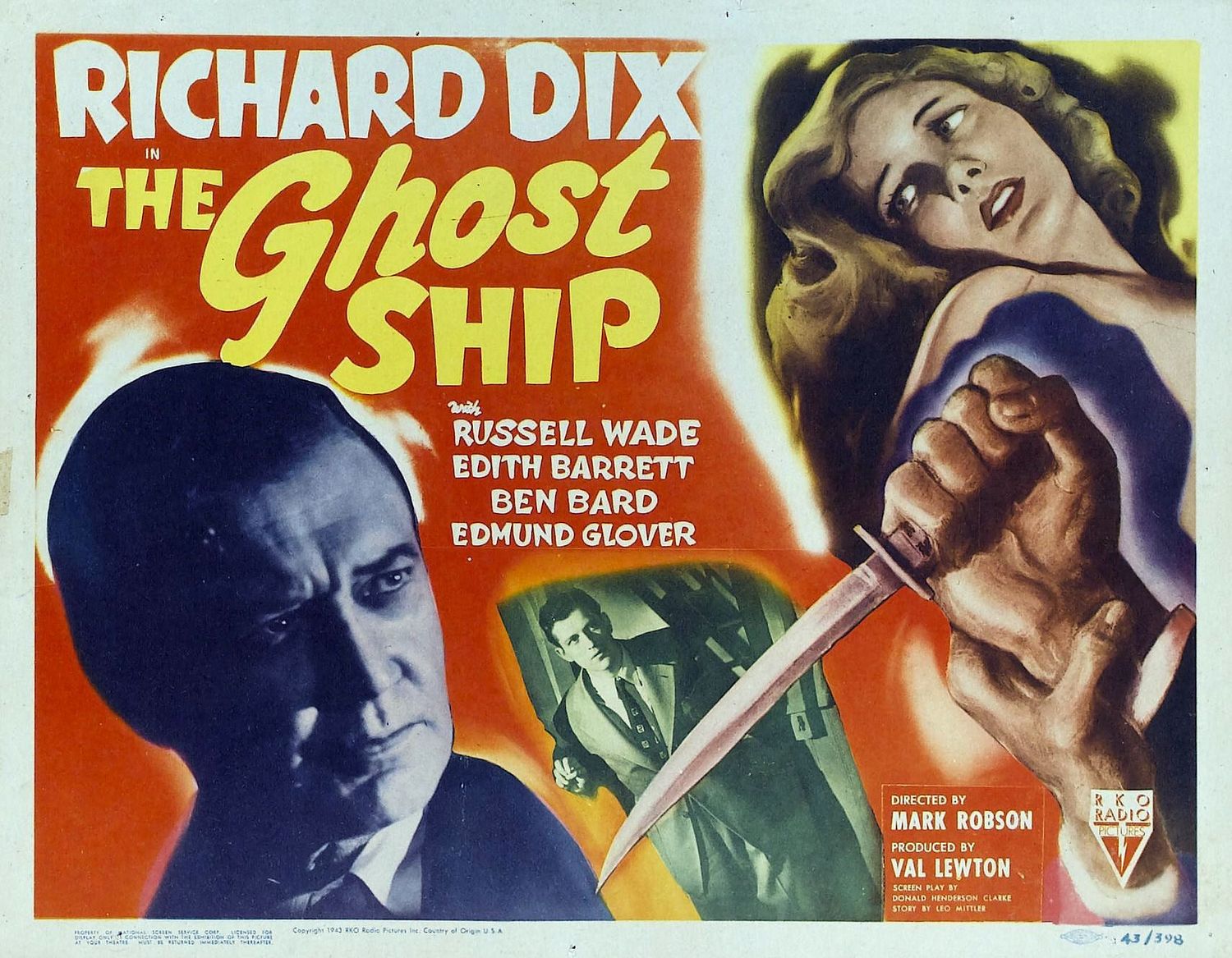
Halloween Havoc!: GHOST SHIP (RKO 1943)


gary loggins's avatarcracked rear viewer

gs1

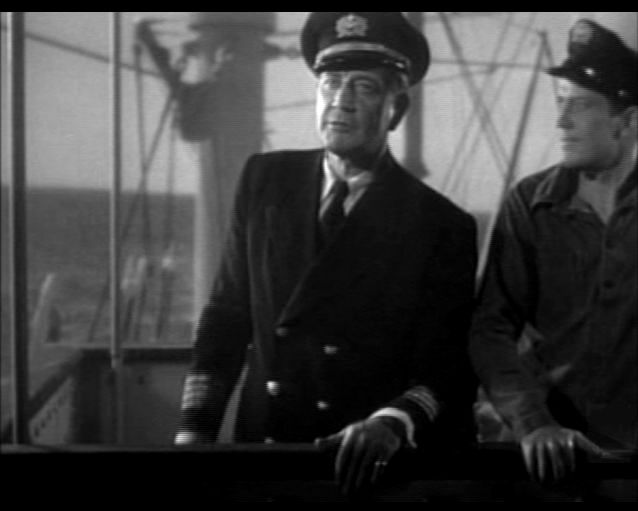
Val Lewton produced some of the most memorable horror films of the 1940’s, moody, atmospheric set pieces noted for their intelligent scripts, chiaroscuro lighting, and eerie use of sound. CAT PEOPLE, THE BODY SNATCHER,  and THE SEVENTH VICTIM  are just three that spring to mind when I think of Lewton movies. GHOST SHIP is one of his lesser known films, a psychological thriller about a sea captain obsessed with authority who goes off the deep end, and while it’s not supernatural as the title implies, it’s a good film worth rediscovering.

gs2

A blind street singer on a fog-shrouded corner gives an ominous warning to 3rd Officer Tom Merriam, about to embark on his first voyage aboard the S.S. Altair, captained by veteran sailor Will Stone. Stone is stern but friendly, eager to teach Tom the ways of the sea, and implement his view’s of the captain’s authority. A crewman dies just…

View original post 709 more words